Pre-Chamber: The Secret of Extracting 400 Horsepower from 2 Liters
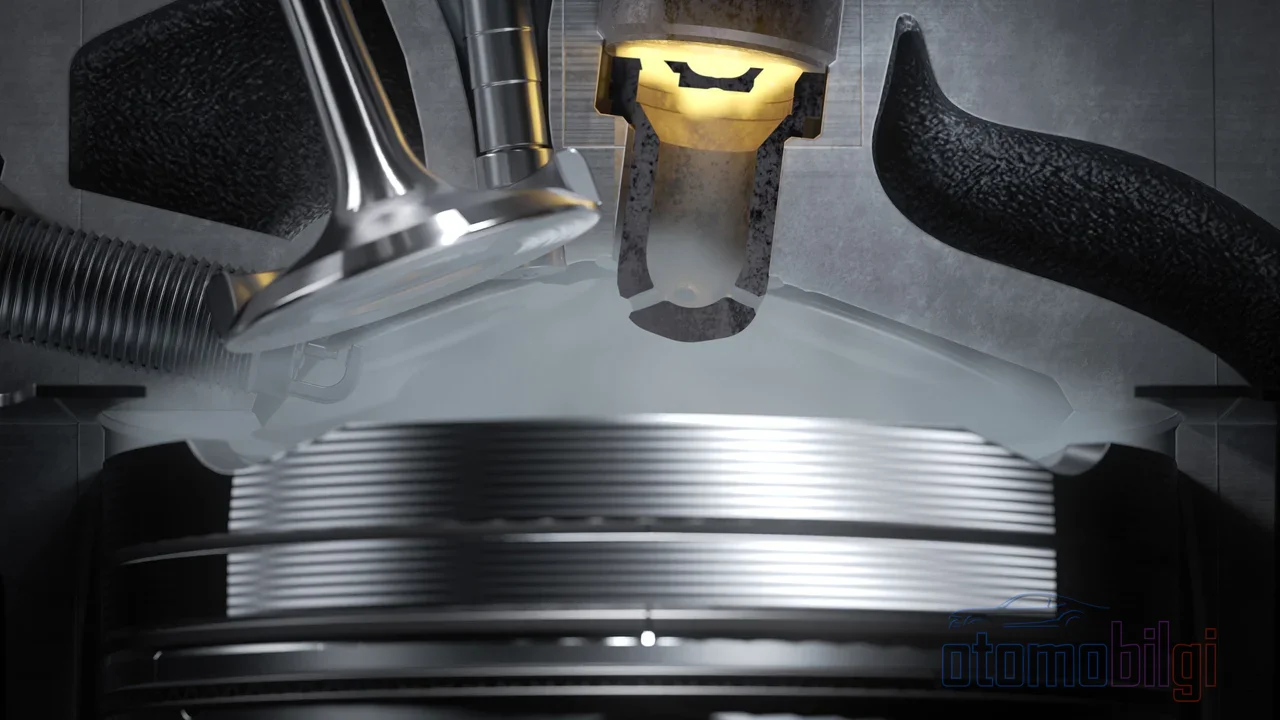
When you want to extract 400 horsepower from a two-liter engine block, the problem you face is often not producing the power, but being able to control it. In a small-displacement forced-induction engine, the mixture compressed into the cylinder is dense and pressurized; classic single-spark ignition struggles to burn this mixture quickly and homogeneously. The knock limit approaches, ignition advance is pulled back, and efficiency drops. There is an answer to this bottleneck of the engine world that has been known for decades but has stayed in the shadows: pre-chamber ignition, also known as turbulent jet ignition.
Amid the debates over turbocharger sizes, compression ratios, and injection pressures, this technology quietly settled from Formula 1 circuits into the cylinder head of production engines. So how can a fire that starts in a small chamber burn a volume hundreds of times larger in the main combustion chamber so quickly?
How Does Pre-Chamber Ignition Work?
The core of the concept is a simple geometric decision: the spark plug is placed not inside the main combustion chamber, but in a small volume located in the cylinder head. This pre-chamber is connected to the main chamber through a series of small holes. During the compression stroke, the pre-chamber takes in a portion of the air-fuel mixture from the main chamber; here, the mixture has a composition close to stoichiometric, that is, close to the ideal ratio, favorable for the fuel to ignite.
When the spark plug ignites this rich mixture in the pre-chamber, high pressure builds up in the small volume, and the combustion products are ejected through the holes into the main chamber as a hot, turbulent jet. This is the key point: the jet creates numerous simultaneous ignition points across a very large surface area, instead of a single ignition point. The mixture in the main chamber is not burned by a single flame front, but simultaneously from every point the jet touches. The result is a much faster and more stable combustion process compared to classic spark ignition.
The elegant aspect of the system is that it does not require a separate igniter in the main combustion chamber. In commercial applications, the pre-chamber spark plug directly replaces the standard spark plug; no fundamental change is required in the engine block or cylinder head. Depending on the application, 4 to 8 ignition jets ignite the main mixture from multiple points.
Highlights
- The ignition jet ignites the main mixture from multiple points; combustion is noticeably faster than classic spark ignition.
- In active systems, lean mixtures of lambda above 2 can be ignited with stability.
- In MAHLE's active jet ignition tests, specific consumption dropped below 200 g per kWh; this corresponds to approximately 43% peak brake thermal efficiency.
- The technology entered Formula 1 with the Honda RA617H in 2017 but its roots go back decades.
- The Maserati Nettuno V6 produces 620 hp while benefiting from an F1-derived pre-chamber.
What Is the Difference Between Active and Passive Pre-Chambers?
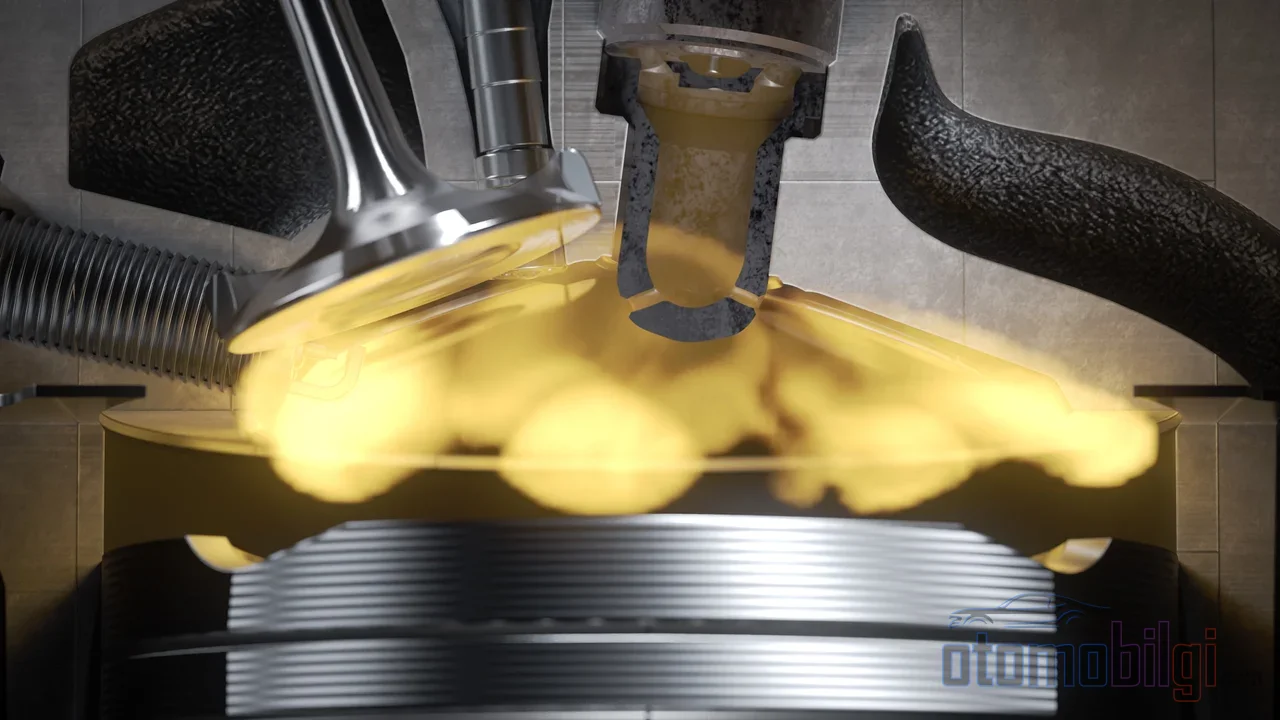
Pre-chamber systems are produced in two basic configurations, and the difference between them depends on where the fuel is supplied. In both architectures, the main chamber receives fuel via conventional port injection or direct injection.
Passive System: Single Fuel Source
In the passive architecture, the engine's single fuel source is the main chamber; the pre-chamber is fed from the main chamber during the compression stroke. This design is suitable for applications running at λ=1, i.e. stoichiometric. Mixture dilution is achieved through exhaust gas recirculation (EGR), and the system works compatibly with the standard exhaust aftertreatment setup of today's gasoline engines. This is a significant advantage from an engineering standpoint: it requires no changes to the three-way catalytic converter circuit.
Active System: Second Injector
In the active architecture, a second low-flow direct injector is added to the pre-combustion chamber. This allows the fuels of the pre-chamber and main chamber to be controlled independently and precisely. This opens the technology's most ambitious door: mixtures leaner than λ=2 can be burned without sacrificing stability. As the main chamber is leaned out, combustion temperature drops, heat losses decrease, and thermal efficiency rises.
The numbers are concrete: in engine tests conducted with the active system, specific consumption below 200 grams per kWh was measured; this figure corresponds to approximately 43% peak brake thermal efficiency, and over 45% is targeted on the roadmap. Operation in the ultra-lean region reduces NOx emissions at the exhaust outlet by more than 99%, while HC emissions remain at the level of standard spark ignition.
Why Do Small-Displacement Turbocharged Engines Benefit So Much?
The answer to this question is directly related to the phenomenon called knock. In gasoline engines, if the mixture self-ignites at the end of the compression stroke without waiting for the spark plug spark, an uncontrolled pressure wave forms; this threatens both power and mechanical strength. The slower the flame front spreads, the greater the chance that the mixture in distant corners self-ignites.
Pre-combustion chamber ignition solves this equation in two ways. First, multi-point ignition shortens the combustion duration, leaving less time for the flame to travel within the cylinder. Second, the controlled combustion in the pre-chamber creates a more gradual pressure rise in the main chamber. Evaluated together, the knock limit expands significantly; in engineering terms, it becomes possible to operate closer to optimum ignition advance.
This expanded limit opens two separate paths for the designer: either you raise the compression ratio to increase efficiency, or you grow the achievable performance under stoichiometric conditions at the same compression ratio. In small-displacement turbocharged engines, both are needed at once; because high specific power (horsepower per liter) means high turbine pressure and a dense mixture. Comparative studies show that when the excess air coefficient in the main chamber exceeds 1.4, the pre-combustion chamber significantly improves thermal efficiency in lean combustion. Passive configuration delivers faster combustion than classic spark plug ignition under all conditions, higher stability, and lower sensitivity to operating conditions.
The Formula 1 Connection and Applications in Road Cars
From the Track to Series Production
The turbocharged hybrid power unit era in Formula 1 began with fuel flow restrictions: engines must produce maximum power with fuel at a fixed limit per liter. The only way to do this is to burn lean mixtures and high cylinder pressures stably. Honda was the manufacturer that brought pre-chamber ignition to Formula 1 in 2017 with the RA617H engine; in F1's pre-chambers, both the spark plug and fuel injector are present, meaning an active configuration is used.
Looking at series production, the most concrete example is Maserati's Nettuno V6 engine. This unit, which powers the heart of the MC20 supercar, produces 620 hp and 538 lb-ft of torque; the pre-chamber derived from Formula 1 suppresses knock, making this power level possible. Active pre-chambers house the spark plug and fuel injector together: after a lean mixture enters the cylinder, the pre-chamber takes over ignition with its rich mixture.
On the other hand, caution is needed: in some production engines, the presence of a pre-chamber has not been clarified through official statements. In the M139, considered Mercedes-AMG's most powerful production four-cylinder engine in the world, the use of two-stage fuel injection and direct injection into the cylinder with piezo injectors has been documented; claims that a pre-chamber housing both the spark plug and injector is used have not been officially confirmed by the manufacturer. On the Ferrari side, a patent shows that the pre-chamber system allows delayed ignition in the main chamber during cycles immediately following a cold start; this is a meaningful engineering signal for the brand's V12 future. It is also known that turbulent jet ignition has been added to Jeep's new four-cylinder engine.
Its Roots Extend Back to the Carburetor and Diesel Era
The pre-chamber is not a recent invention; on the contrary, it is one of the oldest ideas of the internal combustion engine. In the diesel world, a structure known as a pre-chamber and referred to as indirect injection is a second chamber connected to the main combustion chamber by a narrow passage. Fuel is injected into this pre-chamber, ignites there, and expands, flowing into the main chamber along with unburned gases. In the variant called a swirl-chamber, a strong vortex forms during the compression stroke; the fuel-air mixture is prepared rapidly, making higher rpm and lower consumption possible. Mercedes used this structure in the diesels it produced until the advent of ultra-high-pressure direct injection.
There are also pioneers on the gasoline side. Honda introduced pre-chamber ignition in its 1975 Civic CVCC engine to comply with the strict emission rules of that era; this is one of the earliest successful applications of the technology in road cars. Going even further back, the origins of jet ignition can be traced to the 1960s and the work of American Motors. Even in the carbureted era, early pre-chamber concepts had been designed: in some systems, the main chamber receives a lean mixture from the carburetor, and the pre-chamber is fed from this mixture during the compression stroke.
In large-bore stationary and natural gas engines, the pre-combustion chamber has been used as a standard solution for decades. Formula 1 did not invent this technology; it merely re-staged an idea that had been sitting on the shelf until it was combined with small displacement, high revs, and demanding efficiency targets.
Short Answer: How Does a Pre-Combustion Chamber Produce Big Power?
In short, pre-chamber ignition turns a controlled explosion in a small chamber into hot jets that spray into the main combustion chamber; these jets ignite the lean and dense main mixture from multiple points, very quickly and stably. Rapid combustion widens the knock limit; the widened limit allows higher compression ratios, leaner mixtures, or higher boost pressure. In small-displacement turbocharged engines, harvesting these three gains simultaneously pushes the power-per-liter figure to levels that conventional spark ignition cannot reach.
The notion that the system has no spark plug is also a common misconception: a conventional spark plug is always present in the pre-chamber; the difference is that the main mixture is not ignited by this plug itself, but by the jets this plug initiates. While the pace of its spread is being weighed down by cost and the hybrid alternative, as emissions and efficiency pressure grows, this decades-old idea is expected to appear more frequently in small engines.
Sources
- MAHLE Jet Ignition
- Prechamber Jet Ignition for Internal Combustion Engines
- Pre-chamber | Dictionary - Kubota Engine Discovery
- Evaluation of Prechamber Spark Ignition Engine Concepts
- Evolution of Technologies Boasting the Ultimate - Honda Global Motorsports
- How Turbulent Jet Ignition Works, and Why Jeep's New Engine Has It
- Maserati MC20 Engine Tech
- Comparison between Spark-Ignition and Passive Pre-Chamber Combustion