What Is HVO100? Diesel's Renewable Sibling
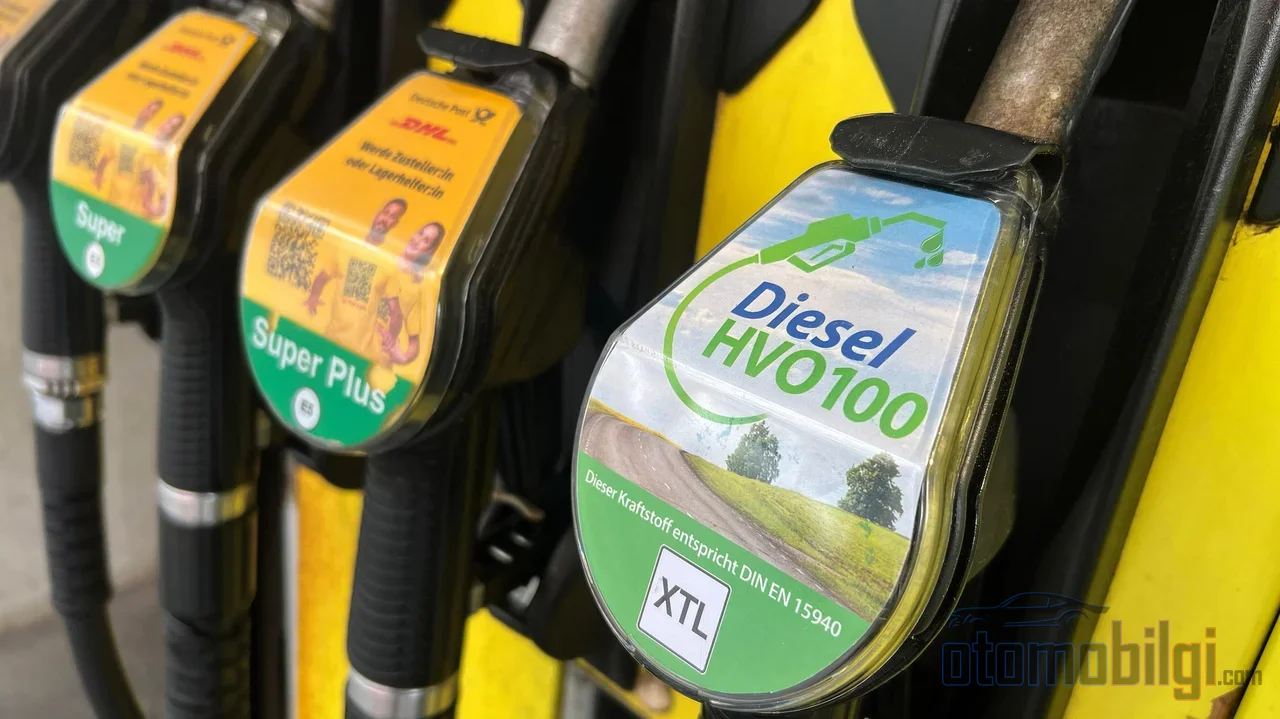
Most drivers who come across the "HVO100" label at a diesel pump assume it is a type of biodiesel. Yet the difference between the two is as fundamental as the difference between gasoline and LPG. One is not even from the same molecule family as standard diesel; the other is a blend produced from fatty acid methyl esters that cannot enter every diesel tank without issue. Knowing this distinction is not merely chemical curiosity: the fuel you put in your vehicle can swing your consumption by 2-4 percent, determine whether the engine starts on a winter morning, and cause leaks through the seals in an older engine.
On this page we cover, with figures, what HVO100 is, why it is chemically distinct from the FAME-based biodiesel in B7, its cold-weather behavior, manufacturer approvals, and the real-world consumption difference. By the end of this page you will know clearly whether you can put HVO in your vehicle and what to expect in terms of range and maintenance.
What Is HVO100: Hydrotreated Paraffinic Fuel
The name HVO100 means 100% Hydrotreated Vegetable Oil. The raw materials for production are waste cooking oils, animal fats, and vegetable oil residues; these are reacted with hydrogen under high heat and pressure. The first stage of the process, hydrotreatment, removes the oxygen and contaminants in the oil's structure; the subsequent isomerization step branches the molecule chains to improve cold-flow properties.
The result is a saturated hydrocarbon mixture composed of normal and iso-paraffins, free of sulfur and polycyclic aromatic hydrocarbons. The critical point is this: HVO100 is a chemically different fuel from fossil diesel, because its structure is purely paraffinic; fossil diesel, on the other hand, is a mixture of hundreds of different hydrocarbons. Since it contains no unsaturated compounds, its oxidation stability is high, and in the tank it behaves very closely to fossil diesel in terms of aging.
On the standardization side, there are three separate categories: fossil diesel is subject to the EN 590 standard, FAME biodiesel to the EN 14214 standard, and paraffinic diesel to the EN 15940 standard. HVO100 is a fuel category in its own right under EN 15940; at pumps in Europe it is usually sold under the "XTL" or "HVO100" label.
Its Difference from the Biodiesel in B7: Two Different Chemistries

The normal diesel (B7) you get at the pump in Europe contains at most 7% FAME by volume. FAME is produced through a process called transesterification: oils are reacted with alcohol to obtain fatty acid methyl esters. The structure of these molecules is the polar opposite of the paraffinic structure that comes from HVO's hydrotreatment, and this difference has concrete consequences in use.
FAME molecules carry 10-12% oxygen by weight; HVO contains no oxygen at all. Oxygen lowers the fuel's energy density and leads to a decrease of roughly 4% in peak engine power with FAME. The double bonds and oxygen in FAME encourage bacterial growth at the water interface in the tank and the formation of sludge; it easily absorbs water and has low oxidation stability. HVO has none of these problems.
Highlights
- HVO100 is a paraffinic fuel and complies with the EN 15940 standard; FAME is not biodiesel
- Cetane number minimum 70; in fossil diesel this value is 51
- Winter-grade HVO100 CFPP value can drop down to -30°C; FAME can clog the filter at -20°C
- Consumption trends upward by roughly 2-4% due to lower density
- All Euro 6 and most Euro 5 engines can use HVO100; manufacturer approval is essential
Comparative Key Characteristics
| Property | HVO100 | Fossil Diesel (EN 590) | FAME Biodiesel |
|---|---|---|---|
| Cetane number (min.) | Above 70 | 51 | 51 |
| Sulfur | <1 mg/kg | ≤10 mg/kg | ≤10 mg/kg |
| Oxygen content | None | None | 10-12% |
| Blend limit | Up to 100% | - | 7% without B100 approval |
| Storage stability | High | Good | Low, risk of bacterial growth |
| Cold weather behavior | Reliable down to -22°C | Roughly -20°C in winter grade | -8°C at best |
Why Does HVO100 Behave Better in Cold Weather?

The measure of cold weather performance is the CFPP, or cold filter plugging point: the temperature at which wax crystals in the fuel grow and begin to clog the filter. The point where cloudiness begins is separately defined as the cloud point (CP). In comparative laboratory evaluations, the B7 formulation containing FAME showed distinct filter plugging at -10°C and especially at -20°C.
HVO100 is typically rated with a CFPP of at least -22°C; according to product specifications, the summer formulation has a CFPP of -15°C and the winter formulation a CFPP of -30°C. This is even above the roughly -20°C limit of winter-grade fossil diesel. If you recall that the isomerization step was added to improve cold flow properties, you can see these figures are no coincidence: the fuel's chemistry was designed for cold weather from the start.
Is the Consumption Difference Real: The Energy Content Question
Some suppliers argue that HVO100's energy content is the same as conventional diesel and that range remains unchanged. However, independent measurements paint a different picture. According to the ADAC test, consumption with HVO increases by 1-5% depending on the load demanded by the engine. In passenger vehicles, an average consumption increase of about 3% was measured with pure HVO. In heavy-duty operational data, HVO100 has been associated with a statistically significant consumption increase of 0.51 L/100 km under conditions of an empty vehicle and low topographic variability.
The reason is straightforward physics: HVO100's density is lower than that of mineral diesel and on a volume basis, the fuel pumped carries slightly less mass per liter, and therefore slightly less energy. The effect is partially compensated by hydrogen content: paraffinic diesel contains about 15.2% hydrogen by weight, while in fossil diesel this figure is 13.5%. Nevertheless, the net balance points to a slight decrease in energy per liter. Practical summary: It is a realistic estimate to expect an increase in consumption of roughly 2-4 percent; in a 60-liter tank, this roughly means a range loss of a few tens of kilometers.
On the performance side, the picture can be the opposite of consumption: while one simulation study reports a 4.53% increase in rated power with HVO100, peak power drops by roughly 4% with FAME due to its oxygen content. In other words, HVO slightly affects range rather than power.
Can Your Vehicle Use HVO100? Manufacturer Approvals
HVO100 is a drop-in fuel that requires no modifications in approved diesel engines: there is no need to empty the tank, and it can be blended with fossil diesel in any ratio. However, a diesel badge alone is not enough; compatibility varies engine by engine, and EN 15940 compliance is no substitute for vehicle-specific manufacturer approval.
The approval map is broad: BMW has approved its diesel engines produced since March 2015 for HVO100, and since January 2025 it has been factory-filling its diesels produced in Germany with 5-8 liters of HVO100 depending on the model. Volvo Group has approved HVO in its diesel engines since 2015; all Euro 6 Scania diesels come from the factory with 100% HVO approval. Toyota has approved roughly half a million N90 HiLux pickups for HVO100. Porsche, in collaboration with a university institute, completed 1.6 million km of testing under real-world conditions over 4.5 years. As a general rule, all Euro 6 and most Euro 5 engines can use HVO100; still, consulting the manufacturer is essential for a definitive decision.
Leakage Risk in Older Engines
The picture is grayer for older diesel engines. Field reports tell of HVO100 causing fuel leakage especially in older Volkswagen 1.9 VE and PD diesels, with the solution usually being replacement with Viton-based seals; problems have also been reported for some older Leyland engine seals and certain DAF components. On the other side, there are operator reports claiming that after adapting to HVO, they could continue switching back to conventional diesel and that no permanent damage was done to the seals. Unlike FAME, HVO's storage and aging properties are known to be very close to standard diesel, while B100, due to its acidic nature, is known to damage old seals and pipes.
In summary, if you have an older engine, take two steps rather than passing definitive judgment: check the manufacturer approval, and if in doubt, renew the seals with modern materials. In modern Euro 5 and newer engines, this risk does not even come into question.
Emissions and Life Cycle Impact
On a life cycle (well-to-wheel) basis, HVO100 reduces greenhouse gas emissions by up to 90% compared to standard diesel, depending on the feedstock and methodology; with the RED III methodology, the typical range varies between 57% and 121%, meaning that with some waste oil feedstocks the net saving can exceed 100%. On the measurement side, HVO-100 yielded approximately 4% lower CO2 emissions than other blends, including B7. In terms of exhaust emissions, HVO blends did not lead to significantly different trends from fossil diesel in laboratory and real-road measurements of the tested vehicles; in other words, emission behavior remains familiar, and the gain is largely achieved on the feedstock side.
Conclusion: HVO100: To Use or Not to Use?
The clear answer to the question is this: HVO100 is not the FAME biodiesel found in B7; it is a hydrogen-treated paraffinic renewable diesel; in modern engines with Euro 5 or higher homologation, it can be used without modification if the manufacturer approves, it performs even better than fossil diesel in winter with a CFPP value down to -30°C, and its lower density increases consumption by roughly 2-4 percent.
There is a small sacrifice on the range side, but great relief on the maintenance side: With HVO, there is none of the storage degradation, bacterial growth, and clogging problems seen with FAME; it can sit in the tank for a long time. If your vehicle is a post-2015 BMW diesel, a Euro 6 Scania, or an approved Toyota HiLux, the decision is easy. If you have an older engine and an unclear approval status, consult the manufacturer first, and if necessary convert the seals to Viton. It is also fine to add diesel to HVO in the tank, or HVO to diesel: the two fuels can be mixed in any ratio and require no transition procedure.
Sources
- What is HVO100? The Complete Guide for Fleet Operators | Biofuel Express
- Emissions and Fuel Economy Evaluation from Two Current Technology Heavy-Duty Trucks Operated on HVO and FAME Blends (SAE)
- ADAC test: HVO100 emissions well below limits (Vision Mobility)
- Impact of HVO blends on modern diesel passenger cars emissions during real world operation (Fuel)
- What's So Different about Biodiesel Fuel? (Penn State Extension)
- What to Know About Renewable Diesel and Biodiesel (Baker Institute)
- Is hydrotreated vegetable oil a superior substitute for fossil diesel? (ScienceDirect)
- Hydrotreated Vegetable Oil for Rail Applications (MDPI)
- Our diesels - tanked with HVO 100 (BMW Group)
- HVO 100 fossil-free fuel instead of diesel (Volvo Penta)