What is the Difference Between P0, P1, P2, P3 and P4 in Mild Hybrids?
When two mild hybrid vehicles come side by side, both carry the 48-volt badge and both support start-stop; but while one reduces fuel consumption by only 7-9 percent, the other achieves up to 14-16 percent improvement in the WLTP cycle. The difference is hidden not in the brochure, but inside the powertrain: where is the electric motor connected? These five positions, numbered P0 through P4 by manufacturers, produce completely different results even with the same 48-volt component set. Sometimes it hangs on the crankshaft via a belt, sometimes it is squeezed between the crankshaft and the transmission, and sometimes it lives inside the rear axle as a separate drive source.
The P0-P4 classification is rarely visible in everyday marketing language; yet it is this letter-number code alone that determines what a mild hybrid vehicle can and cannot do. Is electric driving possible, how efficient is regenerative braking, why is the 12-volt starter motor still there - the answer to all these questions lies in the position of the motor.
What Do P0-P4 Mean: Why Does the Motor's Position Determine Everything?
The naming logic is simple: The letter P describes the location of the electric machine in the powertrain. In the P0 position, the motor is connected via the accessory belt of the internal combustion engine; it is the solution known as the belt-integrated starter generator, or BiSG. P1 is the arrangement where the machine is mounted directly on the crankshaft, while P2 describes the configuration positioned between the motor and the transmission, which can be decoupled from the internal combustion engine with the help of a clutch. In P3, the electric machine is connected to the transmission output via a gear pair; in P4, the motor drives an axle other than the one driven by the internal combustion engine - typically the rear axle or a wheel hub.
The consequences of this positional difference are massive. The further forward (toward the wheels) the electric machine is placed in the powertrain, the fewer the losses involved in energy recuperation; because the kinetic energy collected during braking suffers friction losses with every gear and transmission stage it passes through. In contrast, as the position advances, integration cost and architectural complexity increase. For this reason, while in P0 and P1 the electric machine cannot be mechanically decoupled from the engine, in P2, P3 and P4 it can be decoupled thanks to a clutch - and it is precisely this decoupling capability that opens the way for additional functions such as electric driving.
Highlights
- P0 (belt-driven BiSG) architecture: maximum 12-14 kW power, 7-9% consumption improvement in WLTP.
- P2/P3/P4 architectures: up to 95% efficiency, 14-16% improvement in WLTP.
- All 48V belt-driven systems still use a 12-volt starter motor for cold starts.
- The P4 architecture provides low-cost all-wheel drive thanks to the rear axle driven by the electric motor.
P0: Belt-Integrated Starter Generator and the Most Common Solution
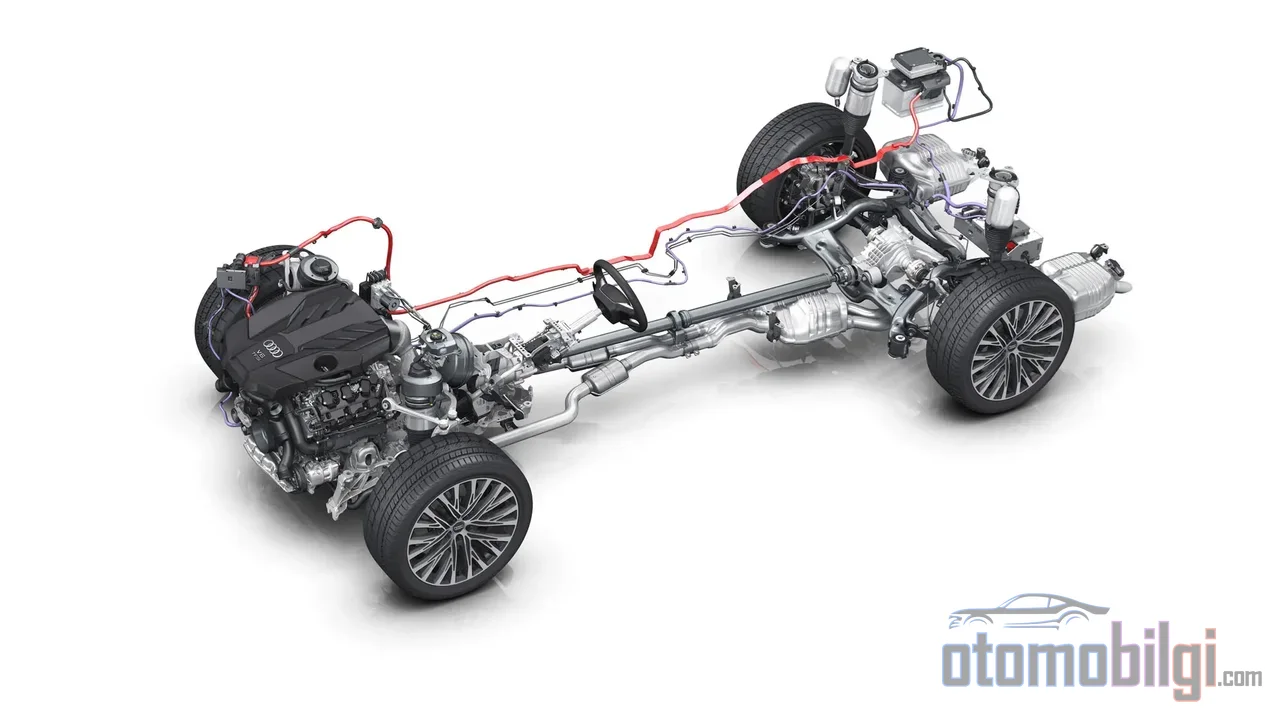
P0 is the most common mild hybrid architecture today, and the reason is clear from an engineering standpoint: its impact on the existing vehicle architecture is limited. When a 48-volt machine is installed in place of the conventional 12-volt alternator, the integration is largely complete. It is therefore the most cost-effective solution and the mainstream technology adopted by most manufacturers; the 48-volt system of the Audi A8 is a familiar example of this architecture.
The performance limits are also clearly drawn. The torque delivered to the crankshaft scales with the belt pulley ratio multiplier and can reach up to about 50 Nm; maximum power is in the 12-14 kW range, while continuous power is in the 2.5-3.5 kW band. System efficiency reaches up to 85 percent and improves fuel consumption by 10-12 percent in the NEDC cycle and 7-9 percent in WLTP. On the supplier side, 48-volt BiSG solutions are packaged with peak values of 8-12 kW and 55 Nm, a 48-volt battery with 200-600 kJ capacity, and a 2 kW DC/DC converter.
Its disadvantages arise from the position itself. Belt slip physically limits the torque that can be transferred; since the high torque required for cold engine starting exceeds this limit, all 48-volt BiSG applications still carry a 12-volt starter motor alongside. Energy recovery is affected by the engine's friction losses because the machine is on the crankshaft side, and low-speed electric driving (creep) is not possible at all. In summary, P0 is destined to remain an enhanced start-stop and torque assist system - but it is precisely this simplicity that makes it the most rational series production solution.
P1: Directly Connected to the Crankshaft, the Abandoned Generation
The P1 architecture mounts the electric machine directly on the crankshaft, and this has tangible benefits: belt loss is eliminated, efficiency increases, torque is delivered higher and faster, and the 12-volt starter motor can be completely removed. Honda's first-generation Integrated Motor Assist (IMA) technology is the best-known example of this architecture; the 2009 Honda Insight Hybrid and the 2010 Mercedes-Benz S400 BlueHybrid are the series production representatives of P1. The Insight's electric machine produces 34 Nm of torque and 10 kW of power on the crankshaft, with efficiency reaching up to 94 percent.
Nevertheless, P1 has left the stage. High production cost, the major impact it makes on existing vehicle architecture, and the impossibility of air cooling have led manufacturers and suppliers away from this line; while the first mild hybrid systems were P1, today they have been replaced by P0, P3, and P4 solutions. The story of P1 is an instructive example of why a technically superior solution can lose in the cost-architecture balance.
P2: The Machine at the Transmission Input and the Functional Leap
P2 places the electric machine between the crankshaft and the transmission, on the transmission side of the clutch. This small change of position creates a leap in the function set: when the engine clutch is opened, the electric machine can operate independently of the engine's friction and the transmission's losses, so energy recovery potential increases noticeably; additional hybrid functions such as low-speed electric driving and regeneration during coasting become possible. The main cost is higher integration costs.
On the series production side, P2 modules combine the motor with a separating clutch, a starting element and a dual-mass flywheel in a single compact package; solutions are available with 350 V nominal system voltage, a 270 mm stator diameter and 95 percent peak efficiency, offered in 48-volt or high-voltage options. The off-axis version, connected to the transmission from the side via a chain, increases the axial length of the drivetrain less, replaces the starter motor and, when needed, can also drive the air conditioning compressor. Scalability is impressive: a dual-clutch transmission solution with an integrated electric motor can be used across a voltage range of 48 to 400 V and with machine power of 26-65 kW, in a spectrum extending from mild hybrid to plug-in hybrid; it manages to transmit up to 450 Nm of total torque.
There is one point where P2 alone is not sufficient: since the machine is on the driveline side, a second electric machine on the engine side is required for start-stop - an enhanced 12-volt starter motor or a BiSG. Yet the common performance table of P2/P3/P4 architectures is still attractive: power of up to 21 kW, efficiency of up to 95 percent, a consumption improvement of 19-22 percent in NEDC and 14-16 percent in WLTP.
P3 and P4: Regeneration on the Driveline Side and Electric Axle
P3 connects the electric machine to the transmission output via a gear; the machine's speed is now a multiple of the wheel speed. P4, meanwhile, takes the logic one step further: the motor drives an axle other than the one driven by the internal combustion engine - as standard, the rear axle or the wheel hubs. In both positions, while braking energy is recovered, engine and transmission losses are not included in the regeneration when the line is open; therefore, the highest energy recovery potential lies in the P3/P4 topology.
The most interesting promise of P4 is all-wheel drive. When the internal combustion engine drives the front axle and the electric motor the rear axle, AWD capability is achieved without a long transfer case and driveshaft; the rear axle can even engage only on slippery surfaces, functioning as temporary all-wheel drive. Such a 48-volt-based system - a belt-driven starter generator, an electric supercharger and an electric rear axle drive called eRAD - was introduced at the 2016 Paris Motor Show, drawing attention with a demonstration that engaged the rear axle on low-traction surfaces to provide all-wheel drive and full electric driving.
P2 or P3: the cost and efficiency competition
P3 offers the most efficient regeneration in theory, but carries two handicaps in practice. First, since the machine cannot be integrated into the transmission or the engine, it requires separate volume inside the vehicle. Second, it requires an additional mandatory P0 machine to automatically start the internal combustion engine, which makes it more expensive; a 2024 academic comparison clearly reveals the cost advantage of the P2 architecture across different segments. In terms of efficiency P3 is ahead, while in terms of total system cost P2 leads - a typical engineering trade-off.
Combined topologies: P0+P4 and beyond
The positions do not need to exclude each other. Multiple machines can be combined in a single system, and current applications show combinations such as P0+P3 or P0+P2.5+P4. In these architectures, the P0/P1 machine on the engine side channels the internal combustion engine's excess torque into battery charging, while the P4 machine handles regenerative braking during deceleration and provides a silent electric driving mode. In a P1+4 layout, the machine located on the rear axle can also engage when needed to provide temporary all-wheel drive.
Position Comparison: Which Architecture Makes Sense for Which Scenario?
| Architecture | Connection | Max. power | WLTP consumption gain | Standout capability |
|---|---|---|---|---|
| P0 | Accessory belt (BiSG) | 12-14 kW | 7-9% | Lowest integration cost |
| P1 | Crankshaft (direct) | 10 kW (example application) | - | Lossless torque transmission, 12V starter can be eliminated |
| P2 | Transmission input, via clutch | 21 kW | 14-16% | Electric creep, scalable power |
| P3 | Transmission output, geared | 21 kW | 14-16% | Highest regeneration |
| P4 | Separate axle / wheel | 21 kW | 14-16% | Electric AWD, electric driving |
Translating the table for the individual buyer: if you are only looking for start-stop and torque support in stop-and-go city traffic, P0 is more than sufficient and offers the most sensible cost balance. The torque limit of the belt system is evident from the numbers; a P0 system never drives a vehicle on electricity alone. P2 forms an intermediate step for users who want an electric driving function while doubling the consumption gain, but do not want to move to full hybrid complexity. P3 and P4, on the other hand, are performance- and efficiency-oriented architectures, with their promises of maximum energy recovery, electric driving, and in particular all-wheel drive via the electric motor.
The market is moving in parallel with this: while P0 maintains its mainstream position thanks to its low cost, the market is gradually evolving toward P4 architectures, as they carry the potential for higher efficiency and CO2 reduction.
What Is the Essence of the Mild Hybrid P0-P4 Classification?
Let us summarize briefly with a quotable answer: The numbers from P0 to P4 describe the position of the mild hybrid electric motor in the drivetrain - belt, crankshaft, transmission input, transmission output, and separate axle. As the position moves closer to the wheel, energy recovery increases, electric driving becomes possible, and at P4 the architecture extends to electric all-wheel drive; but each step also raises the integration cost. P0 represents simplicity, P2 functionality, P4 capability; the right choice depends on the use scenario.
As we return to the 48-volt debates and mild hybrid versus full hybrid comparisons, this classification is the compass in your hand: look not at a manufacturer's voltage, but at where the motor is mounted. That number tells you more honestly what the vehicle can actually do than the brochure does.