A Century of Land Speed Records: From Steam to Gasoline
Share This Page
The century of land speed records is the clearest data series from which we can read the internal combustion engine's curve of technological maturation: The official record that began in 1898 with an electric vehicle at 63 km/h first passed to steam, then to petrol engines, and in 1947 reached the wheel-driven peak of 634 km/h. After 1964, jet and rocket propulsion took over the absolute record; the story of petrol, however, continues today in production cars approaching 500 km/h. This page tells the story of the engine architecture behind every record - the cylinder count, the supercharger, the fuel - together with the engineering limits of its era.
Highlights
- First official record: December 18, 1898, the electric Jeantaud Duc, 63.15 km/h
- Peak of steam: 1906 Stanley Rocket, 205.44 km/h - the steam record stood for 103 years
- Petrol's lasting victory: 1909 Blitzen Benz, 202.6 km/h, a 21.5-liter inline-4
- First 300 mph: September 3, 1935, Campbell-Railton Blue Bird, 301.13 mph
- The last wheel-driven absolute record: 1964, Bluebird CN7, 403.10 mph
How a Record Is Measured: The Engineering History of the Rules Themselves
The absolute land speed record is defined as the highest speed achieved on land by a wheeled vehicle. Today, the measurement is made over 1 km or 1 mile, as the average of two runs in opposite directions completed within one hour; the new record must exceed the old one by at least 1%. This 1% threshold works like a noise filter that prevents record claims based on tenths-of-a-second timing flukes.
The rules were not created in a single day. Around 1902, the Automobile Club de France became the first record arbiter; in 1924 the AIACR - and from 1947 onward the FIA - brought today's framework: two runs in opposite directions, neutralization of wind effects, a gradient tolerance of up to 1%, and time measurement with 0.01-second precision. The meaning of the wind requirement is simple: not raw, naked speed, but speed proven in both directions is measured.
Yet 1963 became the year of crisis for the rules. The FIA refused to recognize Craig Breedlove's three-wheeled, jet-powered Spirit of America vehicle, while the FIM approved it. The confusion ended with the FIA-FIM agreement signed in Paris on December 11, 1964, and since that date no absolute record holder has been wheel-driven.
The Brief Reign of Electricity and Steam: 1898-1906
The first official record is ironic by today's standards: an electric vehicle. On December 18, 1898, at Acheres, Gaston de Chasseloup-Laubat achieved 39.24 mph (63.15 km/h) in the Jeantaud Duc. A year later, on April 29, 1899, Camille Jenatzy broke the 100 km/h barrier, reaching 65.79 mph in the La Jamais Contente, the first LSR car purpose-designed for aerodynamics. Jenatzy's record stood for three years; then its heavy batteries fell victim to petrol and steam rivals.
The peak of steam is summarized in two figures. On April 13, 1902, Leon Serpollet achieved 75.06 mph in the Gardner-Serpollet Oeuf de Paques. The real turning point, however, was January 26, 1906: Fred Marriott, at Daytona Beach with the Stanley Rocket, achieved 127.66 mph (205.44 km/h), breaking both the first record exceeding 200 km/h and the first automobile record to surpass the railway record of the era. This figure stood as the absolute record for four years, and as the steam record for a full 103 years; but on August 25, 2009, the British-built Inspiration steam car renewed the steam land speed record at Edwards Air Force Base with Charles Burnett III in the seat.
When Did the Gasoline Engine Take Over the Record?
The first record of the internal combustion engine dates to August 5, 1902: William Kissam Vanderbilt II, with the Mors Z, at 76.03 mph. A rapid chain followed - Mors, Gobron-Brillié, Mercedes and Darracq vehicles took turns playing for the top. On July 21, 1904, Louis Rigolly, with a Gobron-Brillié, achieved 103.56 mph, recording the first record above 100 mph per mile. In the same period, Henry Ford reached 91.37 mph with the Ford 999 on January 12, 1904; the founder of the industry was not indifferent to the allure of speed, either.
The permanent transition came on November 8, 1909. Victor Hémery, at Brooklands with the Blitzen Benz powered by a 21.5-liter (1,310 in³) inline-4 Benz engine, achieved 125.94 mph - this was the first electronically timed run, and it propelled gasoline forward in a way that would never fall back. From an engineering standpoint, the message is clear: steam's thermal efficiency and weight were indefensible in the long run against the gasoline engine, which was easy to scale up and whose upper revs kept rising. In 1914, Lydston Hornsted, with Benz No. 3 at Brooklands, achieved 124.09 mph, recording the first record under the AIACR's two-way run rule; the rule and the technology had settled into the same framework.
The Age of Aircraft Engines: Daytona, Milan-Naples and the 200 mph Psychology
In the record cars of the 1920s, you see an architectural decision: the engine bay no longer holds an automobile engine, but a mass-produced aircraft engine. Cylinder count and displacement came for free from the aviation industry's supply chain. The table summarizes this leap in five rows:
| Year | Vehicle | Engine | Speed |
|---|---|---|---|
| 1902 | Mors | V4, 9.2 L, 60 hp | 76.03 mph |
| 1922 | Sunbeam 350HP | V12 aircraft engine, 18.3 L, 350 hp | - |
| 1924 | FIAT Mephistopheles | FIAT A.12 inline-6 aircraft engine, 21.7 L | 234.98 mph |
| 1927 | Sunbeam 1000 hp | Twin Sunbeam Matabele V12 | 203.79 mph |
| 1935 | Campbell-Railton Blue Bird | 36.7 L V12 supercharged Rolls-Royce R | 276.82 mph |
The FIAT Mephistopheles's 234.98 mph run also stands in the records as the fastest land speed record pass ever made on a public road. Daytona, meanwhile, stands out as the stage of this era: W.K. Vanderbilt had returned here in 1904 with his Mercedes and a record of 92.30 mph, and Daytona, as the "speed capital of the world," hosted a total of 11 world records. Frank Lockhart came within reach with 198.22 mph in the single-engine class in 1928; On March 29, 1927, Henry Segrave became the first driver to exceed 200 mph, achieving 203.79 mph with the Sunbeam 1000 hp "Mystery" powered by twin Sunbeam Matabele V12 aircraft engines. Segrave raised the mark to 231.45 mph with the Golden Arrow on March 11, 1929, and was knighted following these runs. In the same years, J.G. Parry-Thomas was carrying the British flag with Babs, powered by a 27-liter Liberty L-12 V12 aircraft engine, setting records of 171-172 mph at Pendine in 1926.
The Campbell Era and the First 300 mph
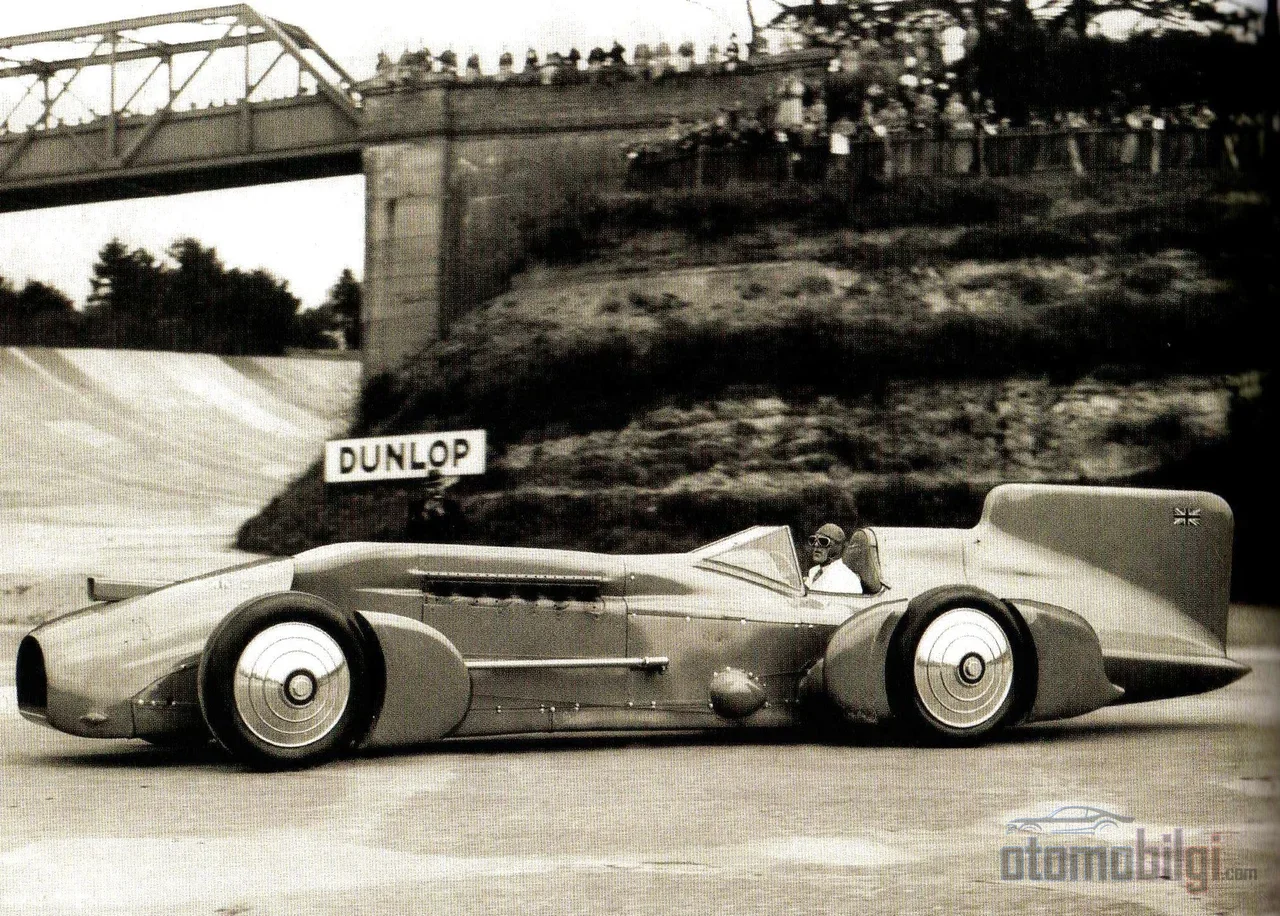
Malcolm Campbell's career reads the scale of growth in a single line: In 1924, 146.16 mph with the Sunbeam 350HP; In 1925, the first 150 mph; In 1927, 174.88 mph with the Napier Lion W12-engined Napier-Campbell Blue Bird; In 1933 and 1935, 272.46 and 276.82 mph with the Campbell-Railton Blue Bird powered by a 36.7-liter supercharged Rolls-Royce R V12. The final step came on September 3, 1935: At Bonneville, 301.13 mph - both the first passage over 300 mph and the first absolute record broken on the Bonneville salt flats.
In the final act before the war, two British giants locked horns: George Eyston's Thunderbolt with twin Rolls-Royce R engines reached 357.5 mph in 1938; John Cobb, with the twin Napier Lion Railton, achieved 394.20 mph in 1947 - the first run to exceed 400 mph in a single pass and the absolute record peak for an internal combustion, wheel-driven vehicle. When you compare these two figures with the speeds of the best track motorcycles of the era, you see as a scale what the gasoline engine made possible within thirty years.
The 1963 Crisis: Why Did Jets Eclipse the Piston Records?
The answer lies in the physics of thrust: In a wheel-driven vehicle, traction is limited by the friction of the tire pressing against the ground, and the wheel's rim speed is limited by the centrifugal load the material can withstand. The turbojet ignores both of these upper limits. On August 5, 1963, Craig Breedlove achieved 407.447 mph at Bonneville with the turbojet-powered Spirit of America; the run was first counted as unofficial, then ratified by the FIM, bringing 34 years of British dominance back to the USA.
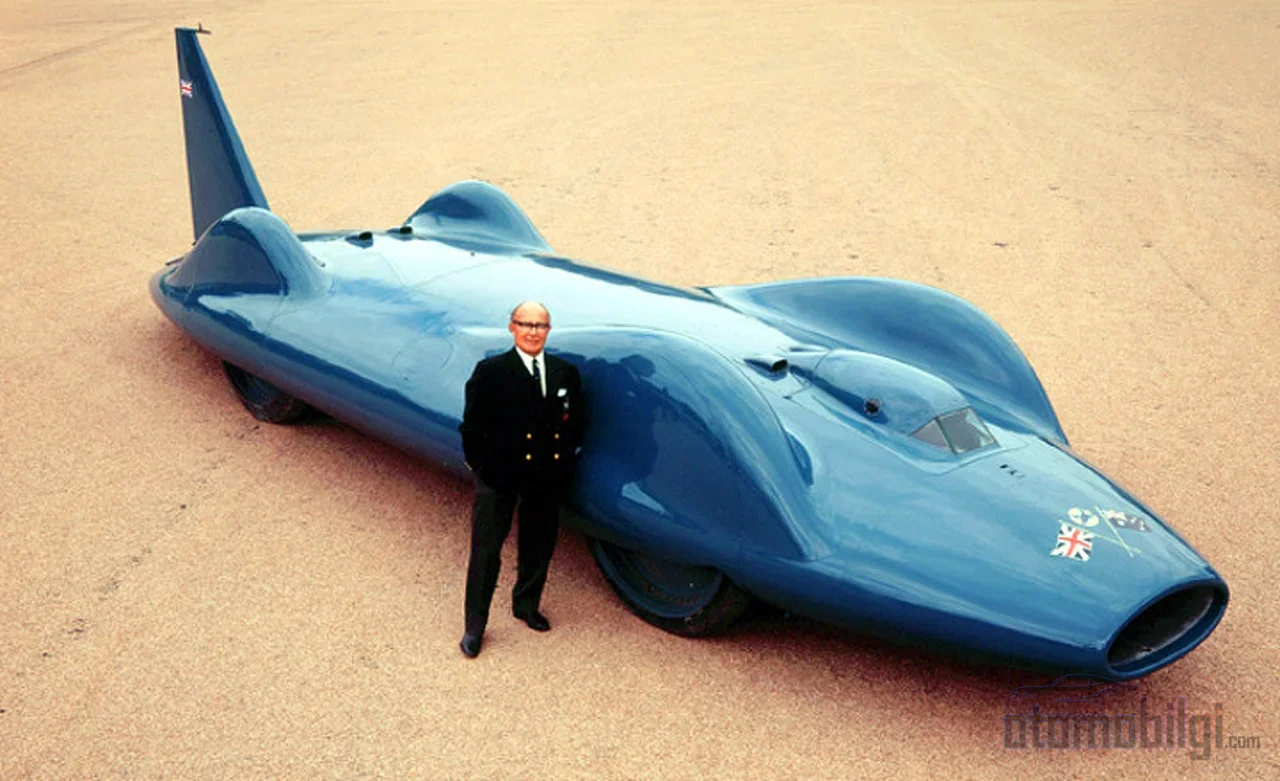
The following two years turned into not a speed race, but a measurable engineering duel. At Bonneville in 1964, the sequence went like this: Wingfoot Express, 413.2; Art Arfons' Green Monster, 434.03; Spirit of America, 468.7 and 526.28; Green Monster, 536.71 mph. In 1965, Breedlove saw 555 with the Sonic 1 and then 600.60 mph, the first FIA-ratified jet-powered record; Arfons responded the same year with 576.55 mph. Meanwhile, Donald Campbell sealed the last wheel-driven absolute record on July 17, 1964, achieving 403.10 mph with the Bluebird CN7 powered by a 4,000 hp Bristol Proteus gas turbine; during the dispute period there were considered to be three different "absolute record" holders at the same time - Campbell (FIA), Breedlove (FIM), and unofficial jet cars.
Ranking in the jet and rocket era also followed engineering logic: On October 23, 1970, Gary Gabelich reached 622.41 mph with the rocket-powered Blue Flame; On October 4, 1983, Richard Noble reached 633.47 mph with the Thrust2 powered by Rolls-Royce Avon turbojets. The peak came on October 15, 1997: Andy Green, with the ThrustSSC powered by two Rolls-Royce Spey turbofans, achieved 763.035 mph (1,227.986 km/h) at Black Rock Desert, becoming the first car to break the sound barrier. In the wheel-driven table, Goldenrod held the record from 1965 to 1991. The claim that the Budweiser Rocket reached 739.666 mph and broke the sound barrier in 1979 was never verified.
What Is the Fastest Production Car Today?
Although the absolute record has been taken over by thrust-driven vehicles, the story of gasoline (and now electricity) continues to unfold in production cars. With the official record announced in September 2025, the Yangwang U9 Xtreme holds the position of the official fastest production car at 308 mph (496 km/h); it is followed by the SSC Tuatara at 475 km/h and the Bugatti W16 Mistral at 454 km/h. The Koenigsegg Jesko Absolut, meanwhile, is shown at the top of some lists with an estimated top value of 330 mph (531 km/h) - here it is necessary to know the distinction between an official measurement and a supplier estimate: one is a proven run, the other is an engineering projection.
The line of milestones is also instructive: The McLaren F1 at 240 mph, the Bugatti Veyron at 253 mph, the Guinness-approved SSC Ultimate Aero TT at 256.18 mph (2007), the Veyron Super Sport at 267 mph. As an earlier reference, the AC Cobra Mk III 427 drew the production benchmark of its era in 1965 with 165 mph (266 km/h). On the electric side, the Rimac Nevera broke its own record in 2023 with four electric motors and 1,888 hp; gasoline and electricity are now trying to reverse the table of 1898-1906 for the first time.
Two forward-looking projects are also on the program: Bloodhound LSR is continuing with a target of 1,050 mph; Australian Rosco McGlashan's Aussie Invader rocket car is awaiting funding. The North American Eagle project was abandoned after the death of its driver Jessi Combs in 2019; Combs's 2013 run of 392.95 mph was crowned in 2020 with the posthumously approved 522.783 mph. The line of women drivers is already a long-standing one: FIA land vehicle records make no distinction of gender; unofficial women's records begin with Dorothy Levitt (1906, 96 mph in a Napier), followed by Paula Murphy, Betty Skelton, Lee Breedlove, and Kitty O'Neil (1976, 512.71 mph in the jet-powered SMI Motivator).
What Does a Century of Data Say?
If you read the records on a single axis, the picture becomes clear: It took eight years to go from 63 km/h to 205 km/h, twenty-nine years to reach 322 km/h (200 mph), and thirty-seven years to reach 483 km/h (300 mph). On the engine side, the same curve was written by three architectural decisions: first growing displacement without limit (the Blitzen Benz's 21.5 liters), then commandeering ready-made multi-cylinder aviation engines (the Napier Lion, the Rolls-Royce R), and finally bringing jets and rockets into play, whose thrust cost was that of prototypes. The roots of the technology working in the middle of a 496 km/h production car today - turbocharging, high revs, advanced fuel - stretch all the way back to the day Marriott's steam died out on Daytona beach. A century-long data series is one of the few records that so clearly shows how the internal combustion engine pushed every boundary, and who took over those boundaries.
Sources
- List of land speed records
- A brief history of early land speed record cars
- Birthplace of Speed - City of Ormond Beach, FL
- Speed Capital of the World - Record Days at Daytona Beach
- Spirit of America - Museum of American Speed
- ThrustSSC
- These are the 10 fastest cars in the world
- Top 100 fastest production cars
- Fastest Car In The World (2026 Guide)