Arbel's Vision of a Nuclear Hybrid Car
Share This Page
At the 1958 Geneva Motor Show, a French automaker introduced a hybrid car that would not need refueling for five years. The power source was a nuclear thermal generator, and the company presented this vision to the press at a launch event held at a restaurant in Paris. Arbel's story is described as the wildest chapter in the hybrid car's history spanning decades - and a chapter that deserves that description.
Because the hybrid idea is actually not very young. 19. At the end of the century, parallel hybrid and series hybrid architectures had already been defined in Belgium and Austria. The question is: why did the same basic idea fail to achieve commercial success both in the 1899 prototypes and in the 1958 nuclear dream, and why was it shelved for eighty years? The story of Arbel is the most colorful answer to this question.
Arbel Symétric: Early Hybrid Prototype with a Fiberglass Body
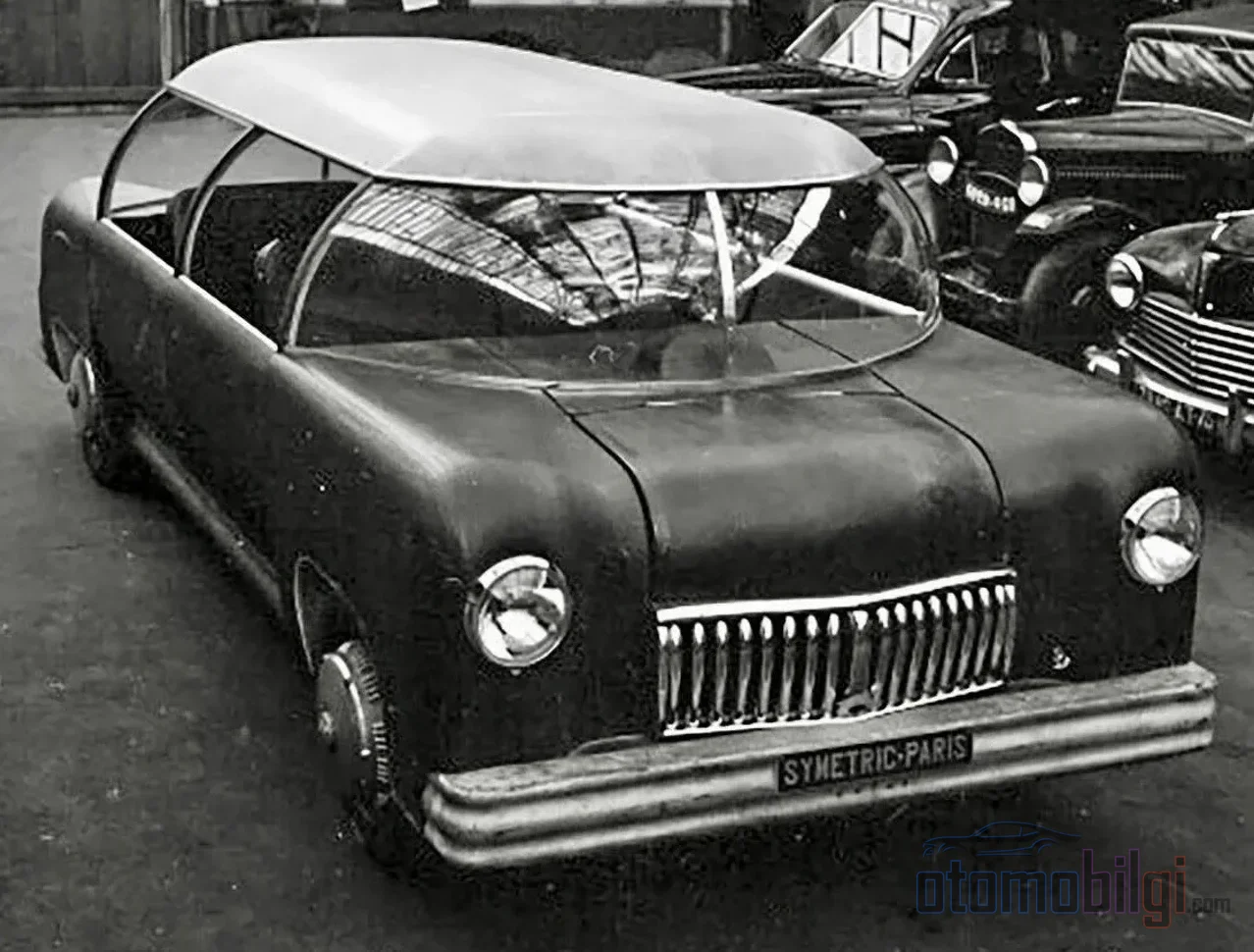
The name behind Arbel was a company called Compagnie Normande d'Etudes pour l'Application de Procédés Mécaniques, and the brain behind the design was 43-year-old car dealer Casimir (Casi) André Loubière. His brother Maurice, who financed the project, owned an air transport company called COSARA in Indochina. Their first commercial name was Les Freres Loubière - meaning this was a project not of an established automaker but of two entrepreneurial brothers.
The first vehicle, dated 1951, the Symétrie, seated eight people. A Simca four-cylinder gasoline engine producing 45 hp at 1100 cc fed electric motors mounted in the hubs of the four wheels. The body was made of glass and light alloy, with the weight at the level of 1,870 pounds (approximately 850 kg); the windows opened by sliding into the domed roof. The targeted price was 295 pounds. The vehicle was displayed at the 1951 Geneva Motor Show but received no interest.
The concept of placing motors in the wheel hubs was not a foreign idea: Between 1900 and 1906, Lohner-Porsche had used the same solution, and in 1897 Kriéger had pioneered both electric front-wheel drive and regenerative braking. Arbel's engineering was not new; its claim was new.
Highlights
- 1951: The eight-seater, fiberglass-bodied Arbel Symétrie hybrid prototype was introduced in Geneva.
- 1953: The single-pedal, gearbox-free roadster was shown at the Paris Salon; claimed top speed of 95 mph.
- 1958: The concept of a nuclear thermal generator called Genestatom producing 40 kW (53 hp) was announced.
- The French government did not allow the use of nuclear fuel; no development was ever carried out.
- The company closed in 1959, and the prototypes disappeared.
1953 Redesign: Single-Pedal Roadster and Measurable Claims
In 1953, the vehicle was redesigned as a plastic-bodied roadster and was introduced at the Paris Salon at the Grand Palais on October 22, 1953. The driving philosophy was radically simplified: a single pedal, an emergency handbrake, and no gearbox. When released, the car slowed down automatically - at low speeds regenerative braking kicked in, and above 15 kph the hood brake took over. In today's terms, it was a driving arrangement largely resembling one-pedal mode.
The claims were impressive on paper: The car reached 60 mph in Paris, top speed was announced as 95 mph, fuel consumption in normal driving was 32 mpg, and the stopping distance from 60 mph was measured at under 40 yards - cars of that era took 60-80 yards for the same distance. With an annual production target of 1,000 vehicles, the price was set at 435 pounds. It was noted that it even attracted the interest of the French Ministry of War of the time.
The technical layout was simple and functional: Under the rear hood, a 1.1-liter Simca engine worked as a generator, and the electricity it produced went directly to the motors in the wheel hubs. This was very close to the mechanical ancestor of what is today called a series hybrid. Were there other vehicles carrying the same idea? Yes - and much earlier than Arbel.
Was There Hybrid Before the Prius? Pieper, Lohner-Porsche and Owen Magnetic
The answer to this question is clear: yes, it had long existed. In 1899, the Liège brothers Henri and Nicolás Pieper developed the first hybrid vehicle, and it is accepted that Pieper's patent, by today's definition, was clearly a parallel hybrid system. The chronology of who owned the first hybrid is not certain - Pieper in 1899, while Ferdinand Porsche developed the System Lohner-Porsche Mixte between 1899-1900; the Mixte is regarded as the first series production hybrid combining a gasoline engine with an electric motor, and was largely financed by Emil Jellinek. Porsche won the 1902 Exelberg Rally with the Mixte; the Semper Vivus of 1901 is also mentioned among the first hybrids.
On the American side, Owen Magnetic (1915-1922) was a pioneering hybrid electric luxury brand. Justin Entz designed the gasoline engine-generator system in Philadelphia in the 1890s and built his first prototype in 1897 with the help of Pope Manufacturing. The 1916 example in collections stands as mechanical proof from roughly 80 years before series production hybrids. In short, Arbel in the mid-twentieth century was offering a new interpretation of a sixty-year-old idea.
| Vehicle | Period | Architecture | Notable feature |
|---|---|---|---|
| Pieper | 1899 | Parallel hybrid | Its patent defined a parallel hybrid system |
| Lohner-Porsche Mixte | 1900-01 | Gasoline + electric | First series production hybrid; wheel hub motors |
| Owen Magnetic | 1915-22 | Engine-generator | American hybrid electric luxury automobile |
| Arbel Symétric | 1951-59 | Generator + wheel motors | One pedal; nuclear generator proposal in 1958 |
Genestatom: The Nuclear Hybrid Car Vision of 1958
The second version, designed in 1957-58, was exhibited at the Geneva Motor Show in March 1958. The company had planned alternative power units for this vehicle. The first was a stationary gas generator running on diesel fuel, and it was named Genestafuel. The second was the part that turned the story into legend: The Genestatom, announced in 1958, was a nuclear thermal generator with a capacity of 40 kW (53 hp). It would run on radioactive cartridges, these cartridges would be produced from nuclear waste, and the vehicle would provide energy for five years. It is also noted that it may have been inspired by the Ford Nucleon.
The launch was befitting the vision: It was held at the Pré Catelan restaurant in Paris, and the colorful brochure showed taxi and private car versions. A list of ambitious features was presented: rubber suspension called Thermogum, Electric-Drive, a body called Polystic, phosphorescent bumpers, a self-emptying ashtray, and washer fluid filled with rainwater. The central chassis tube was used as the fuel tank. But there was a striking detail: Journalists were not allowed a test drive of the vehicle.
The promises were grand too: A new factory in Nice, the Paris taxi fleet within six months, 100 vehicles by the end of the year, and a Le Mans entry in 1959. None of it materialized. The price of the conventional engine version was around FF 900,000 - Citroën DS level. Some customers paid in advance but never received a vehicle.
Why Weren't Nuclear Cars Produced?
Four nuclear concept cars were introduced between 1958 and 1959: Ford Nucleon, Studebaker-Packard Astral, Simca Fulgur and Arbel Symétric. The Ford Nucleon envisioned a small nuclear reactor in the trunk and a steam engine based on uranium fission, promising a 5,000-mile (8,000 km) range and a replaceable reactor; however, only a 3:8 scale model could be produced. The Simca Fulgur was Simca's year-2000 vehicle - Simca having been founded by Fiat: nuclear power, voice-commanded driver assistance, and a claimed balance on two wheels - but there was no detailed technical data. The Studebaker-Packard Astral, with its ionic engine and the concept of an energy curtain for radiation protection, added claims of hovering in the air and traveling over water.
The engineering reality, however, carried none of them into reality. Nuclear energy technology - both then and today - was far from powering mass-production vehicles; reactors were heavy and dangerous, and tons of lead shielding were required for protection. For the same reason, nuclear aircraft attempts (on the B-36 in the US between 1955 and 1957, and the Tu-95M in the Soviet Union) were also canceled. Nuclear power became widespread only in submarines and aircraft carriers. The French government also did not permit Arbel to use nuclear fuel; no development was ever carried out.
Was the Arbel a Scam, or Did It Actually Work?
It is difficult to give a single answer to this question. The Arbels are described as real vehicles produced for experimental and prototype purposes; at least one vehicle was produced and shown to the public. On the other hand, a significant portion of the period's narrative places the project among the classic fraud examples of the automotive world: journalists were not given test drives, customers who paid deposits could not receive their vehicles, and the promises of a factory and taxi fleet never materialized. The brochures and launch had a rarely seen level of professionalism; the company collapsed quickly. The nature of Arbel - genuine engineering expertise or a fabricated promise - is a point still debated today.
The outcome was the same: The company fell into debt, could not recover, and closed in 1959. The prototypes disappeared. The Loubière brothers, whose first patent was dated June 13, 1950, patented another rotary engine in 1963; but that is where the automobile story ended.
The 80-Year Silence of Hybrid History and the Modern Era
Arbel's collapse was part of the long shelf life of the hybrid idea. Early hybrids were ignored for years due to high development costs and uncertain market acceptance. Toyota attributes the delay of its hybrid project to the absence of secondary, that is, rechargeable batteries that met the requirements of the era as the effective reason. On the engineering side, the problem was not the idea, but storage and cost.
The turning point came in 1997: The Toyota Prius went on sale in Japan as the world's first mass-produced hybrid, combining its 1.5-liter gasoline engine with an electric motor. It was later acknowledged that the fuel consumption of the first prototypes was worse than that of the standard Corolla; yet the Prius raised environmental awareness and brought other manufacturers into the hybrid market. In 1999, the Honda Insight became the first hybrid to enter the US market as a first-generation three-door two-seater liftback - it had reached the US before the Prius. With a combination of a 3-cylinder 67 hp gasoline engine and an electric motor, it sold more than the targeted 6,000-7,000 sales in the US, exceeding 14,000 vehicles, and was recognized as the most efficient American-market vehicle of its time. Rising gasoline prices and concerns about carbon pollution made the Prius the world's best-selling hybrid.
Arbel's Legacy: The Boldest Dream in Hybrid History
Did Arbel's nuclear hybrid vision come true? No. The French government did not permit it, no development was ever carried out, the company closed within a year, and the prototypes vanished. Arbel's story is not a failure of the hybrid idea; it was the result of a commercial dream detached from engineering realities, in an era when the technology was not ready. The fundamental architecture - the gasoline engine as a generator, electricity at the wheels - proved its worth a century later in the Prius and the tens of thousands of vehicles that followed it. Nuclear cars remained on the drawing board; the hybrid idea, after eighty years of silence, made it onto the roads.
Sources
- Arbel (automobile)
- Automotive History: The Arbel Symétric – The Atomic Prius That Came And Went
- Arbel Symetric, a sumptuous catalogue for an impossible car
- Nuclear Powered Cars of a Future That Never Was
- The 1958 Ford Nucleon: An idea that's still ahead of its time
- Ford Nucleon
- Lohner–Porsche
- The history of Porsche begins electrically
- Gamechanger: how Ferdinand Porsche designed first hybrid car
- 1901 Lohner-Porsche Semper Vivus and Mixte
- We Hail Hybrids' Hundredth Birthday, But Were They Really Born in Belgium?
- Hybrid electric vehicle
- Owen Magnetic
- The Story Behind the Birth of the Prius
- Milestones: Toyota Prius, the World's First Mass-Produced Hybrid Vehicle, 1997
- Development of Prius and Hybrid Strategy
- Honda Insight
- Honda Marks 25 Years Of Hybrid-Electric Sales
- The History of the Electric Car
- Hybrid Electric Vehicles: A History of Technological Innovation