Why Couldn't STP's Turbine-Powered Car Change the Indy 500?
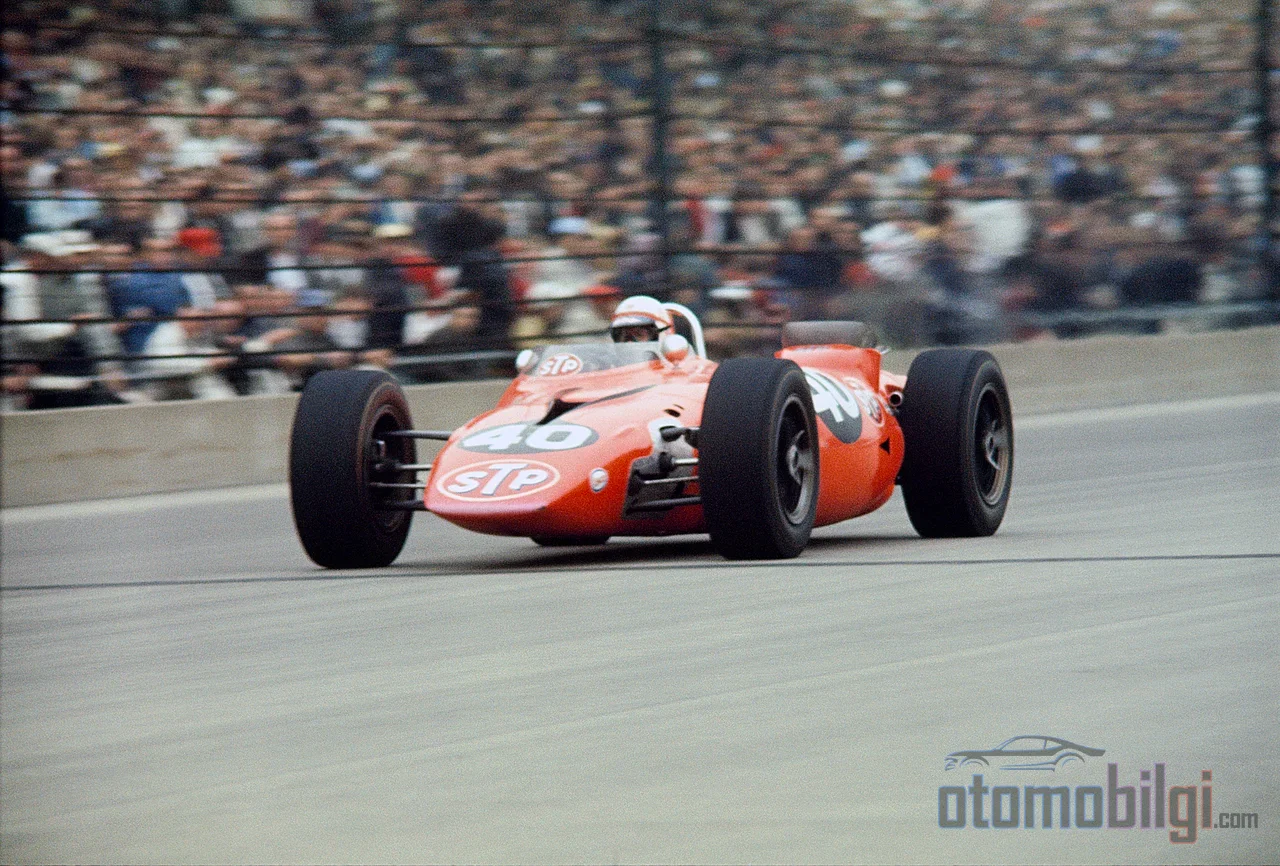
Just imagine: You're in the final 8 miles of the Indianapolis 500, you're leading, your car runs on technology completely different from your rivals', and they're about to hand you the winner's purse. Then a bearing - yes, a bearing worth about 6 dollars - gives up and everything falls apart. That's exactly what happened to Parnelli Jones in 1967, and it marked the end of not just one race but the most extraordinary technology experiment in IndyCar history. To understand what happened on the track that day, we first need to ask this question: What was a jet engine doing at Indianapolis?
The STP-Paxton Turbocar: A Jet Engine on the Track
In January 1966, Andy Granatelli's STP company launched a truly crazy project at its Paxton division in Santa Monica. Designer Ken Wallis had first taken the idea to Dan Gurney, then to Carroll Shelby. Shelby even testified in court, describing the idea as nonsense. But Granatelli thought differently, and the STP-Paxton Turbocar was born.
At the heart of the car was a Pratt & Whitney Canada ST6B-62 gas turbine. In short: a jet engine that needed none of the classic parts like pistons, valves or camshafts, producing 550 hp at 6,200 rpm. No clutch, no gearbox; a torque converter handled everything. What's more, the engine ran at 54% of full throttle even at idle, meaning Jones could get the car moving without even pressing the accelerator. Can you imagine? A race car that moves with a throttle pedal your foot never touches.
The layout was unconventional too: At Granatelli's suggestion, the engine sat in the middle, to the driver's left; Jones sat on the right. The four-wheel drive system was also Granatelli's addition. The fuel was kerosene, carried in five Firestone safety cells totaling 166 liters. And the sound... While its rivals roared, this car glided along with a strange whine; they called it Silent Sam.
Highlights
- The STP-Paxton Turbocar used a Pratt & Whitney gas turbine producing 550 hp in 1967 used a Whitney gas turbine
- Parnelli Jones led 171 laps at the 1967 Indy 500 and dropped out with a bearing failure in the final 8 miles
- USAC lowered the turbine air inlet area from 23.999 square inches to 15.999 square inches a month after the race
- The Lotus 56 brought the wedge-body form to Indy in 1968, but none of the three cars managed to finish the race
- After 1968, turbines and four-wheel drive were completely banned at Indy
The Road Was a Bit Winding
The project did not go in a straight line. The first chassis warped during heat treatment in early 1966, and they missed that year's Indy 500. The second version was built with riveted 7178-T6 titanium alloy, and this chassis, weighing only 60 kg, was ready in early 1967. The car weighed well above the minimum limit in total, 1,750 pounds, or 790 kg; The Indy minimum was 1,350 pounds. So they were racing with a heavy car and were still fast. There was also a throttle delay: drivers described a three-second delay, occasionally reaching up to six seconds. You press the throttle, sip your coffee, and the car seems to respond afterward. Taking a corner at 400 km/h in a car like that takes a special kind of courage.
The 1967 Race: A Heart Attack Eight Miles from the Finish
Jones qualified the car sixth with an average of 267.272 km/h; pole position went to Mario Andretti. It was even thought that he was hiding the car's true potential in qualifying, lifting off the throttle before the braking zones. The race started and Jones took the lead on the first lap. He was out front for nearly all of the 171 laps. The race was stopped by rain for 18 laps, restarted the next day, and Jones was out front again.
Then on lap 196. that is, with about 13 kilometers left to the finish, that cheap transmission bearing gave up. Jones coasted the car into the pits and finished the race in sixth place. A.J., who took over the lead, Foyt won his third Indy 500 victory. One of the bitter sides of the story is this: Jones had been offered a suitcase with 100,000 dollars in cash before the race, plus half of the prize money if he won.
A turbine car was nearly winning, and this left the piston world quite uneasy. So how did the rules respond to this? This is where the story becomes most controversial.
USAC Rules: How Was the Technology Shut Out?
In fact, even before 1967, USAC had limited the turbines' air intake area to 23.999 square inches (154.83 cm²); yet the engine still managed to produce 550 hp. After the 1967 race, things moved quickly. Within a month of the race, USAC lowered the intake area to 15.999 square inches (103.22 cm²) and applied the rule immediately. You can guess: it was customary in the engine world to give two years' notice for changes, and this sudden move was contrary to USAC's own long-standing two-year guarantee policy. The maximum lap speed achievable with the reduced intake area had fallen to around 259 km/h. Let's also add that in September 1966, the USAC Boards Committee proposed banning turbine cars from events; STP had already taken the matter to federal court.
Why such a harsh reaction? Because there was serious concern on the piston engine side: they would either let the turbines dominate everything or change the rules to protect the conventional cars. Pressure from piston engine manufacturers and the balance-of-power debate spreading across the pit lane tipped the scales against the turbines.
For 1968, USAC also restricted the tire sizes of four-wheel-drive cars. Pratt & Whitney responded with the new ST6-70 turbine and again managed to produce 550 hp despite the reduced airflow. The engineers weren't giving up; until the ban came in full force, that is.
Lotus 56: The Wedge Shape and Broken Hearts
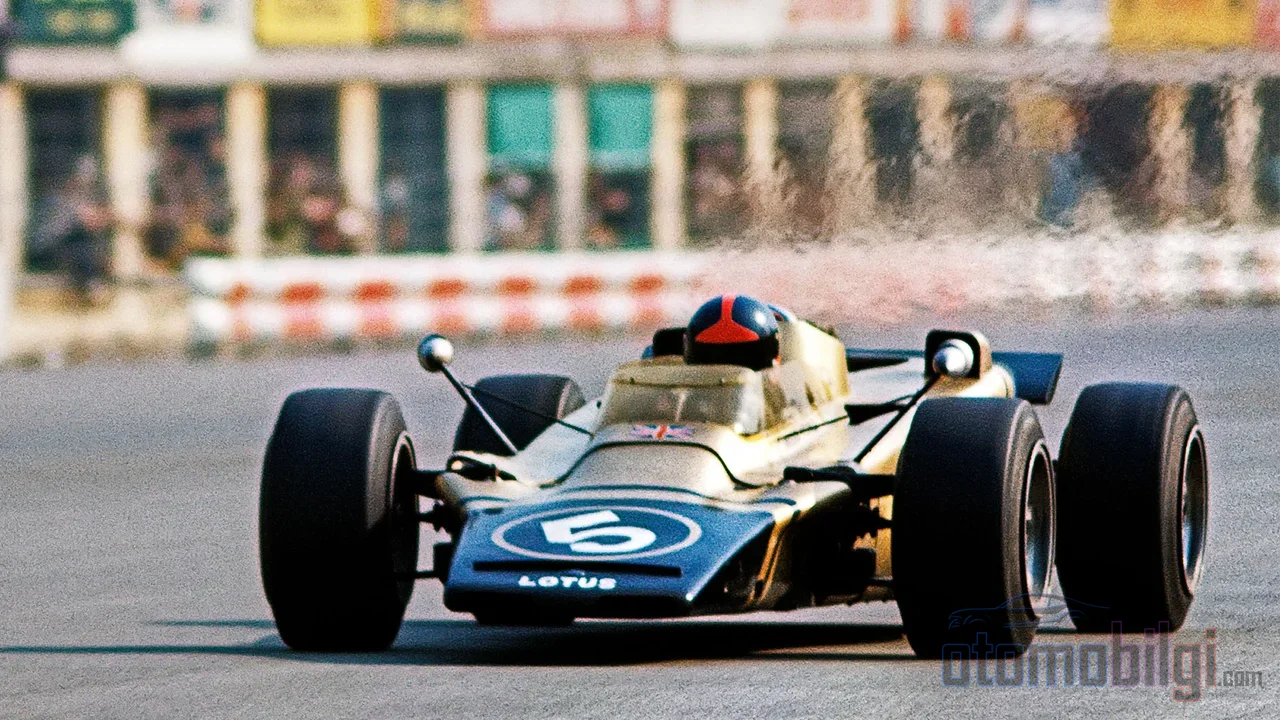
In 1968, the story moved to England. Designed by Maurice Philippe and backed by STP, the Lotus 56 brought a far more sophisticated body to the turbine concept: the wedge shape. It used a modified version of the ST6 from STP-Paxton and was four-wheel drive. The shape was so striking that it inspired a whole series of open-wheel race cars that followed. Today, looking at the silhouettes of IndyCar and Formula 1 cars, it is possible to trace that wedge line.
But 1968 was not easy at all. Mike Spence lost his life when he crashed into the wall at the first corner during practice. Carroll Shelby also planned to enter with two Wallis-designed turbine cars and driver candidates Denny Hulme and Bruce McLaren; after Spence's death, he withdrew his cars. The official explanation was safety, but the real reason is thought to have been the rule restrictions imposed on the turbines. Hulme raced with the Ford Indy V8, and McLaren failed in qualifying.
None of the three Lotus 56s that entered the race finished. Joe Leonard's number 60 car was the closest to winning, but the turbine failed nine laps before the finish. Graham Hill and Leonard were up front; Hill was classified in the race, while Art Pollard drove the number 20 Lotus 56. Nearly winning two years in a row, and then always breaking at the same spot... After 1968, USAC completely banned turbines and four-wheel drive at Indy. The experiment was over.
Were Turbines Really Better?
To be fair, we need to look at the picture from both sides. On one side there was the silence and the kerosene smell from the exhaust, and the complaints of other drivers; most people did not like the car, and apart from the Granatellis, team owners were openly hostile. On the other hand, 200,000 people had come to the practices and Pole Day just to see this car with their own eyes. So the spectators were curious, but the competitors were not.
There is an interesting detail on the consumption side: the kerosene version was estimated to get roughly 4-6 mpg, nearly twice as efficient as the Indy Ford. The balance of performance and efficiency actually looked favorable. The problem was the reliability dramas experienced two years in a row: a bearing in 1967, a turbine failure in 1968. And of course, the cost of the bearing is reported variously in sources as between 6 and 12 dollars, but the main point does not change: what stopped the revolution was not a colossal engineering failure, but a cheap part itself.
Now let us come to the clear answer to the question in the title: STP's turbine cars failed to win the Indy 500 because a cheap transmission bearing gave up in 1967, and a turbine failure nine laps before the finish gave up in 1968. But more important than the race results was that they proved they were fast enough to win. With the piston world also seeing this, USAC narrowed the air intake area, enforced the rules immediately, and eventually banned the technology completely. The turbines were not defeated on the track; they were defeated at the table.
Where Can You See Them Today?
The actual 1967 Turbocar was donated to the Smithsonian by STP and is exhibited there today. At the Indianapolis Motor Speedway Museum there is a replica built exactly to the plans; the car's hood was lost for more than 20 years and was found in an office at the Smithsonian in 2007. Delivered to a small team: even TV host Johnny Carroll drove the car in a special test session in 1967.
The legacy of the Lotus 56 is even broader: The Formula 1 derivative developed as the Lotus 56B is considered one of the most radical F1 cars of all time. The wedge body shape remained even after turbines were banned and shaped the future of race car design. Granatelli once believed that just as mid-engined cars drove front-engined ones off the field, turbines would drive pistons off too. That didn't happen, but these two years, spent through rule changes and engineering sacrifices, remain one of the most striking technology chapters in IndyCar history. Maybe that's why we're still talking about it so much, right?