2026 Tesla Model Y: Segment, Range and Position in Türkiye
Share This Page
The Tesla Model Y shares its platform with the Model 3 sedan and is a five-seater, rear-wheel-drive or all-wheel-drive electric midsize fastback SUV. Fitting up to 2,138 liters of total cargo volume (including the front trunk) into its 4.79-meter body, the Model Y is one of the benchmark vehicles in its class in terms of range, charging infrastructure, and software ecosystem. In this guide, we examine its segment, its range and charging characteristics, its minimalist interior, what sets it apart from its rivals, and its position in the Türkiye market - covering all dimensions without diving into the price list.
Highlights
- WLTP range varies by version between 314-391 miles (approximately 505-629 km).
- Peak DC charging power is 250 kW; the 10-80% window is completed in under 30 minutes.
- AAA's real-world test with the Long Range version measured 559 km .
- With the 2025 Juniper refresh, the turn signal stalk returned and cabin quality improved.
- In August 2025 in Türkiye, it became the best-selling model among all vehicle types with 8,730 units .
Which segment is the Model Y in, and who is it designed for?
By Tesla's own definition, the Model Y is an "electric midsize SUV"; in practice, this corresponds to a body type that sits above the C segment, at the center of D-segment SUVs. Car and Driver's classification is clearer: a five-seat, electric, RWD or AWD fastback SUV. It shares its platform with the Model 3 sedan but offers more cargo volume and more rear-seat living space. The dimensions also confirm this shared engineering: a 4.79-meter length and a wheelbase close to 2.89 meters give the body a short-overhang proportion that keeps the interior spacious.
The rival set is broad and heterogeneous. On the German premium side are the BMW iX3, Mercedes GLC, Porsche Macan, and Audi Q6 e-tron; on the more price-focused side are the Kia EV5, Ford Mustang Mach-E, BYD Sealion 7, Peugeot E-3008, Skoda Enyaq, and Renault Scenic E-Tech. In other words, the Model Y is compared simultaneously with both premium SUVs and mainstream EVs - few models can carry that weight.
What did the Juniper refresh change?
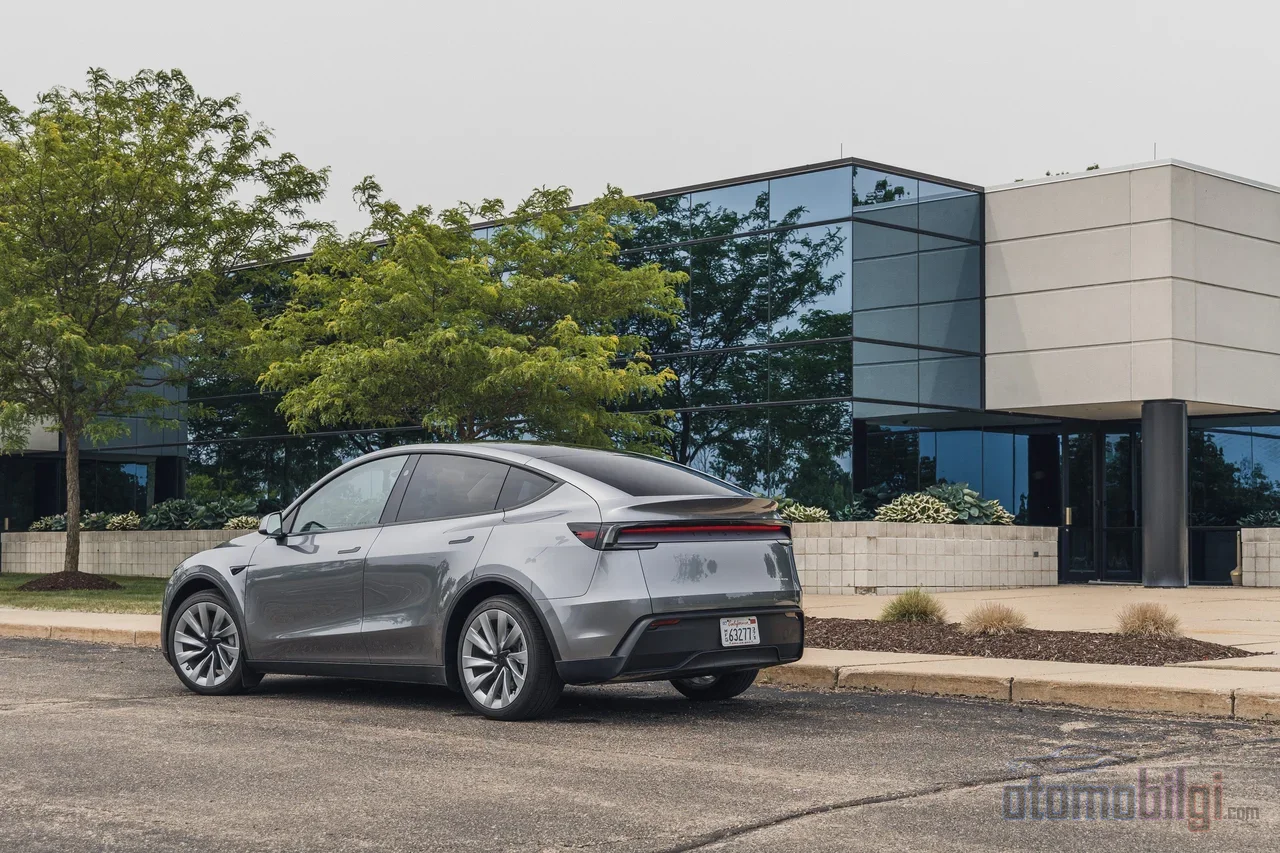
The Juniper refresh, which arrived in 2025, brought a design language inspired by the Cybertruck and Cybercab to the body: a full-width front light bar (absent on the entry-level Standard package), a more aerodynamic body, a stiffer body structure, and an increase of roughly 20 miles in official range. The 2026 model year refresh, meanwhile, touched the comfort side: new bumpers and lighting elements, more comfortable front seats, a redesigned dashboard, ambient lighting, improved sound insulation, and an 8-inch rear passenger screen under the center console. Ventilated front seats also became standard on upper trims.
The most debated change was symbolic: in response to the steering wheel buttons in the Model 3 Highland, the turn signal stalk returned in the Juniper; by the end of 2025, the Model 3 also got its stalk back. In 2026, a new entry-level Standard trim added - $5,000 cheaper than the Premium RWD, with simplified equipment (no ventilated front seats, heated rear seats, or rear climate screen), a single 300 hp motor, and a lower-capacity battery. Maximum range is 321 miles on 18-inch wheels, 303 miles on 19-inch wheels.
What is the real-world range of the Tesla Model Y?
Official figures break down as follows by version. On the WLTP cycle, the Standard RWD does 314 miles, Premium RWD 387 miles, Premium AWD 391 miles (372 miles with 7 seats) and Performance AWD 360 miles. EPA figures are more conservative: Standard 321 miles, Premium RWD 357 miles (344 on 20-inch wheels), AWD 327 miles on 19-inch wheels and 303 miles on 20-inch wheels. Tesla does not officially disclose battery capacity; expert estimates suggest about 75 kWh NMC in the Long Range version, and about 64 kWh LFP chemistry in the Standard.
| Version | WLTP range | Note |
|---|---|---|
| Standard RWD | 314 miles (~505 km) | Entry level, estimated 64 kWh LFP |
| Premium RWD | 387 miles (~623 km) | EPA: 357 miles |
| Premium AWD | 391 miles (~629 km) | 372 miles with 7 seats |
| Performance AWD | 360 miles (~579 km) | 0-60 mph in 3.3 seconds |
Real-world figures vary depending on measurement conditions, and this difference is not a contradiction about the car itself but a natural result of test methodology. In a cold-weather test, the Standard version produced 260 miles of real range with 3.6 miles/kWh efficiency at 5 °C; in warm weather, over 300 miles is expected. AAA measured 559 km on a single charge with the Long Range version - only 7% below the official 600 km figure, a strong result for real-world testing. On the highway side, according to a test at 75 mph, the Long Range RWD delivered 270 miles and the base AWD 240 miles. Summary: a realistic expectation is around 280-300 miles (450-480 km) depending on the version, and noticeably less in winter conditions.
Charging character: why is the Supercharger network still decisive?
On the DC side, the Model Y 250 kW charges at peak power; the 10-80% range is completed in well under 30 minutes. Measured average values for the Long Range RWD are more talkative: an average of 85 kW over the 10-90% range and 44 minutes. Tesla's own data is more striking: in a 15-minute charge, the Premium RWD adds 182 miles of range, the AWD 169 miles. So a coffee break on a long trip restores a large portion of the range in practice.
On the AC side, there is an 11.5 kW onboard charger; Type 2 and CCS connectors are standard. The real differentiator is the charging infrastructure itself: the Supercharger network is cited as a benchmark in terms of both cost and reliability, and described as an advantage that determines the purchase decision for high-mileage drivers. The plug-and-charge-like seamless experience and its ubiquity are the main reason competing brands struggle in the field even if their fast-charging figures are high.
Interior and software ecosystem: minimalism or missing equipment?
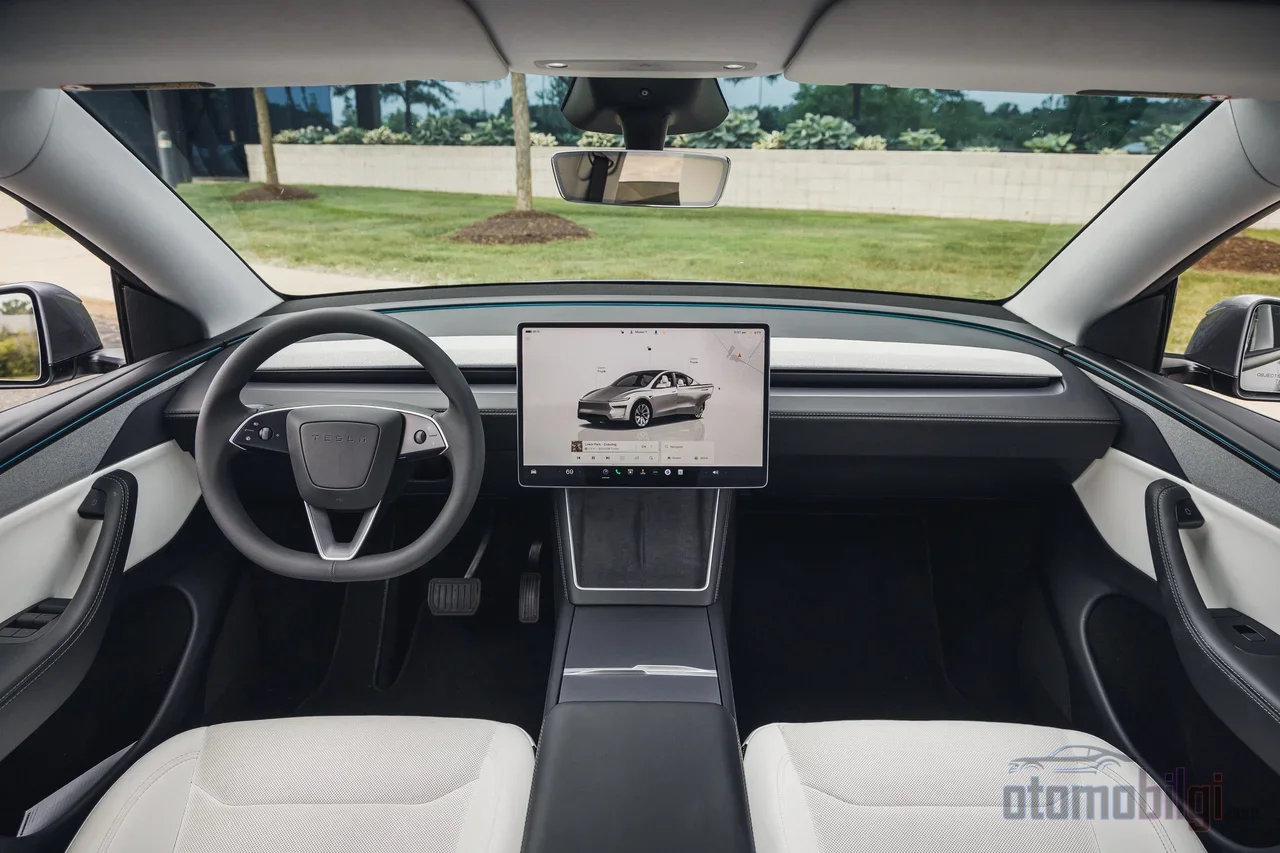
The cabin is organized around a single logic: 15.4-inch central touchscreen it manages almost every function including the gear selector. On Performance this screen is 16 inches with 80% more pixels; there's a second 8-inch screen on the rear console for climate and gaming (not available on the Standard trim). The glass roof is standard; on the Standard trim it can be closed with an interior mechanism. For those seeing the cabin for the first time, the common impression is clear: a refreshing minimalism and an interface fluidity reminiscent of Apple products.
With Juniper, material quality and ambient lighting make the cabin feel noticeably more premium; still, reviews say it doesn't reach the German premium level. On the software side is the Model Y's most lasting advantage: OTA updates, an improved Wi-Fi hotspot and an ultra-wideband phone key are standard. On the other hand, CarPlay and Android Auto are still missing - this shortfall is the harshest part of the adjustment period for accustomed users.
In practice, the cargo side is strong: the new electrically folding seats bring a 20-liter loss, but total volume including the frunk reaches 2,138 liters; in the 7-seat variant there are 381 liters behind the third row. In one test, the cabin swallowed 7 suitcases, 19 with the seats folded. On the driving side, the picture is mixed: the Premium AWD does 0-60 mph in 4.6 seconds (a test measured with a different trim showed 3.9 seconds) but ride comfort is still firm and tire noise is noticeable, especially on 20-inch tires.
Why is the Model Y different against the Ioniq 5, EV6 and ID.4?
This trio is frequently compared in the same basket and each vehicle has a clear identity. The Ioniq 5 stands out with its space-age design and roomy cabin, the Model Y with its sporty performance and software; the ID.4 is described as "conservative" in reviews, while the EV6 has a more fun driving character but a smaller interior. Dimensions are part of the story too: the Ioniq 5 is 182.5 inches and the ID.4 180.5 inches long - both at the short end of the segment, while the Model Y is noticeably longer than them.
Technically, the biggest difference is the voltage architecture: the Ioniq 5 and EV6 use an 800-volt system, while the Model Y stays in the 400-volt class. This gives the Korean duo an advantage in theoretical charging curves. But in the real world, the balance is struck elsewhere: according to users, while the user experience of the Ioniq 5 and EV6 is better than VW and Ford's, connectivity features - including the smartphone app - lag behind. The Model Y's trio of range, charging network and software is the combination that explains why the updated version beat electric SUVs from Chevy, Ford, Hyundai, Kia, Toyota and VW in a MotorTrend comparison test.
The Model Y's position in Türkiye: imports and target audience
The Model Y is sold in Türkiye through Tesla's official website; the configurator page states that prices are shown excluding SCT and VAT, with estimated delivery pointing to the February-March 2027 period. In other words, it's an imported product under the full effect of the import tax structure, and the order-to-delivery time is measured in months. Despite tax increases, demand remained strong even under these conditions.
Market data paints an interesting picture: while Tesla's sales declined in Europe, it rose to first place in Türkiye; in the relevant period, the Model Y with 3,310 units became the best-selling model. Even more strikingly, in August 2025 the Model Y in Türkiye with 8,730 units reached the position of best-selling model among all vehicle types - including internal combustion - and unseated Togg from the leadership seat. It is a rare occurrence in the Turkish market for an electrically powered imported model to take overall market leadership on a monthly basis.
The target audience is defined by this picture as well: drivers who prioritize charging infrastructure and the software ecosystem, who see range anxiety as an engineering problem solved by the Supercharger network, and who trust the brand's OTA update cadence. In a market with high price sensitivity, tax law creates premium-segment prices; yet what the Model Y sells is less the car's standalone feature list and more the premium paid for that ecosystem as a whole.
Long-term reliability: known weak points
Early production quality is one of the Model Y's most debated aspects. For the 2020 model year, suspension and steering, climate control, noise and leaks, interior electronics, paint-trim, charging, battery and electric accessories were flagged as problem areas. Long-term assessments point in the same direction: concerns are concentrated in early production quality such as panel gaps and trim, not in the battery and motors.
User experiences are also two-sided. Some owners find the touchscreen-heavy control dangerous while driving and complain about the firm suspension; an Australian owner who completed 60,000 km said he experienced tire blowouts and charging difficulties but would still buy the car again. On the other hand, it was noted in a 25-month long-term review that the "phantom braking" (uncommanded braking) problem improved over time with software updates. The low reliability ranking among nearly new vehicles and the claimed 17.3% serious fault rate reflected in TÜV reports should be read with caution, as they are based on secondary sources. One final clarity: despite its name, "Full Self-Driving" is not fully autonomous and requires driver attention.
Conclusion: whose car is the Model Y?
The Model Y is a car with its measurable advantages concentrated in specific areas: range efficiency, 250 kW charging speed, the Supercharger network, and the most mature software ecosystem in its class. In return, ride comfort is firm, cabin prestige lags behind its German rivals, and the control architecture leans on a single screen. The Ioniq 5 and EV6 are finding their own audiences with their voltage architecture, and the ID.4 with its conservative yet balanced character. As for who it is right for, the answer is clear in the Türkiye context: for drivers who prioritize infrastructure and software and accept the delivery times and import-driven pricing structure, the Model Y remains the default choice in its class.
Sources
- 2026 Tesla Model Y Review, Pricing, and Specs
- Tesla Model Y Review & Buying Guide 2026
- Model Y - Electric Mid-Size SUV
- Design Your Model Y
- Tesla Model Y RWD (Juniper)
- Tesla Model Y triumphs again in latest AAA real-world EV range tests
- Tesla Model Y Review
- Tesla Model Y Became the Best-Selling SUV in the Türkiye Market
- Tesla Türkiye Is Competing with Europe in Sales and Has Overtaken Togg
- Tesla Model Y Review: Sleek Interior, Easy Charging
- 2026 Tesla Model Y vs. 6 More EVs: Electric SUV Big Test!
- Tesla Model-Y vs Hyundai Ioniq-5 vs Volkswagen ID.4 vs Kia EV6
- 2026 Kia EV6 vs Ioniq 5 vs VW ID.4
- Hyundai Ioniq 5 vs. Mustang Mach-E, Tesla Model Y and VW ID.4
- 2020 Tesla Model Y Reliability
- I've done 60,000km in a Tesla Model Y
- Tesla Model Y Owner Reviews
- Reflecting On 25 Months With A Tesla Model Y