Does LPG Conversion Really Save Money?
Share This Page
Yes, LPG conversion provides savings under the right conditions: since the price per liter is roughly half that of gasoline, net fuel costs drop by 35–45%, and the conversion cost typically pays for itself within 9 to 18 months depending on annual mileage. However, if the installation fee, increased consumption, extra maintenance expenses, and insurance obligations are not factored into this calculation, the resulting figure becomes misleading. In this article, we will walk through that calculation step by step, in a way you can apply to your own vehicle.
Key Highlights
- Conversion cost on 4-cylinder engines 25,000–40,000 TL, in the range for sequential injection systems.
- LPG consumption per liter is 20–25% higher, but the price per liter is roughly half that of gasoline.
- For a driver covering 15,000 km per year, the payback period is 14–18 months; at 25,000 km it is 9–12 months.
- Additional annual maintenance cost is approximately 2,500–4,000 TL.
- The conversion must be reported to the insurance company and recorded in the vehicle registration certificate; otherwise, there is a risk of claim denial.
In how many months does an LPG conversion pay for itself: The Payback Period method
The most honest way to do this calculation is the Payback Period method, long used in engineering economics. The formula is simple: divide the total investment cost by the annual net savings. Adapted for LPG, it works like this: the conversion cost is divided by the monthly savings arising from the price difference between gasoline and LPG; the resulting number of months is the period in which the investment returns to your pocket.
To find the monthly savings, you need three variables: your monthly mileage, your vehicle's savings per liter, and the current price difference. To find the fuel cost per kilometer, divide the distance by 100, multiply by consumption, and multiply by the liter price. Calculate these two figures in gasoline mode and LPG mode, and when you look at the difference, your real savings per kilometer emerges. No one can provide this figure on your behalf; since fuel prices are constantly moving, tying the entire page to a currently up-to-date figure would also be meaningless. A reader who learns the method can refresh the calculation themselves whenever prices change.
It is worth knowing the two limitations of the method. A simple payback calculation ignores the time value of money and does not take into account gains after the payback. In a high-inflation environment, since today's value of money is not the same as its future value, the discounted payback period is used for a more rigorous calculation. If cash flows are not evenly distributed, the exact duration can be found by linear interpolation at the point where the balance turns from negative to positive, using the cumulative total method. There is another rule known to those who have done these calculations for years: if more than half of the total duration goes to payback, the investment is considered risky in terms of time; the profitable period is found by subtracting the payback period from the total lifespan.
The initial investment cost of the conversion: How much do you pay for what?
The figure written in the account's share column is not just the price of the kit. Kit, tank, labor, and paperwork are all calculated together. Cylinder count is decisive: while an average of 25,000–40,000 TL is discussed for a sequential injection system with a TSE-certified tank in 4-cylinder engines, this range extends to 50,000–70,000 TL for 6-cylinder vehicles. Brand choice also determines the price; a range of 18,000–35,000 TL is a reasonable framework for the complete sequential system installation, while on direct-injection engines the figure can climb above 40,000 TL.
| Item | Approximate Cost (2026) |
|---|---|
| Sequential injection conversion (4-cylinder, kit + tank + labor) | 25,000–40,000 TL |
| Sequential system installation, wide range (including paperwork) | 18,000–35,000 TL |
| 6-cylinder engine conversion | 50,000–70,000 TL |
| Direct injection system conversion | Above 40,000 TL |
| LPG removal project fee | 4,000 TL + VAT |
| TSE Vehicle Control Center fee | 3,288 TL |
The items most drivers overlook are the last two rows of the table. The path to getting it registered on the vehicle documents includes a project file and TSE inspection; these official costs push the total investment up by several thousand lira more. In the past, this paperwork could be stretched with under-the-counter installations; now that door is almost completely closed, and rightfully so: the bill for undocumented installation is waiting to surface at the moment of a future claim.
Efficiency difference: why does per-liter consumption increase with LPG?
The true size of the savings cannot be understood without honestly accounting for the consumption difference. Since LPG carries less energy in the same volume as gasoline, the engine covers the same distance burning more liters. In practice, consumption in an LPG vehicle is 20–25% higher 35–45% lower
Despite this increase, the math still favors the driver, because the liter price falls by a much greater margin than the consumption difference. As of May 2026, gasoline is in the 63–64 TL per liter band while LPG is around 33–34 TL; that is, roughly half the price per liter. Combining the two effects, net fuel cost comes out 35-45% lower on LPG. Set up the calculation for your own vehicle like this: divide your annual kilometers by 100, multiply by your gasoline consumption, and multiply by the gasoline price; repeat the same operation with consumption increased by 20–25% and the LPG price; the difference between the two figures is your annual gross fuel savings.
Maintenance impact: the share taken from savings
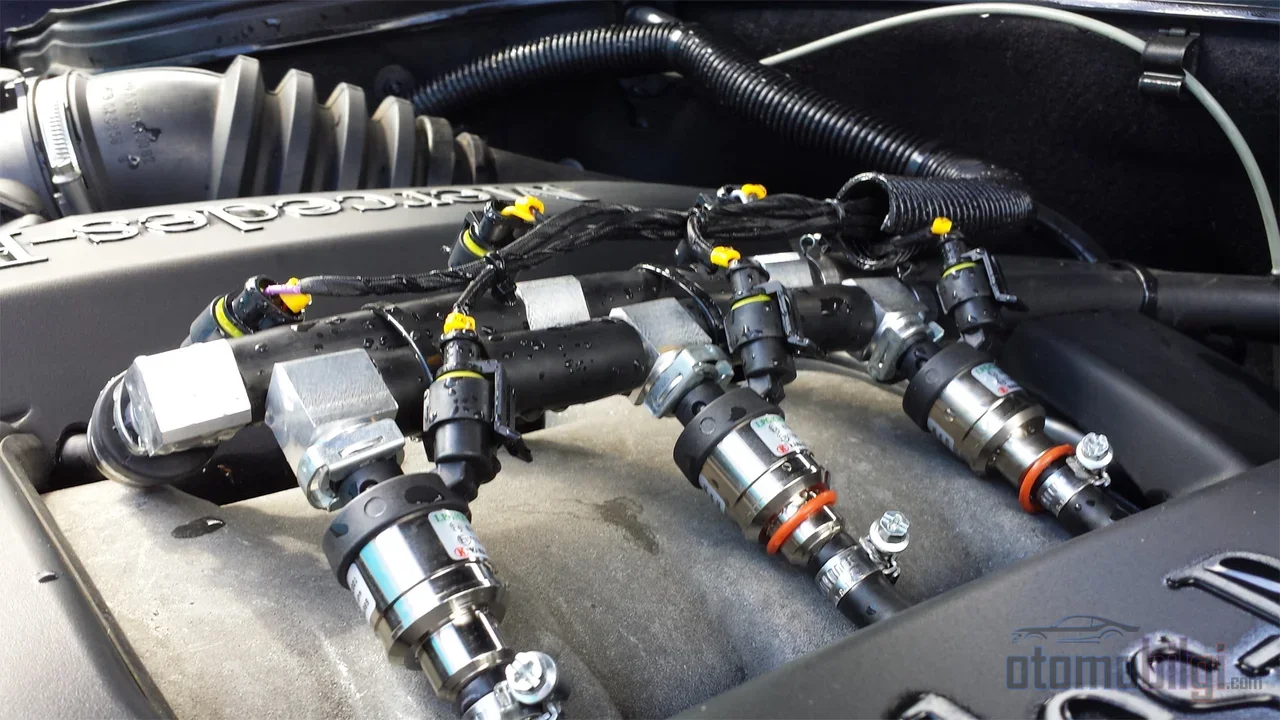
Net savings says the figure written into the denominator of the formula must be net, not gross. The added maintenance items on an LPG vehicle are: filter replacement at 40,000–60,000 km, a general system check every two years, and an LPG tank test every ten years. The annual average of all of these comes to about 2,500–4,000 TL - not a serious burden alongside the savings, but not to be ignored either.
Part-by-part table looks like this: cutoff filter 100–200 TL, regulator maintenance 1,000–2,000 TL, replacement of a tank completing its tenth year 2,500–5,000 TL. A clogged filter restricts gas flow, the mixture runs lean, performance drops; therefore, keeping to the filter intervals is not an aesthetic choice but a mechanical necessity. On the spark plug side there is also a point the experts warn about: LPG does not require spark plugs with the same heat rating as gasoline; choosing LPG-compatible spark plugs after the conversion matters for engine health. Tank testing regulation is based on a 10-year service life; it is checked from the manufacturing date on the tank.
Insurance, comprehensive coverage, and inspection: the cost of an undocumented conversion
In the past, seeing an LPG line in your comprehensive policy paper was the exception; today it is a standard notification matter. Installing LPG does not automatically invalidate your existing comprehensive coverage, but the conversion must be reported to the insurance company; the notification period is usually 30 days. Insurers may refuse to pay for installations not recorded on the registration certificate; therefore, being recorded on the registration is not a paperwork formality but the payment itself at the time of a claim. The additional document insurers most frequently request is the LPG leak-proofing report. As for the effect on the comprehensive premium, no single fixed proportion applies across vehicles; the healthiest approach is to ask your company for the post-conversion premium before renewing your policy.
On the inspection side, the official requirements are clear: for vehicles with LPG or CNG modifications, the Fuel System Installation Certificate is mandatory during inspection, and the gas tank's service life is also checked. In addition to the exhaust measurement, an leak-proofing report is requested from LPG vehicles. In short, when the documents are in place, inspection passes smoothly; an inspection passed with missing documents puts you under a liability for the following year.
Second-hand value and total cost of ownership
The second-hand value effect is the part of this calculation discussed with the least numerical data. There is of course a measured difference in the market price of converted vehicles, but tying it to a single fixed rate would be misleading; compared to its gasoline counterpart, an LPG equivalent is received differently by buyers depending on the brand, system quality, and documentation status. Let us offer a method here too: compare listings of the model you are considering selling, with and without conversion, record the average price difference, and write it into your calculation as an expense item. When this difference is compared with the savings you have accumulated over its lifetime, the decision becomes clear.
In the bigger picture, the total cost of ownership framework is useful: divide the sum of fuel, maintenance, traffic insurance, comprehensive coverage, motor vehicle tax, inspection, tires, and depreciation items by your annual mileage; you get your cost per kilometer. LPG conversion moves two items in this table: fuel down, maintenance somewhat up. The decision depends on the magnitude of these two movements and your mileage. A driver doing around 20,000 km per year has a savings capacity on the order of 25,000–35,000 TL per year even after the additional maintenance share is deducted; for those whose annual mileage stays below 10,000, the same investment pays back much more slowly.
Calculating your own payback period: A five-step method
- Write down the investment cost: kit + tank + labor + removal project fee + TSE inspection fee. Don't just use the figure in the service quote; add the paperwork costs too.
- Find the savings per kilometer: Measure your consumption over 100 km in petrol mode, add 20-25% for LPG; the cost difference between the two modes is your saving per kilometer.
- Move on to annual net savings: annual kilometers × saving per km − annual extra LPG maintenance (2,500-4,000 TL).
- Divide: investment cost ÷ annual net savings. The resulting number is your payback period in months.
- Compare: compare the payback period with how long you plan to keep your vehicle; if the planned duration is well beyond the payback, the investment benefits not you but the next owner.
One final safety note: TSE-approved systems include a multi-valve, and LPG tanks are made of steel thicker than petrol tanks; a documented and compliant installation runs trouble-free for many years. The savings question is actually the same question: whoever does the job by the rules wins.
Sources
- Payback Period
- LPG Conversion Payback Period - Free Calculation
- LPG Calculation 2026 - LPG Vehicle Consumption and Cost Calculation
- LPG vs Gasoline Cost Comparison
- LPG Conversion Guide 2026: Advantages, Disadvantages
- The Cost of Owning a Car in Türkiye 2026
- 2026 LPG Removal Project Prices
- Vehicle Fuel Calculation - Cost Per Km
- LPG Vehicle Maintenance
- Does LPG Affect Comprehensive Insurance?
- Required Documents for Vehicle Inspection
- Vehicle Ownership Cost Calculation