Galvani, Destroyed in 1838: The Tragic Story of the First Electric Vehicle
Share This Page
The world's first electric locomotive came from the hands of a Scottish chemist: Robert Davidson turned his electromagnetic motor, which began working in 1837, into a full-scale machine over several years, and in September 1842 he ran his locomotive, named Galvani, on the Edinburgh–Glasgow railway. A locomotive without coal, smoke, or fire - but history also has a tragic side to it: Galvani was destroyed by people who feared the machine itself or saw it as a threat to their livelihoods, and not a single piece of the original has survived to this day.
Key Highlights
- Robert Davidson was born in Aberdeen on April 18, 1804; He tested Galvani in September 1842
- The locomotive was about 16 feet (4.9 m) long and, according to sources, weighed between 5 and 7 tons
- Test speed was approximately 4 mph (6.4 km/h); distance covered was about 1.5 miles (2.4 km)
- The locomotive was destroyed before Davidson could recover it; steam proponents are suspected as the culprits
- No physical remains of the original Galvani have survived to this day; a working motor replica is on display at a museum in Alford
Who Was Robert Davidson? An Aberdeen Chemist's Electromagnetism Hobby
Davidson was not a railway engineer. Born in Aberdeen, he was a chemist and dyer who spent nearly his entire life in the same city. He attended classes at Marischal College - today part of the University of Aberdeen - between 1819 and 1821; he funded this education himself by working as a laboratory assistant. In the 1820s, he set up his own business near the Aberdeen–Inverurie Canal: first yeast supply, then chemical production. As a side business, he also did sharpening and perfumery. This is a detail worth noting: What funded his electromagnetism hobby was the profit from synthetic yeast production.
He also designed his own chemical batteries. For someone combining chemical supply and workshop skills, this was not considered a difficult task by the standards of the era. So the first electric locomotive was not built by a locomotive workshop of the steam age, but by a yeast producer's workshop - and this is one of the most ironic details in engineering history.
How Did the Galvani Locomotive Work?
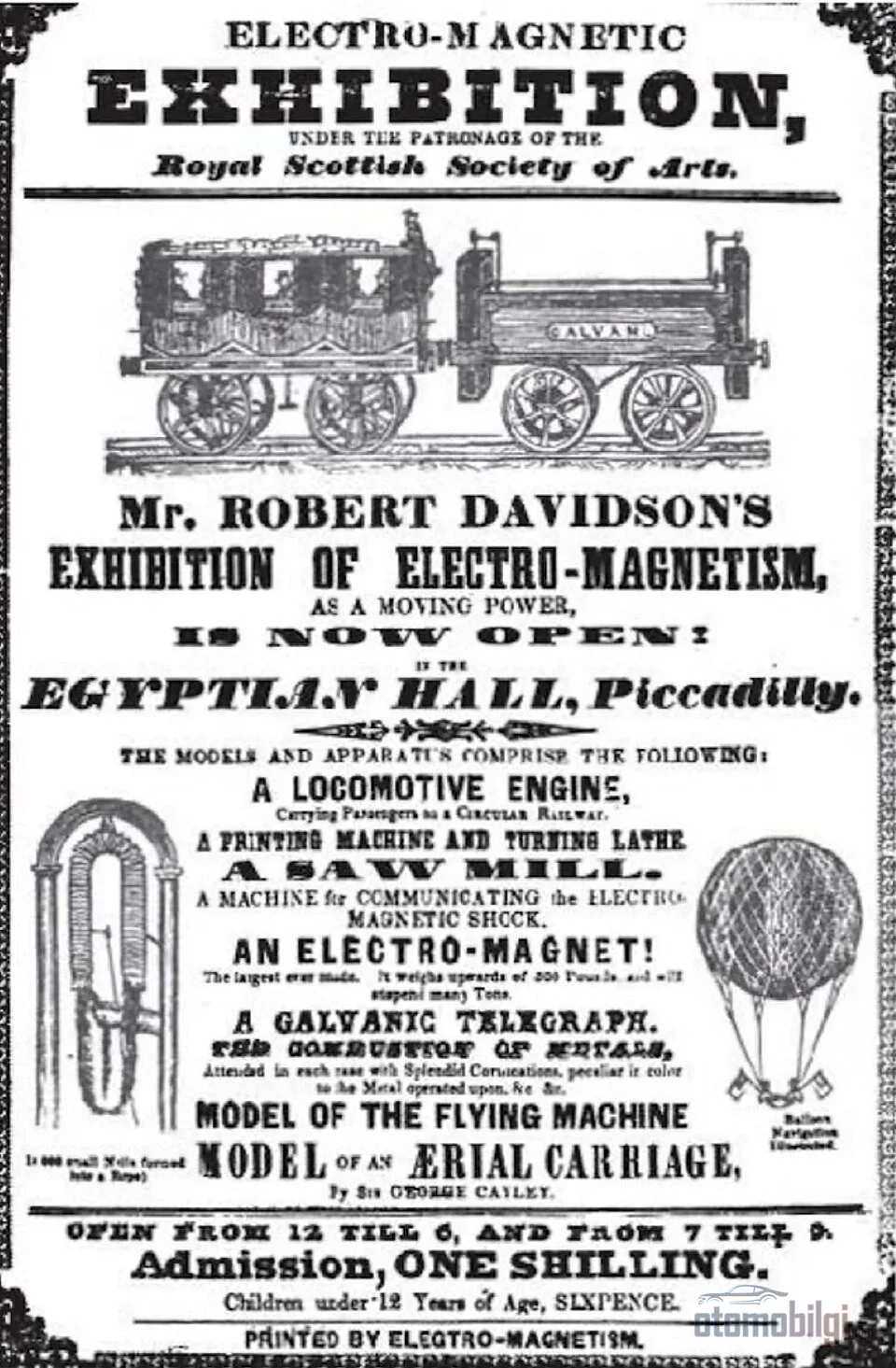
Davidson's development process progressed step by step. In 1837, he produced his first working electromagnetic motor and a model electric locomotive. In 1839, he built a four-wheeled electric vehicle, an electric lathe, and an electric printing press - that four-wheeled vehicle is counted as the earliest known electric four-wheeled vehicle. In 1840, he opened a public Electromagnetic Exhibition in Aberdeen: a model locomotive carrying two people, an electric lathe, a printing press, and an electromagnet lifting 2 tons. Thousands of people paid a shilling each to watch these; meaning Davidson's machines were working, at the invention stage, not just on paper but before the public's eyes.
The full-scale Galvani took its name from the Italian scientist Luigi Galvani, who was the first to point to the relationship between electricity and motion. The machine's working chain was the same in basic logic as today's electric vehicles:
- Galvanic battery: Primary cells using zinc plates in an acid electrolyte, producing direct current. The critical point is this: these cells could not be recharged; producing current meant consuming the zinc.
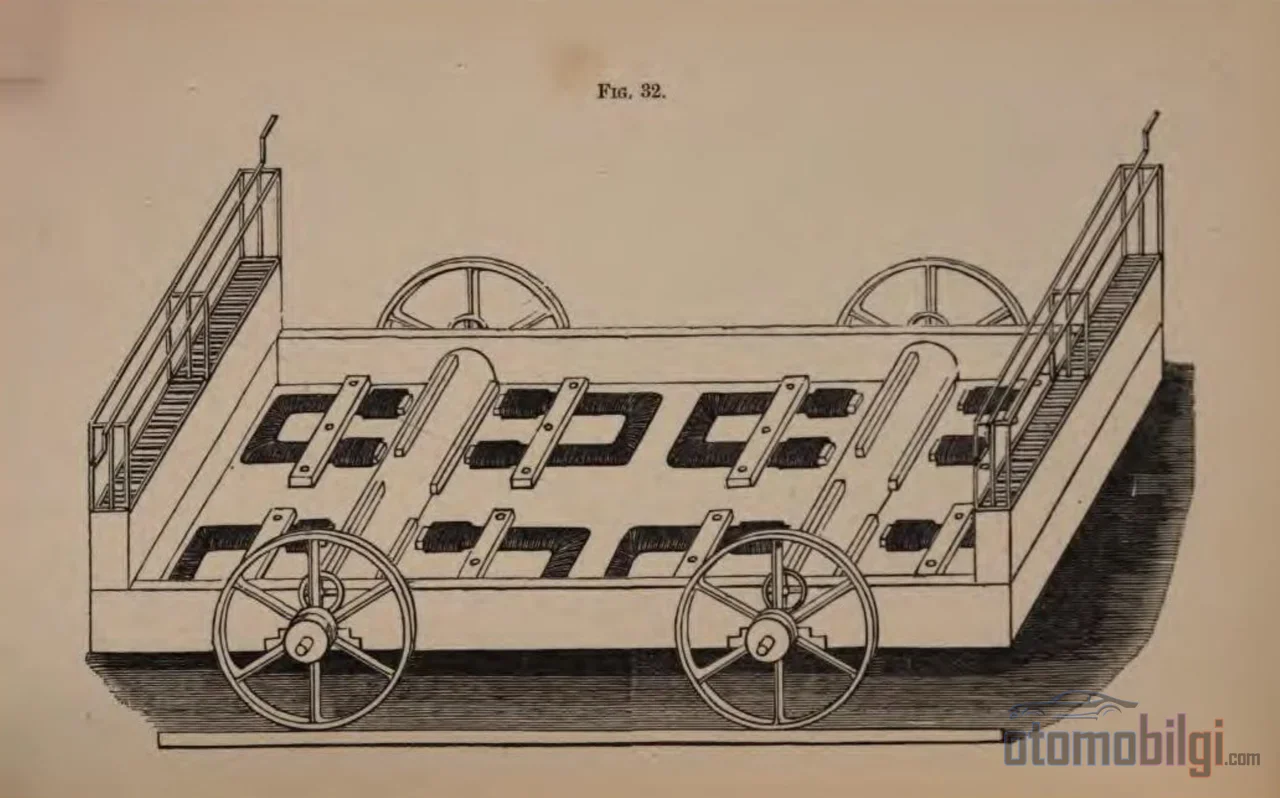
- Electromagnetic motors: Two motors, one for each axle. Electromagnets pulled iron rods fixed around a rotating wooden cylinder; a commutator cut the current at exactly the right moment, making the sequence of attraction continuous.
- Transmission: Via gears directly to the iron wheels. No fire, no coal, no steam, no smoke.
Looking at it through the eyes of a modern engineer, an interesting note is worth making: Davidson's motor was an early form of what we today call a switched reluctance motor. A principle finding renewed value in industry 180 years later shows how solid a foundation Davidson stood on.
| Feature | Value |
|---|---|
| Construction period | 1837-1841 |
| Length | Approximately 16 feet (4.9 m) |
| Weight | Between 5 and 7 tons (varies by definition) |
| Power source | Non-rechargeable galvanic (zinc-acid) cells |
| Motors | Two electromagnetic motors, one per axle |
| Test speed | Approximately 4 mph (6.4 km/h) |
| Test site | Edinburgh and Glasgow Railway |
The reason for the 5-7 ton swing in weight is that different records measured the machine against different definitions; what is certain is that the Galvani was a machine of several tons, moving at walking speed.
September 1842: The First Electric Journey on the Edinburgh-Glasgow Line
The test was conducted on the Edinburgh and Glasgow Railway. The line, Scotland's first intercity line, had only opened to passenger traffic on 21 February 1842 - meaning Davidson's trial took place seven months after the line's opening, on one of the world's most modern railways. In September 1842, the Galvani moved at approximately 4 mph over a distance of roughly 1.5 miles. The route was short, the speed low; but the concept had been proven: the wheels were turning without the need for the power of steam.
While one source says the locomotive pulled a 6-ton load over this distance, institutional accounts of Davidson's work state that the machine carried only its own weight. Whichever interpretation the measurements are taken in, the picture does not change: this was not a showpiece, but a real locomotive running on rails. The fact that British engineering institutions still describe it today as the world's first electric locomotive is not without reason.
The most striking detail was the railway management's attitude: The directors were not sufficiently impressed to carry the concept forward. The technology was expensive and of no interest to the railway companies. This assessment, as we will see in the next section, was the result of chemistry and cost analysis - not of prejudice.
The Destruction of the Galvani: Who, Why, Where?
The locomotive's end is as undocumented as its story. Galvani was likely destroyed while being stored in a locomotive shed in Perth - it was scrapped before Davidson could retrieve it. The identity of the perpetrator is unknown; but those suspected of being supporters of steam engines are among the strongest suspects.
The common narrative is that railway workers, fearing job losses, destroyed the locomotive. This interpretation is plausible: A fireless locomotive meant no stoker, no fireman, and no coal supply chain - in other words, the future of dozens of professions tied to steam was at stake. Yet it must be made clear: While workers' fear remains the traditional explanation, exactly who carried out this destruction, precisely where and when, has not been definitively documented. The only certain thing is that the machine was destroyed. As a mechanical engineer, it must be noted that in history, the physical erasure of an invention before its economic defeat is seen in very few cases; Galvani is one of them.
The Economics of Commercial Failure: Chemistry Lost, Not Engineering
The real reason that sealed Galvani's fate was not technical, but economic. The problem was not in engineering, but in chemistry: Primary galvanic cells consume zinc while producing current, zinc was expensive, and coal was cheap. Every meter of travel meant literally burning money. This equation did not close at the market prices of the day.
The claim that Galvani's cost per mile was roughly 40 times higher than a steam engine is widespread; but this figure circulates as a later summary rather than a direct document from 1842. In the same period, in Russia, Moritz von Jacobi also measured the zinc consumption of his own motors and reached the same conclusion: Electric motors were not economical due to the high price of zinc. Two independent researchers reaching the same economic conclusion makes it clear that the problem lay not in Davidson's engineering, but in the battery chemistry.
The Missing Piece: The Rechargeable Battery
Only one component was missing to make Davidson's Galvani commercially viable: a rechargeable battery. That component arrived in 1859, when the French physicist Gaston Planté invented the rechargeable lead-acid battery - that is, a full seven years later, by which time Galvani's parts had long since been scattered. The fate of electric traction was tied to the timing of a single chemical invention.
Why Was Davidson Forgotten While Siemens Was Remembered?
The official birth date of the electric railway is given as 1879 in most calendars: Werner von Siemens demonstrated his locomotive, powered by a generator and drawing current from a third rail, at the Berlin Industrial Exhibition; it pulled three wagons over a 300-meter track and carried 90,000 passengers during the four months of the exhibition. It was an impressive display - but it trailed Davidson by 37 years. The difference was not the technology, but the infrastructure and the economics: Siemens, with Planté's rechargeable battery and generator technology, made electric traction profitable; Davidson, however, had proven the concept but failed to price it. History writing, meanwhile, usually records the winner. That is why some encyclopedia entries even today show 1879 as the first successful application of electric traction and do not include Davidson's 1842 attempt in that count.
Davidson's priority was widely accepted only in 1890, when the London City & South London Railway, the world's first deep-level electric underground line, opened. The press rediscovered the 86-year-old Davidson that year as the oldest living electrician; in the electrical engineering press he was remembered with the statement that he was the first person to practically demonstrate the possibility of electric traction. Davidson, for his part, had not lost his self-confidence: He had his business cards read Father of the Electric Locomotive.
He was, in fact, part of an unprecedented pioneer generation: Thomas Davenport, a blacksmith from Vermont in the USA, received the first US electric motor patent in February 1837 and ran a model car on a short track; Moritz von Jacobi operated an electric paddle boat carrying passengers on the Neva in St Petersburg in September 1838. The Scot Robert Anderson is said to have produced a crude electric road vehicle between 1832 and 1839; however, no patent for Anderson, no contemporary reliable record, and no physical evidence of the vehicle can be found, and he is frequently confused with Davidson - both being Scots working with galvanic cells in the same decade. Anderson's priority is theoretically possible, but the level of documentation falls far short of Davidson's.
What Remained of Galvani?
Nothing. Not a single piece of the original locomotive, its motor, or its batteries has survived to this day. Davidson's house and workplace on Canal Road were demolished. He died at the age of 90 on 16 November 1894; the gravestone in St Peter's Cemetery in Aberdeen says only "chemist". The stone does not even bear the name of a single invention; this is a closing far removed from doing justice to a demolished machine.
Yet the memory was not entirely erased. The Grampian Transport Museum in the town of Alford in Aberdeenshire displays a full-size working replica of Galvani, a replica of a galvanic battery, and a model of the locomotive. A book telling Davidson's story has also been published, and his name has begun to be counted again among Scottish inventions. From an engineering standpoint, what remains is not a physical object but a measurable result: A machine that ran on rails, powered by its own battery, propelled by its own motors, and publicly validated the concept. That was a reality in 1842, and it remains a reality today.
Galvani's story is like a summary of the first century of electric transport: right engineering, wrong chemistry, and a pushed-back calendar. Davidson's motor was recognized, discussed, and exhibited in the scientific and industrial environment of its era - then physically destroyed and pushed into the archives due to its economic impracticality. Its rediscovery is somewhat ironic: Today, while thousands of battery electric vehicles roam the roads, remembering the world's first electric locomotive requires looking at a replica, a model, and a chemist's gravestone.