Why Can't F1 Cars Refuel During a Race?
Have you ever watched a pit stop and thought, "dude, these guys change four tires in two seconds, so why doesn't it occur to them to refuel?" You're right, it does seem silly at first glance. As a normal driver, finishing a 300-kilometer trip without stopping at a gas station is already hard enough; F1 cars do it at full throttle, braking fifty times a minute. So the answer isn't that they "forgot," of course. The answer lies in the story of safety, cost and engineering behind a ban introduced in the 2010 season. And believe me, this story features cars catching fire, pit stops measured in seconds, and moments when drivers couldn't bear to lift their foot off the throttle.
Why was refueling banned?
The FIA removed refueling during races entirely from the 2010 season onward. Since that day, every car starts the race with all the fuel it needs to finish; that is, you fill the tank before the race begins and fend for yourself all the way to the finish line. So why was such a radical decision made?
Two major reasons stand out. The first is driver safety: fuel-filled hoses meeting, all at once, hot brakes and a pit lane full of anything that could ignite a fire invited disaster many times over the years (we'll get to some of those incidents shortly, so brace yourself). The second is cost: for the FIA, transporting heavy refueling equipment to every Grand Prix around the world meant a serious freight burden. In short, it was a system that was both dangerous and expensive; when the two came together, its fate was sealed.
There's also an interesting technical detail: before 2010, the cars' fuel tanks were already large enough to finish a race on a single tank. For the ban to work, the cars were given permission to grow by 22 cm; that way, a larger tank could be fitted. The rule change meant a change not just on paper, but in the car's physical form as well.
Highlights
- In-race refueling was banned from the 2010 season onward on safety and cost grounds.
- Cars start the race with a maximum of 110 kg of fuel; at the finish, they must provide the FIA with a 1-liter sample.
- Fuel flow limit: 100 kg/h above 10,500 rpm; an energy-based 3000 MJ/h regulation is coming in 2026.
- Every 10 kg of fuel means a loss of about 0.3 seconds per lap.
- Pit stops that took 6-9 seconds in the refueling era have today dropped to 2-3 seconds.
What's in the tank, and how does the car finish the race?
First, let's correct the picture in people's heads: An F1 car's fuel tank is not a box like the one in a road car. It's a flexible, crush-proof bladder - a fuel cell - that is squeezed inside and inflates like a balloon. It sits behind the driver, just in front of the engine; for aerodynamics it must be as small as possible, and under the regulations its width stays below 800 mm. Before the race, the cars are prepared by the teams and no refueling takes place on the grid. If fuel is needed during practice or qualifying sessions, the car is pushed into the garage.
Under the current rule, a car can start the race with a maximum of 110 kg of fuel. And here comes the cruelest part of the rule: at the end of the race, you must hand a 1-liter fuel sample to the FIA for inspection. If you can't, you're disqualified. Sebastian Vettel experienced just how real this risk is at the 2021 Hungarian GP; when his car couldn't complete the cool-down lap, no sufficient sample could be given and the second-place podium was gone. So while playing the "tank must be completely empty at the finish line" game, even being off by a liter burns everything down.
What is the fuel flow limit?
When the turbo-hybrid era began in 2014, not only "how much fuel you carry" but also "how fast you burn it" was regulated. According to Article 5.1.5 of the regulations, the fuel the engine consumes at 10,500 rpm and above cannot exceed a maximum of 100 kg per hour. The flow sensor fitted to the car monitors this value in real time. In the rule's first year, Daniel Ricciardo was disqualified at the Australian GP for exceeding this flow limit; so the sensor doesn't joke around.
To help you grasp the scale, let's compare it with the earlier era: Before 2014, cars used about 160 kg of fuel per race, with flow rates around 170 kg per hour. In 2014 the race allowance settled at 100 kg, and today it's 110 kg; roughly a one-third jump in efficiency. Before 2014 there was no flow limit; the injection pressure limit also came later. From 2020 onward, teams have been required to run a second fuel flow sensor; the FIA keeps closing the gray areas aimed at gaming the system. In the 2026 power unit rules, the limit shifts to an energy basis: 3000 MJ/h above 10,500 rpm. Limiting fuel by the energy it contains rather than by kilograms is also a signpost on the road to sustainable fuels.
Dancing with fire: the dark moments of the refueling era
To truly understand the "why" of the ban, you need to look at the era's photographs. Fueling actually went in and out of the sport since the first championship in 1950; even Juan Manuel Fangio made a mid-race stop and won the 1957 German GP. Modern refueling strategy began in 1982, when Brabham discovered that starting with a half tank was faster. It was banned for the first time in 1984 due to safety concerns, and returned in 1994; in the era's first race with refueling, Michael Schumacher gained an advantage with his refueling strategy, even though he couldn't overtake his rival.
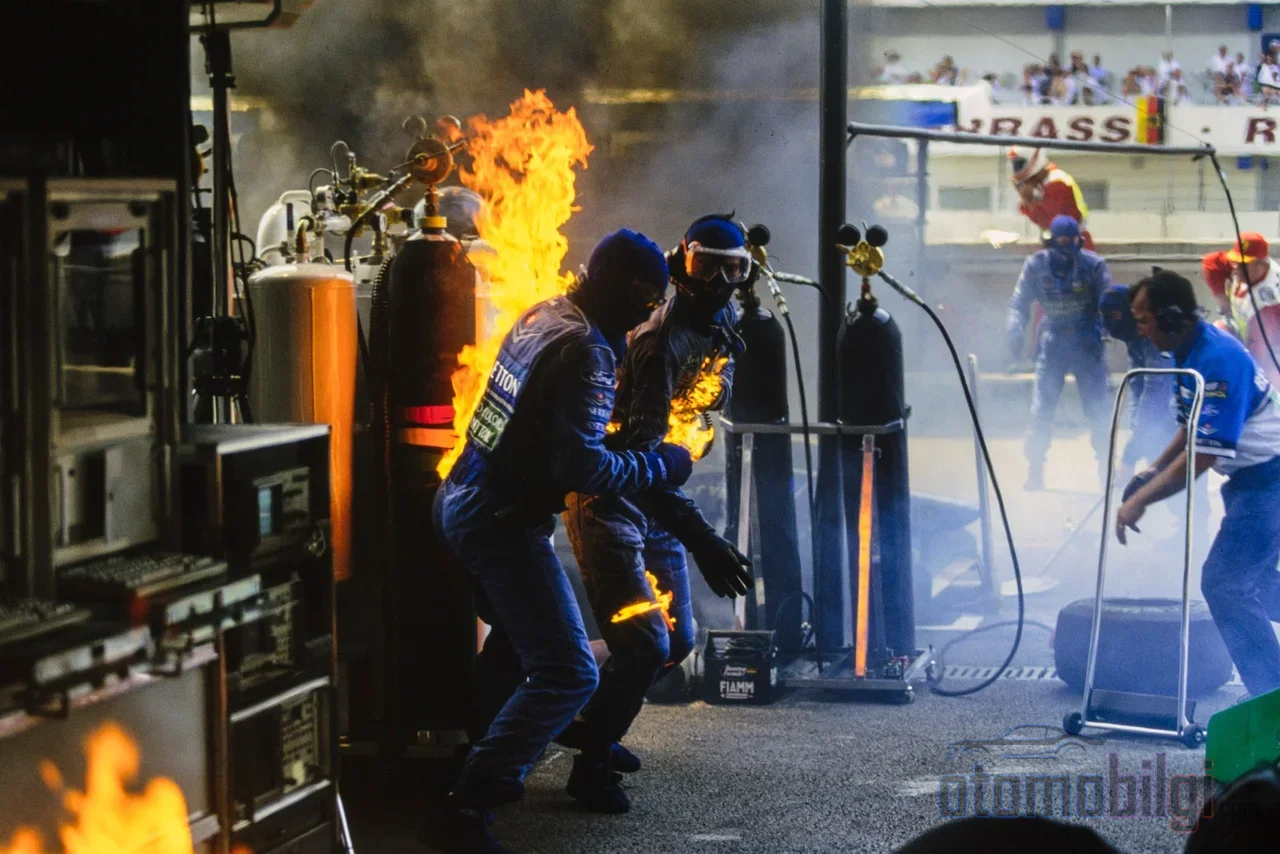
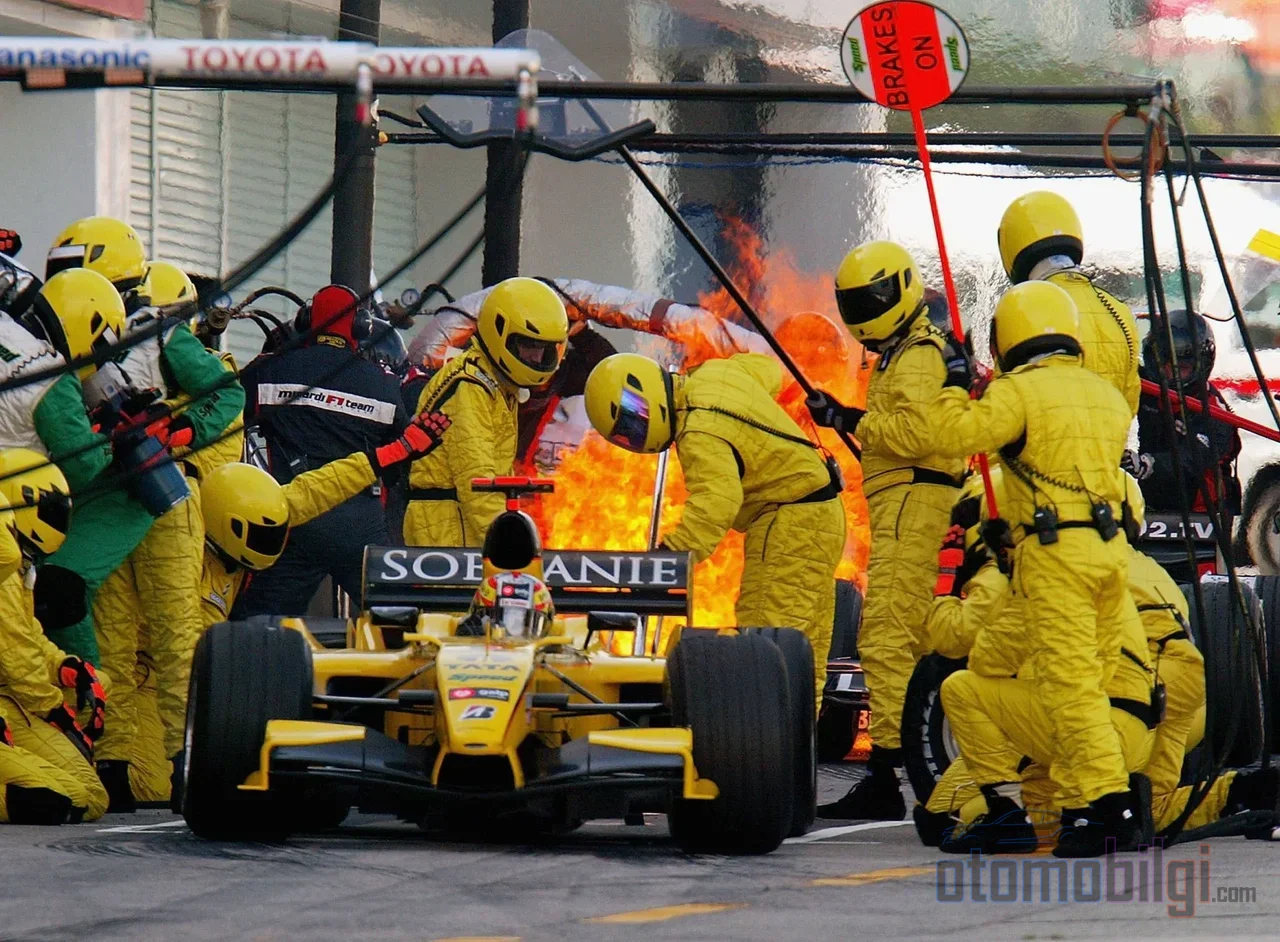
But the price of the return was heavy. At the 1994 German GP at Hockenheim, the fuel hose during Jos Verstappen's pit stop spilled petrol onto the car, which instantly turned into a fireball; Verstappen and the mechanics around him were burned. At the 2009 Brazilian GP, fuel leaking from Heikki Kovalainen's McLaren started a fire in the pit lane, and Kimi Räikkonen nearby suffered minor burns. There were also accidents where cars pulled away from the garage with the hose still attached. Every time these images played, support for the FIA's decision grew: petrol and the pit lane are not a good pair.
Kilograms and seconds: how does fuel turn into lap time?
Now let's get to the fun part, because the fuel ban turned into a completely different game. In an F1 car, every kilo isn't just speed - it's also about slowing down. According to the roughly accepted calculation, every 10 kg of extra fuel costs about 0.3 seconds per lap. Think about it: a car carrying 100 kg of fuel at the start of the race gets more than a second faster by the end, because the tank empties and the car gets lighter. The character of the same car changes between the first laps and the last laps of a race.
That's why strategists set the pre-race fuel target very carefully. Too much fuel = unnecessary weight and slow lap times. Too little fuel = the risk of not finishing the race or not being able to provide that famous 1-liter sample. If a safety car comes out, fuel is saved for free and everyone is happy; but in a full-throttle race, "lift and coast" comes into play. We'll get to that shortly.
The picture changed in qualifying too. During the refueling era, teams could play games by refueling race fuel later in order to run light laps in qualifying; after the ban, race fuel was fixed from the start, so those games were gone. The goal in qualifying is now a single flying lap: start light, do one lap. Strategists can even take the risk of loading only enough fuel for a single quick lap in qualifying; if the lap is deleted or traffic strikes, the driver drops further back than expected.
Lift and coast: how do drivers manage fuel?
In simple terms, it means "lift the throttle and coast": before a heavy braking zone, the driver releases the throttle earlier than the normal point and lets the car glide on engine braking and aerodynamic drag all the way to the braking point. Lewis Hamilton summed it up with the example he gave when explaining the technique: on a fuel-saving lap, you lift off the throttle two hundred meters before the braking point and coast. With the throttle closed for several hundred meters, the fuel really adds up.
A numerical example would be more concrete: in technical analyses, a driver who lifts off the throttle 120 meters before the nominal point in a corner saves fuel worth about 2.2% of the lap while losing only 0.080 seconds. As you can see, the time-cost efficiency is incredible; that's why lift and coast is considered the most effective way to save fuel with minimal loss of time. Some drivers even use this technique not just for fuel, but to cool the engine as well.
There's also a psychological side to it: in F1, while the driver lifts off full throttle to start saving, in series like Formula 2 everyone can go full throttle. Why? Because in F1 fuel is limited and part of the strategy; saving fuel isn't weakness - it's speed. Another interesting point from Michelin's strategy analysis: strategy isn't just about restrictions; some teams may even prefer to burn fuel quickly at the start of the race so the car's mass drops early and lap times improve sooner. Fuel load is a variable you can play with.
How did pit stops turn into a two-second show?
The most visible result of the ban happened in the pit lane. In the refuelling era, a pit stop used to take 6-9 seconds; because you had to wait for fuel to be pumped into the tank. Once refuelling was scrapped, stops became purely about tire changes, and today teams are doing 2-3 second stops, with the best perhaps dipping below 2 seconds. The pit stop stopped being a maintenance break and turned into an arena of competition where every millisecond is fought for.
Its effect on strategy is mixed. In the refuelling era, drivers had the freedom to pit early or late depending on how the race was unfolding; the strategic range was wider. Today the options are narrower, and tire-change stops are somewhat less decisive in strategy. That is why there have always been those who advocate the return of refuelling: Romain Grosjean believed cars, 60-70 kg lighter, would be easier on the tires; Lewis Hamilton also wanted refuelling to return to balance the effect of increasing car weight on the tires. But the opposing side carries more weight: the safety risk, the FIA's logistics costs, and F1's sustainability and carbon-neutral goals keep the door to a return practically locked. A modern F1 car already weighs 745 kg; while cars grow heavier every season, not dancing with fuel at least keeps the pit lane safe.
For those curious: refuelling is still a living tradition. In series such as IndyCar, NASCAR and WEC, fuel is taken during pit stops; in MotoGP and other formula series, as in F1, there is none. F1 made its decision once and for now appears determined not to go back.
The short answer: Why can't fuel be added during an F1 race?
Here is the summary of the summary: Citing safety and cost reasons, the FIA has banned in-race refuelling since 2010; every car starts the race with a maximum of 110 kg of fuel that it must make last, manages its fuel within a 100 kg/h flow limit, and drivers save fuel with lift and coast when needed. So the secret of those two-second pit stops is that the fuel hose never enters them. Next time you watch the mechanics swarm over the car in the pit lane, know this: the price of that spectacle being fast is the driver knowing how to fill the tank from the start and how to lift off the throttle. Not a bad trade, right?
Sources
- Why do F1 cars not refuel during a race?
- Why don't F1 cars refuel during pitstops?
- Why Can't F1 Cars Refuel During a Race?
- Refuelling in Formula 1: History and Safety
- Why Was Refuelling Banned In F1? | F1 Explained
- Analysis: Why the FIA has acted on fuel-flow rates
- Technical analysis: the science of fuel-flow sensors in F1