How Do Flags, the Safety Car and Race Control Work in F1?
Share This Page
In F1, flags, the safety car and race control are the set of rules that manage hazards and interruptions on track: each flag type signals a different level of danger, the race director and stewards run the session, the safety car and virtual safety car slow the race down in a controlled way, and the red flag stops the race entirely. In other words, behind every yellow flag, every "SC" board and every penalty decision you see on TV, there is a separate procedure.
Highlights
- 10 different flag types signal danger, slowing down and behavior on track
- The safety car compresses the field, the virtual safety car preserves the track order
- After drive-through and stop-go penalties are announced, they 2 laps must be served within
- Under a red flag, cars enter the pit lane; teams that stop in the pit can change tires
- A driver who ignores the third blue flag warning receives a penalty
It happens while watching a race: suddenly "VSC" appears in the corner of the screen, the commentator gets excited, the strategy expert says "now is the time to pit," and you sit there thinking "but nobody crashed, what happened now?" That's exactly what this article is here to solve. Grab a cold soda and let us explain: in F1, while 20 cars race on track, a second race is actually running alongside - the management of the race.
What Do the Flags Mean? A One-By-One Translation of Every Flag
Flags are an old but still very much alive language of F1. When the trackside marshals wave them, they carry short messages that drivers understand within seconds at the wheel. On modern circuits, these flags are supplemented by digital light panels - especially at night races and in moments of changing weather, messages are clearly conveyed through these panels. But the flag is still the foundation of the language. Here is what you will encounter:
- Green flag: Track is clear, full throttle allowed. Shown during the formation lap, in practice, or after an incident under a yellow flag.
- Single yellow flag: There is danger on the track or at its edge. Reduce speed, overtaking is prohibited, be ready to change direction. You must prove you have genuinely slowed down in the relevant sectors.
- Double yellow flag: Something serious - the track is blocked or marshals are working on it. Slow down significantly, be prepared to stop. In practice and qualifying, a meaningful lap time attempt is prohibited, and the lap is canceled.
- Red-and-yellow striped flag: There is a slippery substance such as oil on the track, grip has dropped. Shown stationary.
- White flag: There is a much slower car ahead of you. Also seen in practice during grid start practice.
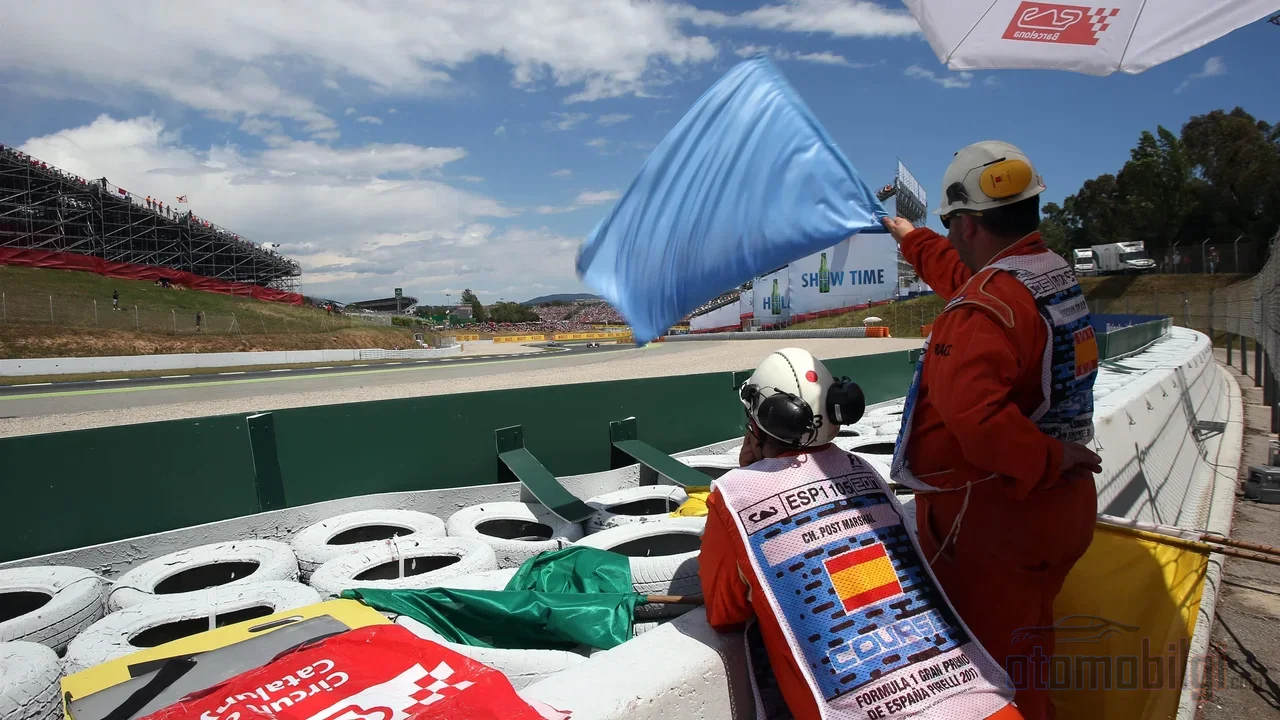
- Blue flag: In practice, it means a faster car is approaching from behind. In the race, it is shown to a driver who has been lapped, and that car must let the faster one through. Ignoring the third warning brings a penalty.
- Black-and-white cross flag: An official warning for unsportsmanlike conduct. It is not a penalty, but a message that you are on the edge of one.
- Black flag with orange disc: Your car has a mechanical problem that is dangerous for others. You must return to the pit. If the problem is fixed, the race director may allow you to rejoin the race.
- Black flag: Disqualified. Return to the garage. Given by the stewards and truly rare in F1.
- Checkered flag: The end of the session or race. It is waved from above the pit wall and keeps waving until all competing cars have reached it.
To these, add the abbreviations you see on the screens. The race director or clerk of the course can impose a single uniform speed limit across the entire track in a double-yellow-flag situation: an "FCY" board or 60 km/h limit indicated by "Code 60" (purple flag with white circle), a "VSC" board if a variable limit is required, or a "SLOW" board if only certain sectors need to slow down. So the flags do not work alone; they work together with this digital layer.
Who Makes the Decisions? The Role of Race Control and the Stewards
The decision chain behind a race weekend is built on two main actors: the race director and the stewards. The race director is appointed by the FIA for each race and is responsible for the overall management of the weekend - even whether the red flag is waved falls within their authority. They remain in constant contact with the officials at race control and the clerk of the course; the FIA describes this mechanism as a process extending "from the monitor wall in race control to the final decision in the stewards' room."
The stewards form the judicial side of the event: they check compliance with the regulations, investigate track incidents, hear drivers and teams, and can hand down penalties ranging from a warning to disqualification. You can think of it a bit like a court - an incident happens, it is investigated, the parties are heard, and a decision is reached. Red flag deployment belongs to the race director, penalty decisions to the stewards; once you know this distinction, you also understand who is deciding what on your screen.
What Does the Safety Car Do and Why Can It Ruin (or Win) a Race?
When there is a crash and the debris needs to be cleared, instead of closing the track completely, the race is neutralized: the Safety Car comes out and all competing cars circulate behind it. The purpose is to allow the marshals to work safely on the track - a translation of a statement from Mercedes' safety car team summarizes this nicely:
The safety car ensures the safety of the marshals around the track; this is its greatest benefit.
While the safety car is deployed, large white boards reading "SC" are displayed at all flag points, the yellow flag is waved, and yellow flag rules apply across the track - overtaking is completely forbidden. When the safety car returns to the pit, the green flag is shown at the start line and then at all flag points for one lap; cars cannot overtake before crossing the start/finish line. Let's also clarify the difference from the red flag: the safety car slows the race but the cars remain on the track; the red flag stops the session completely.
Strategic Impact: Who Wins, Who Burns?
Here is where things get brutally unfair. Because the safety car compresses the entire field to a single speed, the differences between cars evaporate and the order physically bunches up. For a driver who has opened a gap at the front, the SC coming out can turn into an advantage, even a rescue. Quite the opposite, a driver who pits one lap before the SC comes out can have their race ruined - plain logic: changing your tires before pit entry is normally an advantage, but if you did it while everyone was slowing down, you just gave away time for free. Pitting under yellow flags or the SC can also reduce the time lost under normal conditions; because of the strategists, these moments are memorized like a calendar.
How Does the Virtual Safety Car (VSC) Work?
The VSC is the electronic twin of the safety car: there is no physical car on the track, but a simultaneous delta (lap time difference) limit is imposed on every car. On the screen on the steering wheel, the driver sees how close their own lap time is to the targeted minimum time, and this delta is updated every 50 meters . In other words, the driver sees in real time the calculation of "how much do I need to slow down, how far behind am I, how much throttle can I apply". During the VSC, at all flag points a "VSC" sign is displayed and on light panels the word "VSC" appears in a yellow frame; drivers must stay below the minimum time set by race control in every marshalling sector.
Overtaking is also forbidden under the VSC - exceptions are only for cars entering the pits or slowing down due to an obvious problem. The most critical tactical detail is this: approximately 10-15 seconds before the VSC ends, before the green flag is waved, teams are notified through the official messaging system. Teams know this window, and pitting at exactly that moment means gaining serious time with a VSC stop. To summarize the strategic difference between the SC and the VSC:
| Feature | Safety Car (SC) | Virtual Safety Car (VSC) |
|---|---|---|
| Physical car | Present, roams at the head of the field | Absent, entirely electronic |
| Effect on the order | Erases gaps, compresses the order | Largely preserves the track order |
| Overtaking | Completely forbidden | Forbidden (exception for cars pitting/slowing down) |
| Strategic impact | Very large | Moderate, depends on the delta calculation |
When Is the Red Flag Waved and What Happens?
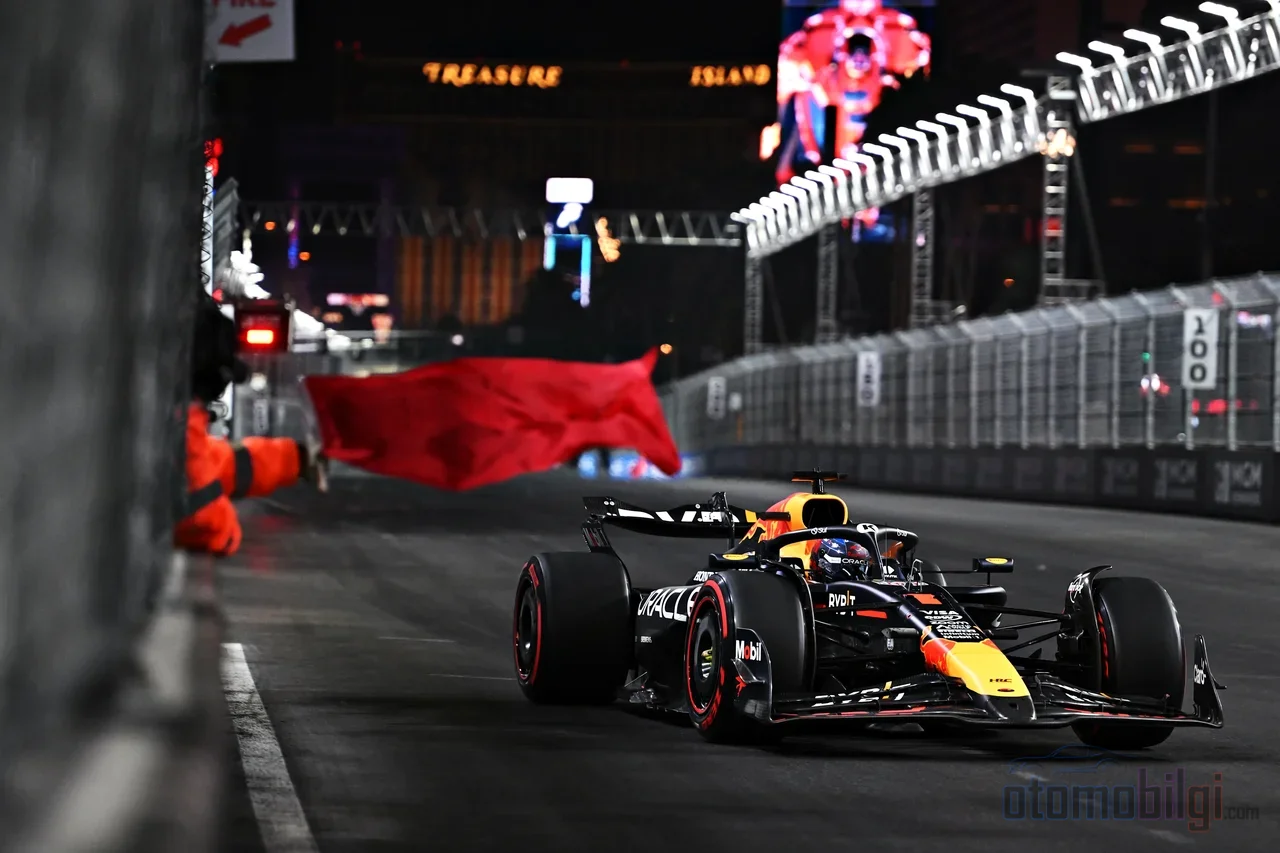
The red flag is the race director's decision to stop the session entirely. It is waved at the start line and at every marshalling point. The reasons generally fall into two categories: a serious crash or bad weather conditions. The decision resting on the director's discretion is also why red-flagged races can become a subject of debate - the "should there have been a red there, was the SC enough" argument is a classic in the grandstands.
The stopping procedure depends on the session type. During practice and qualifying, drivers slow down and return to their garages. In a race, however, cars slow down and enter the pit lane, line up at the exit, and wait for instructions. A strategic door also opens here: while the race is stopped in the pit lane, teams can change tires, and this change counts toward the normal rule counter. In other words, a red flag arriving at the right moment means a free pit stop - the next time there's an interruption, you'll now know who to watch taking advantage of it.
How Does the Penalty System Work?
If the stewards decide to penalize an incident, the range extends from a warning (reprimand) to disqualification. The most common penalties you'll see during a race are drive-through (passing through the pit lane) and stop-go (stopping in the pit lane) penalties; a driver who receives one must serve the penalty within two laps after the team has been notified of the stewards' decision. License points, on the other hand, are not automatically given with every sporting penalty - the stewards decide whether or not an incident warrants points.
And of course, there's the inevitable question: "Why are the stewards always so inconsistent?" To support decision-making consistency, the FIA publishes steward guidelines titled "Driving Standards & Penalties," and these guidelines aim to provide stewards with support for fair and consistent decision-making - the updated version was announced on March 6, 2026. Still, since every on-track incident occurs under different conditions, the guidelines naturally cannot fit every decision into a single mold - which guarantees the debates will never end. Among the updates added to the 2026 Sporting Regulations, the race director can also widen the maximum gap between cars in low-visibility conditions - meaning the rules are a living document, polished every season.
Now You'll Understand It In Front of the Screen Too
From now on, when watching a race and "VSC" appears in the corner of your screen, you will think of the delta window; at a yellow flag, the pit plan; at a red flag, a free tire change. F1's real excitement isn't just 300 km/h speeds; it's the fact that this decision-making machinery behind the scenes is working second by second. Next time there's an interruption, don't let the commentator talk - you do the talking.
Sources
- The beginner's guide to F1 flags
- Racing flags
- Safety car
- INSIGHT: Understanding F1 Safety Cars
- Updated FIA Stewards Guidelines for Driving Standards & Penalties
- FIA 2026 F1 Regulations - Section B [Sporting] Iss 05
- F1 Stewards: Who are they, what do they do & how are they chosen
- Who Decides Penalties and How They Make Their Decisions
- Exclusive: What goes on inside Formula 1's race control room
- Who Really Controls FORMULA 1? Inside the FIA's Power and Controversy
- List of red-flagged Formula One races
- F1 Red Flag Rules and Restarts Explained
- Safety Car & VSC Explained
- The beginner's guide to F1 penalties
- F1 penalty points explained
- Understanding Yellow Flags Strategy and Safety Car Deployments