What Do Rallycross Pit Crews Do Between Races?
Share This Page
In rallycross, pit crews complete tire changes, mechanical checks, damage repairs, and fuel-and-cooling work in a very limited time during the short intervals between heats, semi-finals, and finals. There is no pit stop planned minutes in advance like in F1, nor a long service interval like in WRC; here everything runs fast, practical, and often by feel. So the real unsung heroes of the race work in the pit lane, out of the camera's sight.
Highlights
- In the World RX format, 4 qualifying heats, semi-finals, and a final are run within a single day; the car must be ready again between every round.
- RX1 Supercar cars produce approximately 570-600 hp of power and 840-920 Nm of torque; these machines are maintained by small crews.
- While four tires are changed in about 2 seconds in F1, there is no time to spare in a rallycross pit; the work must be finished by the start of the next heat.
- Drivers and cars must be in the pre-grid area at least 6 minutes before the scheduled start of the semi-finals and finals.
- The 2025 season finals were held in Türkiye on September 20-21 at TOSFED Istanbul Park.
Why Does the Rallycross Format Push Pit Crews So Hard?
To understand rallycross pit work, you first need to look at the format, because that is where the truly grueling part is hidden. A World Rallycross Championship event lasts two days, and the track is a closed, short circuit mixing asphalt and gravel. During the day, four qualifying heats are run first; in each heat, three to five cars compete in short battles over four laps, one of which is the mandatory Joker Lap. Then the 12 highest-scoring names advance to the semi-finals; in each semi-final, six cars run six laps, and the top three of each series move on to the final. The final is also a six-lap duel with six cars.
Now think of this from the mechanics' perspective: on the same day, the car will enter four separate qualifying heats, and perhaps the semi-final and the final. Each time a heat ends and the car returns to the pit lane, there is a checklist you must go through before the next outing. What's more, before the semi-finals and finals, a strict rule awaits you: the driver and the car must be in the pre-grid area at least 6 minutes before the scheduled start. So your pit window is not that wide; you are racing against the clock in reverse.
On top of that, add the car's character. In the RX1 Supercar class, 2.0-liter turbocharged four-cylinder engines run with a 45 mm intake restrictor and produce approximately 570-600 hp of power and 840-920 Nm of torque. Unrestricted, this engine has a potential of around 1,000 hp. Power goes to all four wheels through a six-speed sequential gearbox, and the car weighs about 1,300 kg. In other words, each outing you are accounting for a machine pushed to its limits, filled with vibration and shock. In 2022, the top category switched entirely to the electric RX1e, with two electric motors delivering a total of 680 hp and instant torque of 880 Nm; In 2024, however, internal combustion vehicles running on sustainable fuel returned to the stage. Whether it's the electric one or its diesel sibling, the pace of the pit team never changes.
What Actually Happens in the Pit Lane Between Races?
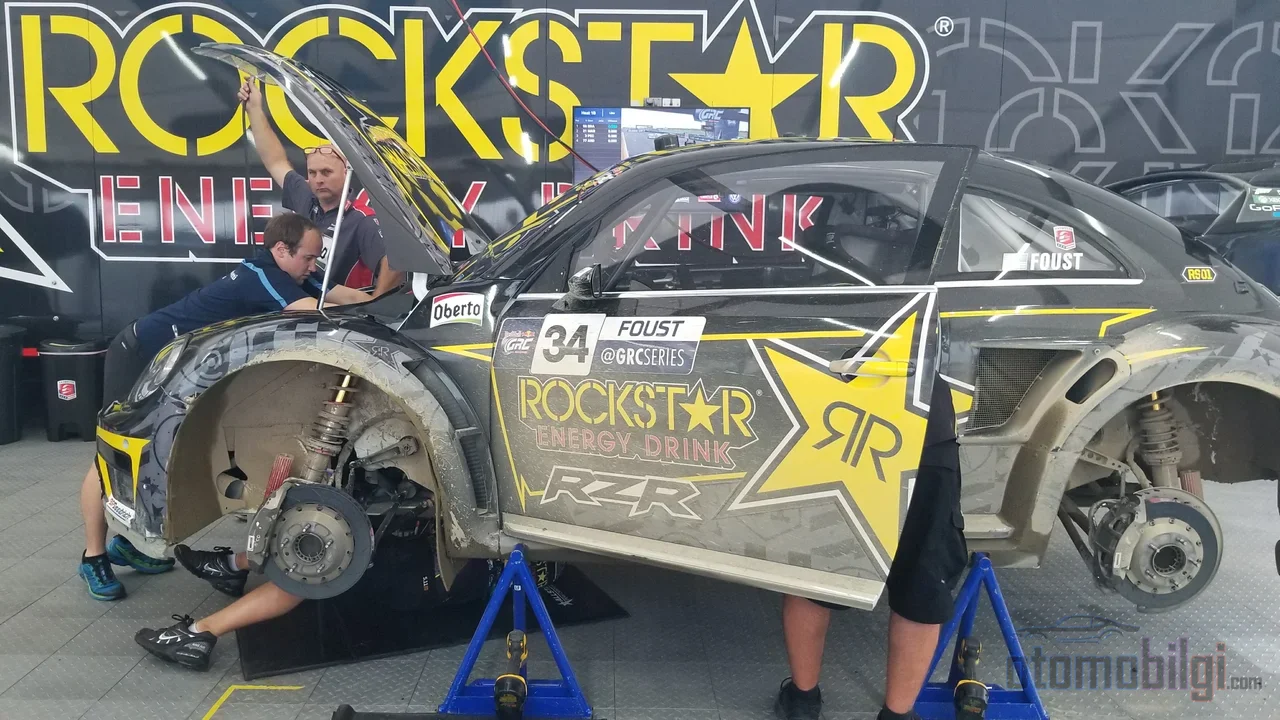
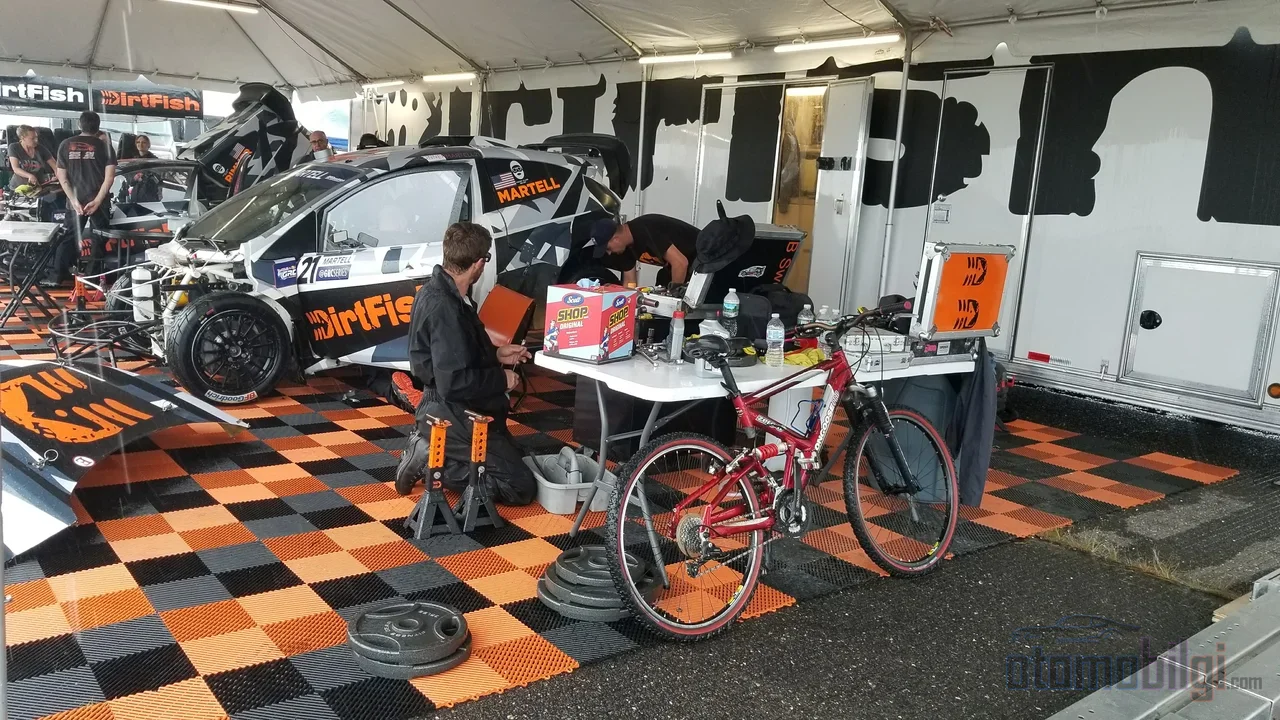
While the driver relaxes in their seat between series, the clock runs in reverse in the pit lane. First the car enters its pit spot, the team immediately swarms around it, and the work flows like a checklist. What gets done during this short break that the camera doesn't capture is roughly as follows:
- Tire inspection and replacement: Tires mixed with gravel wear out without mercy; pressure and wear are checked, and if necessary the team replaces the tires.
- Transmission and suspension check: The sequential gearbox and suspension components are tested with knocking and impact loads on every run; linkages, control arms, and load-bearing parts are reviewed.
- Damage repair: In rallycross, the first corner is never taken contact-free; any area with a collision, brush, or barrier contact is quickly repaired or saved with a temporary fix.
- Cooling and general check: Fluid levels and the cooling side are checked; in electric vehicles, the battery and electrical systems are monitored.
- The driver's report: As soon as the driver gets out, they describe what they felt; if an adjustment is needed, corrections are made with simple and quick interventions.
Here's what you need to pay attention to: in rallycross, there is no standardized, timed ritual for pit work. Each team solves the job differently according to its own budget and crew. While big factory teams have dedicated specialists, in small teams the same two or three people change the tires, take on fuel, and talk to headquarters on the phone all at once. That's why the length of the pit window means something different for every team: the goal is for the car to be "raceable" before the start of the next series. The time isn't fixed, but the goal is.
Cooling and Fuel: The Two Most Critical Jobs in the Pit
One of the most discussed technical topics in the pits for rallycross cars is the cooling setup. One of the most striking differences in RX Supercars is that the radiator is mounted at the rear; a different approach from WRC cars. This is a vital choice, both for weight distribution and in a category where gravel and dust pile up at the front. In the pits, the team pays special attention to this rear cooling line and its channels; a pile of gravel or a dent can be enough to make temperatures climb for the entire series.
The fuel side likewise relies on practical ingenuity. Instead of a rule-bound, standardized refueling procedure like in circuit racing, in rallycross the job proceeds according to the time available and the team's equipment. If the fuel is out or running low, it's quickly topped up during the short break; because what awaits you in the next series isn't lap count, but intensity per lap. In rallycross, the car launches flat out with a bang every lap, and extra planning for the Joker Lap tactic is a bonus. That's why in the pits there's no recipe like "this task in this many seconds"; everything takes shape according to the needs of the next run.
F1's 2 Seconds, WRC's Service Park, Rallycross's Practice
Comparing pit work with other motorsports shows most clearly just how different an animal rallycross is. In Formula 1, modern teams change four tires in about 2 seconds, and more than 20 mechanics are assigned to the job. In NASCAR, the car is lifted with a hydraulic jack at the pit stop, and the tire changers wait ready with the lug nuts and tires. So there, the matter is dividing seconds; in rallycross, it is dividing the minutes into the right tasks.
| Discipline | The Character of Pit Work | Team Structure |
|---|---|---|
| Formula 1 | Four tires changed in about 2 seconds, the pit stop is planned in advance | A typical pit stop involves more than 20 mechanics |
| NASCAR | The car is lifted with a hydraulic jack, the tire change is central | Specialized tire changers dedicated to each task |
| Rally (WRC) | Limited repairs in the service park; under the Super Rally rule, a maximum of 4 hours of repair time to continue | Service crews organized around the service truck |
| Rallycross | Short breaks between heats with flexible content; the goal is preparation for the next run | Usually small, multi-tasking crews and mobile workshops |
The rally side is also an interesting point of comparison. In WRC, the driver is largely alone on the stage, and maintenance can only be done in the service park; what's more, there are restrictions even there - if there is structural damage, you cannot repair it by welding. Rallycross, on the other hand, stands somewhere between circuit racing and rally: you can touch the car after every heat, but you do it not with a massive pit crew as in circuit racing, but with rally's mobile workshop culture. The service truck tradition is already strong in motorsports; rally teams' service trucks work practically as workshops on wheels, and even in extreme conditions like the Dakar, mobile workshop support is provided to customer teams. Rallycross teams manage pitless life with a compact version of the same logic: a small mobile workshop set up beside the car, spare parts crates, and a few pairs of hands handling a dozen jobs at once.
The Line Between Driver and Engineer: What Really Matters in the Pit
As much as the physical work on the pit lane, the conversation happening there is also critical. In the rally world, communication is described as one of the most critical elements of a performance engineer's job; the right information needs to be conveyed clearly, in the right amount, between driver and engineer. In race engineering education as well, communication is considered one of the key skills of a race engineer; establishing a communication style with the driver can directly affect performance.
Translating this to rallycross, the situation is as follows: as soon as the driver exits the pit, they have to describe what they felt in the heat in the simplest and clearest language. Was the steering strange, did the rear end slide on the gravel, did the gear shifts get harsher? The engineer or team chief listens to this information while at the same time looking at the tire condition, the fluids, and their watch. In small teams, this dialogue sometimes runs over the phone with another technical person back at base; meaning the two people in the pit are making decisions together with a third mind far away. This is where the driver's trust in the team comes into play: understanding what the car is doing, setting up in-race communication correctly, and blindly believing the decision given in the pit may be the most important part of making the right choice in a short window. Do you think a driver can describe exactly how the car feels in 20 seconds? Well, in rallycross, that test is done between every single heat.
Pit Realities on the Türkiye Stage
This pit culture also had a living stage in Türkiye: The finals of the 2025 FIA World Rallycross Championship season were run at TOSFED İstanbul Park as a double-header weekend on September 20-21, 2025. So the world's toughest rallycross teams prepared their cars at the same tempo on İstanbul's pit lane as well. Minister Bak's visit to İstanbul Park, where he received information from officials about the circuit's modernization works and drove on the track with national athletes, also showed official interest in this scene in Türkiye.
You should also know the current picture: the championship's organizational structure has changed, and the FIA announced that it is charting a new path for rallycross from 2026 onward. The newly announced FIA Rallycross World Cup format features 8-car semi-finals and finals, two mandatory Joker Laps in every race, and a Superpole leg. This is a detail that makes the pit team recalculate: more crowded semi-finals and two Joker Laps also affect the load on the car and the job list between pits. On the 2026 European championship side, Johan Kristoffersson leads Euro RX1 with 235 points; behind him come Juha Rytkönen with 175 and Andreas Bakkerud with 171 points.
If the Camera Doesn't See, Nobody Will Know
To summarize the pit story of rallycross: in this discipline, pit work is not a show, it is a survival reflex. There are no F1 seconds watched by millions, nor WRC's long service windows; instead, there are small crews, engineers communicating by phone, and mobile workshops. The next time you watch a race, in the empty minutes on screen between heats, keep this in mind: on the pit lane, while the camera isn't looking, a few people are running to save the next heat. The real second half of the race takes place there, where we cannot see.
Sources
- FIA World Rallycross Championship
- FIA Rallycross Championships | Official Website
- The FIA Rallycross World Cup Sporting Format is revealed
- Supplementary Regulations
- Rear cooling in RX Supercars - WRCWings
- What Happens at Service Park - ŠKODA Motorsport
- A Workshop on Wheels: ŠKODA Motorsport Service Truck
- A typical day of a rally performance engineer - Hyundai Motorsport
- Race Engineering Communications - The MIA
- Synergy on the Track - Eurocup3
- Biggest Differences Between Rally And Circuit Racing - Jalopnik
- Rally-raid, rallycross, WRC: Differences - Red Bull
- Rallycross Stars Gather at TOSFED Istanbul Park for the Double Final - TOSFED
- World Rallycross Championship 2025 Istanbul - Red Bull TR
- The new Reiger Service Truck at Rallye Dakar