Safety in Rallycross: What Happens When 600-Horsepower Cars Collide Side by Side?
Share This Page
Safety in rallycross is a layered system built around 600-horsepower Supercars that race in contact with each other: roll cage, multi-point harnesses, energy-absorbing barriers and the federation's post-crash inspection processes all work together. That is exactly what sets it apart from classic rally: here, cars are designed against side-by-side collisions.
Highlights
- 350 N/mm² minimum yield strength steel is the fundamental requirement for roll cage tubes
- The main rollbar legs of the roll cage are attached to the body with at least 3 M8 bolts and 120 cm² of reinforcement plate
- Every seat mounting point must withstand a force of 15000 N in every direction
- Skipping the joker lap: in the generic lap, +30 seconds penalty, last row in the final and zero points
- September 20-21, 2025 the double final of the FIA World and European Rallycross Championships was held at Istanbul Park
Why Is Rallycross a Different Safety Problem from Classic Rally?
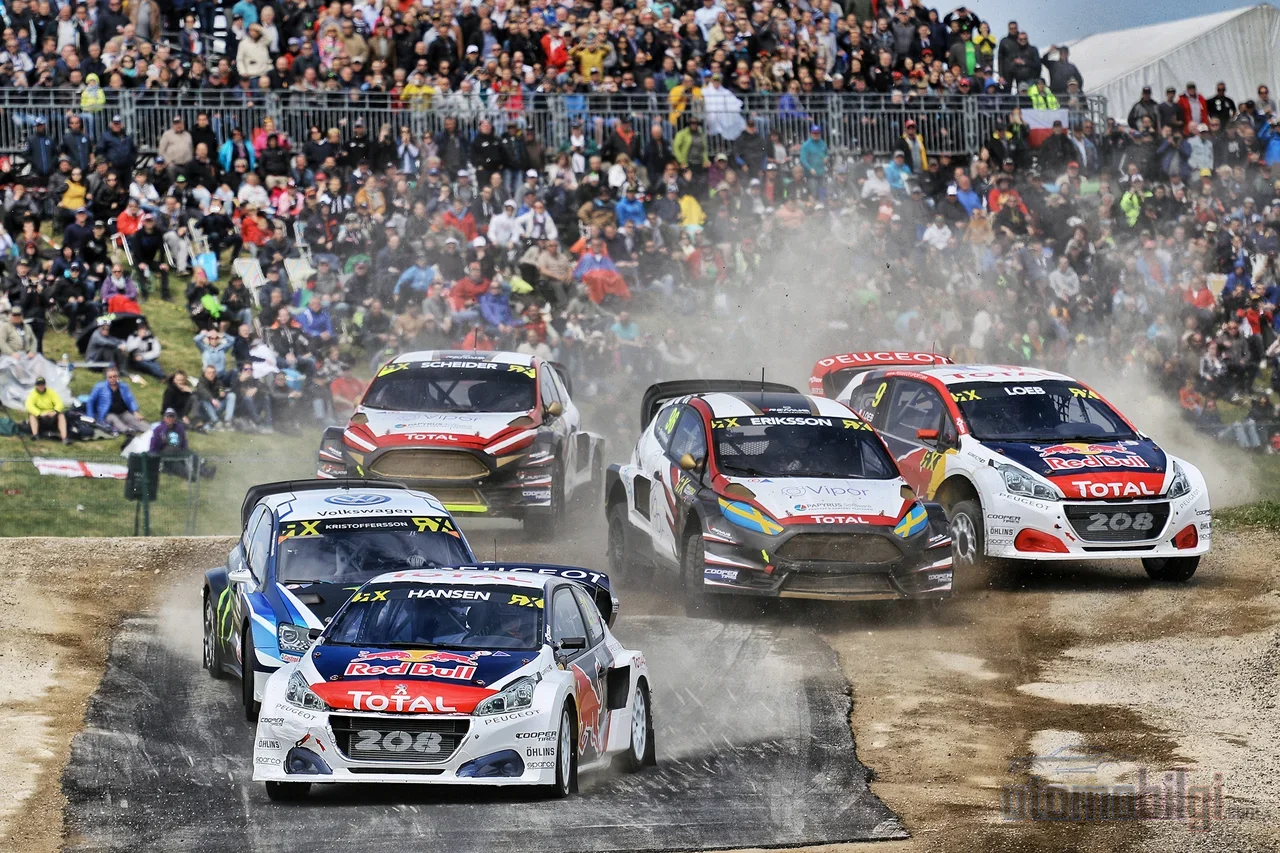
In classic rally, the car races against the clock alone on a closed road. There is no other car ahead, so the risk of contact mainly concerns the surroundings: trees, barriers, hillside edges. In rallycross, the picture is entirely different. On a closed circuit, on a track made of a mix of asphalt and dirt, cars start at the same time and complete laps battling wheel to wheel. When the intensity of circuit racing combines with the power of a rally car, that crazy thing called contact racing emerges: here, a collision is not an exception but a possibility inherent in the very nature of the discipline.
Now imagine: six or more Supercars moving at the same time, entering the first corner side by side. In this scenario, the concept of safety has to learn from two worlds at once. The roll cage, seat and harness culture that comes from rallying; the barriers and run-off areas that come from circuit racing. The synthesis of the two is the real story of rallycross safety. The sources do not spell out this synthesis one by one, but when you look at the regulations, the logic is clearly visible.
How Does a Roll Cage Work: The Hidden Skeleton Inside the Car
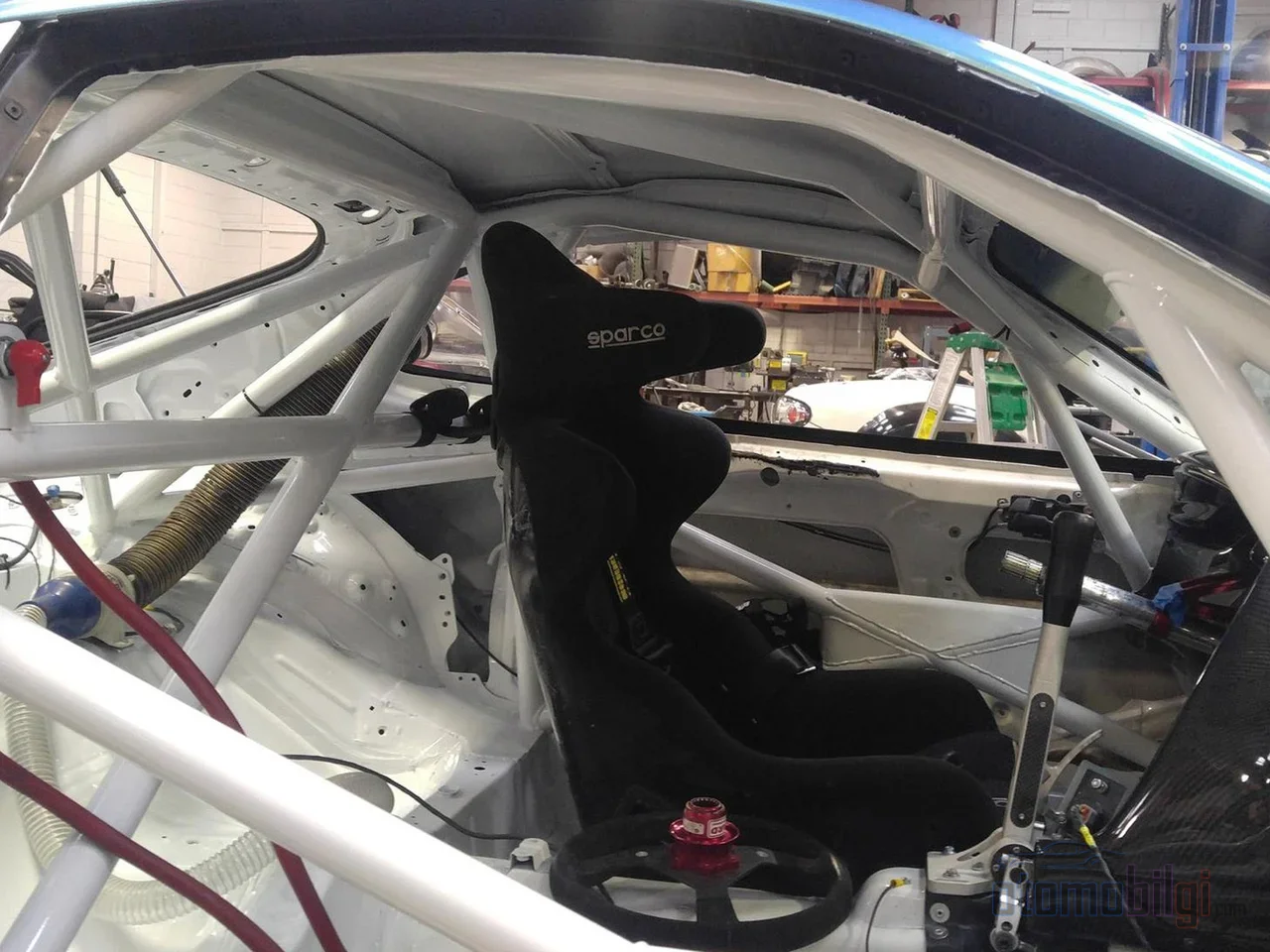
When you look at a rallycross car, you see its body, but the real hero is the skeleton woven from tubes inside: the roll cage, that is, the rollover cage. Its job is to seriously prevent the body from deforming in the event of a collision or a rollover. You could think of it as if a second car is being built around the driver.
The regulations here are incredibly detail-oriented. The cage consists of a main rollbar, a front rollbar or lateral rollbars on both sides, connecting elements, at least one diagonal element and support legs called backstays. There is zero flexibility on materials: cold-drawn, seamless unalloyed carbon steel must be used, and the carbon content must be at most 0.3% with a minimum yield strength of 350 N/mm². The tube size must be either 45x2.5 mm or 50x2.0 mm . Aluminum alloy cages are completely forbidden.
My favorite detail is this: each main rollbar leg, with at least 3 M8 bolts and a minimum of 120 cm² is fixed to the body with a surface-mounted steel reinforcement plate. The backstays attach close to the roof and form an angle of at least 30° with the vertical. There is also fine-tuning: the cage needs to be rigid enough against impact, but flexible enough to distribute energy away from the driver. In other words, it is not a completely rigid box, but a deliberate engineering balance. In addition, it is recommended that pipes near the driver's head, within 150 mm, be covered with energy-absorbing, flame-retardant material - imagine a layer acting as a cushion in the moment your helmet hits the pipe.
Seat and Harnesses: The System That Locks You into the Car
If the cage creates the survival cell, the seat and harnesses fix you right in the middle of it. Racing seats are attached to the chassis with bolts of at least 8 mm diameter, from at least 4 mounting points. And the numbers are dazzling: each mounting point must withstand 15000 N of force in every direction. Quick-release systems can withstand up to 18000 N. So the chance of being separated from your seat in a crash is very low in a properly installed system.
Harnesses come in 3, 4, 5 and 6 point versions. A six-point harness creates a total of six attachment points with two shoulder straps, one lap belt and two leg straps; it distributes the load across the shoulders and pelvis, and doesn't pile the pressure of a collision onto a single point. FIA homologation is mandatory at international events; current standard harnesses can be used for 5 years after the label year. There is also a rule most beginners skip: a harness that has been in a serious accident must be discarded because it has stretched; those exposed to oil, acid or heat are also replaced. Think of the harness as a single-use safety item.
The real trick is this: safety is not the miracle of a 6-point harness alone. It's the cage, seat, harness and fire suppression system being installed as a whole, with correct geometry. It's like a chain - if one link is weak, the whole chain is weak.
The Joker Lap: Where Tactics Meet Collision Risk
The joker lap, unique to rallycross, is an extra section of track; the driver is required to pass through it at least once during the race (twice in the new format). It's tactically brilliant: do you pass in front of your rival, or wait behind the pack? But there's also a reality on the safety side: the point where the joker lap merges with the main track is one of the places with the highest collision risk. Vehicles at different speeds intersecting at the same point creates a moment as critical as a pit exit in circuit racing.
The penalty for a rule violation is also clear. If you skip the joker lap in a qualifying heat, you get a +30 second penalty; if you skip it in the semi-final or final, you drop to last place and your points are reset. In the new format introduced with current regulations, 8-car semi-finals and finals, two mandatory Joker Laps per race and the Superpole format stand out. In other words, as the number of cars increases, the track gets more crowded, the merge points become riskier, and the safety systems become all the more important.
Barriers and Track Design: The Track Itself Is a Safety Device
Inside the car, protection ends, but it continues along the edge of the track. Barrier technology has gone through a long evolution: from hay bales to Armco guardrails, and from there to tire barriers. Today's standards are the result: tire walls, earth-backed arrangements, concrete barriers, and multi-row guardrail systems are used together.
Why are tire barriers so popular? One of the FIA's safety bulletins gives a clear answer: tire barriers absorb the vehicle's energy during a collision and significantly reduce the severity of the crash. The physics is very simple: as the stopping distance gets longer, the force on the body decreases. Instead of hitting a metal wall at 300 km/h, the difference is hitting a wall that deforms and absorbs energy at a lower speed. The same logic applies to the SAFER-type barriers used in circuit racing: the metal surface deforms, and the foam behind it absorbs the impact force. Soft wall technology places an energy cushion in front of the hard obstacle.
On rallycross tracks, the asphalt-dirt mix adds another variable: grip and braking distances change on different surfaces, so transition points must be carefully designed. Good news for those who want to see this first-hand in Türkiye: September 20-21, 2025, TOSFED hosted the double final of the FIA World and European Rallycross Championships at Istanbul Park. The event, with a concept pitting electric vehicles against gasoline-powered ones, lasted two days on a half-asphalt, half-dirt course.
What Are the Federations Doing: Rules, Tests and Post-Crash Review
Safety is not just about metal and rubber; the rules on paper and the process after a crash are also part of the system. The FIA publishes comprehensive guides for rally safety; the aim of the current guide is to improve safety and especially to increase spectator protection. The approach of FIA safety delegates can be summed up as: in rallying, wait for the unexpected. Think through every scenario in advance and make a plan.
The test methodology is serious business too. The FIA applies numerous static tests on chassis; additional tests are carried out on front, side and rear impact structures. The purpose of these tests is to base how the vehicle reacts to specific forces on measurement, not on manufacturer claims. The same rigor extends to equipment: fire suppression systems must comply with specific FIA standards, the trigger link that activates the system 25 g must withstand deceleration of, and the external trigger point must be marked with a red E symbol on a white background. Safety fuel cells are also subject to standards; homologation 5 years expires after, and can be extended by 2 years with manufacturer inspection.
The process doesn't end after the accidents either. The FIA conducts reviews of serious accidents and issues statements when necessary; in incidents touching on spectator safety, investigations can come to the agenda. On the rallycross side, examples illustrate the nature of the discipline: Liam Doran's 2016 flip crash, Reinis Nitišs' dramatic escapes, and car-to-car contacts in finals. They all send the same message: a crash scenario from contact is always on the table in racing, which is why the system is designed accordingly at every layer.
What Should You Pay Attention to When Watching the Next One?
Next time you watch rallycross, turn your attention not just to the collision but to its surroundings: where the tire walls are stacked, the braking zones before the joker lap merge, and how the roll cage holds up when a car flips. The real story of safety lies not in the crash itself, but in those invisible details standing before and after it. And honestly, the fact that a sport where 600-horsepower cars collide side by side sees so few serious injuries is the truly surprising part.
Sources
- Motorsport UK Common Regulations for Competitors: Safety (K) 2022
- FIA Rally Safety Guidelines 2025
- 2026 FIA RX Sporting Regulations
- FIA Safety Bulletin 41 - Tyre barriers
- Safety in the WRC: How a roll cage works
- What you need to know about Rallycross
- Peugeot Sport - Rallycross Explained
- TOSFED - Rallycross Stars at Istanbul Park for the Double Final
- SportsCar Feature: Racetrack Barriers
- SAFER barrier
- Liam Doran's Crash From Hell 2016
- Breaking the barriers of safety