Rallycross Guide: Joker Lap, Contact Racing and the Secret of Champions
Share This Page
Rallycross is a sprint-style motorsport where several cars start side by side on a short track alternating between asphalt and gravel, with each race lasting only a few minutes. Think about it: in the WRC, drivers hammer through stages alone for hours, while in rallycross everyone races at the same time, in the same dust cloud, just 5 centimeters apart. In short, it is the wildest meeting point of rallying and circuit racing.
Highlights
- The first rallycross race was held in 1967 at the Lydden Hill circuit in England was held
- Every driver in every race must complete a joker lap once; this route on average costs 2-3 seconds loses
- RX1 Supercars with ~570-600 hp complete 0-97 km/h in under 2 seconds - faster than F1!
- Johan Kristoffersson 7 times became World Rallycross Champion
- The 2024 World Championship final at Istanbul Park was held
What is rallycross and how does it differ from the WRC?
Let me give an everyday comparison: if the WRC is a marathon run, rallycross is a 60-meter hurdles race. A WRC rally typically consists of 15-25 special stages and up to 350 kilometers of racing against the clock on closed roads; drivers run one by one on the stage, racing against time. In rallycross, each race lasts a few minutes and the cars start in groups - meaning you are truly battling each other.
The track is also a hybrid monster: part asphalt, part gravel, plus tight corners and surface transitions. You are on gravel right now, and two seconds later you need to brake on asphalt. That is why rallycross drivers develop incredible braking, avoidance and panic management skills. The first races were held in 1967 at the Lydden Hill circuit in England; afterwards the European Championship was founded and the FIA World Rallycross Championship (World RX) started in 2014.
So how does a race weekend work? In the old World RX format, an event lasted two days: 4 Heat series, 2 Semi-Finals and a Final. In the heats, each car races over 4 laps with 3-5 cars starting side by side, and the fastest total race time determines the winner. After the heats, the 12 drivers with the most points advance to the semi-finals; the semi-finals and final are run over 6 laps each with 6 cars each, and the top 3 from each semi-final advance to the final. So in the finals, everything is decided in a single day, even in a few minutes. This intensity is the magic of rallycross.
What is the joker lap and how does it turn strategy upside down?
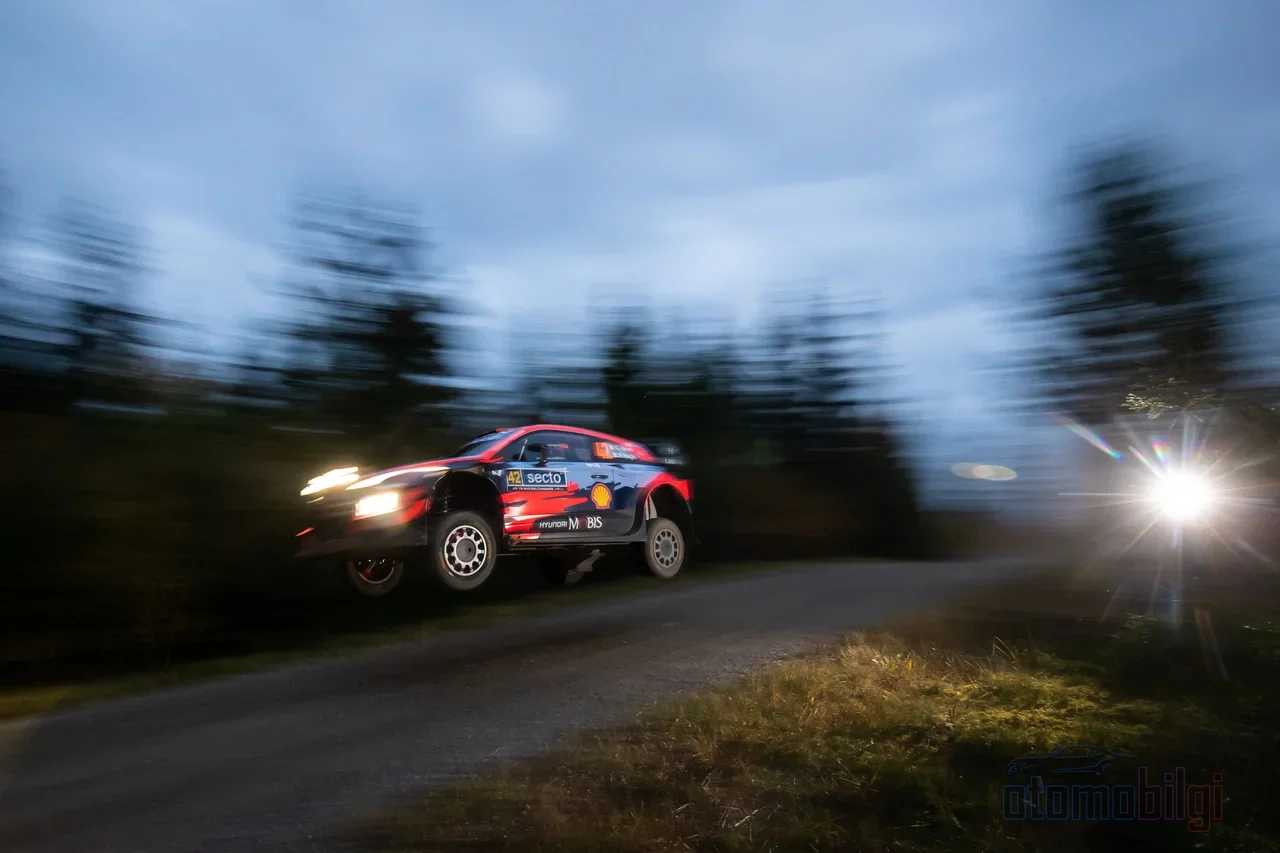
Now let's get to the heart of the matter, because the joker lap is the heart of this sport. Every driver, in every race, must once pass through an alternative section that branches off the track's main route. This joker route adds on average 2-3 seconds to the lap time. Why does it exist? Because it means everyone has to slow down once, giving cars caught in the pack a chance to overtake - otherwise the leading car escapes and the race turns into an ordinary follow-the-leader session.
The real beauty is in the strategy: whenever you take your joker changes its effect on the whole race. If you're leading, you save the joker for the end, trying to minimize the 2-3 seconds you lose on an empty track. If you're stuck in the pack or trapped behind a slow rival, you take the joker early and recover in clean air. The spotter in the tower radios the driver about the situation; on some tracks the joker section can even count as an opportunity. So the same track, the same cars, but every race is a different chessboard. In my opinion this is the smartest rule design in motorsport.
So what happens if you break the rule? Short and clear:
- If you start the race with a false start: the penalty is two joker laps
- Two false starts: disqualification
- If you skip the joker lap in the heats: penalty + 30 seconds
- If you skip it in the semi-final or final: last place and zero points
One more current note: In the FIA Rallycross World Cup format announced for 2026, things have changed a bit - semi-finals and finals are run with 8 cars, there are two mandatory joker laps per race, and a new Superpole format has been introduced. The first event is on December 5-6 in Jakarta, Indonesia. So those doing joker math will now carry two jokers in their pocket.
Supercar technology: is the faster launch than F1 real?
Short answer: on launch, yes. RX1 Supercar class cars use 2.0-liter turbocharged 4-cylinder engines with about 570-600 hp of power; torque is around 840-920 Nm . Despite the 45 mm intake restrictor and boost values of 3.4 bar, the engine actually has an unrestricted capacity of ~1,000 hp / 1,500 Nm. Add all-wheel drive, a Sadev 6-speed sequential gearbox, launch control and a weight of ~1,300 kg including the driver, and here's the result: 0-97 km/h (0-60 mph) in under 2 seconds. So a faster launch than an F1 car - everyone gets a shock in the first 50 meters of the track.
The electric side is no slouch either. RX1e produces a combined 680 hp and 880 Nm of instant torque with two electric motors; 0-97 km/h in 1.8 seconds. The lower categories are as follows: RX2 (Supercar Lites) with a 2.4-liter naturally aspirated engine at 310-320 hp; RX2e with two motors at 335 hp / 510 Nm; and RX3 with a 1.6-liter naturally aspirated engine, 220-250 hp, front-wheel drive and a ~4.5-second 0-97 km/h. For the curious: electric rallycross cars like the FC1-X offer a peak of 1,000+ hp and 0-60 mph in 1.5 seconds, with acceleration up to 3G. You could call it a rocket seat.
There's also the issue of turbo lag: these cars use an anti-lag system to keep the turbo from dying when revs drop; they recycle exhaust gases to keep the turbo on boost. That famous "bang bang" sound coming out of corners comes from exactly this. If I had to make an analogy, they keep the turbo constantly on alert, like a guard who never sleeps.
Legendary names: from Solberg to Kristoffersson
The stars of this sport are also legendary. Petter Solberg, the 2003 WRC world champion - the Norwegian who narrowly passed Sébastien Loeb by one point (saying Michael Loeb would be wrong) - switched to rallycross in 2013 and the first World RX champion in 2014 . Reaching the top in one discipline, then switching to another and sitting at the top again... You can't help but respect that. In 2017 he raced for the same team as his young rival Johan Kristoffersson, which can also be read as a challenge to young talent.
But the true king of rallycross is Johan Kristoffersson. He became champion in 2017, 2018, 2020, 2021, 2022, 2023, 2024 and 2025 - an eight-time world champion, the record holder in this discipline. What's more, he took his most recent title and the teams' championship with Kristoffersson Motorsport. He also leads the World RX podium standings by a wide margin: Kristoffersson 64, Timmy Hansen 49, Petter Solberg and Andreas Bakkerud 30 each, Mattias Ekström with 27 podiums. On the car front, the most wins belong to the VW Polo: 50 wins; followed by the Peugeot 208 (21), Audi S1 (16), Citroën DS3 (9), Hyundai i20 (7) and Ford Fiesta (6).
The rallycross situation in Türkiye: Istanbul on the world stage
Here's some good news for you: rallycross has long been present in Türkiye. The final round of the 2024 FIA World Rallycross Championship, the "World RX of Türkiye", was held on 9-10 November 2024 at Istanbul Racing Circuit, organized by TOSFED. A year later, on 20-21 September 2025, the World and European Rallycross Championships were contested with a double round at TOSFED Istanbul Park, and both the 2025 world and European champions were decided in Istanbul. In other words, the fastest rallycross drivers in the world raced in the country you live in - assuming you didn't miss it.
What's more, this isn't just a one-off visit: the Türkiye Rallycross Championship is on TOSFED's 2026 National Competition Calendar, and the final of the 2026 Türkiye Rallycross Championship will be held on 28-29 November 2026 . So if you want to go to the track and watch this fiery format live, there's a date on the calendar.
Meanwhile, let's not skip the big picture: the FIA World Rallycross Championship was cancelled in 2025 and, for the 2026 season, was replaced by the FIA European Rallycross Championship and the new FIA Rallycross World Cup format. The discipline's top level is being reshaped - before the dust rises on the track, no one knows the winner; let's just add that the format itself is changing just as fast.
Frequently asked questions: when to take the joker, what's the penalty?
Let me quickly clarify the three questions I get asked most:
- When should the joker lap be taken? If you're leading, save it for the end and enjoy the clear-track advantage; if you're in the pack, take it early to get into clean air. In the sim racing community too, "save it for the end to pass a rival who can't be overtaken on joker-heavy tracks" is a popular approach.
- What happens if I skip the joker? In the heats: a penalty plus 30 seconds; in the semi-final or final: last place and zero points. In other words, no forgetting!
- Is a rallycross car faster than an F1 car? Not on the straights, but yes in the first 60 meters: RX1 Supercars do 0-97 km/h in under 2 seconds, while the RX1e does it in 1.8 seconds.
So, electric or petrol? In the World RX top series, everything went fully electric with RX1e in August 2022, but in 2024 internal combustion cars running on sustainable fuels returned alongside RX1e; RX2e was discontinued at the end of 2024. In 2025, three championships were contested: World RX (RX1e + RX1), Euro RX1, and Euro RX3. So the technology story is still being written - both sides know how to put on a show on track.
Let me leave you with a question: if it were you, would you save the joker for the final corner or take it on the first lap? I know my answer, but you go first - see you on track!
Sources
- RALLYCROSS EXPLAINED | Peugeot Sport - Stellantis Media
- FIA World Rallycross Championship - Wikipedia
- New 2026 FIA RX Sporting Regulations (published 15.08.2026) - FIA
- FIA Rallycross World Cup Sporting Format announcement - FIA Rallycross Instagram
- Petter Solberg - Wikipedia
- World Rally Champion Petter Solberg - wrc.com
- Solberg and Kristoffersson team up for 2017 World RX campaign - FIA
- Rallycross categories - Rallycross France
- FC1-X EV Rallycross Car - vtcar.com
- How Global Rallycross Cars Can Accelerate Faster Than Gravity - Road & Track
- How Global Rallycross cars hit 60 mph in 1.9 seconds - Motor Authority
- What you need to know about Rallycross - Red Bull Türkiye
- 2026 National Competition Calendar Announced - TOSFED
- Rallycross Stars Gather at TOSFED Istanbul Park for the Double Final - TOSFED
- World Rallycross Championship at Istanbul Racing Circuit on November 9-10 - Motorsport.com Türkiye
- 2026 Türkiye Rallycross Championship Final - sonetap.com
- Joker lap - Rallycross Wiki