Why Was the Tucker 48 Only Produced in 51 Units?
Share This Page
Why did the Tucker 48 end up with only 51 units ever made? Because Preston Tucker's dream challenged the most powerful automotive giants of the era and the strict scrutiny of the US government at the same time; an SEC investigation, a fraud trial, and a negative media campaign completely halted the company in 1949. The promised car of the future, even though it was acquitted in the very trial it faced, was never produced again.
Highlights
- Only 51 cars were produced; the company on March 3, 1949 ceased its operations
- Of these cars, 47 are still around today
- Preston Tucker was acquitted of all charges in January 1950 acquitted
- Collector values today are in the 1-2 million dollars range
I'll admit it: the Tucker 48 is for me the most frustrating "what if?" story in automotive history. Disc brakes, safety glass, the swiveling center headlight... in 1948! And on American roads, no less! But the most striking part of this story isn't the car itself, it's how it was killed. Let me tell it from the beginning, because this piece reads like the autopsy report not of a car, but of a dream.
Let's Talk About the Car First: Was It Really That Advanced for 1948?
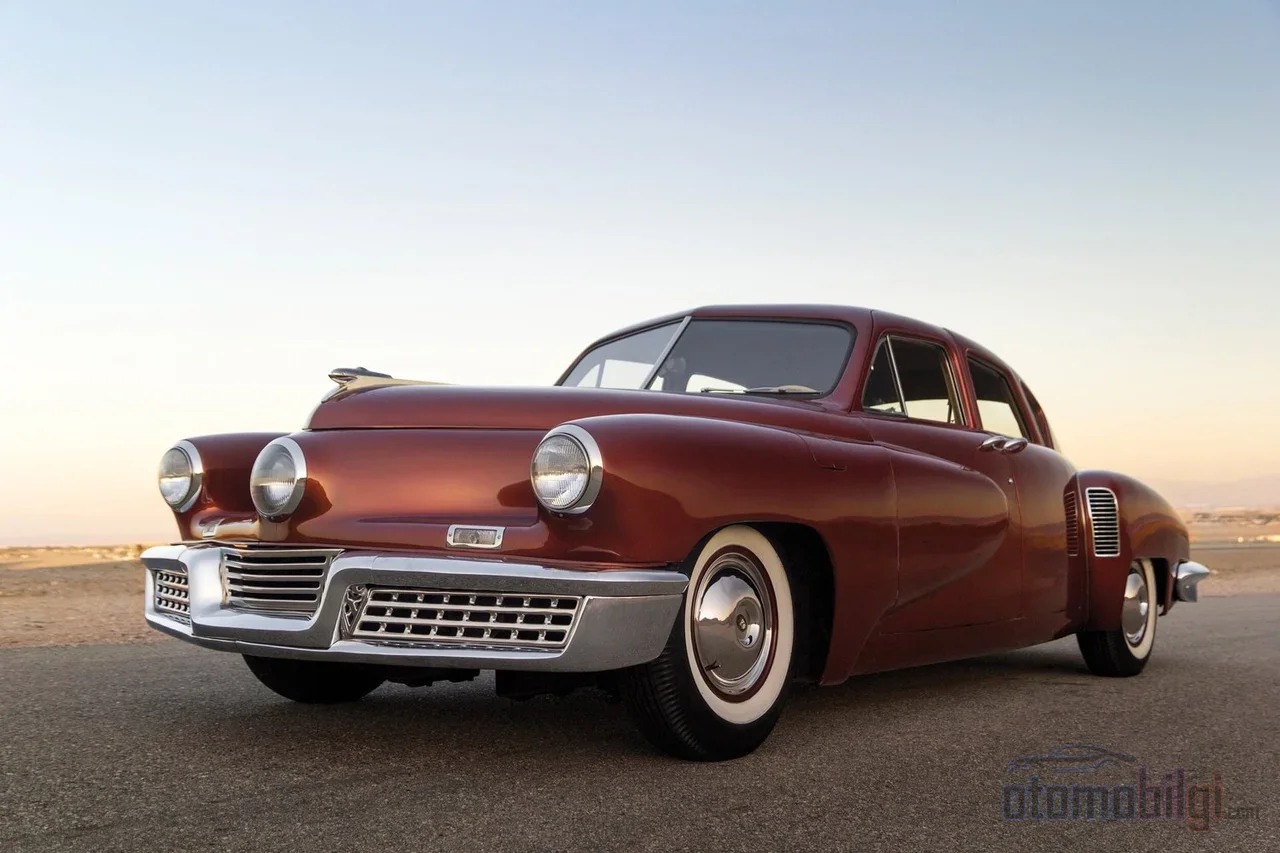
Preston Tucker first launched his car under the name "Torpedo"; it was designed in Ypsilanti, Michigan, and briefly produced in Chicago in 1948. Everyone's jaw dropped at the introduction, because what was presented didn't look like an ordinary sedan, but like a machine ready for the roads of the future. Rear-mounted engine, independent suspension on all four wheels, a 5.475-liter boxer-six engine with 166 horsepower and 372 lb-ft of torque... Those were serious numbers for the time.
But what really made the difference was the safety-focused design. Tucker's car had a reinforced "safety cell" passenger cabin; in a collision, the windshield popped out without shattering; the dashboard was padded and there was a "crash chamber" space in front where passengers could take refuge. A roof-integrated reinforcement bar, a lockable handbrake with its own separate key... As you read these, stop and think: some of the safety solutions we consider ordinary today were first tested in an experimental car exactly 78 years ago. The ideas of the padded dashboard and pop-out windshield are universally applied today - they are ideas that lived on in Tucker's mind.
| Feature | Value |
|---|---|
| Production year and count | 1948, 51 units in total (including the prototype) |
| Engine | 5.475 L boxer-6, rear-mounted, RWD |
| Power / torque | 166 hp / 372 lb-ft |
| Weight / wheelbase | 4,200 lb / 128 inches |
| Acceleration / top speed | 0-60 mph under 10 seconds / ~120 mph |
| Suggested / actual price | $1,000 / ~$4,000 |
The Three-Eyed Headlight: The Story of the Cyclops Eye
The third headlight on the car's front, the "Cyclops Eye," was perhaps its most characteristic feature. It would activate when the steering angle exceeded 10 degrees, illuminating the inside of the corner. But the funny part is this: the idea of a turning headlight actually existed since the 1920s; Tucker's was merely the first example embedded into the body. So beneath every "revolutionary" detail sometimes lies an old idea. Worse still, in that era more than two headlights were banned in 17 states - Tucker had to produce headlight covers for those states. You were building tomorrow's car but fitting covers for today's bureaucracy. It couldn't be put any other way.
Engineering Realities: Not Everything Was Smooth
Let's be honest: the Tucker 48 was not perfect. The originally designed 9.7-liter, 589 cubic-inch flat-six engine, with its camshaft-less, oil-pressure-operated valve system, was targeting around 200 horsepower, but in real life it could only produce 88 horsepower. The solution was quite unusual: the Franklin O-335 engine produced for the Bell 47 helicopter was taken, converted to water cooling, and fitted into the vehicle with heavy modifications. A car with a helicopter engine - think about that sentence once more!
There were also compromises on the transmission side: 22 second-hand gearboxes were purchased for the four-speed unit adapted from the Cord 810/812, and 18 of them were usable. Then the Warren Rice-designed "Tuckermatic" continuously variable transmission with only 27 moving parts was developed. Magnesium wheels, disc brakes, fuel injection, and self-sealing tubeless tires were removed from production due to cost and time. In terms of driver experience, the car was heavy and rear-weighted; it was challenging in corners. So it was a magical machine, but an overseas machine - the distance between dream and factory is always long.
The Rise: From a Public Hype to a 17-Million-Dollar Company
Tucker wasn't just building cars; it was starting a movement. The company raised 17 million dollars through share issuances - a massive figure for the time - and it was one of the first speculative IPOs. On top of that, the pre-sale of accessories like seat covers, radios, and luggage brought in another 2 million dollars. Selling dealerships and distributorships nationwide was also a source of income. So there was money, enthusiasm, and public excitement.
The launch day on June 19, 1947 was a separate drama scene: 3,000 people had gathered at the Chicago plant, but the night before, the suspension arms broke and that noisy 589 engine got on everyone's nerves. Tucker's solution? Asking the band to play loudly. The engine was kept running. It was an interesting combination, like those moments when showmanship came before engineering.
The Fall: The Media, the SEC, and the Anatomy of a Trial
Now for the bitter part of the story. Journalist Drew Pearson fueled the fraud claims by writing that the car had no reverse gear and made a strange noise he called "goose-geese" - the reverse gear claim was especially wrong, because the problems in the prototype were not features carried over to the production model. But it didn't stay inside; the negative media storm grew. On top of that, Tucker's slogan of "the car of the year produced after 15 years of testing" became one of the SEC's grounds for fraud charges at a time when there wasn't even a working prototype.
May 28, 1948, the SEC review determined that the pre-sale of accessories was illegal and fraudulent, and ordered the production of the car. Shortly after, March 3, 1949, the company entered receivership. Tucker and company executives were charged with 25 counts of mail fraud and 5 SEC violations; the trial began in 1949. Tucker's suspicions, however, pointed in a completely different direction: he believed that the Detroit Big Three and Michigan Senator Homer S. Ferguson had a hand in this collapse. In addition, his steel scissors had been rejected by the War Assets Administration under "questionable policy". So the supply chain was being squeezed too.
Acquittal: Winning the Case, Losing the War
In January 1950, the jury delivered its verdict: Tucker was acquitted of all charges. The prosecution lost the case against a defense that did not even call a witness. The Tucker fleet gathered in front of the courtroom was the strongest evidence practically refuting the claim that "he had no intention of producing cars" - there were 50 working cars right there. But life is cruel: Tucker won the case, but the company could not be won back. It never recovered, and the car was never produced again.
But Was There Really a Conspiracy?
I have to give an honest answer to this question. Tucker's suspicions about the Big Three are documented, recorded facts. The acquittal and the weakness of the indictment are also documented. However, we have no independent, definitive proof of the Big Three's direct guilt. So the picture is this: on one side there are concrete difficulties such as pressure from government bodies, a media campaign, and raw material blockades; on the other side there is the debate over whether these difficulties turned into a coordinated conspiracy or were simply poor management, overly optimistic promises, and the market realities facing a vulnerable startup. My reading is this: the conspiracy cannot be proven, but the lessons showing how the system strangled a new player are clear. Which do you find more chilling - the possibility of a conspiracy, or the mechanisms that didn't even need one?
Cult Status: 47 Survivors, Millions of Dollars, and a Movie
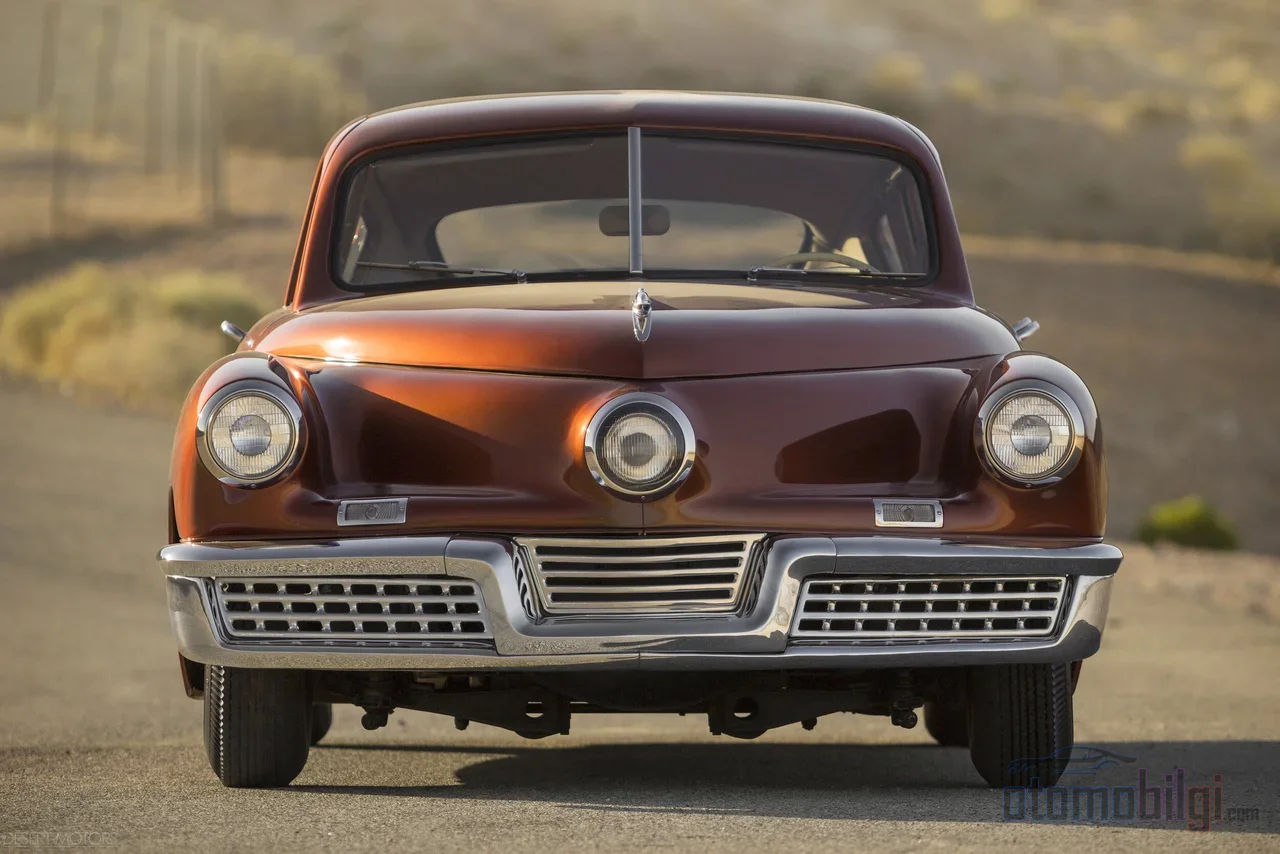
Today, 47 of the 51 vehicles produced have survived to this day, and each is among the most valuable pieces of the American classic car market. Let the numbers speak quickly: a 1948 Tucker 1021, an example used in the film, for 1.7 million dollars sold; survivors can even reach the 2 million dollar level. While an example went for $577,500 in 2006, one found a buyer for $1,017,500 in 2008 - meaning the rise in value can be seen quite sharply. At the auctions of 2026 as well, Tucker 48s changed hands again in seven-figure sums. In May 2026 there was also exciting news: a lost Tucker 48 will be restored for a museum display and will become the "48th" of the 47 known survivors. Experts estimate that more than half of the survivors run, but may not be fit for road use.
Tucker's trace in popular culture is discussed mostly through the Tucker: The Man and His Dream film. In this 1988 film directed by Francis Ford Coppola, Jeff Bridges plays Preston Tucker; Joan Allen and Martin Landau are also in the cast. Coppola himself is a Tucker owner and displays his car at his winery; moreover, George Lucas and Coppola each own two Tuckers. For the film, 4 replicas were produced on a 1974 Ford chassis. The film presents Tucker as a visionary who "came under attack from the major automakers and the US government" - meaning popular culture, too, has essentially taken the conspiracy's side.
The Real Legacy of the Tucker 48: In Every Car You Drive Today
The most enduring legacy of the Tucker 48 is not its collection value but its safety philosophy. The padded dashboard, the shatter-proof pop-out windshield, integrated reinforcements in the body... These are no longer "features" today, but requirements. What Tucker achieved was to think of the car not only in terms of speed and comfort, but through the passenger's survival. This perspective was his greatest innovation - and unfortunately he paid the price of that innovation alone.
If you ever see a Tucker 48 in a classic car museum one day, I would say stand before it a little longer. That car is not a classic; it is a warning. In entrepreneurship stories, sometimes the hardest thing is not beating your rival, but living with the rules of your own era. Preston Tucker could not know this - or perhaps he could not afford to know, because if he had known, he would not have given up. In my opinion he should not have given up either; but because he remained with only 51 cars, he left a question to history: Was he perhaps born a little too early for the future?
Sources
- Tucker 48 - Wikipedia
- Preston Tucker - Wikipedia
- 1948 Tucker Model 48 - Audrain Auto Museum
- The 1948 Tucker sedan-the car of tomorrow - Smithsonian
- Preston Tucker's sedan: Showcasing a beautiful business failure - Smithsonian American History
- What Caused the Tucker Automobile Corporation to Fail? - G. Langelett, SDSU
- Tucker History - TuckerClub
- 1948 Tucker 48 | The Monterey Auction 2026 - RM Sotheby's
- Which "cutting edge" feature on the 1948 Tucker was actually 44 years old? - Hagerty
- Long-Lost Tucker 48 to Be Rebuilt as Museum Showpiece - Autoweek
- Tucker: The Man and His Dream - Wikipedia
- Tucker: The Man and His Dream (1988) - IMDb Trivia
- Video: 1948 Tucker 1021 sold for $1.7 million - Vanderbilt Cup Races
- There Are Only 47 of These Vintage Tucker Cars Left - American Essence