Citroën SM: When French Elegance Met an Italian Engine
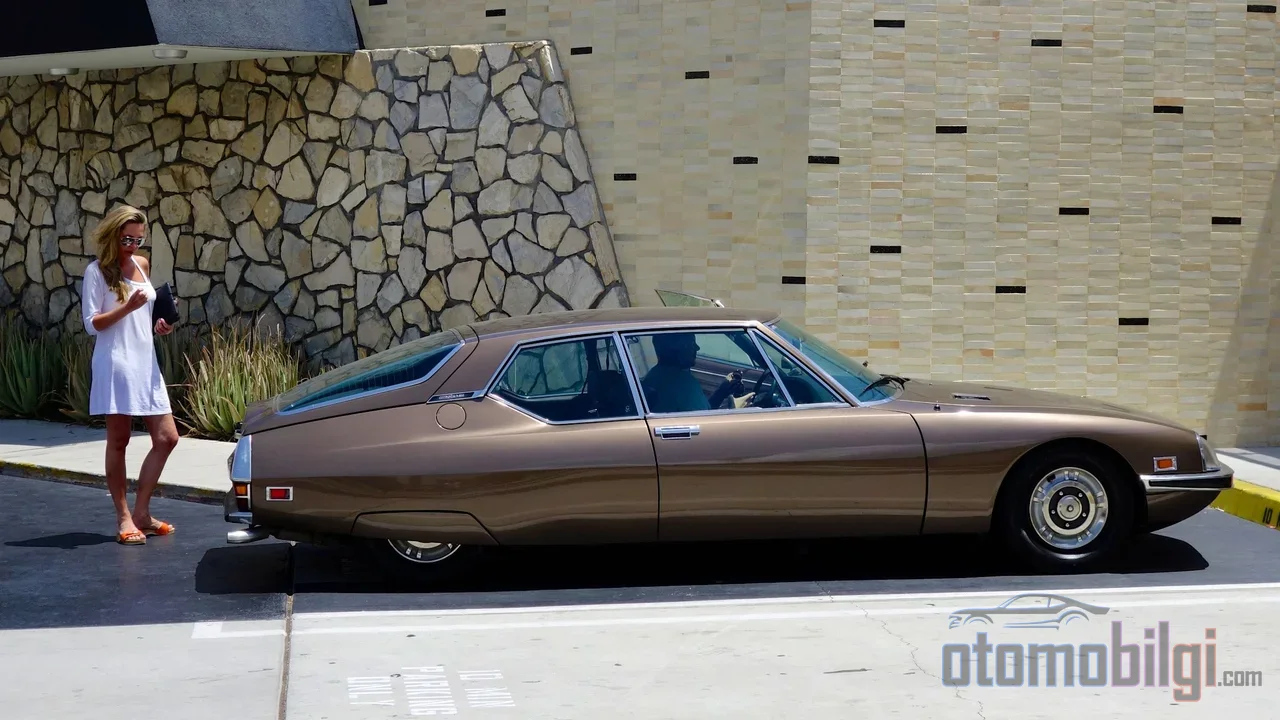
In 1968, France's most eccentric automaker, Citroën, bought Italy's loudest engine master, Maserati. Would what emerged be a nightmare or a masterpiece? No one was sure, but the result became one of the boldest marriages in automotive history: the Citroën SM. So how did the Maserati V6 at the heart of this GT coupe come about? If you're ready, the story begins with a 9-year engineering marathon.
The SM's roots reach back to Project S in 1961. Initially, this project was conceived as a faster, sportier version of 1955's legendary DS. But over 9 years the project grew so much that it transformed into an entirely new, start-to-finish engineering marvel of a car. Unveiled at the Geneva Motor Show in March 1970 and going on sale in France in September 1970, the SM dropped onto the luxury grand tourer segment like a bolt of lightning. Where does the name come from? Now that's a good question: "S" comes from Project S, while "M" represents either Maserati or the French expression for "Majesty." No one knows the definitive answer, but both fit it quite well, don't they?
Highlights
- Citroën bought Maserati in 1968, and the SM's engine was designed from scratch
- The 2.7-liter Maserati V6 produces around 170 hp of power and ~235 Nm of torque
- 0-100 km/h acceleration in 8.9 seconds, top speed 220 km/h according to factory figures
- Named Motor Trend Car of the Year in the US in 1972
- Only 12,920 units were produced in total, with production ending in 1975
The Maserati V6: The Engine of a Marriage
This is the heart of the story, so listen carefully. When Citroën bought Maserati, its goal was clear: To combine the Italians' high-performance engine expertise with its own hydropneumatic suspension technology. In other words, one side was like cake, the other like ice cream; bringing the two together was everyone's dream, but no one had tried it.
Maserati's legendary engineer Giulio Alfieri was given the task of designing a V6 from scratch. Alfieri's solution remains an engineering refinement still talked about today: The engine was conceived so it could be built on existing Maserati V8 production lines. That's why there is an unusual 90-degree angle between the cylinder banks. In V6 engines, this angle would usually be narrower; Alfieri put practicality ahead of the ideal. The result? An aluminum-bodied engine weighing just 140 kg, light and compact. This engine was always mounted behind the front axle; so unlike the oh-so-heavy American V8s, the SM's balance was of a true sword master's finesse.
So why such an unusual displacement as 2.7 liters? Here the government comes into play. In postwar France, the so-called "puissance fiscale" - tax horsepower regulations - punished luxury cars. Citroën therefore kept the engine small; this was not a technical choice but the engineering reflex of tax avoidance. Fed by three Weber carburetors, the engine coded C114 produced about 170 hp of power and around 235 Nm of torque. The same engine family later lived on in the Maserati Merak and, in modified form, in the Biturbo, produced in the thousands; even the Ligier JS2 used this V6. So the Alfieri's engine was not limited to the SM.
Version by Version, Number by Number
Throughout the SM's production, engine and transmission combinations evolved. In 1972, Bosch D-Jetronic electronic injection arrived, and in 1973 the displacement was increased to 3.0 liters. Here is a summary of the versions:
| Version | Engine | Power | Production |
|---|---|---|---|
| SM 2.7 (1970-72) | 2,670 cc, 3x Weber carburetors | 170 PS | 7,133 units |
| SM 2.7 Injection (1972-75) | Bosch D-Jetronic injection | 178 PS | 3,500 units |
| SM 3.0 (1973) | 2,965 cc | 180 PS | 600 units |
| SM 3.0 Automatique (1973-75) | 2,965 cc, 3-speed automatic | 180 PS | 1,012 units |
And a note for the curious: An SM was used as a test bed for the 4.0-liter, 260 hp V8 that Maserati developed for the Quattroporte II. So this body managed to carry a far more powerful monster than itself.
Hydropneumatic Magic and a Wind-Cutting Body
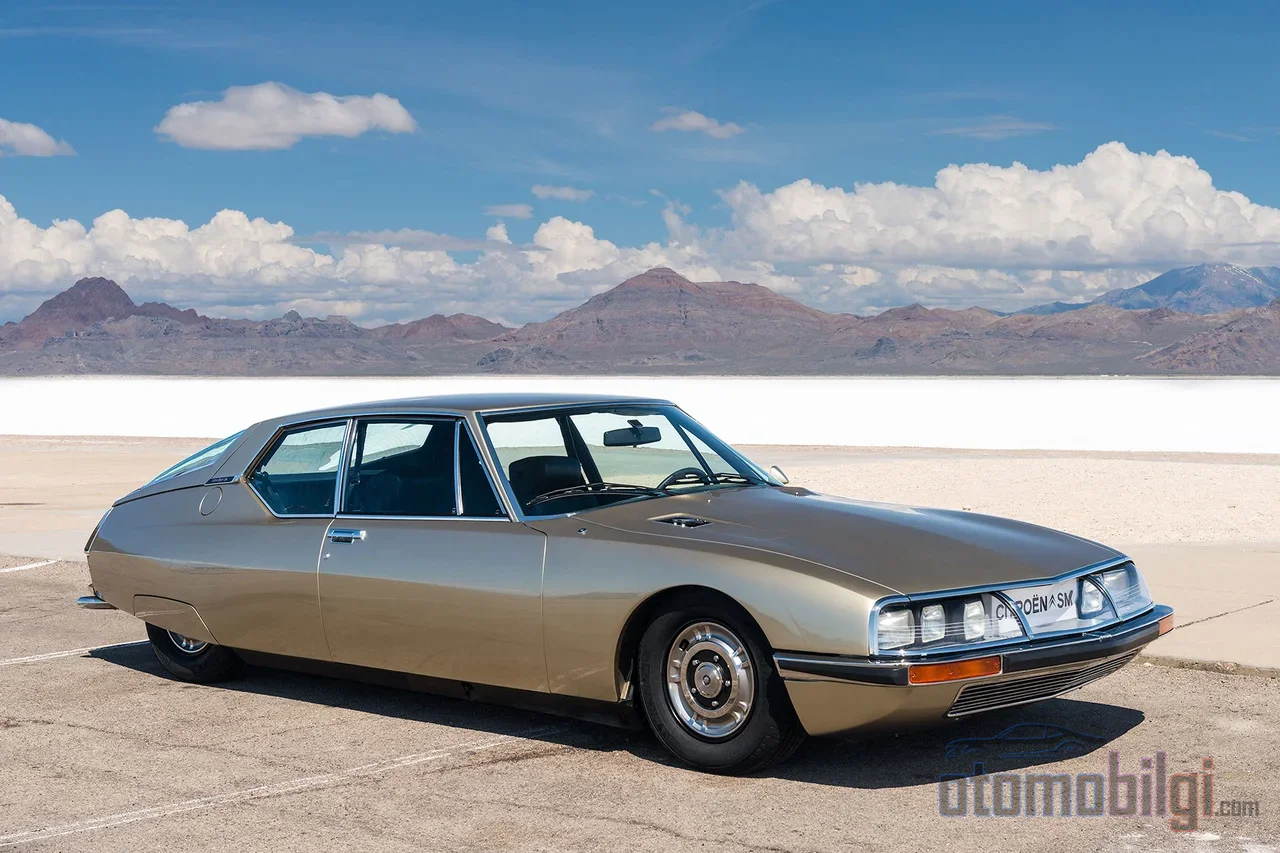
The engine was only half the story. What truly made the SM legendary was Citroën's hydropneumatic genius. Think about it: The car's suspension works with a self-leveling hydraulic system. No matter how rough the road, the car maintains its composure; and when braking, the entire body lowers evenly. This means that instead of the car's front diving and the rear lifting, it stays balanced like a fly. Making this possible were four-corner disc brakes, with the front discs mounted inboard.
The steering system, called DIRAVI, is a lesson in itself: Fully hydraulic, speed-sensitive and self-centering. While parking, you turn it with one finger; at autobahn speeds, the system firms up. You turn it two times to lock-to-lock, and the moment you let go, the steering returns to center on its own. For the 1970s, this seemed like science fiction. The automatic self-leveling headlights that steered with the wheels, however, were illegal in the US at the time; can you imagine, a car being banned because its technology was too advanced!
As for the design, the signature belonged to Robert Opron. Opron joined Citroën in 1962 and rose to head of the design department in 1964. Viewed from above, the SM looks like a teardrop: a wide front track, a track tapering toward the rear, rear fender skirts and a Kamm tail. Citroën announced the drag coefficient as 0.26 at launch; the figure was later revised to 0.339, but even so it was low for its day. Thanks to this aerodynamics, despite its modest displacement with three Weber carburetors, the car reaches a factory top speed of 220 km/h, and in independent tests could accelerate up to 235 km/h. The hood was aviation-grade aluminum, while the exterior parts were made of stainless steel instead of chrome; and Michelin's fiberglass wheels, developed for racing, were half the weight of the standard wheel.
"Concorde on the Road": Awards and Becoming an Icon
The SM was not just an engineering marvel; it was also a symbol. The authorities of the era dubbed it "Concorde on Wheels"; the comparison was not made in vain. Just as the Concorde was the symbol of aviation's optimism and progressive technology, the SM carried the same spirit in the automotive world.
Let's clarify a point frequently confused in the awards section: The SM did not win the 1971 European Car of the Year contest; it came third that year, and first place went to its in-house rival, Citroën's own model, the GS. But the SM found its true category in 1972: it won the Motor Trend Car of the Year award in the USA, which was an almost unique achievement for a non-American vehicle at the time. In the award citation, it was stated that the car embodied the spirit of Car of the Year better than anything else in the world. Popular Science, meanwhile, reported that none of the vehicles it tested had a shorter braking distance than the SM.
It did not stay silent in motorsport either. The SM won the grueling 1971 Rallye du Maroc, its racing debut; Citroën even developed a short-wheelbase racing variant. Claims such as the 1974 world rally championship and the 1975 Daytona victory also circulate in the relevant literature, but these two achievements cannot be verified with reliable archival records; the only major victory that stands firm is the 1971 Rallye du Maroc. Knowing this distinction is important for preserving the facts that make the legend a legend.
Technical Specifications: What Do the Numbers Say About the SM?
Let's take a look at the numbers you are curious about. According to factory data, the carbureted 2.7 version offered 170 PS of power, a top speed of 220 km/h, and consumption of 12.5 L/100 km. Acceleration from 0-60 mph took 8.5 seconds; the 0-100 km/h figure, measured in km/h, was recorded as 8.9 seconds in independent tests. The torque figure is an interesting case: The manufacturer did not disclose the torque in official technical tables; the available figure of approximately 235 Nm comes from secondary sources, which is why we do not present it as definitive factory data.
| Specification | Value (SM 2.7, carbureted) |
|---|---|
| Engine | Maserati C114 V6, 2,670 cc |
| Power | 170 PS (125 kW) |
| Torque | Approximately 235 Nm (not stated by the manufacturer) |
| 0-100 km/h | 8.9 seconds |
| Top speed | 220 km/h (factory) |
| Transmission | 5-speed manual |
| Weight | 1,450 kg |
| Production volume | 12,920 (all versions) |
Final Curtain: Why Did It End in 1975?
As with every good story, this one was approaching an end, and at an alarming pace. The sales figures tell the story themselves: The SM, which sold 4,988 units in 1971, fell to only 294 units in 1974 and 115 units in 1975. So what happened?
Everyone's first suspect is the 1973 oil crisis; the era was indeed struggling with economic stagnation. But the picture is more complicated. In the same period, vehicles that consumed even more fuel were launched and sold. The real blow came in the US market from the 5 mph bumper regulation that NHTSA put into effect in 1974: This rule was effectively incompatible with the SM's variable-height hydropneumatic suspension, and the design was stillborn for the US market. And then there is the maintenance factor: Neglecting Weber carburetor adjustments and timing chain maintenance led to engine failures around 60,000 km. In other words, the SM was a vehicle that taught its owner expensive lessons when not properly maintained.
The final act came in 1974-75: Citroën went bankrupt and Peugeot took over the company. The new management decided in May 1975 to part ways with Maserati and halt SM production. The final 135 SMs were produced at Ligier's factory in Vichy. With a total of 12,920 units, the SM lived a short but intense life.
The Legacy: What Did the SM Leave Us?
Even though production ended, the story was not over. The speed-sensitive hydraulic principle of the DIRAVI steering gradually spread throughout the entire automotive industry; most of the SM's dynamic qualities were carried over to the Citroën CX, launched in 1974 to great success. Transmission components continued to live on in the Lotus Esprit, while the engine carried on in the Maserati Merak. In 1987, SM World's turbocharged SM set a class record at Bonneville, reaching a speed of 325 km/h; the body's aerodynamics were still doing their job even after its death.
The prestige side was strong too: Two SM présidentielles served French presidents for a full 37 years, and in 1972 it carried Pompidou and Queen Elizabeth II on their inaugural tour. Names like Leonid Brezhnev, Johan Cruijff, and Carlos Santana also owned an SM. In 2005, Automobile Magazine ranked the SM 11th on its "100 Coolest Cars" list. "100 Coolest Cars." The Chapron-built SM Mylord sold at auction in 2014 for 548,320 euros.
So what is the essence of this story? The SM became a flawless synthesis of two different automotive cultures - French hydropneumatic comfort and Italian engine passion. When Alfieri's 90-degree V6, Opron's teardrop body, and the DIRAVI's hydraulic magic combined, the most extraordinary GT in automotive history was born. It is no coincidence that despite its short life, it is still among collectors' favorites today: The SM is not just a car, but a manifesto that unites the engineering genius of two countries in a single body. And let me say, as a 15-year-old car enthusiast: Bold cars like this are no longer made.
Sources
- Citroën SM
- The Citroën SM: The 1972 Motor Trend Car of the Year
- Car of the Year 1971
- Sadomasochistic: The Pleasures and Pains of the Citroën SM
- 50 Years ago: The Citroën SM - The Concorde of the Road
- 1975 Citroën SM Injection performance
- CITROEN SM (1970-1975)
- 1973 Citroën SM a smooth, Maserati-engined masterpiece
- 1974 Citroën SM V8: A Mystery No More
- Citroen SM Review