The Iconization Story of the Citroën DS, the Goddess Floating in the Air
Share This Page
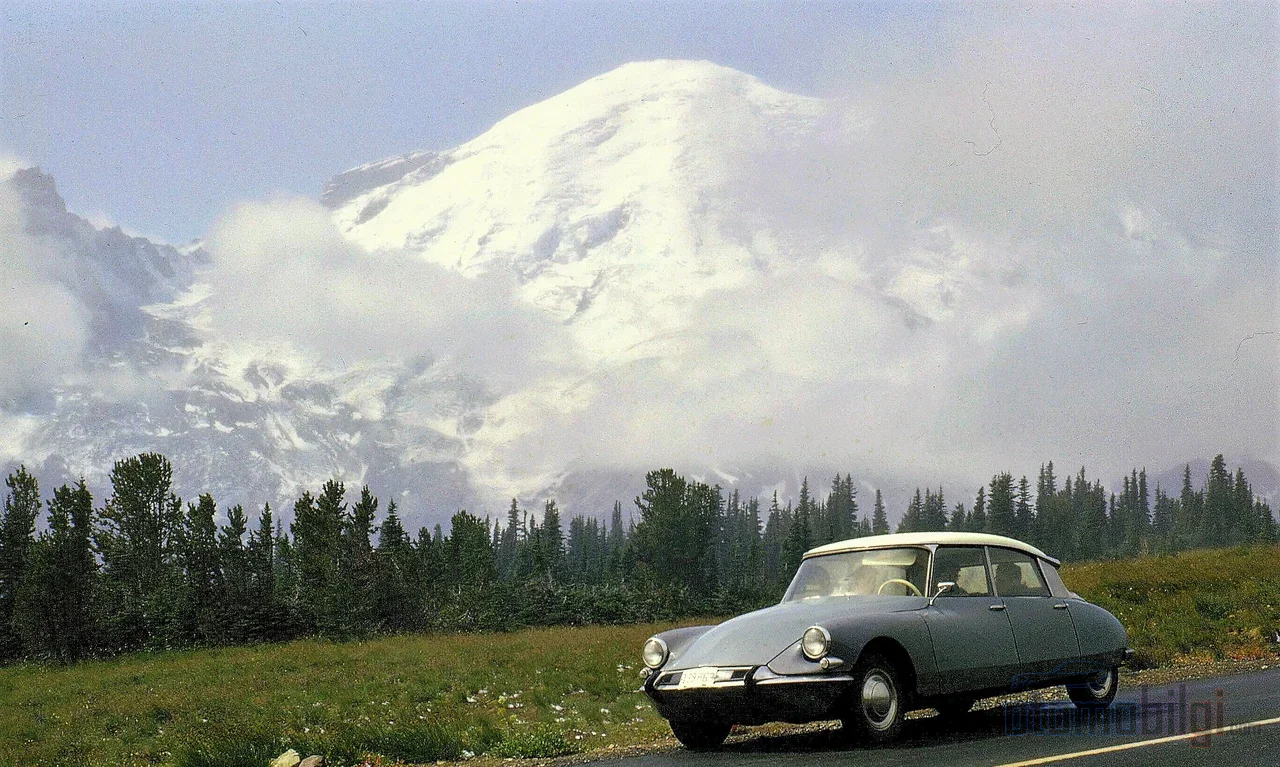
The curtain rose on October 6, 1955 at the Grand Palais in Paris, and everyone at the show was looking at the same car: the Citroën DS. This strange yet beautiful car, which seemed to float in mid-air, bore a name that rhymed with the French word "déesse," meaning "goddess." With its hydropneumatic suspension, groundbreaking design, and the mark it left on our culture, the DS became far more than just a car over its 20-year production run. Here is the story of the birth of a goddess.
Highlights
- 12,000 deposits on the first day of the show, 80,000 over the course of the fair - a record that stood unbroken for over 60 years.
- A total of 1,455,746 units were produced between 1955-1975.
- The first mass-produced car equipped with disc brakes and hydropneumatic suspension.
- It arrived in 1967 with headlights that turned with the steering wheel; the production pioneer of the adaptive headlight.
- It was chosen as "the most beautiful car of all time" in a designers' poll.
The 1955 Paris Motor Show: The Goddess Who Became a Star Overnight
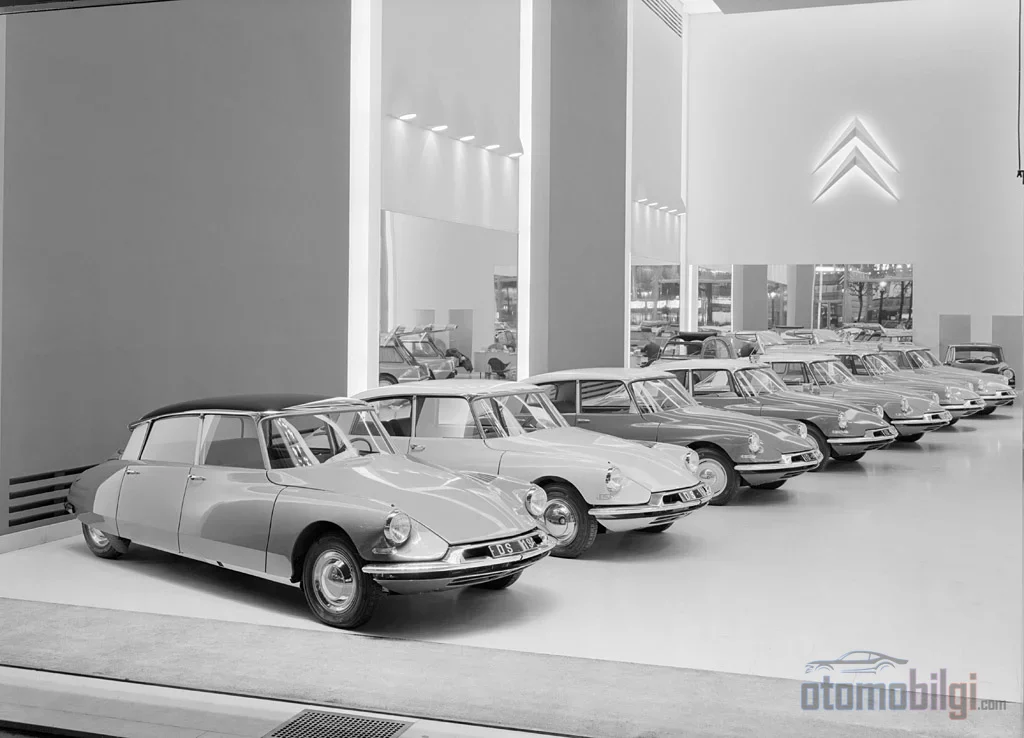
Would you believe that a car could make people gasp at a show hall in traffic? That is exactly what happened when the DS 19 was unveiled on Thursday, October 6, 1955. Developed in secret for 18 years, this car was the successor to the Traction Avant, but no one guessed it would be so different. The numbers were incredible: 743 orders in the first 15 minutes of the show, 12,000 orders on the first day, and a full 80,000 deposits over the 10-day fair. This record went unchanged for more than 60 years, until an electric car's first-day deposit count surpassed it in 2016.
So why did everyone get so excited? Because the DS looked nothing like the other cars of its era. From behind, a fastback line that seemed to glide while cutting through the wind, a single flowing body instead of visible fenders, and of course that elegant single-spoke steering wheel. Its design was drawn together by Italian sculptor Flaminio Bertoni and French aeronautical engineer André Lefèbvre. It was no coincidence that an aeronautical engineer worked on the car: the DS was designed like an aircraft descending gracefully from the sky.
But a brilliant entrance came at a price. The DS 19 was 65% more expensive than the Traction Avant it replaced. Everyone adored the goddess, but not everyone's pocket could afford her. That's why Citroën added a cheaper base model in 1957: the ID. The name was a play on words here too, because "ID" had the same pronunciation as the French "idée," meaning "idea." The ID 19 was slightly less powerful than the DS 19 and carried conventional systems instead of the expensive hydraulic steering and semi-automatic transmission.
Hydropneumatic Suspension: Why Does the Car Seem to Float in the Air?
Now let's get to the heart of the DS. What is hydropneumatic suspension, and why was it talked about so much? In the simplest analogy: normal cars have springs, while in the DS each wheel is supported by hydraulic fluid and a sphere filled with nitrogen. Think of it like a basketball - the air pressure inside the ball absorbs impacts, just as the nitrogen does inside the sphere. The engine-driven pump system pressurizes up to 17.2 MPa (2,490 psi). The result? When one wheel hits a bump, the fluid is transferred through the pipes to the other wheels, and the car always stays balanced. It can even drive on three wheels - you've surely seen those viral videos on the internet.
This system had two huge advantages. The first was comfort: the ride was so smooth that people called it a "flying carpet." The second was automatic leveling: no matter how many suitcases you put in the back seats, the car balanced itself, and the driver could even change the ride height if desired. Before pulling out of a spot, raising the car into the air to see what's underneath... In 1955, this was like science fiction.
In the DS, hydraulics weren't limited to the suspension. Power steering, the clutch, and semi-automatic transmission control were also fed from the same system. Inboard-mounted front disc brakes reduce unsprung weight, and the fiberglass roof lowers the mass up high. This was very clever, but it also demanded meticulous maintenance: the originally used vegetable-based LHV and later the synthetic LHS fluids were hygroscopic, meaning they absorbed water and degraded. In 1967, the switch was made to mineral-based LHM; a bright green dye was added to that fluid, and the hydraulic components were also painted green so they wouldn't be mixed up. In the USA and Canada, approval for this new fluid unfortunately couldn't be obtained until January 1969.
A Future Full of Innovation: Disc Brakes and Swiveling Headlights
Just the suspension? The DS is the first production car equipped with both hydropneumatic suspension and disc brakes. The inboard-mounted front disc brakes reduced unsprung weight, while the fiberglass roof lowered the mass at the highest point. So they made the car not just smooth, but also safe and agile. Even the brakes were hydraulic - you press the pedal, the pressure does the work.
Wouldn't you want your headlights to turn along with the curve of the road when you enter a corner at night? In the 1967 Series 3 facelift, they did exactly that. The inner long headlights of the four-headlight face designed by Robert Opron could turn up to 80 degrees thanks to a cable mechanism linked to the steering; the outer short headlights also adjusted themselves according to braking and acceleration. A similar idea had been tried on another car in 1948, but Citroën was the first brand to bring swiveling headlights to market in series production. Here's the frustrating part: since US regulations didn't allow swiveling headlights, the DS models sold in America lacked this magic and got four fixed exposed headlights instead.
Rally Victories and Why It Didn't Catch On in the USA?
Who would have thought that a car that looked so soft could also be a contender in racing? The DS turned out to be a complete rally monster. It won the 1959 and 1966 Monte Carlo Rally; in 1962, Pauli Toivonen won the 1000 Lakes Rally with a DS 19, and René and Robert Neyret took the Rallye du Maroc in 1969-70 with a DS 21. The crown was worn at the 1974 London-Sahara-Munich World Cup Rally: DS won, leaving 70 cars behind, and only 5 cars managed to finish that grueling race. A goddess that could run on three wheels, and withstand mud and misery.
But every story has another side. The DS was sold in the US from 1956 to 1972, but found only 38,000 buyers in all of North America. Why? The American idea of luxury demanded an automatic transmission, air conditioning, power windows, and huge engines; the DS offered few of these. Spare parts were hard to find, and the pricing math was unfortunate: In 1969, a 115 hp DS cost $4,170, while for the same money you could get a 360 hp Buick Electra 225 Custom. Who would pay $4,170 for 115 horsepower? The question was asked, the answer was scarce.
From Films to Philosophers: The DS in Popular Culture
The DS is one of those rare cars that stepped out of car magazines and into life itself. The calm yet unsettling DS scene in Alain Delon's Le Samouraï is one of cinema history's unforgettable frames. And in the Fantômas films, the goddess literally sprouted wings and flew. In 1963, Charles de Gaulle paid the car a grand personal visit; in 1993, the artist Gabriel Orozco sliced a DS into pieces and turned it into a sculpture - meaning the car becoming a work of art became a work of art in itself.
For looking at an automobile as if it were a riddle and comparing it to an object fallen from the sky.
The philosopher Roland Barthes had compared the DS to "something fallen from the sky" - the BBC calls it "the car loved by philosophers and presidents." In a photo gallery, the DS is lined up side by side with the Eiffel Tower as "two icons of French culture." When does a car ever get this treatment? And the magazine Classic & Sports Car surveyed 20 designers, including famous names like Giorgetto Giugiaro and Ian Callum; the result: the DS is the most beautiful car of all time. It also ranked 5th on a car magazine's 2005 "100 Coolest Cars" list. place.
The 1975 Farewell and Today's Legacy
When did the goddess leave the stage? The last DS - vehicle number 1,456,115 in production order - came off the line at the Quai de Javel factory in Paris as a DS 23 Pallas Electronic Injection on April 24, 1975, at 3:00 PM. In total, 1,455,746 DS and ID models were produced; of these, 1,330,755 came from Quai de Javel, and the rest came from factories in six countries around the world: including Slough in England, South Africa, the former Yugoslavia, and "ID 19 Parisienne" production in Australia. The peak production year was 1970. The Citroën CX took its place - a worthy successor, but one that could not reach the magnitude of the shock the goddess created. Consider this: After the DS, Citroën could not produce an all-new model from scratch from 1955 to 1970; the company was afraid it would never again reach that same standard of boldness.
Today the DS remains an icon, and in 2025, the brand's 70th anniversary was celebrated with various events. DS Automobiles boss Olivier François has said that a new flagship inspired by the original DS may be on the agenda. Its value in the classic car market is also clear: A 1955 DS 19 recently changed hands for an average price of $94,900, and sales volume has shown a serious increase. So the question of "the most beautiful car ever made" is still being debated, but one thing is certain: Even 70 years later, people still turn their heads when they see a DS. So if it were you, standing among the crowd at the 1955 show, would you have marveled at the goddess? In my view, the answer is obvious.
Sources
- Citroën DS - Wikipedia
- DS, A 70-YEAR HISTORY | Stellantis Media (DS Automobiles)
- Presentation of the DS - L'Aventure Citroën
- Citroën's Hydropneumatic Suspension Is Being Depressurized Forever - Car and Driver
- PH Origins: Directional headlights - Pistonheads
- Citroën DS: A 'goddess' of a car - BBC Culture
- The Citroën DS, a Goddess of Design, Turns 70 - Hagerty
- 1955 Citroen DS19 - Hagerty Valuation Tools
- New DS flagship to get inspiration from world's coolest car - Auto Express