The Story of the Citroën 2CV, the Car That Put France on the Roads
Share This Page
The Citroën 2CV is the people's car that French manufacturer Citroën produced for a full 42 years between 1948 and 1990, and that truly put post-war France on the road. Its name comes from the French "deux chevaux", meaning "two horses"; this is a reference to the tax horsepower system of the era. This modest car, designed to carry a farmer's load without breaking eggs, eventually became a legend with sales of over approximately 3.9 million units.
Highlights
- 1948-1990: From the 2CV sedan, more than 3.8 million vehicles were produced, over 9 million including derivatives
- Design goal: Carry four people and 50 kg of agricultural products without breaking the eggs
- First Type A: 375 cc engine, only 9 hp, top speed 65 km/h
- The car that seemed comical to the press at launch created a three-year waiting list
- In 2026, Citroën is bringing back the 2CV as an electric vehicle
Hello! Today I'm going to tell you one of my favorite stories in automotive history. Because think about it: some cars become legendary for being super fast, others for being super stylish. The 2CV had neither. It had nothing. Yet it managed to connect France to motorized transport. How? Let's get started, because this story involves war, espionage, and a handful of buried prototypes - really!
The Design Brief: How Do You Request a Car That Carries Eggs Without Breaking Them?
The story begins in the 1930s. At that time, millions of people lived in rural France, but almost none of them had a car. In 1934, the tire giant Michelin took over the bankrupt Citroën as its largest creditor, and management commissioned that famous market research. The result was clear: a cheap and sturdy car suited to the French farmer was needed.
So what was the brief? This is the part that makes me smile every time. The requested car had to do the following:
- Carry four people and 50 kg of agricultural products at 50 km/h
- across muddy roads to market, not exceeding 3 L/100 km
- (child's play by today's standards!)
And most famously: be able to travel across a field with a basket of eggs without breaking them. So the egg story is not an urban legend; it was an official requirement of the design brief. The secret of the soft suspension lies right here: a torsion bar system with eight rods connecting the front and rear wheels gave the car a floating feel, like a kind of "umbrella on wheels". Think of it this way: each wheel dances almost independently, without the passenger noticing.
TPV: A Completely Secret Project
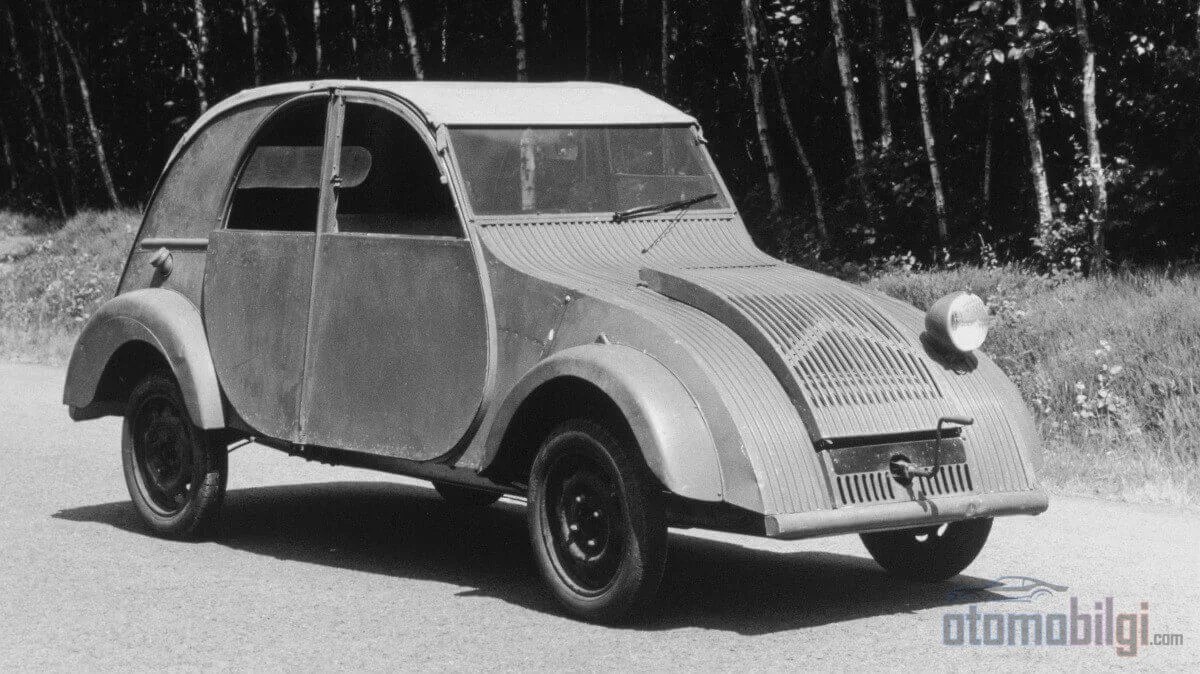
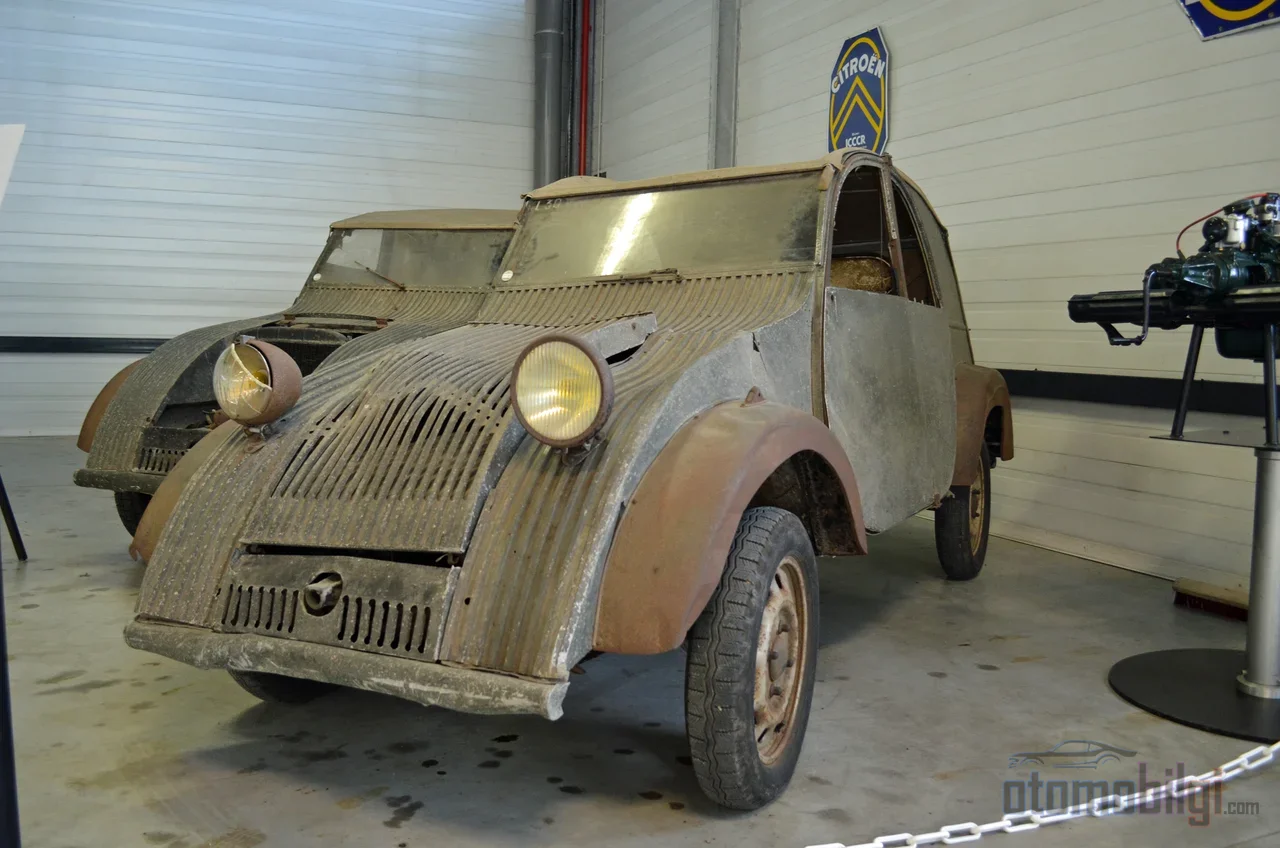
The project's name was TPV - "Toute Petite Voiture", meaning "Very Small Car". Project head Pierre-Jules Boulanger conducted it in complete secrecy at Michelin's Clermont-Ferrand facilities. Engineering duty fell to André Lefèbvre, while the suspension was designed by Alphonse Forceau. By the end of 1937, there were 20 prototypes; by 1939, there were exactly 47 different experimental prototypes produced and tested. The first prototypes were quite different from the 2CV we know today: aluminum and magnesium parts, water-cooled flat-twin engines, seats like hammocks suspended from the roof by wire, and even a single headlight as required by French law!
In mid-1939, a pilot series of 250 vehicles was produced, and approval was granted on August 28. Everything was ready, the stage was set...
When War Said No: The Car Buried and Hidden from the Nazis
Exactly one week later, on September 3, 1939, France entered the war. The Paris Motor Show was canceled, and the launch was shelved. But this is where the really interesting part begins: During the German occupation, Boulanger was placed on the Gestapo's "enemy of the Reich" list for refusing to collaborate. Citroën management also decided to hide the TPV from the Nazis - some prototypes were buried in secret locations, one was disguised as a pickup truck, and others were destroyed. Like a spy movie, right?
Years later, the on-paper result of this secrecy came to light: For years it was believed that only two prototypes had survived, until three more TPVs were found in a barn in 1994. The number of TPVs known today is five.
The war also changed the car technically. When aluminum prices rose by 40%, the vehicle was redesigned around a steel body. In 1944, Walter Becchia 375 cc designed an air-cooled twin-cylinder engine and managed to fit not a three-speed but a four-speed transmission into the same space - he even succeeded in getting Boulanger to accept the fourth gear as an "overdrive." The body was reshaped by the Italian Flaminio Bertoni. Post-war France was living through "Les années grises" (the gray years): Of the two million pre-war cars, only 100,000 were on the road. Production was once again delayed due to the economic plan - and finally 1948 arrived.
The 1948 Paris Salon: The Press Mocked, The People Queued Up
On October 7, 1948, the 2CV took the stage at the Paris Salon. The Type A's specs sound like an insult passed by word of mouth today: 375 cc, 9 hp, top speed 65 km/h. A single stop lamp, only a gray color option, a speedometer mounted on the windshield pillar, an ammeter and a fluid dipstick. No GoPro, no touchscreen - a life like a wind-up toy.
The press's reaction? Rock bottom. One journalist wrote that the designer "kissed his own work with an almost masochistic devotion." An American journalist quipped, "Does it come with a can opener?" But here's exactly where the irony lies: The people immediately saw what the press could not. First a three-year, quickly a five-year waiting list formed. For those who didn't want to wait, a used 2CV was more expensive than a new one - think about that once more! Production also climbed rapidly: from 876 vehicles in 1949 it reached 6,196 units in 1950 . Unfortunately, Boulanger lost his life in a car accident in 1950 and did not live to see this. In that period, vehicles were sold primarily to rural veterinarians, doctors, midwives, priests and small farmers - staying true to the spirit of the brief.
The Engineering Art of Simplification
The thing that floored me most about the 2CV is this: It wasn't just "simple," it was deliberately simplified. A legendary example of the art of simplification. This wasn't dry-headed engineering but a fully thought-out minimalism. The full-width canvas roof could be rolled back and, until 1955, extended all the way to the trunk. Michelin, which commercialized its radial tire for the first time on this car, made the radial design an integral part of the chassis. Dry weight was just 600 kg, the wheelbase was 2,400 mm - by the way, the same wheelbase as the VW Beetle; would you call that a coincidence?
The Beetle parallel is truly interesting: Both were designed in the 1930s and entered mass production in the late 1940s, both had air-cooled engines, both were produced for over four decades with a single generation and sold in the millions. But the differences are striking too; for example, the 2CV engine didn't even have the thermostat valve found in the Beetle and the Fiat 500. "Suicide doors" were used from 1948 to 1964, and from 1965 onward the car switched to front-hinged doors.
The writer L. J. K. Setright described it this way:
The most brilliant application of minimalism that has succeeded as a car; a ruthless rationality.
In 1953, an automobile magazine also called it "undoubtedly the most original design since the Model T Ford." In my view, that isn't even an exaggeration.
42 Years, 9 Million Vehicles: The Numbers and the Derivatives
Now let's look at the big picture. Over 42 years, more than 3.8 million sedan 2CVs were produced; the exact figures shift a bit depending on how the number is counted, because whether you include the commercial versions and derivatives changes the total. Including commercial versions it is over 5 million, and with all derivatives the total exceeds 9 million. It was one of the world's first front-wheel-drive cars to surpass one million units.
| Model / Version | What Happened? |
|---|---|
| 2CV Type A (1948) | 375 cc, 9 hp, 65 km/h - the first version |
| Fourgonnette | Panel van commercial version |
| Ami (1961) | A larger derivative |
| Dyane (1967) | Intended to replace the 2CV; sold ~1.4 million |
| Méhari | Plastic-bodied, airy derivative |
| Acadiane | Commercial derivative |
| 2CV Sahara 4x4 (1960) | With a second engine at the rear, only 694 units |
The Sahara 4x4 is also worth mentioning: It carried a second engine-gearbox unit at the rear, and since only 694 units were produced, it is quite a collector's item today. Interestingly, the peak year fell not at the end of the model's life but in its middle: In 1974, 163,143 vehicles were produced. The oil crisis made this low-consumption car popular again, and the 2CV turned from an old people's car into a lifestyle statement for the young. What followed is a familiar story: In 1980 production fell to 89,994, and in 1983 to 59,673. In 1989, early emission standards forced the car out of a number of European markets. Production in France ended on February 25, 1988; at the Mangualde plant in Portugal, production continued until 1990, and the last 2CV was a specially prepared Charleston model.
Here's a detail that sums up just how iconic the car is: the Dyane was designed specifically to replace the 2CV. But the 2CV outlived the Dyane by seven years. The one that came to take its place went first.
How Does a Car Become a Way of Life? Films, Rallies and "Duck" Culture
Those who think of the 2CV as just a car would have missed the boat. Citroën's public relations manager Jacques Wolgensinger launched the slogan "Not just a car - a way of life" and the "Raid" rallies aimed at young people. And those rallies were no small undertakings: in 1970, at the Paris–Kabul rally, 500 2CVs covered 16,500 km, in 1971 at Paris–Persepolis 500 vehicles traveled 13,500 km, and in 1973 at Raid Afrique 60 vehicles drove from Abidjan to Tunis, covering 8,000 km. Imagine that, in a 9 hp family car!
Of course, pop culture's coronation required a James Bond film, and For Your Eyes Only (1981) took on the job: Roger Moore escaped a chase scene in a yellow 2CV6 - a flat-four from the Citroën GS had been fitted so the engine's power could be doubled. Citroën also sold limited-production "2CV 007" models with "007" stickers on the doors and fake bullet holes. Even the German Patent Office describes the 2CV as an item of popular culture; in France, dozens of "duck" imitations filled with love for the car are in circulation, along with rally ducks and fake police ducks. If a documentary is being made about a car and it's titled "Not a Car, a Way of Life," then the iconization is indisputably complete.
The 2CV Today: Collector Values and an Electric Revival
So where is the 2CV today? It still lives on in the collecting world. Classic versions are positioned below median prices, in the accessible segment; meaning owning this legend is far more possible than you might think. In fact, in 2026 a collector released hundreds of 2CV sedans in his hands onto the classic car market - so the second-hand scene has never been this active.
But the real news is this: Citroën is bringing back the 2CV as an electric vehicle. With retro touches, to be produced in Europe, and the targeted price is around €15,000. The concept was unveiled at the Paris Motor Show and carries classic design elements such as a rollable fabric roof and round headlights. Moreover, the presentations keep insisting: the new 2CV will remain a safe place for eggs too. Even after 78 years, the designers' loyalty to that famous brief says something to you, I think.
Why Is It Still Loved?
Because the 2CV became an icon without being a performance legend or a design marvel - you'd rarely find that in history. It was millions of people's first car, better than the farmer's tractor, the city dweller's cheapest freedom. Today, while every model in the car market looks alike, the fact that the "simplest yet most effective" formula lasted 42 years and is being reborn in 2026 is proof that minimalism is truly timeless. My question to you: Could this culture have been recreated with a car of only 9 hp, or was it precisely that lack that made people so devoted? I'm waiting for your answers in the comments!
Sources
- Citroën 2CV
- The mythical "very small car" that birthed France's beloved 2CV
- History of the Development of the Citroen 2CV
- July 27, 1990 - After 42 years, the last Citroën 2CV rolls off the assembly line
- Citroën 2CV - 30 Years of Production End
- DPMA | The 2CV
- Citroen revives the 2CV for an electric age
- Citroen's 2CV Is Back, And It's Still A Safe Space For Eggs
- Hundreds of Citroen 2CV sedans to hit the classic market
- Classic Citroen 2CV Dolly: Buyer's Guide