How Did Common Rail Make the Diesel Quiet?
Share This Page
Common rail injection is a diesel fuel system that collects high-pressure fuel in a single accumulator rail shared by all injectors and electronically manages both the timing and the quantity of injection. This structure replaced the old setup in which pressure was generated separately for each cylinder by mechanical pumps driven by the camshaft; a system capable of making five separate injections in a single cycle, instead of just one, freed diesel from its clatter and turned it into a quiet, efficient, and clean engine.
Highlights
- In modern common rail systems, rail pressure is typically above 2,000 bar; first-generation systems were in the 1,400-1,600 bar range.
- In mechanical pumps, pressure was around 800 bar and dependent on engine speed; in common rail, pressure is independent of engine speed.
- In a single cycle, 5 separate injections can be made: pre, pilot, main, post, and secondary post injection.
- Pilot injection significantly reduces the characteristic clatter of the diesel engine (the auditory equivalent of diesel knock).
- The interval between injections can go down to 200 microseconds.
Why Were Old Diesels So Noisy?
Those who remember the diesels of the 80s and 90s can hardly forget that idle rattle, like a bucket full of bolts being chewed. The source of this sound was not mechanical but a physical event: when diesel fuel was injected into compressed air, combustion would begin all at once, like an explosion. The fuel-air mixture accumulated in the cylinder until the injected fuel ignited and began to burn, then burned with a sudden pressure spike, and this shock was heard as a rattle in the engine block. Known in engineering literature as diesel knock, it is the auditory equivalent of this sudden combustion shock.
The root of the problem lay in the structure of the old system. In mechanical distributor pumps, pressure was generated from the camshaft separately for each injection and typically remained around 800 bar . Moreover, this pressure was dependent on engine speed: at low revs the injection was weak, fuel entered the cylinder in large droplets, and combustion proceeded more unevenly. Injection timing was also doomed to mechanical settings; precise control approaching optimum based on speed, load, and temperature was impossible. The only remedy for quietness was adding something to the injection that would soften combustion - and this required separating pressure generation from injection.
How Does Common Rail Work: The Separation of Pressure and Injection?
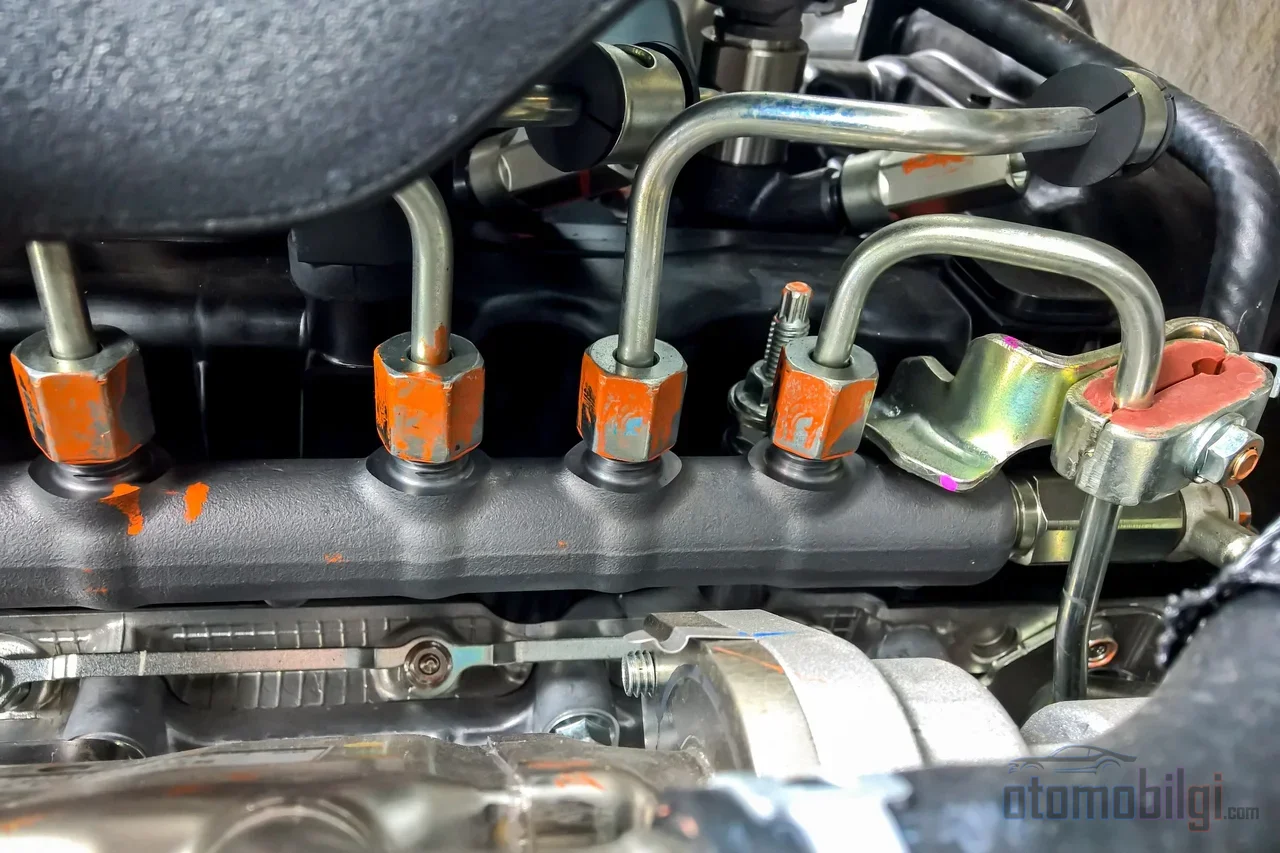
The system's name describes its working principle itself. The high-pressure pump continuously pushes fuel into a common accumulator rail - the "rail". This rail, like a hydraulic accumulator, breaks the link between the moment of injection and pressure generation. The injectors are connected to this high-pressure reserve waiting in standby; the electronic control unit (ECU) decides when and how much to inject. In the old system, two jobs had to be done at the moment of injection - creating pressure and opening the injector - now these are done by two separate components.
The measurable result of this separation is pressure. The first series-production systems 1,400-1,600 bar band was operating; today's systems typically exceed 2,000 bar, while third-generation designs can reach up to 2,500 bar. More importantly, pressure is now independent of engine speed: both at idle and at full throttle, the ECU can maintain the required pressure in the rail.
Why Is Pressure So Important?
The purpose of high pressure is to convert the fuel into as fine a mist as possible. Raising the injection pressure from 200 bar to 1,500 bar shrinks the fuel droplet size by fifty percent and dramatically improves atomization - that is, the quality of the fuel's mixing with air. Smaller droplets mean faster and more homogeneous combustion. Large droplets create fuel-rich regions where soot forms before the fuel can reach enough oxygen to burn; fine atomization eliminates these regions and reduces particulate matter. Cold-weather starting also benefits from the same logic: the ECU adjusts injection timing and pressure according to temperature sensor data, significantly improving cold starts compared to older systems.
Electronic Control with Microsecond Precision
The ECU, which processes data from the rail pressure sensor, crankshaft and camshaft position sensors, the mass air flow meter, coolant and fuel temperature sensors, and oxygen sensors, makes every injection decision with microsecond precision. The system uses closed-loop pressure control: the pressure in the rail is continuously measured, and if it deviates from the target value, the pump intervenes immediately. The ECU also performs adaptive learning; it self-corrects injection parameters according to the engine's age, the fuel's properties, and operating conditions. This is a flexibility that a mechanical pump could never achieve - injection timing can be advanced or retarded according to speed, load, and temperature, and cycle-to-cycle and cylinder-to-cylinder inconsistencies are minimized.
Multiple Injection: The Idea That Ended Diesel Clatter
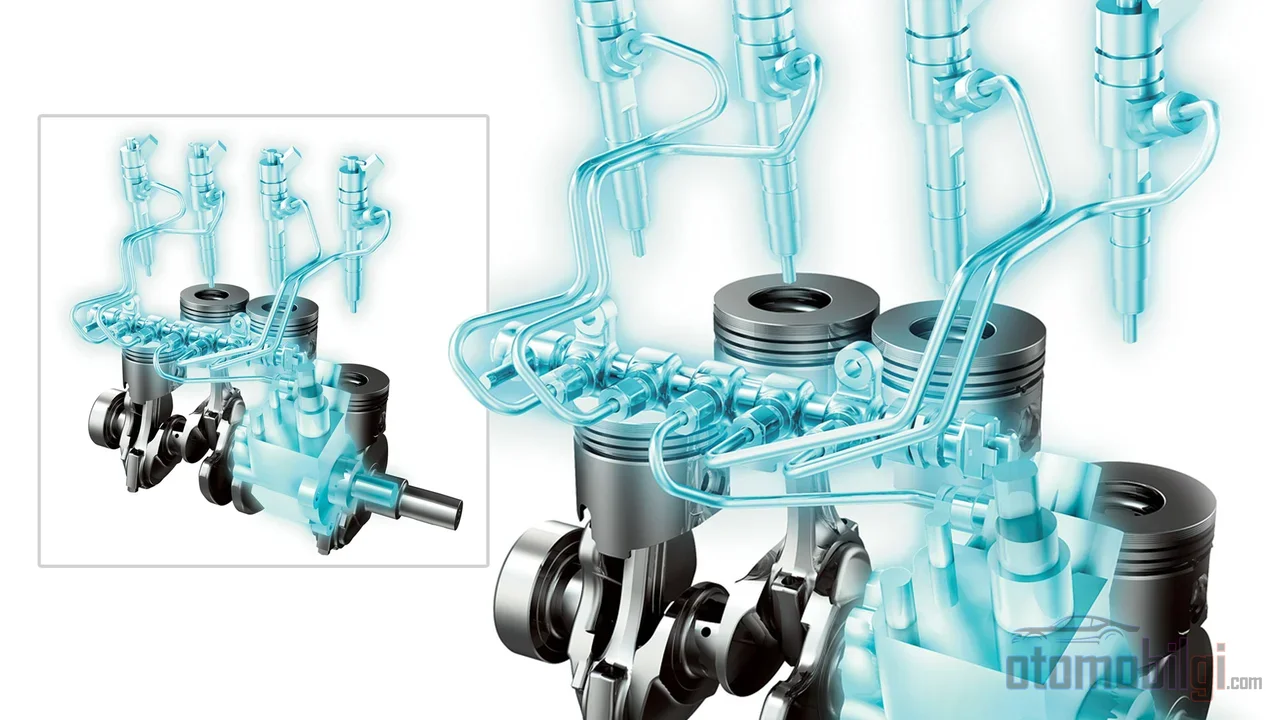
The fact that common rail solved the diesel rattle is not a result of high pressure itself, but a by-product of the possibilities that high pressure opened up. In a mechanical system, each cylinder could only receive a single injection once per cycle; thanks to the rail and electronic injectors, five separate injections can be made within one cycle. The intervals can be as short as 200 microseconds, and sophisticated systems sequence these five stages as follows: pre/pilot, main, post, and secondary post injection.
Pilot Injection: The Gentle Start
Injecting a small amount of fuel into the cylinder before the main fuel load starts combustion gradually. When this small pilot dose ignites, the cylinder warms up and pressure rises along a soft curve; by the time the main dose arrives, it is met by a hot and prepared environment. The sudden combustion shock - the source of diesel knock - is thus prevented. A single pilot injection is sufficient to reduce noise in most cases; double and triple pilot injections can provide additional quietness. The waiting period between the pilot and main injection is also critical: this interval directly affects combustion noise and is adjusted by the ECU according to operating conditions. The result is that the familiar rattle of the old diesel gives way to relatively quiet combustion.
Post-Injection: Cleaning and Heat
The job of the post-injection made after the main combustion is different: it completes the burning of soot and particulates remaining in the cylinder, and also provides the heat needed by exhaust after-treatment systems - such as the regeneration of the particulate filter (DPF). In other words, the injection strategy is also used so that the emission equipment behind the system can function. Multi-stage injection strategies also improve the balance between NOx emissions and fuel consumption at medium loads; research shows that multi-stage split injection reduces fuel consumption by approximately 1.78% and reduces particulate matter emissions by 30% The balance is not always easy: some strategies provide an average 12% advantage in NOx while increasing fuel consumption. Noise, emissions, and efficiency are always a matter of trade-off; engineering is about finding the best point among these three for every condition.
Comparing the Mechanical System with Common Rail
Putting the two systems side by side clarifies the scale of the change. Although the figures vary by manufacturer and generation, the general curve is this: common rail offers significantly more power and torque, lower fuel consumption, and lower NOx emissions compared to old mechanical injection. Since such improvement ratios are based on manufacturer claims, it is a more honest framework to focus on the qualitative differences in the table without exaggerating the percentage values.
| Feature | Mechanical injection | Common rail |
|---|---|---|
| Injection pressure | Around 800 bar, dependent on engine speed | 1,400-2,500 bar, independent of engine speed |
| Number of injections (per cycle) | Single injection | Up to 5 injections |
| Timing control | Mechanical, fixed setting | Electronic, with microsecond precision |
| Combustion character | Sudden, knocking | Gradual, quiet |
| Consistency between cylinders | Limited | High, with adaptive correction |
| Service approach | Simple and cheap repair | Precise, more costly components |
The last line deserves a fair warning: mechanical diesels are considered more reliable and cheaper to repair than electronic systems. The repair and initial cost of injectors and high-pressure equipment is higher in common rail. The price of the gained quietness, efficiency, and emission performance is hardware that demands more complex and more meticulous maintenance.
From History to Today: A Brief Timeline of Development
The idea of common rail injection is much older than you might think. The first high-pressure accumulator systems 1916 were tried in submarine engines; between 1920 and 1980, large marine engines operated at approximately 600 bar of pressure. Fundamental research continued in university laboratories from the 1930s onward, but for it to enter automobiles, electronic control had to mature. The first step in series production was taken on the heavy-duty side in 1995; passenger car applications began in 1997 and within less than a decade, common rail became the de facto standard of the modern diesel. Today, work is underway to bring ultra-high-pressure systems close to 3,000 bar ; ceramic and composite materials along with directly actuated piezo injectors are at the forefront of the developments driven by this goal. Renewable diesel fuels and compatibility with up to B20 biodiesel blends, as well as common rail designs suitable for hybrid platforms, are also on the agenda.
Failure Symptoms of the Common Rail System and How to Extend Its Life
Precision comes at a price: the system is extremely sensitive to fuel quality. Fuel contamination is the number one cause of injector failures; the system requires 2-5 micron filtration, and operating with clogged filters rapidly wears out the pump and injectors. Low-lubricity fuel and excessive idling are also among the factors that shorten its life.
Typical symptoms of injector problems include:
- Hard starting and rough idling
- Excessive black, white, or blue smoke
- Power loss and increased fuel consumption
- Misfiring (cylinder skipping) and illumination of the check engine light
It is also misleading to think that everything improves as pressure increases: it has been shown that as rail pressure rises, engine noise can increase, especially in the high-frequency range. In other words, quietness comes not only from pressure, but from the correct balancing of the pilot injection strategy with high pressure. What quiets the diesel is not high pressure alone, but the electronic intelligence that manages high pressure in microseconds.
In Summary: A Summary of the Evolution
The noise of old diesel wasn't a character flaw, but the natural consequence of single-injection, low-pressure combustion. Common rail, by separating pressure generation from injection, turned each cylinder cycle into five separate decisions with microsecond precision; pilot injection softened combustion, the final injection cleaned up particulates, and electronic control hit the optimal point under every condition. The result was a diesel engine that was at once quiet, more efficient, and cleaner - a balance that in one place couldn't even be achieved with the sound of a single bolt being chewed.
Sources
- How does Common Rail Injection work?
- Common Rail Injectors 101: Everything You Need to Know
- Common rail
- Common Rail Fuel Injection
- Fuel Injection for Clean Diesel Engines
- How a Common Rail Fuel System Works (2026)
- History and Evolution of Common Rail System
- Effects of Multi-Stage Split Injection on Efficiency and Emissions
- Potential of multiple injection strategies
- The effect of multiple injection on CI engine pollutant emissions
- Influence of common rail pressure on noise and sound quality of diesel engine
- Common Problems With Common Rail Injectors