How Does Air Density Affect a Drag Engine?
Share This Page
On the drag strip, it's the same car, same tires, same fuel... but you just can't match the time you ran in the morning come the afternoon. The secret's name is air density: your engine's power depends directly on the amount of oxygen in the air it draws in, and that amount changes throughout the day with temperature, pressure, and humidity. When this invisible value we call density altitude drops, the engine breathes easily and times get faster; when it rises, power is choked off and times get longer. In short, getting down the quarter mile quickly is determined not just by your foot on the pedal, but by what the sky is doing that day.
Key Takeaways
- Naturally aspirated engines lose about 3% of their power for every 1,000 ft (roughly 300 m) above sea level loses 3% of its power
- Every 100 ft increase in density altitude can slow the elapsed time by 0.01 seconds or more can slow it down
- On a hot, humid afternoon, the same 0-60 time can stretch by up to half a second
- Since nitromethane can burn without air above a certain temperature, Top Fuel engines still manage to produce around 12,000 horsepower even with the air disrupted
- The Kepez Drag Strip in the 2026 season is hosting both car and motorcycle drag races
What Exactly Are Air Density and Density Altitude?
Think of the engine as a respiratory system. The engine gets the fuel from you, ready in the tank, but it draws the oxygen that combustion absolutely requires from the air. If the air is dense, more oxygen enters the cylinders with every intake stroke, meaning more fuel can be burned and more power is produced. If the air is thin, it's exactly the opposite: less oxygen in the same volume, less efficient combustion, less horsepower. It's actually that simple a physics.
This is where the concept of density altitude (DA) used by racers comes into play. DA combines pressure, temperature, and humidity into a single number, expressing how "thick" the air is as an altitude value. A hot day makes a sea-level track feel like a track at higher elevation; that means the DA has risen. When the DA drops, the air densifies, the engine gets stronger, and times get quicker. That's why professional teams come to the track with barometric pressure, temperature, and humidity gauges. Their goal isn't to make a weather forecast, but to calculate the exact air density the engine will be running in that day.
Power Loss in Numbers: What Do You Lose Per 1,000 Ft?
The most crucial part of the matter is the numbers. A naturally aspirated engine, meaning one without a turbo or supercharger, loses about 1,000 ft for every 3% of its power above sea level. Some racing calculations put this range at 3-5%; it can vary depending on the setup and the engine. It may sound small, but when you multiply it out, the scale changes: a 5,000 ft difference in DA means a power loss of fifteen to twenty-five percentage points in an atmospheric engine. On the drag strip, that translates to seconds written into logbooks.
On the elapsed time side, the rule of thumb among experienced racers goes like this: every 100 ft increase in density altitude slows the time by 0.01 seconds or slow it down further. Those who know bracket racing will understand what I mean; there you race against your dial-in by thousandths of a second, and 0.01 seconds is an entire lap's loss. On a hot and humid afternoon, the same car's 0-60 time can stretch by up to half a second. You can now ask physics why the morning time and the evening time don't match.
| Condition | Effect on the Engine | Reflection on the Time |
|---|---|---|
| Cold, dense, dry air | Maximum oxygen, highest power | Fastest ETs, but cold ground can reduce traction |
| Hot afternoon | Thin air, increased risk of detonation | 0-60 time can stretch by up to half a second |
| High humidity | Part of the oxygen is displaced by water vapor | A few percentage points of power loss |
| High DA at altitude | Noticeable power loss in naturally aspirated engines | Approximately 0.01 seconds slower for every 100 ft of DA |
Why Is Temperature the Biggest Player?
Among the environmental variables that change throughout the day, temperature is the most decisive. Hot air is less dense because it expands; less oxygen enters the cylinder with each intake stroke, so power drops. On top of that, additional heat is loaded into the intake system as it passes through the engine bay. The temperature at the start of compression and the peak combustion temperature rise, which increases the risk of knock (detonation). That's why racers may retard ignition timing on hot days, enrich the mixture, or switch to a higher-octane fuel.
So Is Cold Air Always Good?
This is where things are not as simple as you might think. Cold air brings plenty of oxygen, but in a poorly tuned engine this can turn into a dangerously lean mixture. At temperatures near freezing, fuel vaporization also weakens; meaning the fuel cannot mix nicely with the air. And fuel sitting in the sun can get well above ambient temperature, which increases the risk of vapor lock. Also, as I'll explain in the next section, cooling the air while leaving the track cold is by no means a gain.
What Does the Octane Balance Depend On?
The scenario where the highest octane is needed is no surprise: hot, dense air at sea level. While cylinder pressure is at its peak, high temperature invites knock. In cool, high-altitude conditions, knock risk decreases because cylinder pressure drops; some racers can comfortably run lower octane or more aggressive ignition advance at altitude. So the most expensive fuel is not always the right fuel; what matters is compatibility with the air.
Humidity: A Small But Necessary Factor to Consider
Humidity works by water vapor in the air taking the place of oxygen molecules. Water vapor does not contribute to combustion, so the amount of oxygen available to burn in humid air decreases and power drops slightly. The effect is not as dramatic as temperature and altitude; even in extreme humidity it stays around a few percentage points. But professional teams calculate this too, because even a few percentage points make a difference in bracket racing.
The interesting part is that humidity works both ways. Under certain conditions, water vapor acts like an intercooler, lowering combustion chamber temperatures and knock risk; some racers have noticed they can run slightly more aggressive ignition timing on humid days. In carbureted systems, humidity can alter mixture richness and fuel atomization; a very dry desert climate versus a humid coastal region may even require small jetting changes. There is no single "correct setting" - the air itself is part of the setup.
How Do Teams Adjust According to the Air?
When the air changes, teams certainly don't sit idle. In carbureted engines, the most classic move is jetting - changing the jet orifices that determine fuel flow. There is an interesting detail here: different sources suggest different rules. There is the recommendation of one jet size reduction for every 2,000 ft of altitude gain, the old drag school that demands a tune for every 700-800 ft of change, and technical sources that recommend 1-2 jets smaller for every 1,000 ft This is not a contradiction; jetting depends on the vehicle, the setup, and the engine's sensitivity. But the summary is this: as the air thins, fuel is reduced.
- Density altitude is recorded separately for each session: barometric pressure, temperature, and humidity are written into the logbook
- Modern weather stations and racing applications calculate DA automatically
- At significant DA changes, for example moving from 1,000 ft to 5,000 ft, fueling, jetting, and ignition timing are retuned
Turbocharged engines are a bit lucky in this regard. The turbo compresses the thin air, partially compensating for the oxygen deficit created by altitude. But this compensation is not unlimited: at extreme density altitudes it cannot fully close the gap. The best proof of this is high-altitude F1 tracks like Mexico City; even there, the most advanced engines can lose about 20% of their power. High DA has a single advantage: because of the same thinness, aerodynamic drag also decreases, and in Mexico City very high top speeds could be measured despite the power loss. So the engine is slower, air resistance is lower too, and the two partially offset each other.
Why Do Nitro Engines Care So Little About the Air?
The secret of the Top Fuel engines' 12,000 horsepower story lies in nitromethane. This fuel can burn even without air above a certain temperature; it becomes both a fuel and an oxidizer. So, unlike an atmospheric engine, the nitro engine is somewhat immune to the oxygen deficit in the air. Air density affects them too, of course, but these giants feel the impact that would shake an ordinary gasoline engine far more lightly. Wind, humidity, and the massive fuel volume burned per pass amplify the effects; that is why the sensory imprint left by a Top Fuel run is one of the most memorable moments of drag racing.
Another cool detail: Top Fuel and Funny Car teams think the extra cooling from colder nitro isn't worth the lost density gain. Strange as it sounds, the logic is this: rather than cooling the engine by a few degrees, capturing every gram of free oxygen from the air matters more.
Track Surface: How Do You Maintain Grip Despite the Air?
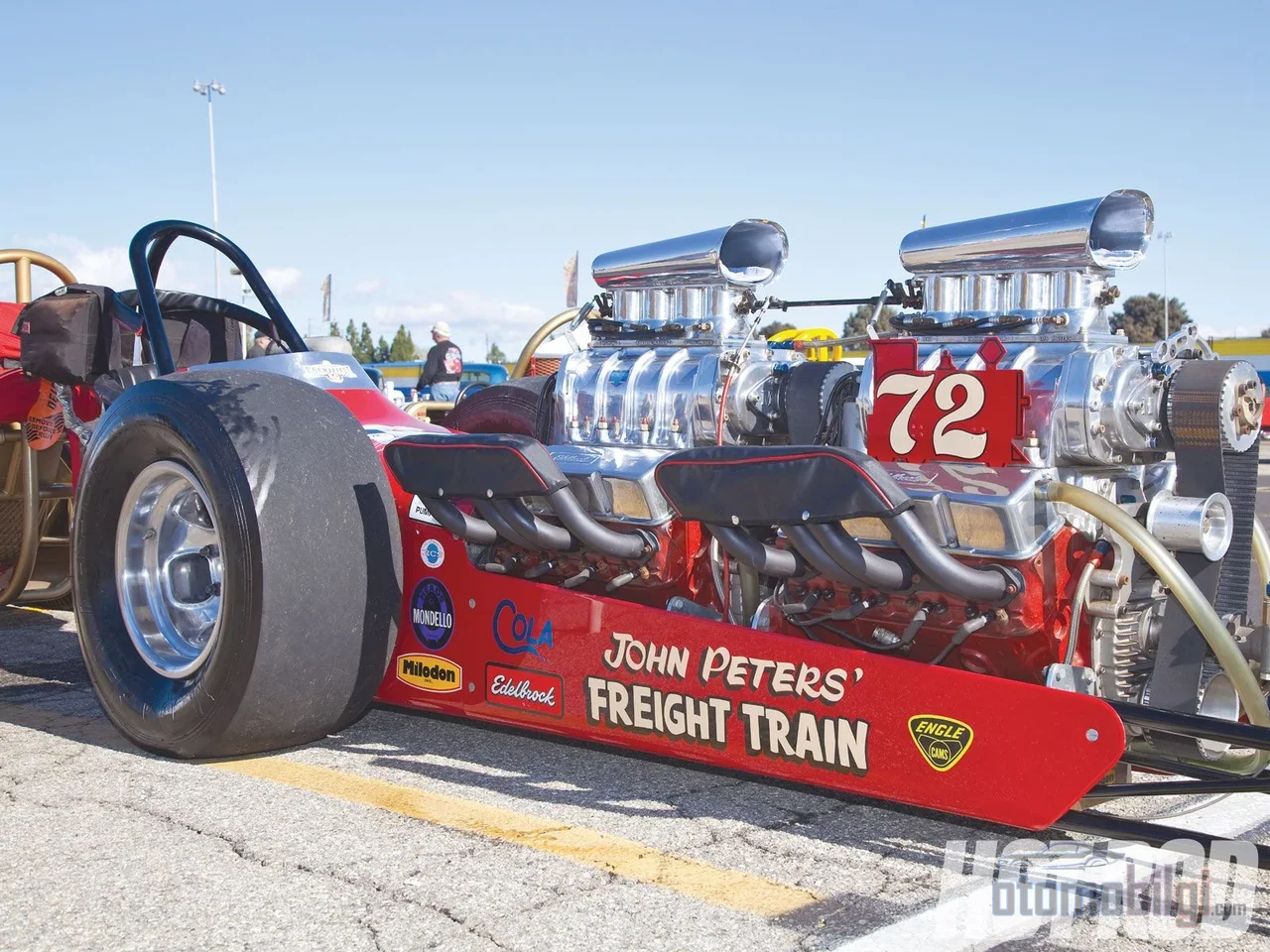
The other half of the power story is the track itself. Professional drag strips use specially prepared surfaces to maximize tire grip. Teams apply traction compound to the starting area of the track before racing; the best known is PJ1 TrackBite, commonly known as VHT, a black, specially formulated synthetic resin. This substance improves adhesion between the track surface and the tires. Then burnouts come into play: the tires both heat up and form a sticky bond with the compound on the track.
The critical point here is track temperature. Cold air may be great for the engine, but a cold surface reduces grip; the tires can't bond sufficiently with the compound, traction is lost, and the car starts to spin. That's why the minimum track temperature before traction loss is a constantly debated topic in racing circles. And here is exactly where the answer to the "best drag racing weather conditions" question becomes clear: although cold, dense, and dry air seems ideal, in extreme cold the ground grip can take back the gains. What's gained in the air can be lost on the track.
Same Day, Same Car, Different Times
Let's return to the question at the beginning of this article: why does the same car run different times on the same day? Because air density changes constantly throughout the day with temperature and humidity, and DA translates this directly into power, which in turn translates into ET. Moreover, according to racers' experiences, the effect isn't even one-directional: a car that runs just fine in cold weather can lose grip as the ground cools and fall below the time it achieved in milder conditions. Every line on the weather chart has to match a line on the engine chart.
The Situation in Türkiye: How Is the Air at Kepez?
For the Türkiye drag scene, these topics are far from theoretical. The Kepez Drag Strip in Antalya is set to be the centerpiece of the 2026 season. In TOSFED's 2026 calendar, auto drag races consist of three rounds, with the first round getting underway on May 2-3. On the motorcycle side, per the TMF calendar, the second round of the Türkiye Moto Drag Championship was run at Kepez on June 6-7, 2026, with the third round planned for September 19-20, 2026. On Antalya's hot summer days, teams running at the strip must factor the DA difference between evening coolness and morning heat into their calculations. In other words, at Kepez it's not just tires and tuning - the air is a competitor too.
Final Word: Even the Sky Has a Dial-In
Next time you're at the strip or watching videos and you see the same car posting different times within a single day, cast your eyes upward: the rival is right there. Temperature, humidity, and pressure shape the engine's breath second by second, while the track surface is the final link transferring that power to the asphalt. A naturally aspirated engine giving up 3% per 1,000 ft, nitromethane burning even in thin air, cold ground wiping out all the gains... they all teach the same lesson: in drag racing, the fast one isn't just the car with the stronger engine, but the one that reads the air. If it were you, which session would you run in - the coolness of the morning or the scorching midday heat?
Sources
- How Altitude, Humidity, and Temperature Affect Racing Fuel Performance
- The Effects of Density Altitude in Racing
- Density Altitude Explained for Racers
- Density Altitude & Car Performance
- How To Tune Your Holley Carburetor for Driving at High Altitude
- How to Tune Your Race Car for Weather Conditions
- Elevation Changes and How They Affect Engine Tuning
- PJ1 TrackBite
- What Do They Lay Down On Drag Tracks To Make The Surface Sticky?
- 12.000 horsepower, the nitro secrets of Top Fuel engines
- What Is Nitromethane? The Complete Guide to Top Fuel's Secret Weapon
- Race Calendar: Türkiye Musatti Drag Championship
- Kepez's drag strip set to make its mark on the 2026 season
- Air Filter Performance and Importance at High Altitude
- What are the best weather conditions for drag racing?