How the Ford Model T Put the World on Wheels?
Share This Page
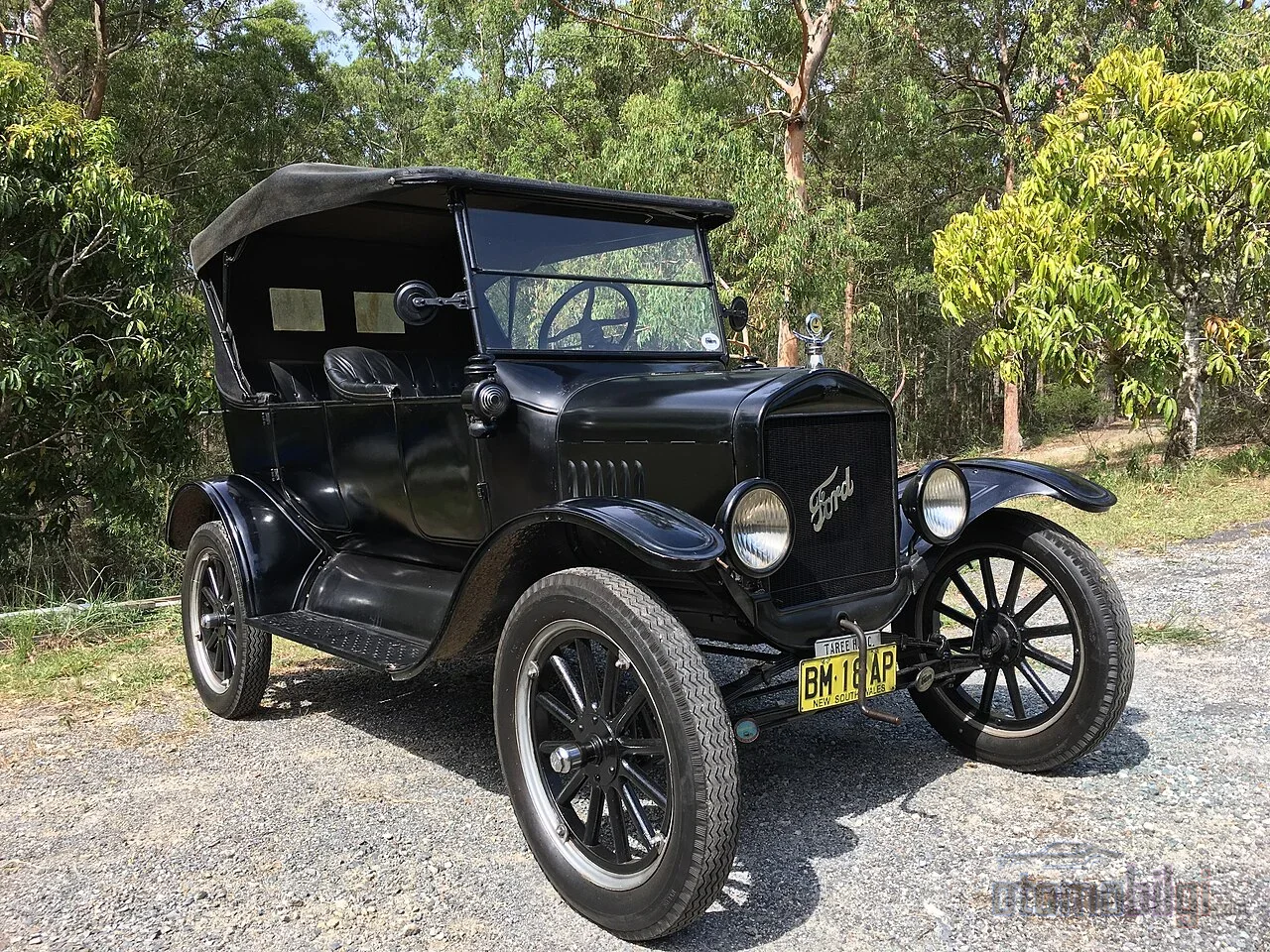
The Ford Model T, which entered production in 1908 and, with more than 15 million units built, became one of the most-produced automobiles in history, was the car that ushered in the modern automobile era through mass production. Reaching a price that an ordinary American could afford, this car put rural America on wheels and decided how the 20th century would take shape.
Highlights
- Production: October 1, 1908 - May 26, 1927, a total of more than 15 million vehicles
- Engine: 2.9-liter inline 4-cylinder, 20 hp, top speed ~68 km/h
- Assembly line production time from 12 hours down to 1 hour 33 minutes was reduced
- Price: in 1910 $780, in 1924 only $290
- In 1918, half of all cars in the US were Model Ts
How Was the "Tin Lizzie" Born? The Revolutionary Moment of 1908
Just think: even when the Ford Mustang or GT40 we all covet today didn't exist, Ford's real legend was a much more humble vehicle. The first Model T was produced on August 12, 1908 and set off from the Piquette Avenue Plant in Detroit on September 27, 1908. The first 12,000 units also came entirely from this factory and were shipped to dealers by rail.
The design team was ambitious too: Childe Harold Wills, chief engineer Joseph A. Galamb and Eugene Farkas were all involved; Henry Ford personally oversaw the design. Lessons had been learned from its predecessor, the Model N, but the result was a far more ambitious product. In the first two days after launch, exactly 15,000 orders were received. Fifteen thousand! Under the conditions of that era, this was like an event where a phone pre-order sells out within seconds today.
The interesting thing is this: the Model T's cult status didn't stem from offering technological marvels, but from its accessibility . While its rivals of the time were asking $2,000-3,000 , the launch price was at the level of $825-850 . Mobility was no longer just a privilege of the wealthy.
The Moving Assembly Line: From 12 Hours to 93 Minutes
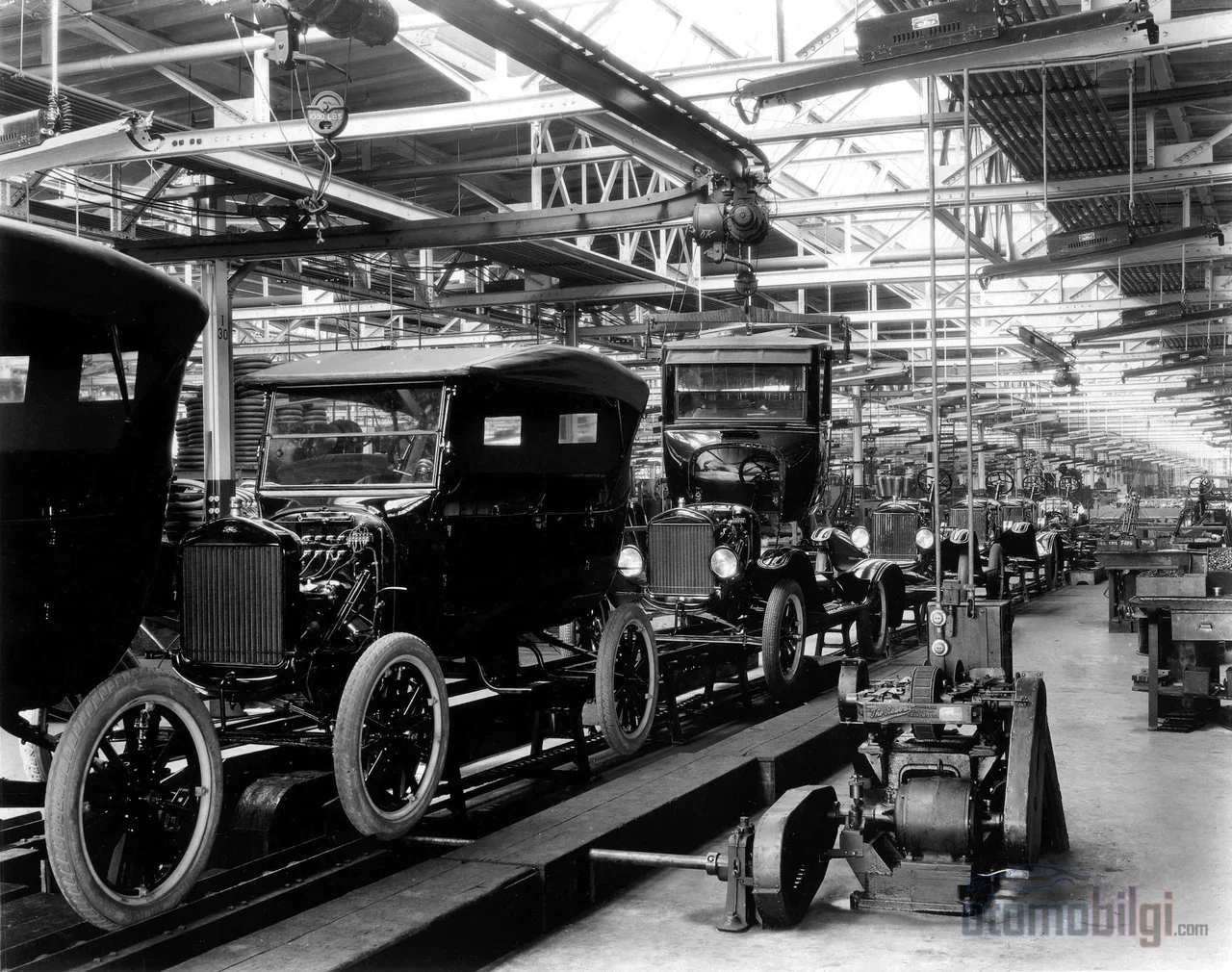
So how can you make a car this cheap? The answer was one of the smartest ideas in industrial history: the moving assembly line, which started operating on December 1, 1913. Ford's engineers combined interchangeable parts, a divided workforce, and fluid material movement into a single system. The result is incredible: a vehicle's production time dropped from 12 hours to 1 hour 33 minutes . Picture it in your head: a car left half-finished in the morning was on the road by evening.
Here's a simple analogy: instead of cooking a meal alone from start to finish, if one person only chops, another only sautés, and a third only plates, the work speeds up incredibly. That's exactly what the assembly line was; each worker performed a single task over and over, becoming a master at it.
Did Ford invent the assembly line?
Actually no, and correcting this myth is important. Ransom E. Olds had developed an assembly line for the Oldsmobile Curved Dash in 1901. Ford's team's contribution was making this system radically efficient and scaling it to millions of vehicles. So Ford didn't invent it; Ford perfected the system. Sometimes revolution lies hidden in making an existing idea several times better - in my opinion, that's a lesson that applies to every field.
"Any Color You Want... As Long As It Lasts": The Truth Behind the Black Legend
The customer can choose any color they want, as long as it lasts.
Everyone knows this sentence, but what most people don't know is this: Not all Model Ts were black! Vehicles produced between 1908-1913 were gray, green, blue, and even red. In 1912, there was a midnight blue body + black fender combination. The switch to black only happened in 1914 and lasted until 1925. So the belief that "they were all black" is one of history's most widespread automotive myths.
So why black?
The reasons were entirely practical. Carbon black pigment was one of the cheapest pigments of the era. Gilsonite (bitumen), which made metal paints durable, only allowed dark colors anyway. Also, a single color didn't mean stopping the assembly line for paint changes - the line kept flowing. As for the claim that "black dries faster," there is no real evidence. And hard to believe, but more than 30 different types of black paint were used during production; so even "one black" wasn't such a uniform black.
Why Was It So Cheap and Durable?
The Model T wasn't a super high-tech vehicle on paper. But it was designed precisely for the farmer's needs: light, sturdy, easy to use and repair, and a vehicle that could run even on the terrible dirt roads of the era. The front axle was made from a single piece of forged vanadium steel; Ford twisted the axles a full 8 turns (2,880 degrees) to demonstrate their durability to dealers. That's a scene that would challenge even today's crazy marketing stunts!
On the handling side, transversely mounted semi-elliptic springs absorbed the large wheel movements on dirt roads. The vehicle was practically designed with the mindset of a tractor or portable engine: you could remove a wheel, attach a belt to the pulley, and run a saw, threshing machine, water pump, or generator. There were even dozens of companies on the market selling kits that converted the Model T into a real tractor - these "doodlebug" tractors became an essential part of farm life.
On the production side, hand labor was abandoned, and the assembly line's efficiency was reflected in the price. Over time, the price dropped insanely: in 1910, the price was $780, by 1924 it was only $290. In today's money, that's roughly a drop from $26,952 to $5,448. In 1925, daily production reached 9,000-10,000 vehicles, and annual production reached approximately 2 million units.
How Did Rural America Get Motorized Vehicles?
Before the Model T, automobiles were produced in small series mostly catering to wealthy urban customers. The Model T reversed this picture: in states with dense rural populations, per capita vehicle registration grew much faster after the Model T. In short, a real motorized vehicle reached America's villages and farms for the first time.
Its impact went far beyond the numbers. It gave young people independence, accelerated the development of rural communities, paved the way for the rise of the suburbs, and increased geographic mobility. As transportation costs fell, urban food prices also declined. That is why the Model T is remembered alongside the airplane, radio, television, and digital computer as one of the inventions that shaped the 20th century. So, if it had been you, what would it have felt like to sit behind the wheel of the first automobile headed to your village?
It was also on the stage of history in World War I: the Allies made intensive use of the Model T as an ambulance, personnel carrier, and light truck. In Poland, an armored derivative called the FT-B was even developed. A modest people's car built a career extending all the way to the battlefield.
Spec Sheet: What's Under the Hood?
The Model T's spec table describes a package that is small but clever by today's standards. Its 2-speed planetary transmission was both simple and robust for the driving conditions of the era - without fiddling with a clutch pedal, the car moved as if it were talking to you.
| Feature | Value |
|---|---|
| Engine | 2.9 L (177 cubic inches) inline 4-cylinder |
| Power | 20 hp |
| Top speed | ~68 km/h |
| Wheelbase | 100 inches (2,540 mm) |
| Curb weight | 540-750 kg |
| Fuel economy | 13-21 mpg |
| Electric lighting | Arrived in 1915 |
| Electric starter | Arrived in 1919 |
The engine's flexibility is also interesting: in addition to gasoline, it could run on kerosene and even ethanol. (So the legend of "designed for multiple fuels" is a bit exaggerated - gasoline was the main fuel, the others were practical alternatives.) Over time the car also got nicer: electric lighting arrived in 1915, and the electric starter in 1919. Fewer and fewer people were cranking the handle and pulling the starting crank out of their pocket, and the car felt more and more like "a modern machine."
The End of the Legend and the Car of the Century Title
The 15 millionth Model T rolled off the line at the Highland Park, Michigan factory under Henry Ford's watch on May 26, 1927. It was followed in 1927 by the Model A - a word of caution: the name did not go to "U", because Ford saw it not as a continuation but as a fresh start , and returned to the beginning of the alphabet.
The record book is also striking: in 1972 the VW Beetle took the title of best-selling car in history from the Model T. Both were "people's cars"; both reached broad masses through affordability and fuel economy. But here is the Model T's real magic: while the Beetle's cult status rests mostly on its design and charm, the Model T's cult was more social than technological. It was a symbol of modernization for the middle class. Its selection as the most influential car of the 20th century in the 1999 "Car of the Century" competition, beating out the BMC Mini, Citroën DS, and VW Beetle, was no coincidence.
Mustangs, GT40s, supercars all faded into the background; the real revolution came from this black-bodied, humble vehicle called the "Tin Lizzie." With its low price, durability, and the idea of being for everyone, it laid the root of the modern world. In my opinion, this is the true starting point of the passion for cars - what do you think, the next time you see a car and say "how beautiful is this," have you ever wondered whether there's a trace of the Model T in its history?
Sources
- Ford Model T
- Our History - Ford Piquette Avenue Plant
- Ford's assembly line starts rolling
- The Moving Assembly Line and the Five-Dollar Workday
- Ford Model T-1911
- The Model T - The Journal of Economic History
- Ford's Model T: Mass Automobility - Studebaker Museum
- "Any color the customer wants, as long as it's black" - James Madison Museum
- K-12 Research Guide: Assembly Line - The Henry Ford
- Wheels of Change - Richmond Fed