How the Moving Assembly Line Brought the Car to the Masses?
Share This Page
The moving assembly line that Henry Ford put into operation at his Highland Park factory in 1913 reduced the assembly time of a Model T from 12 hours to 93 minutes; this leap in speed lowered the car's price so much that the automobile became, for the first time, a product ordinary families could afford. In other words, the assembly line truly brought the car to the masses - not from under the hood, but from the price tag.
Highlights
- Assembly time dropped from 12.5 hours to 93 minutes
- Model T price: from $850 (1908) to $260 (1924)
- December 1 1913: The line ran for the first time for a complete car
- Labor turnover rate soared to around 370-380% by the end of 1913
- January 1914: The $5-a-day wage was announced for an 8-hour workday
How Did the Moving Assembly Line Lower the Price?
Think of it this way: if you're going to build a car, all the parts have to fit together perfectly. Ford's "before" story starts exactly here. Ford didn't invent the automobile, nor did he invent the conveyor. He combined three ready-made ideas: interchangeable parts, workers whose tasks were divided into small steps, and the continuous flow of materials. When these three came together, the result wasn't magic but a highly efficient system - and the bill for that magic was constantly falling prices.
The idea of interchangeable parts isn't actually foreign; it entered American industry with Eli Whitney and took root in the earliest firearm manufacturing. The French gunsmith Honore LeBlanc was also among the idea's early advocates. Ford adopted this principle in automobile manufacturing long before it became an industry standard. Why is this so important? Because if parts are interchangeable, the worker no longer needs to file and fit parts; assembly becomes a straightforward joining task rather than trial and error. And the joining work can be divided. Divided work speeds up. A simple but massive domino effect.
Highland Park: First Experiments in the Glass Palace
The setting is Michigan. In 1907, Ford buys 130 acres of land in Highland Park; the factory is designed by Albert Kahn, and thanks to its glass roof and glass walls, the building earns the nickname "Crystal Palace." Production moves here in 1910 from the Piquette Street facility in Detroit. This is exactly the main setting of our story.
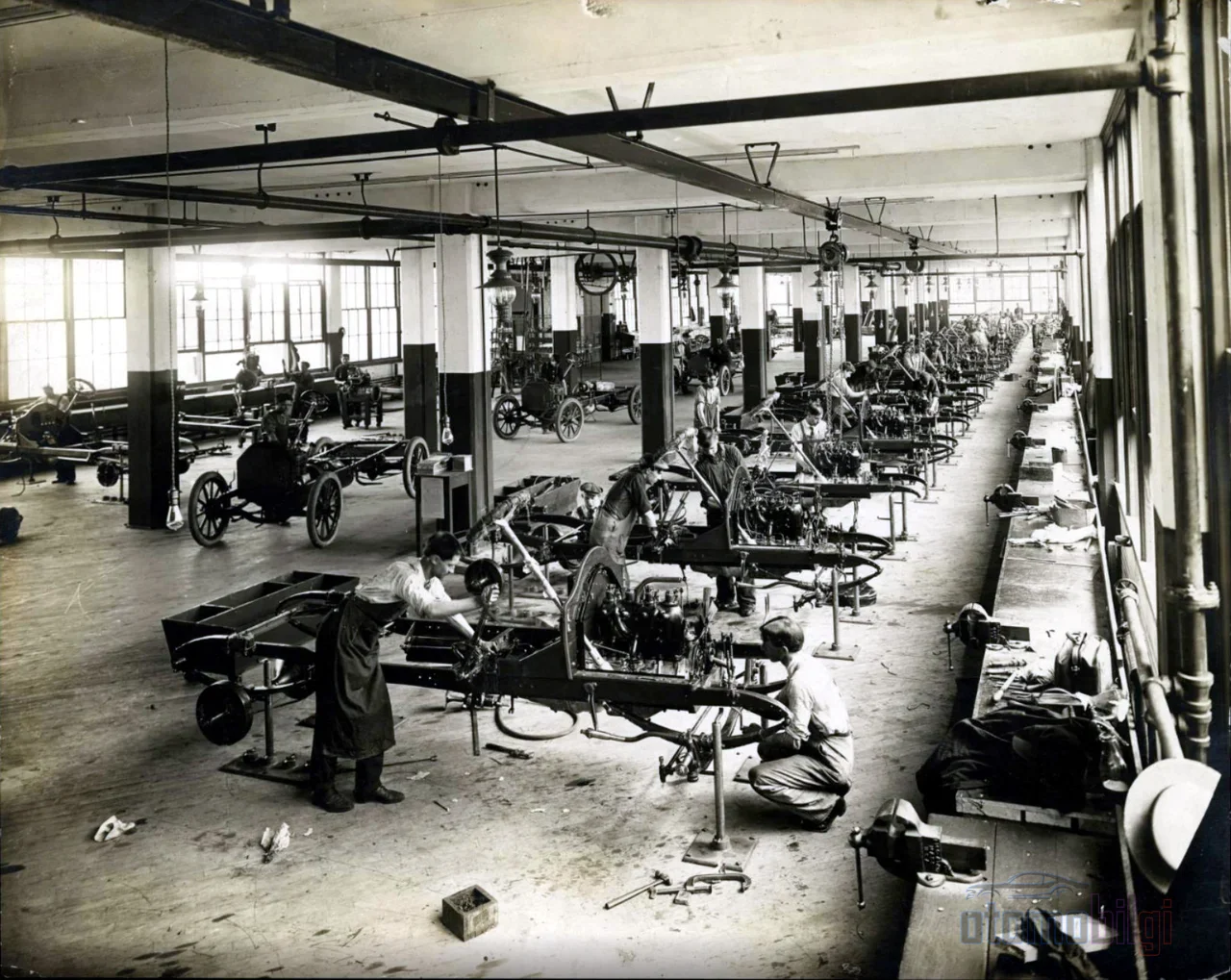
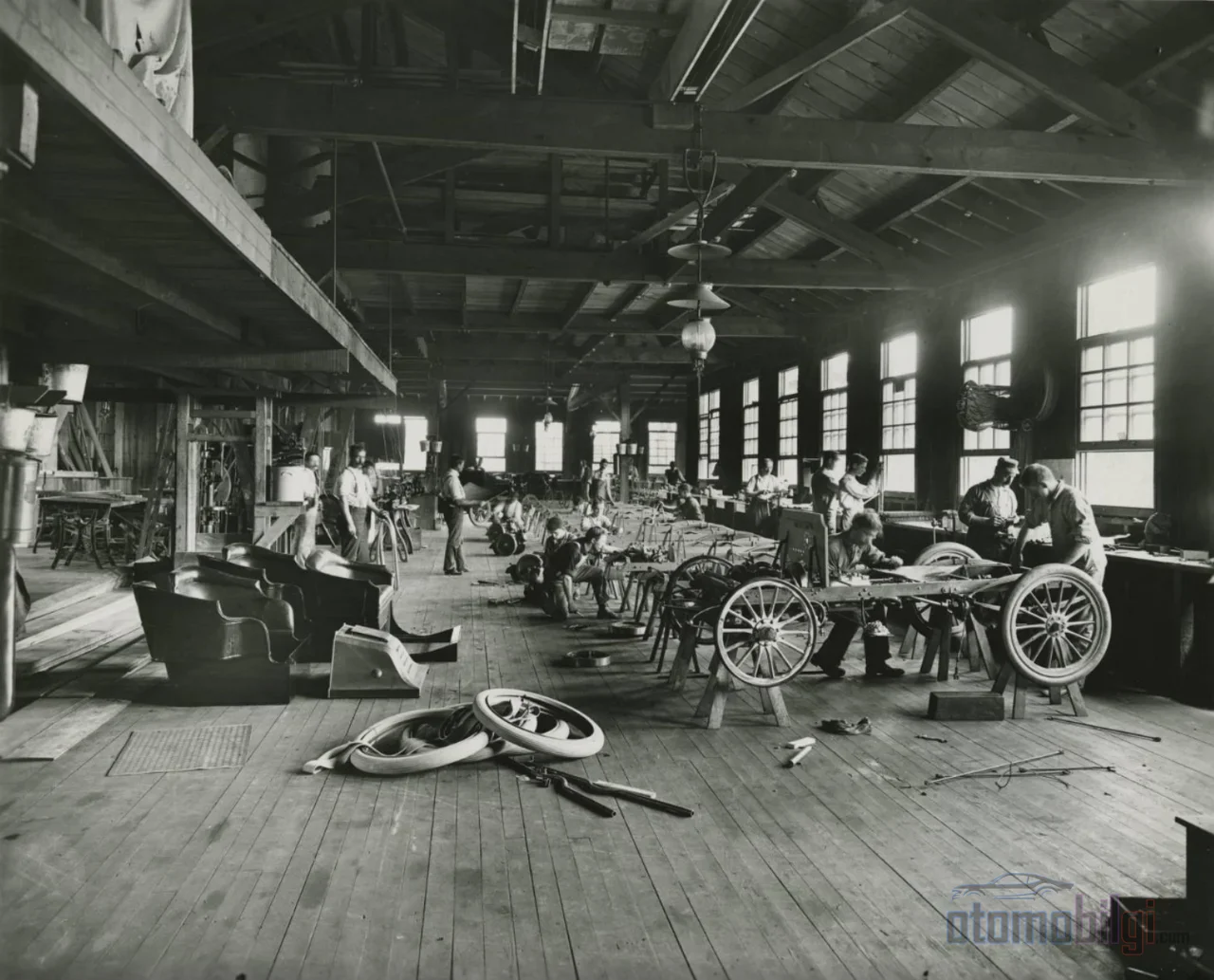
The first experiments aren't as elegant as you might think. In April 1913, Ford begins magneto production with a crude moving line. Even rope is used on the early lines; workers push and pull cars from station to station by hand. This "sliding" method is both exhausting and chaotic. Then comes a chain-driven system, solving two things at once: handling work is reduced, and the pace of work is automatically regulated. In other words, the tempo now depends not on the worker's stamina but on the speed of the line.
The inspiration isn't entirely original either; it is borrowed from bakeries, flour mills, breweries, and especially meatpacking plants. The "disassembly line" principle in slaughterhouses - the step-by-step breakdown of a large animal - is reversed and adapted to automobile production. Parts come together and turn into a car. Clever, isn't it?
From 12.5 Hours to 93 Minutes: The Line Starts Rolling
Write it in your historical notebook. October 7, 1913: Highland Park is running with a continuously moving assembly line for the first time. December 1, 1913: Ford sets up the first moving assembly line for a complete automobile. Then, January 14, 1914, Model T chassis are fed onto a chain-driven line - the culmination of separate production lines merging.
The result? The numbers are incredible. The assembly of a Model T drops from 12.5 hours to 93 minutes . In the first stage in between, the time falls to 6 hours, then, as the system settles in, down to 93 minutes - that is, 1 hour and 33 minutes. The production process is divided into 45 separate steps . By April 1914, three parallel chassis lines are running simultaneously, and workers can assemble more than 1,200 chassis in 8 hours. Daily production leaps from hundreds of cars to thousands. Remember that the belt moves at its own speed: the slowest station in the system sets the pace of the entire line. This principle has remained unchanged from that day to this.
How Did the Model T Become the People's Car?
Here is the heart of the story. As speed increases, costs drop, and Ford passes part of the savings on to the consumer. The table tells it all:
| Year | Model T price |
|---|---|
| 1908 | $850 |
| 1914 | $490 |
| 1924 | $260 (about $8,200 in today's money) |
Now think about what this means. The $850 car was, thankfully, in the "rich man's toy" class. The $260 car, on the other hand, dropped to a level an average working family could afford . So the assembly line didn't just provide speed at the factory; it completely changed the car's social status. As the belt turned, prices fell, and as prices fell, the customer base exploded. The Model T, until May 1927, with more than 15 million sales, went down in history as the world's best-selling car. The first car to reach the masses - literally.
The Dark Side of the Line: Worn-Out Workers and the Five-Dollar Day
Now the other side of the coin. The line was brilliant, but working on it was anything but great. The relentless pace, the same movements repeated all day long, rigid scheduling... Everyone had to work the same hours, and time cards were even printed for workers to enforce the rules. The result: by the end of 1913, Ford's labor turnover rate reached approximately 370-380%. In short, workers couldn't stop quitting - the factory was losing people, and hiring more people to make up for the losses.
Whereupon, in January 1914, Ford announced the famous "five-dollar day" of history: for an eight-hour workday, 5 dollars. The previous rate was $2.34 for a nine-hour workday; in other words, wages doubled while the workday was shortened. That's more than twice the going rate of the time. So, was it generosity? Hold on. Most historians answer with a clear "no": the main purpose of the wage increase was to stop the maddening worker turnover. The five-dollar day boosted employment at Highland Park, and by 1925 the number of workers at the factory reached nearly 70,000 reached; on the academic side, this fee was debated for years under the concept of the "efficiency wage." In other words, speed and prosperity were wrapped into the same package, but the package's binding was the worker who did not quit.
The Imitators and the Slowing Revolutionary
The assembly line was so effective that other major automakers adopted it quickly. The productivity gains and price cuts directed manufacturers of every kind toward Ford's methods; most of the fundamental methods are still used today. About the collapse of independent small manufacturers, the "Ford blitz" narrative - that is, competitors crushed by Ford's price pressure - is popular. But there is an interesting counterargument: it is claimed that Ford's pressure played no greater role in this collapse than the manufacturers' own management incompetence. Bad management is always the fastest-closing door.
There is also a bittersweet lesson. Ford's leadership was not shaken until the mid-1920s; but then Ford lost by rejecting change proposals for this very system it had created. In other words, the person who created the assembly line was late in learning that it needed to be questioned. The lesson showing everyone that innovation is not a permanent title came from its own inventor.
The Line Extending to Today's Factories
You think: "Okay, but are factories still the same line today?" Answer: the sequential flow logic - the pure product moving from station to station - yes, still standard. The origins go back a very long way: from the Venice Arsenal to Springfield Armory, then to Ford's 1913 line and Toyota. Toyota's contribution is also exciting: by questioning one of the assembly line's assumptions, it achieved a 40% saving in capital investment.
The line's power was also tested during the war years: in World War II, Ford applied automobile production techniques to the B-24 bomber; at Willow Run, at its peak, an aircraft came out on average every 63 minutes The transition from car line to aircraft line proved how flexible the system was.
And the current part: Ford announced that it is reshaping the iconic assembly line to produce affordable electric vehicles and compete with Chinese rivals - it is described as a 5 billion dollar gamble. Toyota is also overhauling its US facilities for flexible, fast EV production. So that belt that started turning in 1913 has been turning for more than 110 years - only this time it is being charged.
The Belt Is Still Turning
The story of the moving assembly line is not just a story of speed; it is a story of lowering a product's price and bringing it to millions. When interchangeable parts, divided labor, and the idea of flow combined, 12.5 hours of assembly dropped to 93 minutes, an 850 dollar car dropped to 260 dollars, and the automobile became a product of the masses. The cost was the wearing down of workers, and the lesson came with Ford's resistance in the 1920s. Today, while the line is being redesigned for electric vehicles, the question I should not ask is this: which product in your life came off the end of an assembly line without you knowing?
Sources
- Ford Implements the Moving Assembly Line - This Month in Business History (Library of Congress)
- K-12 Research Guide: Assembly Line - AskUs (The Henry Ford)
- Ford's Five Dollar Day Revolution (The Henry Ford)
- Highland Park: Birthplace of the Moving Assembly Line (Ford From the Road)
- Ford's assembly line starts rolling (History.com, Dec 1)
- In 1913, Henry Ford Introduced the Assembly Line (Smithsonian Magazine)
- Automotive industry - Ford and the assembly line (Britannica)
- Did Henry Ford Pay Efficiency Wages? (NBER, Raff 1986)
- Assembly line (Wikipedia)
- Ford ditches the assembly line to make cheap EVs (Morning Brew)