Maintenance on LPG Vehicles: The Filter and Regulator Question
Share This Page
There is an invisible world in the cockpit that separates an LPG-powered car from its petrol counterpart: a line running from the tank to the regulator, and from there to the vapor-phase filter; parts along that line that over the years get clogged, worn, and leaky. Yet most owners still set their calendar according to the periodic maintenance schedule of a petrol car and forget about LPG-specific items until the first service reminder arrives. What is more, the price of this neglect is paid not at the moment of failure, but sometimes years later in the valve seats, or sometimes on a morning when the engine will not start.
So what items does maintenance on LPG-powered vehicles actually cover, and how many thousand kilometers should filters and the regulator really be serviced? In the words of those who have spent long years in this business: copying the petrol maintenance checklist is not enough; you need to keep a separate schedule. This article builds that schedule.
Why Does an LPG System Require Different Maintenance Than a Petrol System?
LPG is fundamentally different from petrol as a fuel: a dry gas. This dryness has a direct consequence for the engine. As petrol passes over the intake valves and valve seats, it provides a certain degree of lubrication; LPG does not. The result is a slow but permanent wear known as valve seat recession, especially in engines not fitted with hardened valve seat inserts. This is exactly why lubrication kits called valve savers were developed: an additive dosed in small amounts into the fuel cools, lubricates, and keeps clean the upper cylinder area.
The differences do not end there. A vehicle running on LPG can put more strain on its ignition system than on petrol; the fuel line is protected by filters; and the regulator, the unit where the gas passes from liquid to vapor phase and its pressure is adjusted, wears out its diaphragms and valves over time. It is therefore not surprising that an LPG-powered car left idle for a long time has trouble starting on the first attempt - even if the system has run flawlessly for years.
Highlights
- Gas filters are replaced, depending on their type, roughly every 15,000-35,000 km, according to the unit manufacturer's recommendation.
- Some manufacturers give the maintenance interval as 25,000 km or every two years.
- The regulator filter should be serviced at least once a year.
- In LPG vehicles, the spark plug gap is usually set slightly smaller than the stock value, with example values around 0.6-0.8 mm.
- Valve saver additive is typically used at a dosage of 1 mL of liquid / 1 L of fuel.
How Many Thousand Kilometers Should Filters Be Replaced?
In an LPG system there is not just one filter but several: the pre-filter on the liquid-phase line after the tank, the parts inside the regulator, and the filter in the gas stage after the vaporizer. Their intervals are not all the same, and this is confusing at first. For example, one unit manufacturer recommends replacing the gas filter roughly every 15,000-35,000 km depending on its type; another ties maintenance for its own vapor injection system to 25,000 km or two years, subject to authorized service conditions. The common practice on the service side is stricter: Every 10,000-15,000 km or once a year, whichever comes first.
The difference is not arbitrary. Large-displacement engines - 5-6 liters and above of cylinder capacity - consume gas faster and the filter fills up sooner. Dusty, dirty refueling points also shorten the interval. The practical rule is this: go by the figure in the user manual that came with your unit; if the manual is silent, an annual check with replacement in the 15,000-20,000 km range is a balanced schedule for most uses. For the gas-stage filter, i.e. the post-vaporizer filter, about 20,000 km is considered a reasonable upper limit.
A clogged filter does not announce itself immediately, but it restricts gas flow; the engine struggles during acceleration, performance drops, and the injection system calibration goes out of adjustment. That is why filter replacement should be treated not as a fault remedy but as a routine maintenance item.
Regulator Maintenance and Signs of Failure
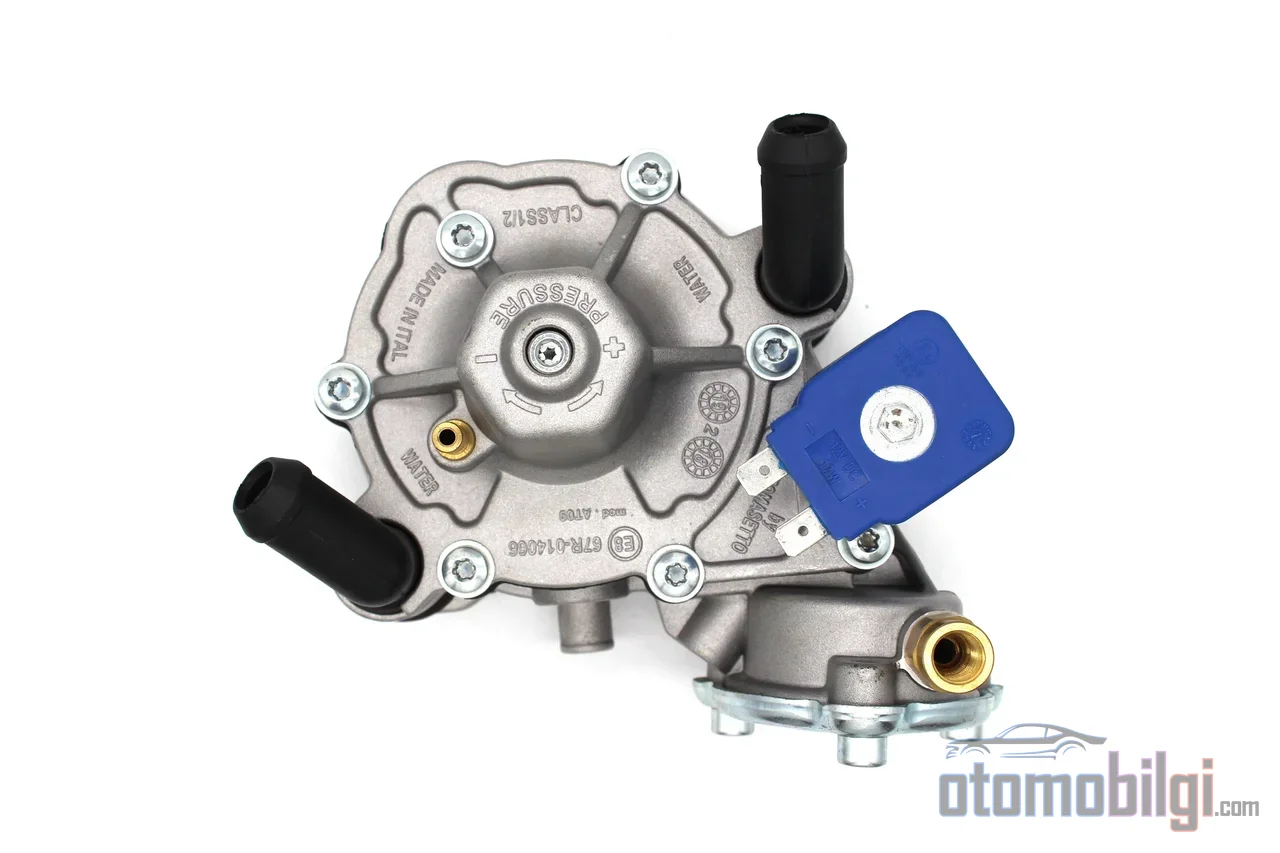
When it comes to the heart of the system, the first part that comes to mind is the regulator. Gas filter maintenance should be done at least once a year; in addition, the intake side is cleaned and system settings are updated after the service. The regulator itself is not a lifetime part: diaphragms, seals and valves wear out over time.
How do you tell a faulty regulator?
- Gas smell: a constant and noticeable gas smell around the regulator or the tank means a leak; the car must be taken to the service without delay.
- Hissing sound: a constant hissing from the connections indicates that gas is escaping from the cylinder, valve, hose or regulator; the sound increases as the leak grows.
- Gas smell from the regulator vent: it usually points to a damaged diaphragm or a safety valve problem.
- Unstable gas flow: a clogged filter or a sticking regulator valve disrupts fuel flow; the engine idles roughly and struggles during transitions.
- Difficulty starting, inconsistent running and traces of corrosion indicate that the time has come to replace the unit.
Icing on the vaporizer can also be a signal, but there is no need to exaggerate: slight partial icing in winter is normal. If the icing is persistent and heavy, especially accompanied by a drop in performance, do not delay booking a service appointment. A safety note: the LPG system remains pressurized inside the lines even after the engine is turned off; working on the system yourself is a job that should not be attempted without the manufacturer's procedure.
Spark Plugs and Ignition System: What Should the Interval Be?
LPG, unlike diesel, burns with a spark rather than compression; so ignition system maintenance becomes even more critical than with gasoline. Fleet maintenance manuals recommend spark plug replacement approximately every 80,000 km, an interval roughly equivalent to four oil changes. User experience, however, says that LPG burns more slowly than gasoline, so setting the spark plug interval slightly below the stock value usually gives better results; in forums, for example, values like 0.6–0.8 mm are circulating, whereas the stock setting may be around 1.1 mm.
You need to be measured here. It is not mandatory to narrow the range for every engine; even the expert services themselves debate whether it is always necessary. When deviating from the stock value, it is also essential not to overdo it - not exceeding more than ±0.008 inches is a common recommendation. The healthiest approach is for the service that installs your system to know the setting specific to your engine and to apply it without straying too far from the manufacturer's value. Having the gap checked by hand when installing new spark plugs is a free precaution that takes only a few minutes.
Valve Seat Protection: Is a Valve Saver Necessary?
The dry fuel issue we touched on above is the topic that owners of older engines worry about the most. Valve saver kits cool, lubricate, and clean the valve seat by spraying small doses of additive into the fuel; the typical dosage is about 1 mL of liquid per liter. Lubrication is known to be most effective at idle and light throttle - meaning the kit's job is more meaningful in usage dominated by city traffic.
So is it essential in every LPG vehicle? There is no definitive answer. Manufacturer catalogs and sellers say the kit is necessary; user experience shows that the kit makes sense especially in older engines without hardened valve seat reinforcement. In most modern engines the seats are already hardened, and the debate over whether it is needed continues. The most honest approach: know your engine's valve setup, decide according to your vehicle, and remember that no additive works miracles.
Things to Watch in the Tank, Lines, and Inspection
The LPG tank is an invisible part as long as you use the vehicle, but it requires regular inspection. As part of the periodic check, the body and weld seams are scanned for corrosion, pitting, and cracks; wall thickness is measured with ultrasonic testing; the opening pressure of the safety valve is checked. Tank inspection covers not only the body: corrosion and grounding, the regulator, valves, and all connections are part of this examination. Inspection requirements and intervals vary by location; in some regions a five-year period applies to portable tanks, while the rules differ for fixed-installed tanks. Knowing the legislation your own vehicle is subject to is the only safe way in this matter.
You will also deal with both inspection intervals. Frost forming on the fuel line is a visible clue to a gas leak; develop the habit of visually checking the line. Also, whenever any work is done on the system, propane-compatible gloves and protective goggles must be used - this has become a standard rule, even included in fleet maintenance guides.
A Practical Maintenance Schedule: What to Do Where?
| Maintenance item | Recommended interval |
|---|---|
| Gas filters (depending on unit/filter type) | Approximately every 15,000–35,000 km or once a year |
| Regulator (reducer) filter maintenance | At least once a year |
| General system check (authorized service) | Every 25,000 km or two years |
| Spark plugs | Approximately 80,000 km (about four oil changes) |
| Valve saver additive dosage | Approximately 1 mL of liquid / 1 L of fuel |
| Tank inspection | According to local regulations; body, weld seam, wall thickness, safety valve |
When tying the schedule to your calendar, keep this in mind: some manufacturers give recommendations based on mileage, others based on years. The most practical rule is to follow the whichever comes first principle. Once a year, preferably in spring, the system should be fully inspected; a system that gets through winter without strain will also be ready for the summer months.
Frequently Asked Questions: It Smells, Clicks, Sweats - What Should You Do?
Let's take the three situations readers report most often, one by one. First, the smell of gas: this is never a symptom to be expected and brushed aside; if there is an odor around the regulator and tank, the vehicle should be inspected before it is driven. Second, loss of performance: the most common cause is a clogged filter; blaming the regulator without replacing the filter can prove costly. Third, a system that has been out of use for a long time: even an installation that has run trouble-free for years can act up on the first start after a long shutdown; in such vehicles, the lines, filter, and regulator should be checked first.
There is also one question that cannot be answered definitively: can the engine oil change interval be extended with predominantly LPG use? This topic is debated among users and no firm rule has settled; the safest approach is to stick to the oil change interval in the vehicle's manual.
Conclusion: A Separate Schedule, A Small Expense
It's clear that LPG lowers fuel costs compared to gasoline; but the price of this advantage is keeping track of a few maintenance items that gasoline doesn't have. The summary rationale is this: replace the filters on schedule - if there is no manual, inspect once a year, replace within the 15,000-20,000 km range; renew the regulator filter at least once a year; install spark plugs suited to your engine, at a modest interval, and have them checked; take the valve saver option seriously on older engines; don't neglect the periodic inspection of the tank and lines. With symptoms like the smell of gas or hissing, there is no room for negotiation: the vehicle stops and gets inspected. Let's say it with thirty years of habit - keeping this schedule is not more work than running on gasoline; just a different list.
Sources
- Service on your Prins VSI LPG system
- Filter maintenance of our LPG reducers - Tomasetto Achille
- LPG Service: What's Included and How Often
- What is the lifetime of the LPG installation?
- Propane Bus Maintenance Schedule: Complete PM Guide
- How does an LPG system work?
- How to Tell If Propane Regulator Is Bad: 9 Major Signs
- Does my engine need additional lubrication
- Periodic Inspection of LPG Tanks
- Do I always need to reduce spark plug gap for LPG?
- Best practices for propane vehicle maintenance