Why Is the Track Sticky? The Art of Preparing a Drag Strip
Share This Page
The reason tracks become sticky is special synthetic resins sprayed onto the surface to ensure tire grip at launch, in other words traction compounds; this stickiness reduces wheel spin, allowing the car to transfer its power to the asphalt and launch faster. So that famous sticky feeling is no accident, but the result of a preparation process lasting hours. So how is that black, honey-consistency liquid applied to the track, how does grip change with temperature, and how does a track evolve over a race weekend? Come on then, let's put the unsung hero of the quarter mile under the microscope!
Highlights
- Products such as PJ1 TrackBite applied to tracks are special synthetic resins that increase tire grip.
- The best grip comes from tire-on-tire contact: the ideal surface is tire film plus compound.
- The compound, thinned with methanol, leaves the track ready for use in about 5 minutes after it evaporates.
- The main component of the 60-foot time is grip; a well-prepared track means a lower ET.
- The center of the quarter mile in Türkiye is the Antalya Kepez Drag Strip, with its 830-meter track.
Why Is the Track Sticky and How Is This Stickiness Created?
While watching drag racing, have you ever wondered how those massive cars shoot out like a cannon? The secret of that launch isn't in the tire, but actually on the ground. The surface of a drag strip consists of two overlapping layers: a thin tire film deposited from the tires over thousands of passes, and the traction compound applied on top of it. The most efficient grip emerges when the tire contacts rubber; in other words, the ideal track essentially behaves like a giant tire surface. On a concrete track, this rubbering-in process works differently than on asphalt, so not every track is prepared the same way.
The adhesive they use is a pretty serious chemical product: PJ1 TrackBite and similar products are synthetic resins specially formulated for drag racing, typically black in color. Let me give you an analogy from everyday life: think of a piece of gum forgotten on the asphalt on a hot summer day sticking to your shoe, but engineers do this deliberately and under control. The difference is that track stickiness works like a critical piece of equipment, not to save the tire, but to lock the power to the ground.
How Is Traction Compound Applied? Step-by-Step Track Preparation
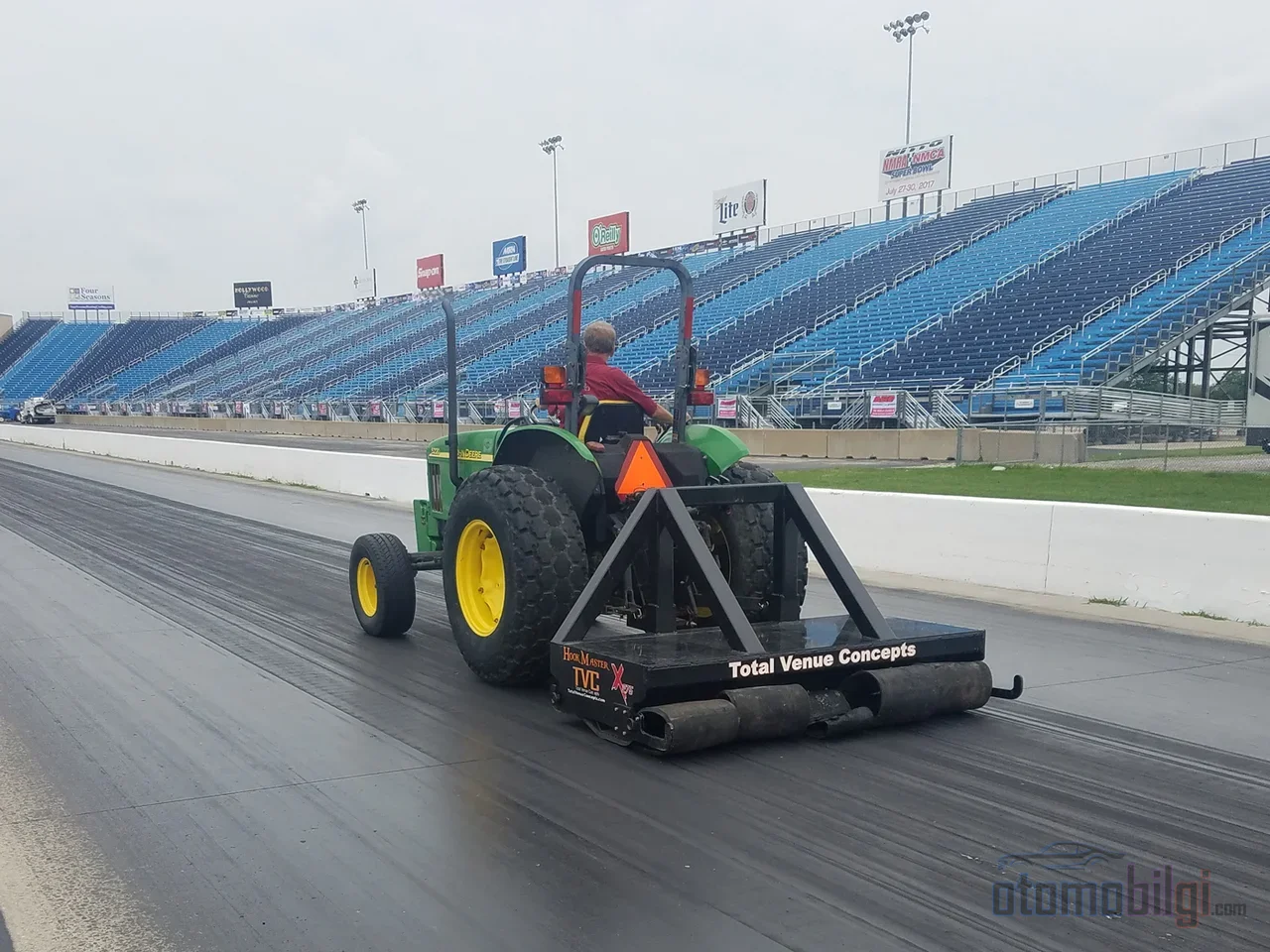
In the early hours of the morning, work begins before the racers even arrive at the pits. The preparation actually starts outside the track, with the pit area being swept, cleaned, and vacuumed; every centimeter from the staging lanes to the starting line is scanned. Why so meticulous? Because even a tiny pebble left on the track can stick to the tire and ruin that lifesaving grip. Cleaning and maintenance are just as important as spraying the compound; just spraying adhesive and moving on is one of the most common mistakes in track preparation.
Rosin, Rotator, and Spinning Tires
The start of the basic recipe is simple: baseball rosin, meaning that resin-like substance used to improve grip on a baseball, plus a traction compound on top of that. Then the real stars come into play: drag rigs equipped with spinning tires, attached to tractors. These vehicles drive the tire across the track, sometimes even spinning it in reverse in certain techniques, coating the surface with a thin layer of rubber. In the rotator technique, setting the tire pressure correctly - that is, the air being just right - is one of the critical details that determines the quality of the job. Some tracks around the world even have their own rotators with serial numbers; serious business, serious equipment!
Bald Spots and Spot-On Application
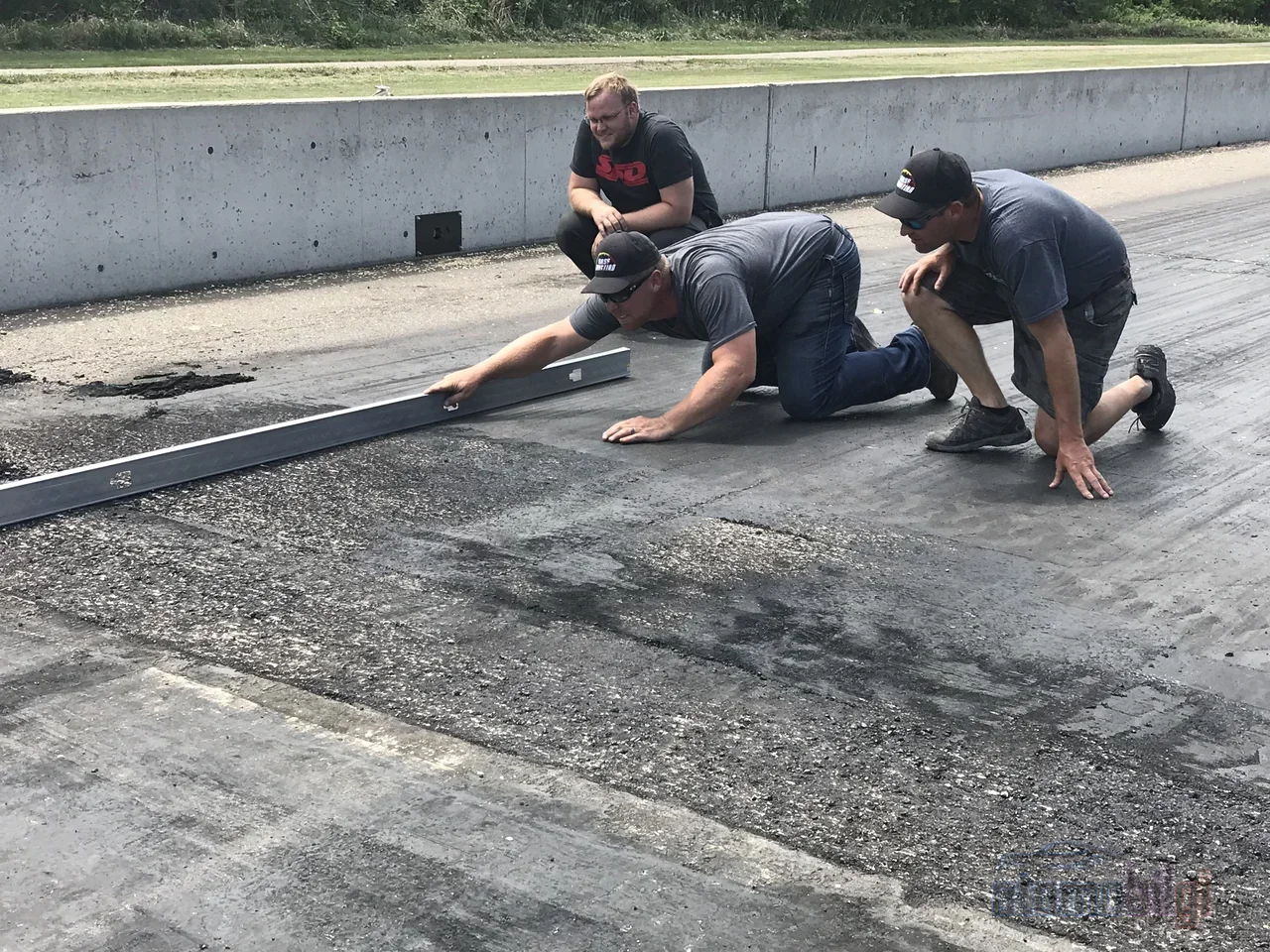
There is also one annoying problem on the track: bald spots. When low-horsepower cars with narrow tires use the same launch point every time, the tire film gets wiped away from there, exposing bare concrete. If left untreated, the area grows and ETs gradually get longer. The solution is almost surgical: compound is first sprayed onto the bald spot, then powdered rosin is sprinkled on and swept, and another layer is sprayed on top. A compound thinned half and half with methanol is applied as a mist, and once the methanol evaporates, the track is ready for use in about 5 minutes. Moreover, these products do not harm the asphalt and are sold in giant 55-gallon drums. For high-horsepower cars, compound is sprayed over a 15-20 feet area in front of the tires, followed by a light burnout on top of it.
How Does Track Temperature Affect Grip?
Temperature is the invisible but most powerful player in this business. The sun heats the track surface, raising the surface temperature, and a hot surface offers a hotter starting point for slick tires. On a cold track, however, the tires start cold and grip drops noticeably. Racing tires become stickier and more gripping when they reach their operating temperatures; just like frozen gum hardening and solidifying in winter, the tire compound only shifts into performance mode when it finds heat.
There is also a concept the track community loves very much: taking rubber, that is, the process of the track taking rubber. On hot summer days, when heat, weather conditions and racing intensity stress the surface, thousands of passes work the tire film deeper into the track, and the track essentially ages, changing its grip character. That is why the same track can look completely different in the morning than in the evening. Racers learn to read the track like a living thing: the one who observes the surface, follows the temperature and makes their adjustments accordingly wins.
Grooved or Rubbered-In? Surface Differences
No two tracks are created equal. A newly opened, scraped and almost bare surface behaves completely differently from a surface that has seen years of racing and been coated in rubber. On a rubbered-in track - that is, a track worked in with tires - the surface essentially carries a skin made of rubber, and grip is both high and consistent. On concrete tracks, the rubbering-in process progresses differently than on asphalt; the texture of asphalt holds the compound, while concrete, being less porous, calls for a different strategy.
At this point, there is an interesting debate in the industry as well. No prep culture - that is, the unprepared racing phenomenon - is not always clear about how unprepared the surface actually is: sometimes the track is scraped, swept and glued the day before the race, and sometimes old rubber and glue residue is merely swept and used as is. Yet experts say that a neglected layer of old rubber and glue can offer even less grip than bare concrete and can be dangerous. For this reason, some tracks find it safer to adopt a no prep approach, taking the track down to completely bare concrete and letting the racer use their own compound.
The Scraping Process: The Moment the Track Resets
Every good thing has its cleaning day. After each event, the accumulated rubber and compound layer on the track is scraped off, and if the buildup is too heavy, scraping can even be done during the event. But this is not a matter of wiping it with a sponge! Manual scraping can take 6-8 person-days. Professionals, on the other hand, put machines to work: a 32-inch scraper mounted on a skid-steer, with flames reaching 6 million BTU, takes the entire quarter mile down to bare concrete in a single day. Of course, if the flame gets too close to the rubber, the rubber turns into a melted carbon mass and can even blast the concrete apart; in other words, this is not a job to be left to amateurs. If we call the track scraping machine the quarter mile's quiet yet most effective hero, that would be fitting.
How Does Track Grip Determine the 60 Feet and Reaction Time?
Now let's move on to the racer's side of things. The first section of the quarter mile, the 60 feet distance, is the gold standard showing how good a launch is. The main component of a good 60 feet time is grip; the tires should barely slip at all at launch. Even Top Fuel cars are not exempt from this rule. If the track surface is not well prepared, even the world's most powerful engine cannot transfer its power to the ground, and the driver just watches in front of the christmas tree. For comparable 60 feet times, launch parameters must be kept constant: the same tire pressure, the same diameter, the same engine rpm, and the same staging tactic. Moreover, the chain of benefits of a well-prepared track is long: better 60 feet, lower ET, and longer tire life. So compound does not just add speed - it is also good for your wallet!
This connection can also be seen in the world of radial tires: in recent years, radial tire records on well-prepared tracks have been utterly turned upside down; after runs like 7.53 seconds @ 191 mph, one driver ran 6.78 seconds @ 218 mph on the track, improving the record by a full 8 mph. Whether it all comes down to the tire or the track is debatable, but the two certainly work together.
Track Preparation Examples from Türkiye and Around the World
In Türkiye, the track itself in drag races is also shaped according to the rulebook: for 402-meter quarter mile runs, the track must be 782 meters long and 11 meters wide; in addition, there must be an approximately 30-meter rubber heating section. While the length measurement varies somewhat across different sources, the essence is the same: the strip should end, with clean-up in between. Among the races that first introduce these standards to the driver are the auto drag races held at the Saraçoğlu Drag Strip in Konya. The country's quarter-mile center is now unquestionably Antalya Kepez: With its 830-meter strip, Kepez is hosting seven championship rounds in the 2026 season; the weekend of September 12-13 is one of the dates on which a round was held.
Looking at the global stage, the picture becomes even more professional. Santa Pod Raceway, one of Europe's leading and fastest strips, openly says it owes its grip to VP Racing's compound. In the USA, under the NHRA umbrella, strip preparation is almost an art: Even in the announcement of the NHRA Pro Mod event held at Flying H Drag Strip in 2026, it is specifically stated that NHRA rules and strip preparation standards will be applied. So no matter where in the world you go, behind that sticky surface lies the same discipline: cleaning, compound, rotator, and patience.
Conclusion: Grip Is No Accident, It's a Craft
The next time you see cars locking onto the strip in a drag video, you'll now know what's going on: there's a sprayed resin there, thousands of tires driven over it, a calculated temperature, and perhaps a surface that was won and cleaned that very morning. The quarter mile is far more than a duel between two cars; it is also a silent negotiation with the strip itself. Which do you think is harder: finishing 300 meters in seconds, or getting those 402 meters ready for the run? In my opinion, think about both, and your answer might change!
Sources
- Track Prep 101
- Strip Grip Traction Compound
- PJ1 TrackBite
- I'm Rubber, You're Glue: Prepping for a Drag Race
- Track Prep and Maintenance
- Be Ready For Race Day Track Conditions
- Drag Racing 101
- Drag Races - Türkiye Motorcycle Federation
- Kepez's drag strip will leave its mark on the 2026 season
- Quarter Mile Mania at Flying H