Habits That Wear Out Your Battery Early and Signs It's Time for Replacement
Share This Page
The battery may seem like the cheapest failure item on a vehicle, but it is the part that creates the most expensive situations: if you get stranded on the road on your way to work, the time you lose, the towing and jump-start costs add up to a far higher bill than replacement. An average car battery lasts 3-5 years; with the right usage habits, this can extend to 5-6 years. In other words, battery life is determined not so much by the part itself as by how you use it.
Highlights
- Average battery life 3-5 years; with the right habits 5-6 years.
- A fully charged battery at rest reads 12.4-12.8 V ; below 11.8 V it is most likely dead.
- For every 10 °C rise in temperature, the battery's chemical aging doubles.
- For the alternator to fully charge the battery, approximately 15-20 km of uninterrupted highway driving is required.
- Between November and February, battery-related service requests increase by up to 170% .
What Habits Wear Out Your Battery Early?
The battery's job is simple: deliver high current to the starter motor when the engine is off, power the electrical consumers while the engine is running, and store the alternator's surplus. Lead-acid chemistry likes this simple job only under certain conditions; when conditions deteriorate, it wears out quickly. In most prematurely dead batteries, the cause of the failure is the usage pattern rather than the quality of the part.
Short-distance use: the silent life shortener
Every start draws a significant amount of energy from the battery, and it takes time for the alternator to put that energy back. Ideally, the alternator needs 15-20 km of uninterrupted highway driving to fully charge the battery. If you constantly make 3-5 kilometer trips to your neighbor, the grocery store, or school, the battery cannot recover more than it gives with each start, and it operates at a low charge level day by day. In this case, the advice is clear: take at least one 30-40 minute drive per week, or combine short trips into a single longer journey. While the durations recommended by different sources range from 20 to 40 minutes, the common point is this: one long trip a week is the cheapest maintenance you can give your battery.
Using electricity with the engine off
When you run the music system, headlights, or climate fan with the engine off, there is no alternator to supply the energy; everything is drawn directly from the battery. This habit quickly drives the battery into deep discharge. Most lead-acid batteries are not designed for deep discharge: a battery cycled at 5% depth of discharge lasts hundreds of cycles, while one discharged to 100% lasts fewer than 5 cycles. That is why disconnecting the battery's negative terminal during long parking periods or connecting a smart charger is standard practice.
Idle charging and sulfation
If a discharged battery is not charged within 24 hours , lead sulfate crystals harden on the plates; this is called sulfation, and the damage is irreversible. The approach to constant charging is somewhat different: keeping a fully charged battery on a charger without letting it drop below 90% can shorten its life; a more correct regime is to recharge when the charge drops to around 80%.
Heat, Vibration, and Connections: Three Factors That Damage Silently
Winter is not the only enemy of battery life; on the contrary, heat is the main factor accelerating chemical aging. Every 10 °C increase in temperature speeds up the chemical reactions inside the battery and doubles the aging. The ideal operating and storage temperature 20-25 °C band; batteries perform best at around 27 °C . In summer, an overheating engine bay silently erodes the battery's capacity, and the bill arrives on a cold winter morning: cold doesn't directly kill the battery, it exposes the weak battery already worn down by summer.
- Vibration: A battery that is not securely fastened sheds the active material from its internal plates. Check twice a year whether the mounting bracket is missing or loose.
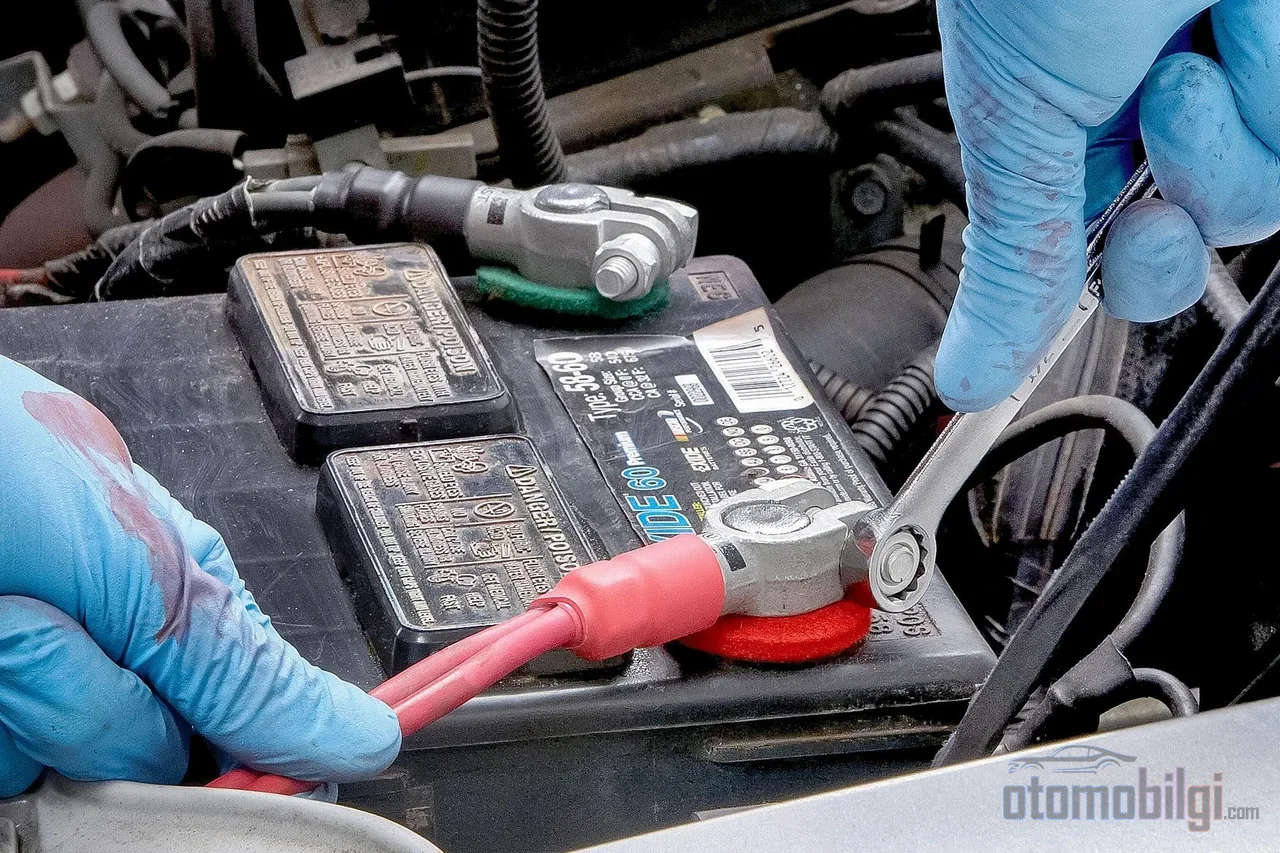
- Terminal contamination: Oxidized terminals increase transmission resistance. Twice a year, cleaning with a mixture of 60 ml of baking soda per 1 liter of water and applying a protective spray is sufficient.
- Incorrect charging regime: If the charging system outputs below 13.8 V, the battery is undercharged; above 14.6 V, it is overcharged; both shorten battery life.
Weak Battery Symptoms: How to Tell It's Time for Replacement
A battery usually doesn't fail suddenly, but with clear signals. Recognizing these signals is the cheapest insurance against being stranded. If you notice one or more of the following symptoms, it's time to test your battery:
- The starter motor not engaging or struggling on the first turn
- Dashboard lights glowing weakly or flickering
- Dim headlights and light flickering at idle
- A weak-sounding horn
- The battery warning light coming on
- Swelling or bulging on the battery casing
A battery that takes a jump start and runs but quits again shortly after is usually a battery that won't hold a charge; in this case, replacement rather than recharging is the definitive solution. If the battery is healthy, it is recharged; if its capacity has dropped significantly, it is replaced - and this distinction must be made with a tester, not with the naked eye.
What Do Voltage Values Tell You? How Is a Charging Test Performed?
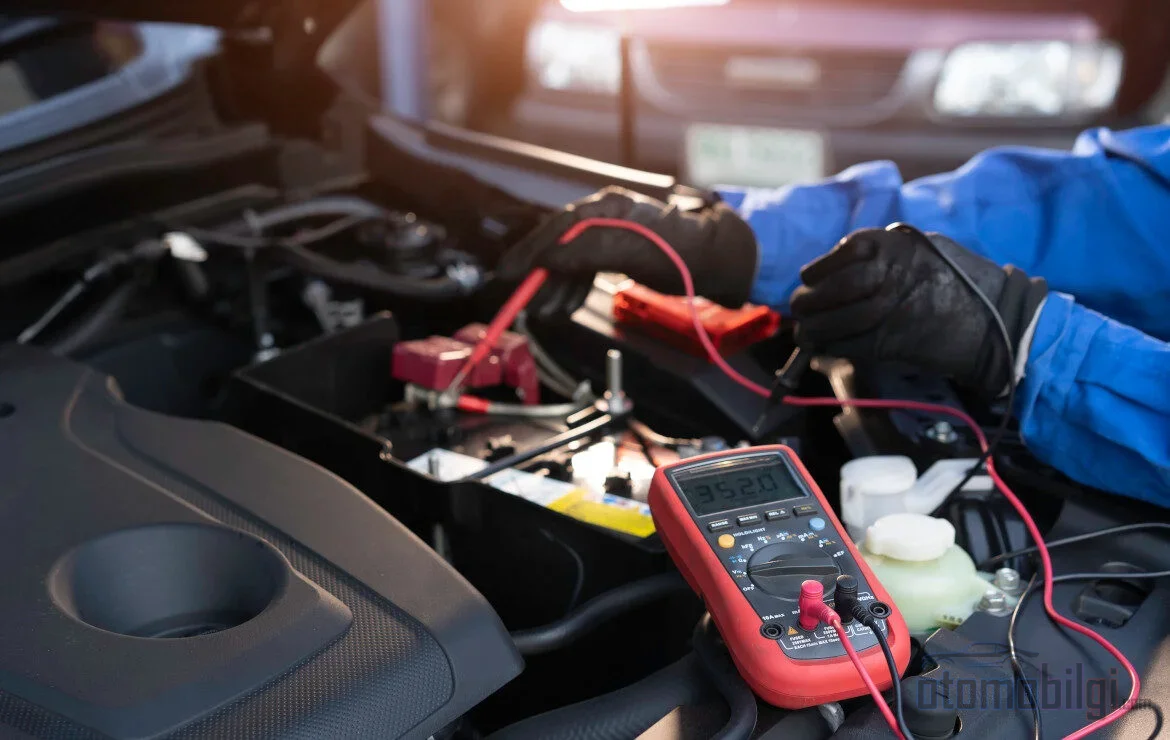
A simple multimeter shows the battery's condition in numbers. The voltage measured with the engine off and the battery rested is the key indicator: a fully charged battery 12.4-12.8 V reads in this range; a healthy battery is typically around 12.6 V . 12.2 V or below means a weak battery; a battery 11.8 V or below is most likely dead. Measuring while the engine is running shows whether the alternator is doing its job: output below 13.8 V means undercharging, above 14.6 V means overcharging, and both harm the battery. That's why charging system testing is an integral part of battery testing; someone who blames and replaces the battery alone will also prematurely kill the new battery if the real problem is the alternator.
A multimeter measurement doesn't measure capacity; it only shows surface voltage. For this reason, once a year, preferably in autumn, having a professional CCA test (cold cranking amp test) done is the most accurate approach. This test measures the battery's real cranking power and warns you months before the battery leaves you stranded. Over 3 years old it makes sense to repeat this test on batteries every year.
Why Do Batteries Run Out Faster in Winter?
Cold weather strikes from two directions at once: the power the battery delivers drops, while in return the cold engine requires more energy from the alternator to turn over. So on a winter morning, the battery faces both lower capacity and a heavier workload. Roadside assistance data from Germany illustrates this point strikingly: approximately 3.7 million of the interventions, 45% were attributable to 12-volt starter batteries. A similar seasonal peak is seen in Türkiye as well; according to industry data, battery-related service requests between November and February show an increase of up to 170%.
Winter preparation comes down to a short checklist: If the battery is older than three years, have it tested in the fall, keep the terminals clean, and if you will park the car for longer than two weeks, disconnect the negative terminal or connect a smart charger. Charging the battery of rarely used vehicles about once every two months also largely eliminates winter surprises.
Choosing the Right Battery: Amperage and the AGM/EFB Distinction
The "bigger is stronger" approach to battery selection is wrong; a vehicle's electrical system and mounting bay are designed for specific capacity ranges. The recommended range for passenger cars is generally 45-70 Ah; for gasoline vehicles used in city driving, 45-55 Ah is ideal. Since diesel engines require higher cranking power, a more durable battery construction should be chosen for diesel vehicles.
The situation is even more critical in vehicles with start-stop systems: in these vehicles, AGM or EFB technology batteries are mandatory. If a standard flooded battery, which is not designed to withstand frequent engine stops and starts and high cranking loads, is installed, system performance drops and the battery is quickly damaged. In addition, flooded and VRLA (AGM/gel) batteries should not be charged with the same charging profile; make sure your charger supports your battery type.
Battery Replacement Cost and the Original-Aftermarket Difference
The replacement cost varies over a wide range depending on the battery's type and the vehicle's requirements. Since prices change quickly, the values below should be verified with current quotes:
| Item | 2026 price range | Note |
|---|---|---|
| Standard passenger car battery | 2,000-4,500 TL | General market range |
| Battery replacement (including labor) | 3,000-5,500 TL | Cost increases in vehicles with start-stop systems |
| AGM battery (e.g. 70 Ah) | ~7,780 TL | Start-stop requirement |
| Entry-level products | Starting from 3,170 TL | Common lower bound in the passenger segment |
| Replacement service fee | 800-8,000 TL | Varies by vehicle and service scope |
An honest picture must be drawn regarding the distinction between original equipment and aftermarket batteries: between two batteries with the same ampere rating, CCA power, production quality, technology, warranty period, and service support may vary. Since there is no definitive and widely accepted comparison data available, the most reliable method is to note the capacity and CCA values in your vehicle's factory specifications and compare warranty and service conditions among products that meet those values. Another practical warning concerns shelf life: a battery bought without checking its production date and left sitting on the shelf for a long time comes with performance loss from day one. Asking about the production date when buying is far cheaper than bargaining afterwards.
Conclusion: Replacing the Battery Before It Leaves You Stranded
The summary of battery maintenance comes down to a few measurable habits: one long drive per week, not running electrical equipment while the engine is off, charging a drained battery within 24 hours, cleaning the terminals twice a year, and having a CCA test every autumn from the age of 3 onward. A vehicle owner who follows this cycle can extend their battery's life from 3 years to 5-6 years and stays outside the most common winter breakdown statistics. The only remaining decision is not to delay the replacement when the test results show capacity loss.
Sources
- Ways to Extend Battery Life and Common Mistakes
- How to Extend Battery Life? 10 Proven Habits
- How to Extend Battery Life?
- Ways to Extend Your Battery's Life
- Simple Tips to Extend Your Battery's Life
- How to Tell If Your Battery Is Dead? Signs of a Weak Battery
- How Many Amps Should a Battery Be?
- Signs of a Weak Battery
- Signs That It's Time to Replace Your Battery
- When Is a Battery Replacement Necessary?
- Battery Maintenance Tips for Surviving the Winter Cold
- Prevent Battery Failure in Winter
- Battery Failures Increase by 170 Percent in Winter
- Key Indicators of a Healthy Battery Test
- Battery Replacement Prices 2026
- Car Battery Replacement Prices 2026
- Battery Prices 2026
- Which Battery Is the Highest Quality?