How Did the Fiat 500 Become Post-War Italy's Motivation?
Share This Page
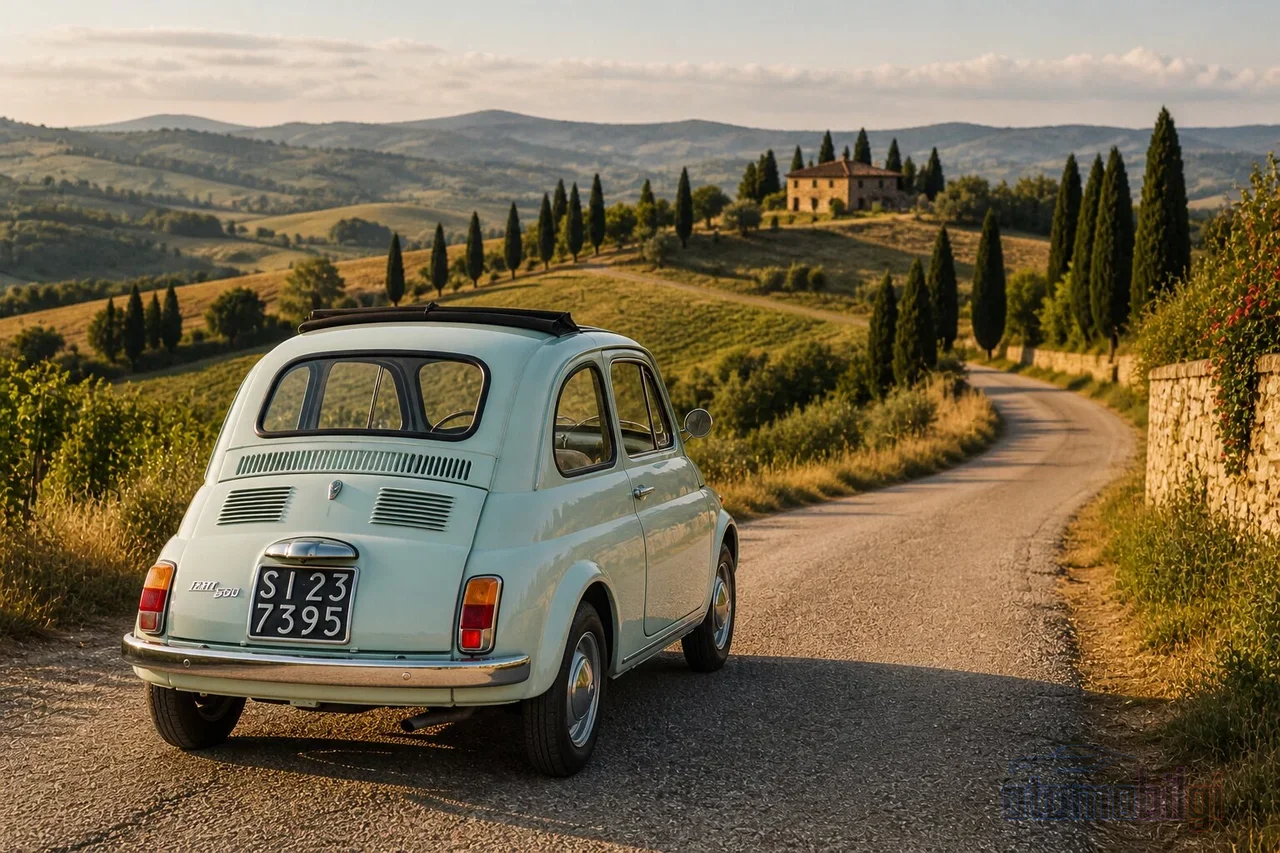
Presented to the world in Turin in 1957, the Fiat Nuova 500, with just its tiny 2.97-meter body, put post-war Italy on wheels. Designed by Dante Giacosa, this rear-engined, 479 cc little car went beyond being a people's car and became a symbol of a country's economic rebirth and design genius. So in short, the answer is this: the Fiat 500 is not just an icon of Italy - it is the very definition of icon.
Highlights
- The Nuova 500 was introduced in July 1957; 2.97 meters long with a rear-mounted 479 cc air-cooled two-cylinder engine.
- Between 1957 and 1975, over 3.8 million were produced.
- In 1959, it won the first Compasso d'Oro design award ever given to an automobile.
- It is exhibited in the collections of the Museum of Modern Art (MoMA) in New York and the Guggenheim Bilbao.
- In 2026, it is on the roads as an electric vehicle under the name 500e.
Why Did Post-War Italy Need Such a Small Car So Badly?
Just think about it: Italy in the mid-1950s. The scars of war were still everywhere, the economy was struggling, even steel was scarce. People wanted to be mobile, but a proper family car was a mere dream for most. That's why mini vehicles called "bubble cars," seating one or two people with their wheels sticking out, began to multiply on the streets. Cute, sure - but you got soaked in the rain, there was nowhere to put your shopping bags, and on top of that, they didn't feel like a real car at all.
The person who saw this gap was Dante Giacosa. This engineer, who joined Fiat in 1927 at just 22 years old and continued consulting for the company "for life" even after his retirement, scored his first great success with the 1936 Fiat 500 Topolino - the "little mouse," named for its small size and headlights reminiscent of the Disney character on its hood. With approximately 520,000 units sold between 1936 and 1955, the Topolino taught Giacosa an important lesson: the essence of the small car research Fiat completed in 1933 was that a small car could not simply be a shrunken version of a big car. It had to be designed from the inside out - people first, then the machine.
Giacosa's answer was ambitious compared to the bubble cars: a four-seater, enclosed, real car - but at a price that fit everyone's pocket. And it was precisely for this reason that the Nuova 500 became Italy's grand ceremony of entry into the age of the motor vehicle. The word "Nuova," meaning "New" in its name, was no coincidence either; the name was deliberately chosen to distinguish it from the old Topolino and, by extension, from the old world.
How Did Dante Giacosa Fit Four People into 2.97 Meters?
The answer lies in architecture: everything is at the rear. The engine is two-cylinder, 479 cc, and air-cooled - meaning no radiator trouble, no coolant trouble. With a logic as simple as plugging your phone charger into the wall, Giacosa placed the engine on the rear axle and left the front entirely to the passengers. A four-speed manual transmission, two people in front, two in the back. The size? 2,970 mm. For a point of comparison: although it was about a meter shorter than the VW Beetle, it could carry the same four passengers.
On the power side, things may look comical by today's standards: the first Nuova 500 produced about 13 hp (figures reaching 15 hp in some versions are also valid; not to be confused with later versions). With 20 lb-ft of torque and a four-speed gearbox, top speed was around 85 km/h; some versions approached 95 km/h. We salute in advance the first-generation 500 owners who had to race trucks on the highway.
But the real genius lies in the details. The folding fabric roof was standard - this was both a sense of understated luxury and it did not consume steel, which was scarce at the time. Smart twice over! Giacosa also had to solve his biggest engineering headache: the swing-axle rear suspensions of that era made rear-engined cars dangerously unruly on the road. The semi-trailing arm suspension Giacosa devised became one of the critical steps in overcoming this problem. A small car did not mean a simple car; the trio of minimum weight, mechanical simplicity, and maximum interior efficiency turned the 500's design philosophy into an approach that pioneered small car engineering worldwide.
How Does a Car With 13 Horsepower Win a Design Award?
It happens in 1959: the Compasso d'Oro, Italy's most prestigious design award, is given to the Fiat 500. And it becomes the first automobile to win the award. Before that, the award mostly went to furniture and household appliances - because Italy took design as seriously in the kitchen as in the automobile. The jury's praise was striking: what was chosen, foregoing superficial automotive ornamentation, was a pure, highly expressive, and extremely functional form.
So the point was not the beauty of the 13-horsepower engine, but that nothing was superfluous. No grille, no chrome trim, nothing is unnecessary. The 500, born as a product of necessity and solved so cleanly, stands like a work of art. Its display at the Guggenheim Bilbao today is no coincidence; there it is openly stated that Giacosa created not merely an affordable car, but an Italian design icon. MoMA has also added the 500 to its collection - the museum emphasizes how effective cheap and reliable post-war cars were in connecting Europe and creating freedom of movement on the continent.
How Did the 500 Change Over 18 Years of Production?
Throughout its production life from 1957 to 1975, the 500 always remained itself but evolved. A useful version map is as follows:
- 500N (1957-1960): the first generation, with rear-hinged "suicide doors" and grilles below the headlights.
- 500 Sport (1958-1960) and D variants: the engine grew to 499 cc, power rose to 21.5 hp.
- 500 Giardiniera (from 1960 onwards): Italy's first true city station wagon - the favorite of families, tradespeople, and craftsmen.
- 500F Berlina (1965): rear-hinged doors were removed for safety reasons; it became the best-selling version and was produced until 1973.
Total production exceeded 3.8 million over 18 years; some counts cite nearly 3.9 million between 1957 and 1975. And that figure is not the end of the story: the modern 500, relaunched in 2007, had surpassed 2.5 million on its own as of 2021. In other words, more than 6 million people in total came to own this car. Or rather, this car became part of those people's lives.
How Does a Car Become Part of a Country's Popular Culture?
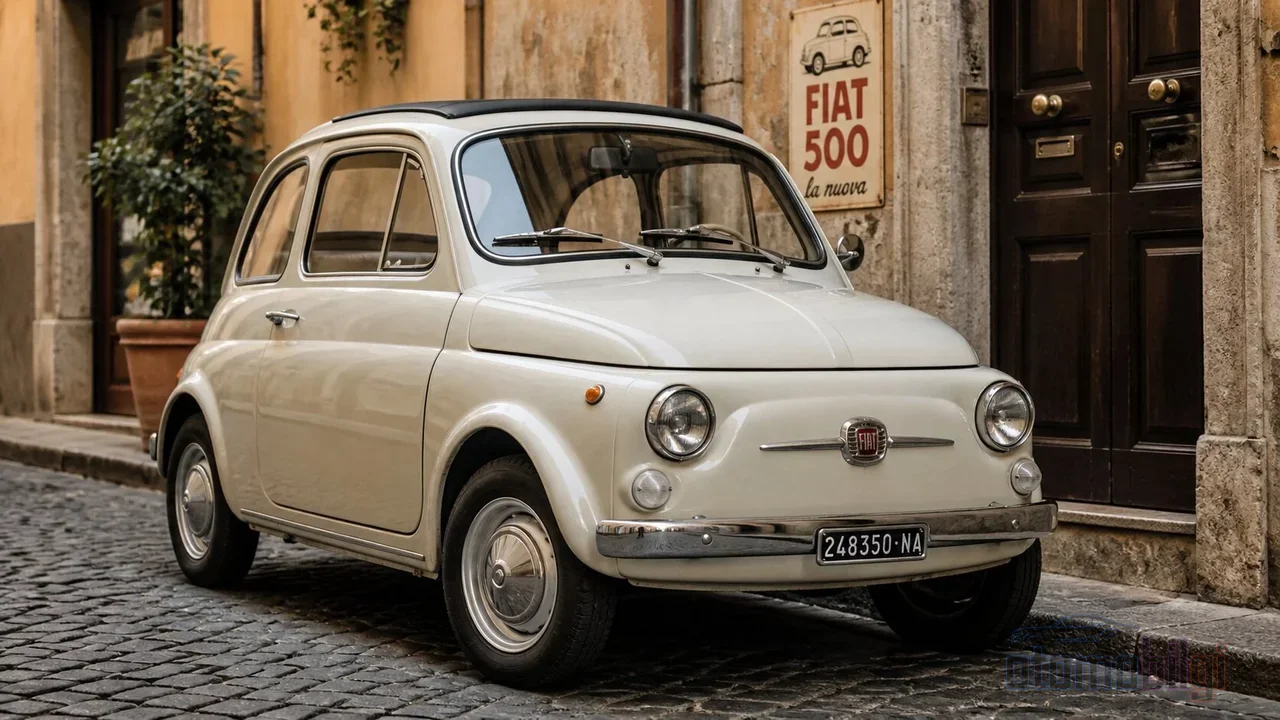
This is where the part that makes the 500 an icon begins. Post-war Italy's economic boom, the era of prosperity and social ascent known as "il miracolo," saw thousands of Cinquecentos on its streets. And when a car is everywhere enough, it stops being an object and becomes a symbol. The 500 became the symbol of the ordinary Italian family's vacation culture; the car taken to the seaside, photographed, and made the subject of stories.
Then popular culture took over. It appeared in films, photographs, and representations of everyday life. In music videos, Madonna appeared with a 500 in her "Hung Up" video, and Katy Perry in her "Last Friday Night" clip. There were even Fiat campaigns featuring Jennifer Lopez - as ironic as it is natural for a people's car to share the frame with stars. Moreover, "500" began to act like a brand in its own right at some point: there is a LEGO set, an Italian postage stamp, and film roles. Today, vintage 500 tours in Italy have become a distinct branch of nostalgic tourism; tourists tour cities in these tiny cars. When a car becomes a tourist attraction in its own right, apparently the word "vehicle" is no longer enough, right?
Was It a Perfect Car? Let's Be Clear: It Was Not
Let's be honest: anyone using the 500 with today's eyes would immediately object to a few things. The interior is cramped, the rear seats are almost a punishment for long journeys, the short wheelbase makes handling shaky, and there are owners who say "the slowest car I've ever driven." The cargo volume also remains narrow compared to the Beetle. Icon status and practicality don't always go hand in hand; that is exactly the 500's situation.
But there is also an interesting technology debate: the 1964 Autobianchi Primula and the 1969 Fiat 128 became a global standard with their front-wheel-drive layout featuring a separate transmission. Although the BMC Mini was the first mass-produced transverse-engine/front-wheel-drive small car in 1959, its transmission shared oil with the engine block; Giacosa's solution laid the foundation for the layout we know today. In other words, the architect of the 500 shaped not only this tiny car but also decades of subsequent automotive engineering.
Where Is the 500 in 2026? An Electric Legacy Story
The story of the classic 500 ended in 1975, but the name did not die. The 2026 Fiat 500e is sold in the US with a 42 kWh battery and Tesla Supercharger access: according to Edmunds data, 141 miles of electric range, 6.2-hour home charging with 240V, front-wheel drive. The starting price is $37,695; the top-tier Icona trim adds heated eco-leather seats, a pearl-finish dashboard, and a 360-degree parking system at $39,695. From the classic version's roughly 13 hp to today's electric power - that itself is a 70-year journey.
Meanwhile, Giacosa himself was not forgotten: the Stellantis Heritage Hub celebrated the engineer's 120th birthday in 2025 with a 10-vehicle exhibition. And the 500 entered the ADI Design Index 2026 list, cementing its current standing in the design world. If a car was a nation's source of motivation in 1957 and is still on design lists in 2026, it is less an automobile than an enduring idea. Wouldn't you agree?
Sources
- Celebrating Dante Giacosa: a special exhibition at the Heritage Hub - Stellantis Heritage
- Dante Giacosa. 500 F city car - MoMA
- Fiat 500 - Wikipedia
- Dante Giacosa - Fiat 500 USA
- January 3, 1905 - The Birth of Dante Giacosa, Architect of the Fiat 500
- Fiat Nuova 500, 1957 - Guggenheim Bilbao
- Icons of Italy: The Fiat 500 Was the First True City Car - Italy Segreta
- The Fiat 500 and the Vacations of Yesteryear - Triennale
- The history of the Fiat 500 (Cinquecento) - The Cinquecento Trip
- 2026 FIAT 500e Price, Reviews - KBB
- 2026 FIAT 500e Specs - Edmunds
- ADI Design Index 2026 - Instagram
- Fiat 500 and Jennifer Lopez - Stellantis Media
- 1957-1976 Fiat 500 buying guide - Magneto magazine