NMC or LFP? A Guide to Electric Vehicle Battery Chemistries
Share This Page
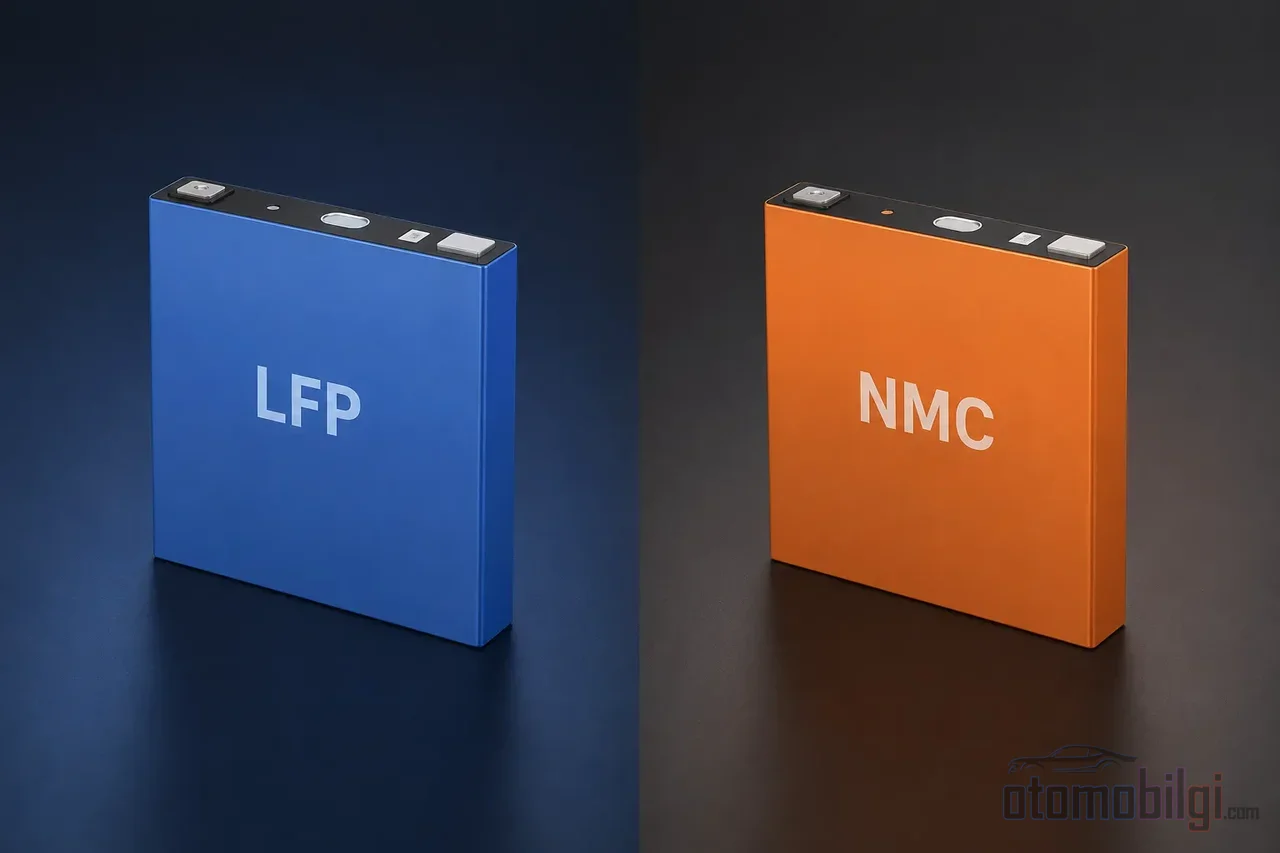
The short answer to "NMC or LFP?": If long range, high energy density and cold weather performance are your priorities, NMC; if lifespan, safety, charging flexibility and cost are your priorities, LFP is the more correct choice. Both chemistries come from the same lithium-ion family, but because their cathode structures differ, their behavior diverges radically. This guide compares the two chemistries across the axes of durability, energy density, charging behavior, temperature tolerance and cost, and clarifies which chemistry suits which user profile.
Highlights
- NMC cells 150-220 Wh/kg, LFP cells 90-200 Wh/kg have an energy density of.
- Cycle life: LFP 4,000-10,000, NMC 1,500-3,000 cycles (up to 80% SOH).
- Thermal decomposition onset: LFP ~270 °C, NMC 150-210 °C.
- LFP packs are on average more than 40% cheaperthan NMC.
- LFP batteries can be charged to 100% in daily use; with NMC, the 80% limit is the widely recommended practice.
What the Chemical Difference Delivers: The Cathode Structure Determines Everything
LFP uses an iron-phosphate cathode (LiFePO4). The olivine crystal structure in the cathode contains strong phosphorus-oxygen covalent bonds; these bonds make it harder for the cell to collapse structurally at high temperatures. The nominal cell voltage is 3.2 V. NMC, on the other hand, uses a layered oxide cathode with a nickel-manganese-cobalt combination (LiNixMnyCozO2); its nominal voltage is higher, at 3.6-3.7 V . The formulas are coded with numbers such as NMC 111, 622, 811, and these numbers indicate the nickel-manganese-cobalt ratio: as the nickel ratio increases, energy density rises while thermal stability decreases.
The critical point from an engineering perspective is this: NMC's high energy density is not a coincidence but a structural consequence. The higher cell voltage and layered oxide cathode allow more energy to be stored at the same weight. But the same layered structure releases oxygen when it decomposes, and this means the fire can sustain itself. LFP's phosphate bonds, on the other hand, lock the oxygen into the structure. In other words, all the practical differences between the two chemistries derive from this fundamental divergence in the cathode's crystal structure.
NMC and LFP Side by Side: Comparison Table
| Property | LFP | NMC |
|---|---|---|
| Energy density (cell) | 90-200 Wh/kg | 150-220 Wh/kg |
| Volumetric density | 220-300 Wh/L | 300-450 Wh/L |
| Cycle life (80% SOH) | 4,000-10,000 cycles | 1,500-3,000 cycles |
| Thermal decomposition onset | ~270 °C | 150-210 °C |
| Pack cost | ~$95/kWh | ~$130-150/kWh |
| Cold weather performance | Weak-moderate | Moderate-good |
| Daily charging limit | 100% usable | 80% recommended |
The fact that the energy density ranges in the table are wide is not an error: the values vary by cell chemistry, manufacturer and formulation. For example, nickel-rich NMC 811 cells 280 Wh/kg threshold, modern LFP cells have reached the 160-200 Wh/kg band. Also, cell-level and pack-level values differ from each other; an NMC that reaches 280 Wh/kg at the cell level drops to around 180-210 Wh/kg at the pack level, because cooling, barriers, and housing integration costs are included in the pack.
Lifespan and Durability: Why LFP Finishes Years Ahead
Cycle life is the number of full charge-discharge cycles a battery can endure until its capacity drops to 80% (SOH). Here the difference is dramatic: standard LFP cells offer 4,000-6,000 cycles, while premium manufacturers' cells guarantee over 10,000 cycles, and NMC cells fall in the 1,500-3,000 cycle band. Converting this to daily charge-discharge cycles, it means a service life exceeding 15-20 years for LFP and 6-10 years for NMC. Automotive literature makes a similar distinction in lifespan estimates: average vehicle life is assumed to be 10 years for NMC/NCA and 15 years for LFP.
Depth of discharge (DOD) also directly affects lifespan. LFP comfortably tolerates 80-100% discharge depth and, when operated at 50% DOD, some cells can exceed 12,000 cycles . NMC, on the other hand, is sensitive to deep discharge; that is why vehicle systems usually limit the usable capacity to 80-90% of total capacity. In other words, the range you see on the charge indicator of an LFP vehicle and that of an NMC vehicle are used at different rates relative to physical capacity.
Safety and Temperature: Where Thermal Runaway Begins
Thermal runaway is the irreversible chain reaction in which a cell's own heat feeds its own decomposition, and the onset threshold differs clearly between the two chemistries. LFP cells enter decomposition at around 270 °C, while NMC cells do so in the 150-210 °C band; high-nickel 811 variants behave close to the lower bound of this band. Even more important is the behavior after runaway begins: in a thermal runaway event, LFP releases roughly one-third of the energy that NMC does and produces about 80% less flammable gas. Because NMC releases oxygen as it decomposes, which feeds combustion, aggressive cooling and barriers between cells are mandatory in pack design.
Operating temperature also shapes lifespan. The ideal range for the two chemistries is defined as 15-35 °C (LFP) and 15-30 °C (NMC). On the hot side, continuous use at 45 °Creduces NMC's cycle life by 40-50% while the decline in LFP remains at the 20-30% level. At the chemical level, cathode metal dissolution lies behind this difference: manganese dissolution increases below room temperature, while nickel dissolution increases at high temperature. In short: LFP is advantageous in hot climates, NMC in cold climates.
Charging Behavior: Can You Really Charge LFP to 100% Every Day
With NMC, the customary rule is to limit daily charging to 80%; high state of charge (above 90% SOC) and deep discharge accelerate decomposition. With LFP, the picture reverses: manufacturers state that even in daily use, the LFP battery can be kept at 100%, and some even recommend doing a periodic full charge. The reason is technical and clear: a full charge is necessary for the battery management system (BMS) to perform cell balancing, i.e. calibration. Due to LFP's flat voltage curve, the differences between cells only become visible at a full charge.
The Full Charge Debate: The Tension Between Recommendation and Data
In practice, this is where the debate arises. While leading manufacturers recommend at least one full charge per week for LFP, some suggest at least one per month; laboratory data shows that LFP batteries can degrade faster under constant full charging, and that repeated full charges increase degradation especially at high state of health. In hot climates, regularly 100% charging carries an even greater risk. The most balanced practical rule is this: LFP does not need to be charged to 100% every day; keeping the charge limit at 100% can be used, but for balancing, one full charge every 7-10 days is sufficient - and if the vehicle will be parked in hot weather, it is wise to time the full charge immediately before the trip.
The Cost and Range Balance: Why Manufacturers Are Splitting Into Two Camps
On the price side, LFP is clearly ahead: while the average for lithium-ion packs is $115/kWh , LFP packs are at ~$95/kWh, and NMC packs are at ~$130-150/kWh levels. At the cell level, LFP is 20-30% cheaper than NMC and as of 2025, LFP packs come at an average of more than 40% cheaper per kWh compared to NMC. The trend is also becoming clear on the supply side: LFP has captured more than 90% of newly commissioned stationary storage projects, and automakers are making a mass transition to LFP in standard-range models.
So why does NMC still exist? The answer is range. LFP's low energy density means shorter range in the same size; in long-range and premium vehicles, NMC's 150-220 Wh/kg density remains indispensable. But this boundary is also eroding: cell-to-pack designs that integrate non-cell components into the pack are closing LFP's volumetric disadvantage and 400-500 km making it practical to produce vehicles with ranges using LFP. Most standard-range popular electric models now come with LFP - this is no coincidence, but the natural result of the cost and lifespan math.
Second Life and Circularity: The Battery's Life Does Not End With the Vehicle
After completing the vehicle's life, the battery still below the 80% state of health level remains batteries can get a second life - stationary storage, backup power systems, and the like. Here, too, chemistry is decisive: LFP's high cycle life offers second-life potential exceeding 10 years at the end of the vehicle's life, making it more valuable in the second-life market. NMC's second-life resale value remains limited; but the situation reverses on the materials side: thanks to its nickel and cobalt content, NMC's recycling value is higher than LFP, which contains metals that are almost impossible to recycle. Life cycle analyses also reflect this duality: some studies find NMC 6-25% more sustainable due to recycling and use-phase efficiency, while LFP is considered advantageous in terms of ethical sourcing and supply chain because it contains no cobalt or nickel. There is no single answer to which chemistry is "green"; it depends on where you look at the problem.
Which Chemistry Suits You: Choosing According to Your User Profile
- If you are looking for a long-range or premium vehicle: NMC; high energy density and better range retention in cold weather (5-8% better) are the decisive advantages.
- City use with standard range: LFP; cheaper pack, lifespan exceeding 4,000 cycles, and freedom to charge to 100%.
- If you live in a hot climate: LFP; at 45 °C, lifespan loss is less than half of NMC's.
- If you park outdoors in a cold climate: NMC; at -20 °C it retains 70-80% of its power.
- High-cycle, intensive use (fleet, taxi): LFP; clearly ahead in lifetime cost.
A third option is on the horizon: sodium-ion chemistry, 120-160 Wh/kg density, 4,000-8,000 cycles and approximately 250 °C thermal stability values, standing out with its power in cold weather; it is expected to overtake LFP on cost around 2027-28. For today, the choice is between NMC and LFP, and the rule is simple: your answer to the question of range or lifespan determines your chemistry.
Sources
- LiFePO4 vs NMC Battery Lifespan: The Real Difference
- LFP Vs NMC Battery: A Technical Comparison Of Cycle Life...
- LFP, NMC and Sodium-ion Compared (2026)
- Electric vehicle batteries - Global EV Outlook 2026
- LFP Battery Health Degrades At Full Charge, Study Finds
- New Study Raises Questions About LFP Battery Charging Habits
- LFP vs NMC Battery: Which Is Better for Your EV in 2026?
- NMC vs LiFePO4 Which Battery Performs Better in the Cold
- LFP vs NMC Battery: What Every Buyer & Seller Must Know
- Is shifting from Li-ion NMC to LFP in EVs beneficial?
- Comparing the circularity and life cycle environmental…
- Recycling or Second Use?
- Degradation factors of commercial lithium-ion batteries
- Battery Life Explained