Renault E-Space Concept Reimagines the Legendary MPV as an Electric Vehicle
Share This Page
Renault, E-Space Concept unveiled its electric concept bearing this name to the world at the Paris Motor Show press day on October 12, 2026. The vehicle carries the brand's legendary model, which effectively created the modern MPV market in Europe in 1984, into the present day with an electric and cabin-focused lounge concept. Renault's official framing is clear: this is not a forerunner of a production model, but an innovation laboratory.
Highlights
- Debut: October 12, 2026, world premiere at the Paris Motor Show
- Dimensions: 4.70 m length, 2.02 m width, 1.67 m height
- Cabin: six individual seats in three rows on a flat floor, rotating second row
- OpenR Panorama: curved display spanning the width of the cabin, 1,130 × 110 mm
- Official positioning: does not preview a production model, does not replace the current Espace
What is the E-Space Concept and what does it promise?
Renault frames the concept with a distinctive philosophy: voitures à vivre, that is, the return of the "cars for living" philosophy. The first Espace, developed with Matra in 1984, was the beginning of an approach to designing vehicles that put the person and their life at the center; forty-two years later, the E-Space Concept is presented as a reinterpretation of these principles for the electric era. The "E" at the beginning of the name stands for electric; the silhouette is one-box.
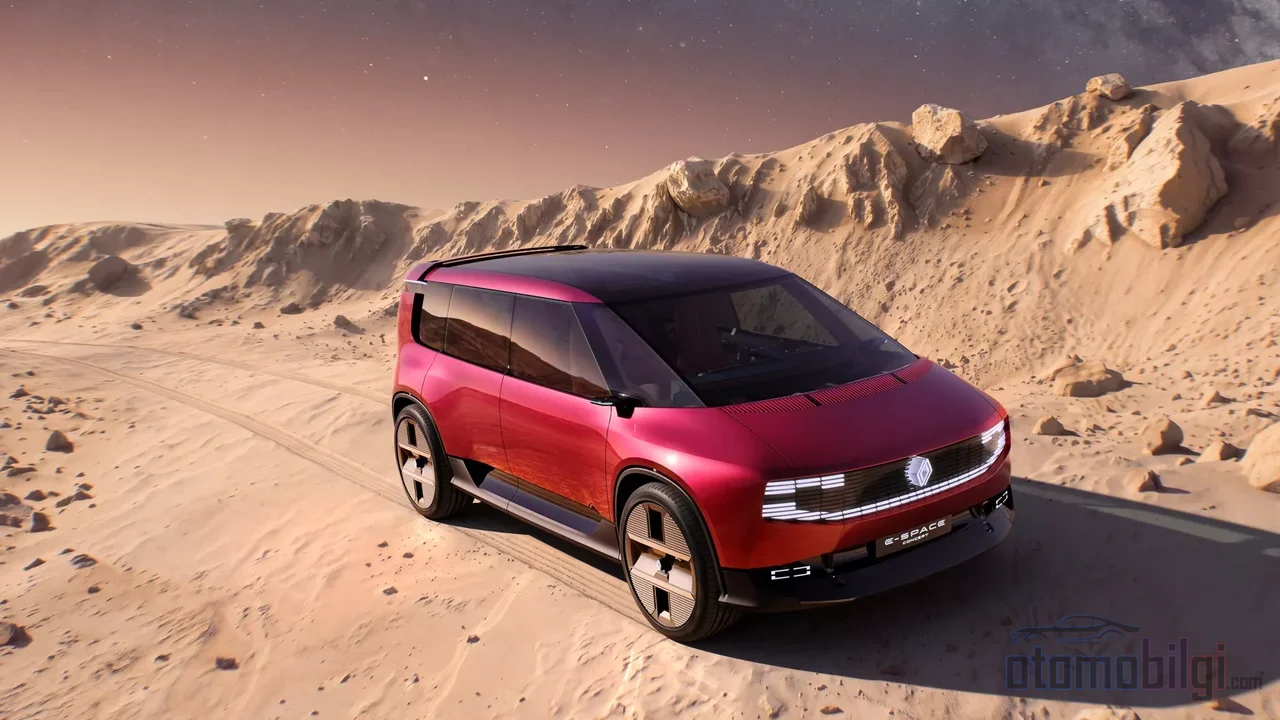
Its dimensions are curiously nostalgic: the 4.70-meter length and height are close to the values of the first Espace. Short overhangs, 23-inch wheels at all four corners, and a dark "skateboard" understructure tucked beneath, wink at the original model's gray side cladding. The length-to-width ratio and roof height deliberately recall the proportions of the first-generation MPV. This is a detail that makes it clear the design team's choice was intentional, not coincidental.
Cabin: not an MPV, a mobile living space
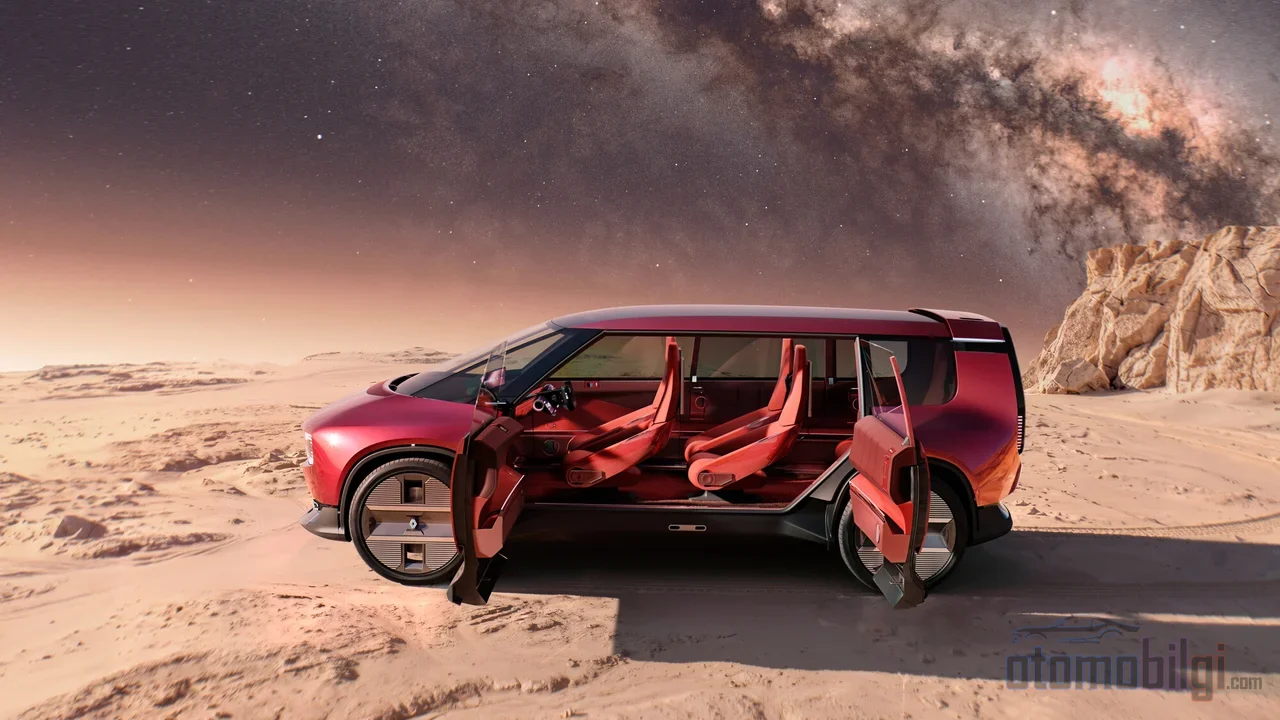
The concept's real story is not in the exterior design, but inside. The floor is completely flat, with six individual seats arranged in three rows; all seats are identical in size and design, meaning arrangements where the person in the back row was considered a second-class passenger have been ended. The interior design team's source of inspiration is not the automobile but furniture; the Pierre Paulin lines evoked by the seats are one of the visible traces of this choice.
Flexibility in TGV logic
The two seats in the second row can be rotated 180 degrees; this face-to-face arrangement with the third row has been named the "TGV train square" in reference to the carriage layout of French high-speed trains. When switching to the four-seat configuration, the second row folds completely and turns into a wide table. Behind the front seats are 12.3-inch folding tray tables with displays.
A console glides along the central rail of the cabin; it contains an air purifier, a mini refrigerator, game controllers and the "Connect 4" board game. The claim of turning travel out of a mere transport job into shared time becomes concrete in details like these. Such living details, once the last thing to look for in MPVs, had almost completely vanished in today's SUV hegemony.
OpenR Panorama and steer-by-wire
The classic instrument panel is replaced by the OpenR Panorama: a curved, non-touch display spanning the full width of the cabin, measuring 1,130 x 110 mm. Renault will use this display in its future upper-segment models; the first stop will be the new Rafale and Scenic. The steering, meanwhile, relies on a steer-by-wire system with no mechanical linkage: a fixed hub, touch controls and a driving interface free of mechanical transmission.
Design language: a glass living cube and aviation traces
The inspirations behind the exterior design have been openly declared: the fully glazed cabin is based on Bauhaus architecture, particularly Ludwig Mies van der Rohe's 1951 work, the Farnsworth House. The design team has combined its references from the world of aviation with a "U"-shaped light signature running front to rear and an illuminated logo with a pixel effect. Pillarless doors with dual rear hinges and a glass extension reaching into the rear window also reinforce the one-box form.
Aerodynamics have also been worked on: the movable front splitter is lowered closer to the ground at high speeds to optimize aerodynamic balance. The cabin is worked in red tones; the scarlet, purple and garnet palette 3 cm meets a coral-colored carpet with a gradient effect. This color determination reminds us that the concept is not an exhibition piece but a design thesis.
Bio-based emphasis in material choices
Renault has presented the concept's material scorecard under a separate heading, and the figures of this scorecard are remarkable. Sustainability is presented here not as a marketing slogan but as a matter of content that can be measured piece by piece:
- In the paint: 18% bio-based resin
- In the steering wheel: 26% castor oil and 25% organic cotton
- Covering the floor, a 100% wool, long-pile carpet
- Painted straw ornaments instead of wood
- An average of 19% natural rubber in the Michelin tires
This content, across the brand's overall product range, <%30 geri dönüşümlü malzeme taahhüdüyle birlikte okunacak biçimde tasarlanmış. Konsept araçların malzeme deneme alanı olma geleneği düşünülürse, burada listelenen oranların ileride seri üretime taşınan çözümlere dönüşmesi beklenen bir senaryo - resmî çerçeve bunu vaat etmese de.
Strategic backdrop: the futuREady era
The E-Space Concept is not a standalone design exercise. Following its Renaulution plan, Renault has moved into a new strategic cycle it calls "futuREady" and has adopted a pragmatic, two-pronged approach to electrification: 100% hybrid + 100% electric. The plan envisages 36 new models by 2030; 22 of them will come to the European market and 16 will be fully electric. The technology targets are also concrete: C-D segment vehicles switching to 800 volts by 2028 and achieving fast charging times of up to 10 minutes by 2030.
In this context, the E-Space Concept can be read as one of the first visual embodiments of the brand's vision for electric family vehicles to have been announced. The rest of the Paris stand is made up of pieces of the same story: the Renault 8 Gordini and Renault 4 JP4x4 concepts, the new Megane E-Tech facelift, the Renault 5 Turbo 3E, the Rafale Hypnotic, and the Twingo E-Tech with its 0.7 m² panoramic glass roof named "Twingobay". Alongside the E-Space, the announcement of LFP battery rollout together with the new Megane also reveals the layers of the electric strategy.
Espace heritage: six generations after 1984
The context needs to be briefly recalled. The original Espace went on sale in 1984; the first generation, designed and built by Matra, effectively created the modern MPV/minivan market in Europe. Six generations were produced over forty years, and the sixth generation, in line with the segment's general trend, shifted to a crossover-SUV format. The E-Space Concept is positioned right in the middle of this cycle as a conscious return to its MPV roots; the emphasis on a break from mainstream SUVs is also clearly present in the brand's own statements.
The key data of the concept is compiled in the table below:
| Feature | Value |
|---|---|
| Unveiling | October 12, 2026, Paris Motor Show |
| Length / Width / Height | 4.70 m / 2.02 m / 1.67 m |
| Wheels | 23 inches, at all four corners |
| Seating layout | Three rows on a flat floor, 6 individual seats |
| Display | OpenR Panorama, 1,130 × 110 mm, not touchscreen |
| Steering | Steer-by-wire, fixed hub |
| Doors | Pillarless, double rear-hinged |
| Official status | Does not preview a production model, does not replace the Espace |
Is a production model coming? What does the official picture say?
The official answer to this question is clear: the E-Space Concept does not directly preview a production model and does not replace the current Espace. Renault presents the concept not as a "contemporary successor" but as a study demonstrating the brand's design and technology direction. No ambitious feature regarding autonomous driving is highlighted in the material either; the noteworthy technology inside is limited to the steer-by-wire system, which does not imply autonomous capability.
Of course, there are voices on social media and in some automotive publications expressing hope for production; "2027 model" expectations and wishes for it to reach production are being discussed. However, these are not verified pieces of information and are not reflected on this page. Our reading is this: Renault has already begun testing the technical and design groundwork for a fully electric living-space concept in family vehicles. Given the rate at which past concepts have made it into series production, it is an expected development that elements of this concept - particularly the OpenR Panorama display and the steer-by-wire system - will in some way find their way into the product lineup. The rest depends on the determination to be shown in the closing days of Paris.
Placing today's technology on top of a forty-year heritage is one of the most difficult design translations in the automotive world. Renault chose to make this translation through the MPV format; the result is not yet a showroom product, but it is a direction indicator. And the direction is stubbornly one-box.
Sources
- Renault E-Space Concept: a contemporary vision of voitures à vivre - Newsroom Renault
- Renault E-Space Concept (2026)
- Strategy plan 'futuREady': Renault plans 16 new electric vehicles by 2030
- Tech-ready: accelerating innovation - Renault Group
- There once was a vehicle named Espace, an iconic name going back 40 years - Renault Group Magazine
- Renault Espace - Wikipedia