Can Traffic Sign Recognition Systems Make Mistakes?
Share This Page
Yes, it can be wrong. Traffic sign recognition (TSR) systems, which use a camera to read speed limit and no-passing signs on the road, usually work correctly, but faded or covered signs, temporary signs in construction zones, different countries' sign designs, and outdated map data can cause an incorrect speed limit to appear on the screen. That's why these systems never replace the driver; the number on the instrument panel is a reminder, and the final say remains with the road itself and your own eyes.
Highlights
- TSR reads the sign with the camera behind the windshield in three steps: detection, tracking, classification.
- Intelligent speed assistance (ISA) is mandatory in all new vehicles sold in the EU since July 2024.
- According to 2025 research, ISA systems can misread signs in up to about 25% of cases .
- EU legislation requires that ISA be overridable ; speed control remains with the driver.
- Even manufacturer manuals explicitly state that the system may not display correctly.
How Does a Traffic Sign Recognition System Work?
Let's start with the mechanics, because as you get to know the system, it also becomes clearer what you can rely on. There is a forward-facing camera behind your vehicle's windshield, usually positioned at the level of the rearview mirror. In some vehicles this camera works only for sign recognition, while in others it is shared with other driver assistance tasks such as lane tracking. The camera continuously collects images of the road, and the software applies three steps in sequence on this image: first it detects regions that could contain a sign, then while the vehicle moves forward it tracks that region, and finally, using neural network algorithms, it compares the image with internal data sets and classifies the sign. In modern systems, this classification task is mostly done by deep learning-based convolutional neural networks; just as you learn to say "this is a speed limit sign" after seeing thousands of examples, the system is trained with thousands of sign images.
The result appears almost instantly as a small icon on the instrument panel, the infotainment screen, or the head-up display if there is one. The system actually works like a second pair of eyes for you: it notices that speed limit you missed when you were tired or in the congestion of an intersection and reminds you. The signs it recognizes vary by model, but the typical list is: speed limit, "Stop," no overtaking that would cross into the oncoming lane, and no entry. The speed limit display stays on the screen for a few hundred meters, or even a much longer distance depending on the sign type; "Stop" and no entry icons are generally shown at speeds below about 60 km/h. Some systems go one step further and store the signs they recognize in memory; the next time they recognize the same sign more easily. In fact, some brands even use the speed limit data collected by their cameras to feed their navigation software.
When the System Shows Its Mistakes the Most: The Sign's Bad Days
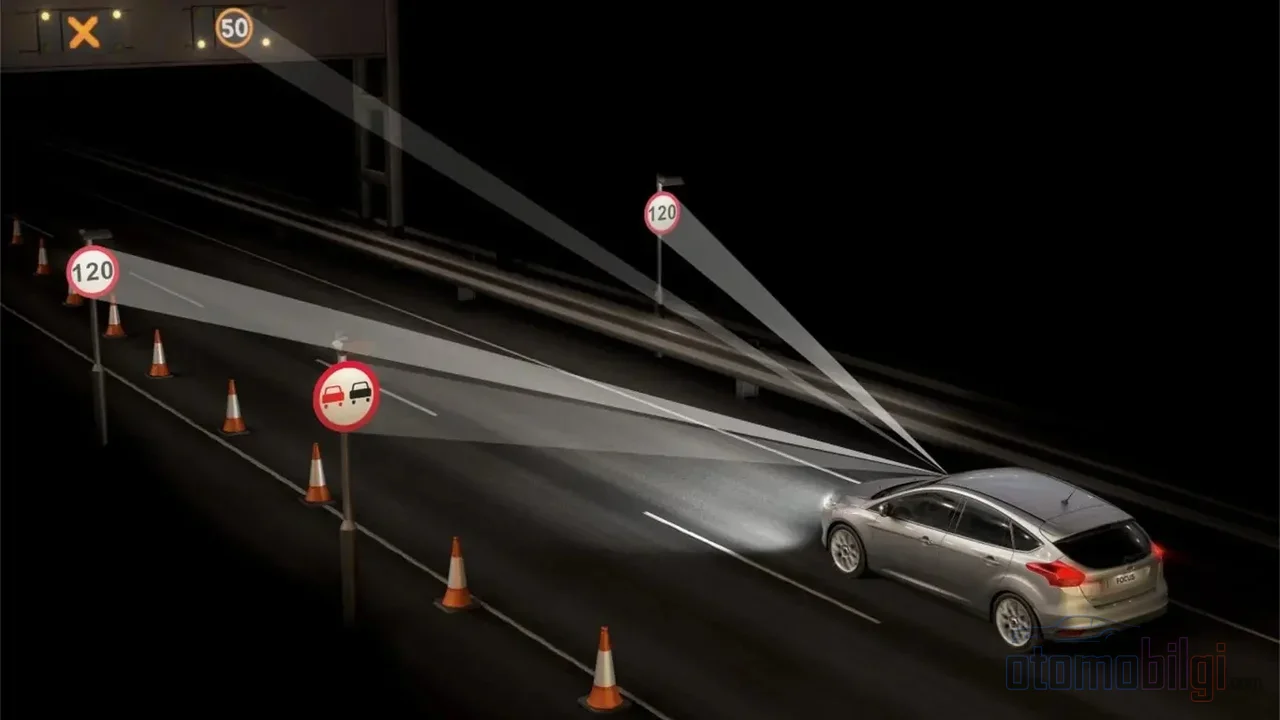
Here's where things start to get interesting. Like any camera-based technology, TSR is only as good as what it can see. In Clemson University's study summarizing the limits of these systems, the list sounds quite familiar: variable lighting conditions, rain and fog, image degradation caused by the vehicle's movement and vibration, and in urban areas, trees or other signs blocking the view. Think about it: even you struggle to read a wet, glare-reflecting sign in the rain at night; the camera wrestles with the same problem, and unlike you, it doesn't have the luxury of blinking it away.
The condition of the sign itself matters just as much as the weather. Faded, bent, dirty, or vandalized signs are the system's nightmare, especially at night. And this isn't a theoretical fear: in a scientific study on sign deterioration, 13 of the 24 signs examined, or 54%, had lost their compliance with standards due to fading, and fading damage produced the highest failure rate. Manufacturers openly admit this in their manuals; Honda writes that scratches, dents, faded and bent signs affect system performance and that no sign may be displayed, and that road signs should never be ignored. Then there's the calibration factor: the camera doesn't calibrate itself; after an accident, windshield replacement, suspension or ride height changes, professional calibration is required. If you've had your windshield replaced and skipped calibration, the system is essentially wearing a poorly fitted pair of glasses.
Camera or Map: Behind the Scenes of a Wrong Number
So far we've talked about camera errors, but in modern vehicles, sign information doesn't come from a single source. Many systems combine the camera with GPS and digital speed maps. This duo is each other's savior: if the camera misses a sign, the map kicks in; if the map is outdated, the camera brings the truth to the screen. The problem is that this partnership can also turn against you. When you enter a different speed zone or turn onto another road, the map data can overwrite the last sign you saw, and the old, now invalid speed limit remains on the screen. Driver forums are full of this scenario: some vehicle owners report the old limit staying stuck on the screen after passing a new sign, while others describe a wrong number from the map being displayed without any camera reading at all.
Two automotive magazine studies published in 2025 put a brutal number on this picture: ISA systems misread up to a quarter of signs or showing the wrong speed limit. So one of four speed changes could be suspect on screen. The fact that sign design varies by country makes the job harder. The 1968 Vienna Convention on Road Signs and Signals standardized signs in more than 50 countries and became the main driving force behind global TSR development, but standardization did not equalize everything. Systems also have to distinguish units: a vehicle crossing from Northern Ireland into Ireland must be able to tell mph signs apart from km/h signs. Some systems solve this with geofencing and clues from navigation databases. Local differences such as the American sign color coding (white regulatory, yellow warning, green directional) can also produce misreadings when they do not match the algorithm's training set; a forum user's vehicle mistaking a minimum speed sign in one state for a maximum speed limit is a striking example of design confusion.
How Does Intelligent Speed Assistance (ISA) Communicate with the Driver?
TSR is an information system; intelligent speed assistance is the side that turns this information into action. Using the sign-reading camera and GPS-linked speed limit data, ISA can actively prevent the vehicle from exceeding the speed limit. The implementation in Europe works like cruise control: the system limits engine power so the speed limit is not exceeded, restricting acceleration in forward gears without interfering with the braking system. The legislative side has also progressed quickly; as of July 6, 2022, ISA became mandatory for all new types of passenger and freight vehicles sold in the EU, and since July 2024 this system is standard on every new vehicle sold in the EU. As of July 7, 2026, a series of additional advanced safety features will join the mandatory list for all new passenger cars and light trucks.
So is ISA a strict-footed teacher? No, and the legislation has deliberately designed it that way. Under the EU rule, the ISA system must use GPS and include an override function; systems can even allow speeding up to three times per calendar month. The driver can disable the system at will or keep control of the speed. Some manufacturers add a touch of finesse: with Chevrolet's Speed Limit Assist, you can set an offset using the RES/+ or SET/- buttons based on the detected speed. The relationship between sign recognition and the speed limiter works on similar logic; when the system detects a 40 mph limit, the cruise speed is automatically updated to 40 mph unless you set a different value. In other words, the system offers you a suggestion, and you accept it or not. You are also still responsible for braking when entering a lower speed zone.
How Much Can You Trust the System: The Driver's Ultimate Responsibility
The question is clear: whose guarantee does the speed limit on the dashboard fall under? The answer is none of them. Outdated GPS data is not legally binding on the driver's obligation to update, and camera-based reading can also make mistakes. Neither the number on the map nor the number the camera reads is a defense in the eyes of the police; if you exceed the speed limit, it is not the sensor that gets the ticket, it's you. Manufacturers don't hesitate to write this truth into their manuals. The Kia EV6 manual describes Intelligent Speed Limit Assist as a supporting function that helps the driver comply with the speed, and explicitly states that it may not display correctly. Honda also emphasizes that no function's capabilities should be overstated, and that the system may not work depending on road, weather, and vehicle conditions.
Let's put this with an analogy: TSR is like a friend walking beside you on the road saying "but the speed limit was 50." Your friend is right most of the time; in fact, one study reported a real-time sign recognition system with a 95.71% accuracy rate. But doesn't your friend sometimes get it wrong too? The sign may have changed, they may have missed the update, they may have confused two signs. Technology behaves just as frankly in the jury box: on one hand there are impressive rates like over 95% accuracy, on the other hand up to 25% misdisplay is measured in field use. The reason for the difference is definition and conditions; laboratory performance and real-world performance, including dirty signs, broken maps, and foggy nights, are not the same thing. That's why the golden rule is simple: the system gives you a hint, you make the decision. If the number on the dashboard doesn't match the sign on the road, the sign wins.
What's Next: Will Signs Get Smarter?
These limitations of camera-based reading are pushing engineers toward alternative approaches. Researchers are examining systems that add electronic identification like RFID to signs, and that can send information to vehicles via vehicle-to-infrastructure communication (V2V/V2I), as complementary solutions. The idea is appealing: the sign announces its identity directly to the vehicle even in darkness or in muddy weather, and the camera doesn't needlessly try to read a number. In the future, it is predicted that TSR directly feeding information into systems like adaptive cruise control is also an expected direction; that is, the system that today only shows you a symbol will tomorrow become a link in the chain that automatically adjusts your speed. Until then, the equation is the same: no matter how smart the system is, the brain behind the steering wheel has the final say. On your next journey, take a look at the speed symbol on the dashboard and compare it with the actual sign on the road; if you see them diverge even once, you will have verified everything this article has told you on your own.
Sources
- Traffic-sign recognition
- What is Traffic-Sign Recognition?
- Traffic Sign Recognition System | Honda Technology
- Understanding The Traffic Sign Recognition System
- Traffic Sign Recognition Systems
- Traffic Sign Recognition: How Your Car Reads Road Signs
- Real-time traffic sign recognition system
- The effects of damage on sign visibility: An assist in traffic...
- Traffic Sign Recognition System
- Intelligent Speed Assistance
- Intelligent Speed Assistance
- ISA: what is Intelligent Speed Assistance and how does it work?
- Active Intelligent Speed Assistance
- Intelligent Speed Assistance: What is an ISA Device?
- Speed Limit Assist
- Intelligent Speed Limit Assist malfunction and limitations
- CHAPTER 4. SIGNS | FHWA - Department of Transportation