Detroit's Forgotten Early American Hybrid Experiments
Share This Page
When the story of the hybrid automobile is told, almost everyone starts from the same place: Ferdinand Porsche's Lohner-Porsche work around 1900-1901, followed by the Toyota Prius arriving in 1997. Most of the period in between passes as an empty box in the classic narrative. Yet inside that box, in the Chicago and Detroit of the 1910s, there were serious American attempts to place gasoline and electricity in the same body; the most tangible of them Woods Dual Power was. On this page, we examine those forgotten early American hybrid experiments, why they were undertaken, and why they did not last, with technical details.
Highlights
- The Woods Dual Power was introduced in 1916 and produced only for the 1917-1918 model years.
- The system combined a 14 hp Continental gasoline engine with a 48 volt General Electric dynamotor working together.
- 15 mph (approximately 24 km/h) and below, the car moved on electricity alone.
- Its 1916 price was $2,650; that was a figure equivalent to roughly four Ford Model Ts.
- Today only four, possibly five, examples remain.
Why Did Hybrids Come on the Agenda in 1910s America?
Looking back from today, early hybrid experiments may seem like unnecessary complexity. The picture in the mid-1910s, however, was less clear. Steam cars required a warm-up time before use, and electrics struggled with range and charging time. Gasoline cars were problematic too: they were noisy, dirty, maintenance-demanding machines, mostly started by hand cranking.
A single comparison is enough to show the scale of the difference. Detroit Electric, the most successful electric car maker of the era, sold fewer than 5,000 vehicles in its peak year of 1914. That same year Henry Ford sold more than 200,000 Model Ts, a figure that doubled by 1916. Electric vehicle manufacturers were looking for a way to reverse that curve; the hybrid was the most logical engineering answer to that path. Combining the strengths of two technologies in a single body was the very logic chain established in the plug-in hybrid debates of the 2010s.
How Did the Woods Dual Power Work?
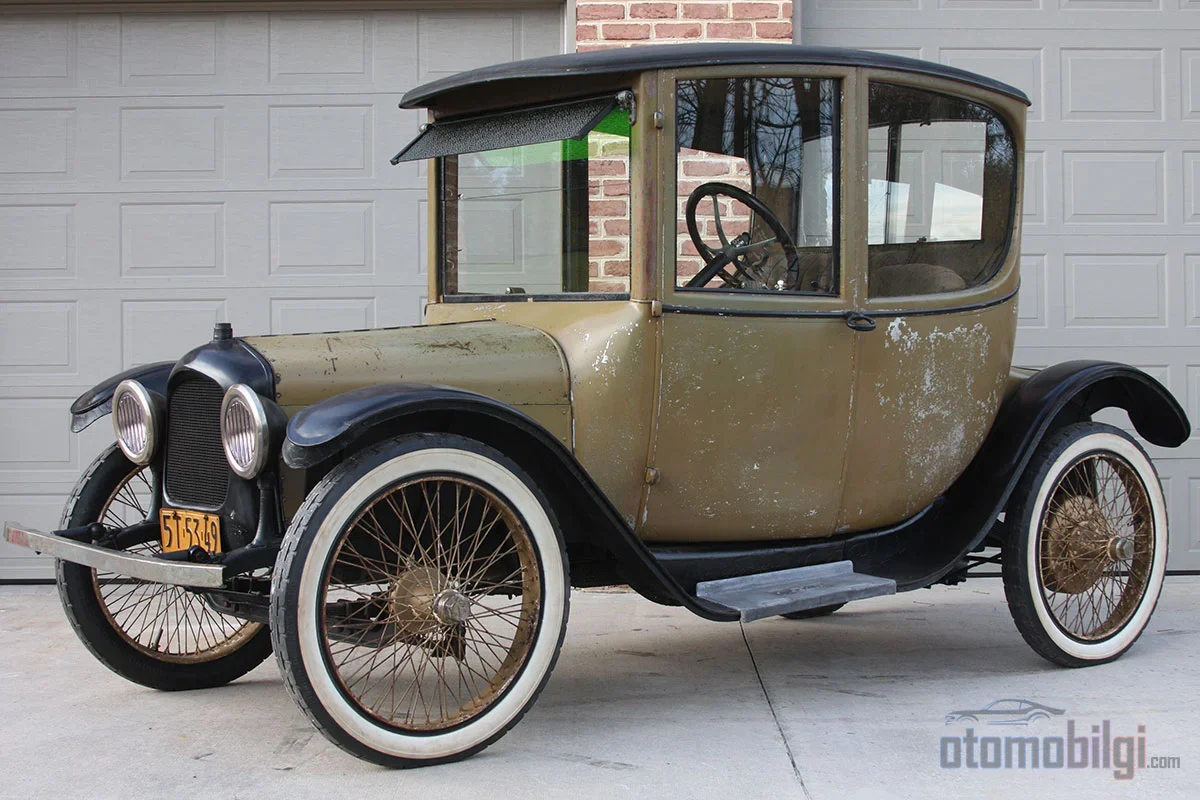
The Woods Motor Vehicle Company was founded in Chicago in 1899 and was a firm producing electric cars and commercial vehicles. Its founder, Clifton Edgar Woods, was one of the pioneers of the electric vehicle field; in 1900 he had written one of the first books on electric automobiles. The Dual Power, which the company introduced in 1916, was a gasoline-electric hybrid built on that experience and was produced between 1917 and 1918.
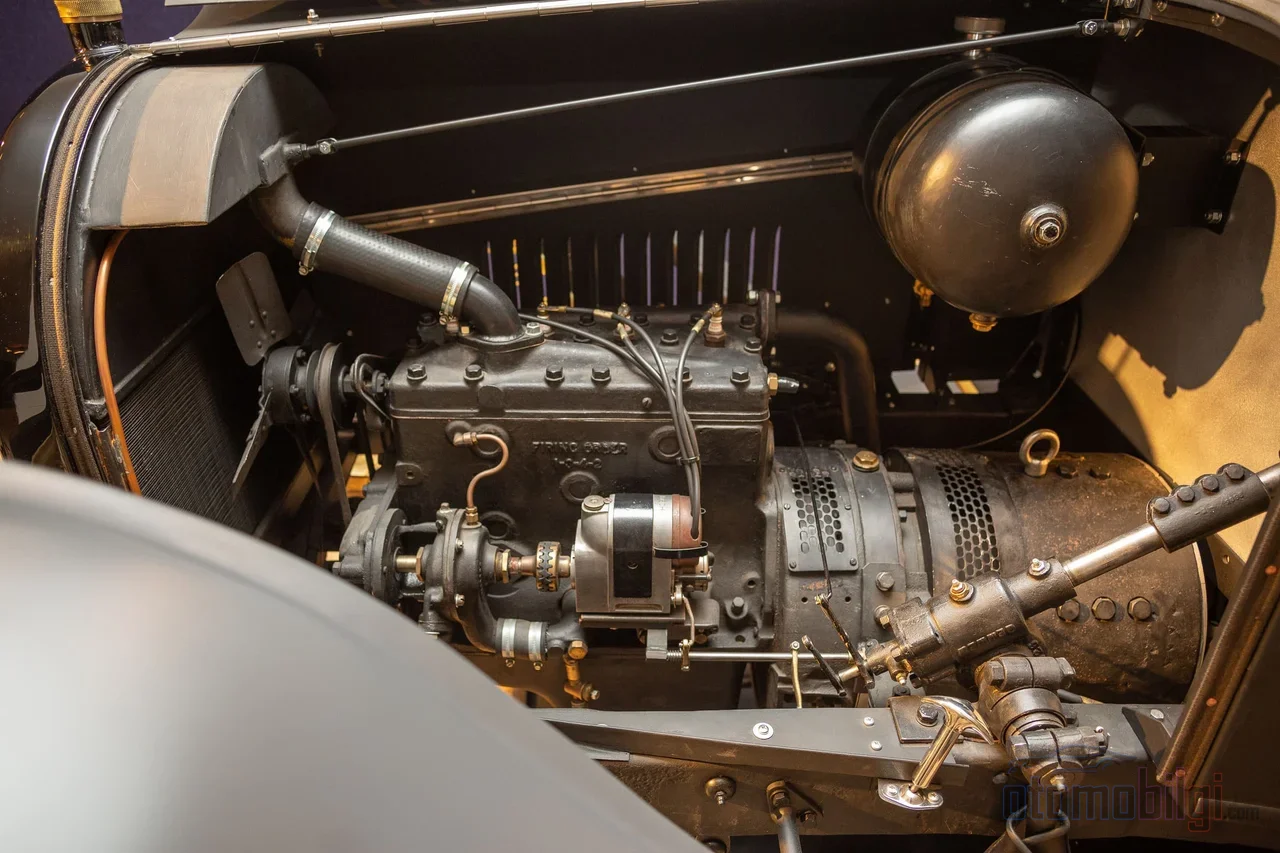
The system's architecture is instructive even today. At the center is a Continental-sourced 14 hp, 68.7 cubic inch (approximately 1,125 cc) displacement L-head inline four-cylinder gasoline engine. Accompanying it is a General Electric-sourced "dynamotor" - that is, a 5-6 hp DC machine with compound winding that could operate as both motor and generator, 48 volt / 60 ampere - connected through a Cutler-Hammer electromagnetic clutch. On the battery side is Exide's specially made, 24-cell, 115 ampere-hour capacity package; an interesting detail is that this package was roughly half the size and weight of the battery packs of the purely electric cars of the era.
The most striking decision: the car had no transmission. 15 mph and below, and in reverse, only the electric motor did the work. Above this speed, the gasoline engine engaged via an electromagnetic clutch and transferred its torque through the electric motor's armature. In other words, the gasoline engine was connected directly to a single-ratio driveline, without any kind of gear selector. Deploying the electric motor's full torque in the low-speed range is the same physical rationale that today's hybrid architectures still use.
Impressive Details for the Era: On-the-Road Charging and Regenerative Braking
One of the features praised in the 1916 catalog of the Dual Power was its starting capability. At a time when electric starter motors were not yet widespread, the dynamotor's ability to start the gasoline engine electrically was a genuine advantage; the car was initially even equipped with a fixed starting crank under the radiator, a solution that was added later.
The system included two concepts that the modern reader would recognize. On-the-road charging: the dynamotor, switching to generator mode, could recharge the batteries while cruising; that is why the car was marketed as "self-charging." Regenerative braking: in the terminology of the era, "dynamic braking," 6 mph engaged at speeds above this. There was even an early notion of battery management; engineers of the 1910s knew that overcharging and full discharge caused "gassing" and "sulphating" on the battery plates, and Woods encouraged use in the 10-30 mph range.
| Specification | Woods Dual Power |
|---|---|
| Production years | 1917-1918 |
| Gasoline engine | 14 hp, 68.7 cubic inch (approx. 1,125 cc) L-head inline 4 (95 CID in 1918) |
| Electric machine | GE dynamotor, 5-6 hp, 48 V / 60 A |
| Battery pack | Exide, 24 cells, 115 Ah |
| Top speed (claimed) | 35 mph (EVs of the era were around 20 mph) |
| Fuel economy (claimed) | 48 mpg |
| Weight | 3,600 pounds (approx. 1,633 kg) |
| Price | 1916: $2,650; 1918: $2,950 |
A Rival Architecture: Owen Magnetic's Electromagnetic Transmission
Woods was not the only example. Owen Magnetic was a luxury automobile produced from 1915 to 1922 - first in New York, then in Cleveland, and in its final phase in Wilkes-Barre. Based on inventor Justus B. Entz's electromagnetic transmission design, the car's gasoline engine spun a generator, and electric power drove the rear wheels. Technically, in other words, it was an early exploration of today's series hybrid architecture. The brothers Raymond and Ralph Owen, with the support of Baker Electric and Rausch & Lang, went into production in 1915; the 1916 price range was $3,000-6,000, well above even that of the Dual Power. That is why the Owen Magnetic is sometimes described as "about 80 years before the Prius" - a description that highlights the gap between 1917 and 1997.
Why Did the Woods Dual Power Fail?
Technically, the system was sophisticated and it is acknowledged to have worked as advertised. Commercially, however, no component caught on. The measurable reasons for the failure are clear:
- Price: 2,650 dollars, equivalent to roughly four Model Ts or two Buicks. When the chassis was stretched to 124 inches and the engine increased to 95 CID in 1918, the price rose to 2,950 dollars, and sales did not increase.
- Performance: A top speed of 35 mph was not sufficient for the luxury customer in a market where the Model T could do 40-45 mph.
- Maturity: The system was not as smooth and reliable as promised; changes were needed in 1917.
- Market: The market share of electric vehicles was already declining rapidly; the hybrid emerged as a product trying to rescue a sinking segment.
The summary verdict is brutally short: the hybrid was too expensive, slow and difficult to maintain to achieve commercial success. The Woods firm went bankrupt in 1918; in total only a handful of Dual Power and fewer than 14,000 Woods-branded vehicles were sold. The marketing approach also reflected the conventions of the era: the "ease of use" emphasis, as with pure electrics, was aimed largely at women drivers.
How Many Examples Survive and Where Can They Be Seen?
Today the known count is four, possibly five. The most important example is the vehicle at The Henry Ford museum in Dearborn: original, preserved, and with 11,085 miles on it; the 1917 example can be seen in the museum's "Driving America" exhibition. One is in a museum collection in the Los Angeles area; the restoration work was done by Howard Auto Preservation. The only known running example is at the Louwman Museum in the Netherlands. One body is said to have been mounted on a Stanley Steamer chassis, and one unit is said to have been re-bodied as a Hispano-Suiza style roadster; a fire-damaged 1917 example was listed for sale for approximately 48,000 dollars .
Were These Vehicles Really the "First Hybrid"?
No - and the priority debate is a matter of historiography. Most sources point to Ferdinand Porsche's Lohner-Porsche work as the first hybrid: the prototype introduced in 1900, and the 1901 Mixte model used an internal combustion engine to turn a generator, and in 1902 Porsche won the Exelberg Rally with this vehicle. Some sources date the Semper Vivus prototype to the 1900 Paris World's Fair and its production to 1901. Nevertheless, one popular history narrative presents the 1917 Woods Dual Power directly as the "first hybrid car"; there is that much inconsistency about dating and priority. The correct framing is this: if the Lohner-Porsche was the first hybrid, the Dual Power was the first serious attempt at mass production in the United States.
It is also necessary to add a note to the "80-year disappearance" narrative. The 1916 Owen Magnetic dating roughly eighty years before the Prius supports this narrative; however, what disappeared was not the idea, but economic viability. Viktor Wouk's 1974 design based on the Buick Skylark, considered the first modern hybrid, followed by the Prius, which sold 18,000 units in Japan in 1997, and the two-seat Honda Insight that entered the market at the end of 1999, show the activation of the same architectural idea once the battery and power electronics finally matured. Woods's dynamotor was the first schematic of that technology package, built eighty years too early.
Conclusion: An Engineering Idea and a Market Reality
The story of the Woods Dual Power proves that the hybrid car lived as an idea in America in the 1910s as well, and became a tangible product here. The system included on-road charging, regenerative braking, electric starting, and even an awareness of protecting battery life. What was missing were two variables no engineer could fix: power and cost. For a vehicle priced four times higher, traveling at 35 mph in the same market as the Model T, what was needed was not physics but economics - and that economics only emerged eighty years later, in the years when the hybrid's name was Prius.
Sources
- It wasn't the first hybrid, but the 1917 Woods Dual Power was an electrically assisted marvel
- Hybrid Pioneer: The 1916 Woods Dual Power
- Woods Motor Vehicle Company
- Vehicle Conservation | Wood Dual Powered Coupe
- Owen Magnetic
- Lohner–Porsche
- The history of Porsche begins electrically
- The First Hybrid Automobile | The Engines of Our Ingenuity
- Milestones: Toyota Prius, the World's First Mass-Produced Hybrid Vehicle, 1997