Balance Shaft: The Technology That Tames Engine Vibration
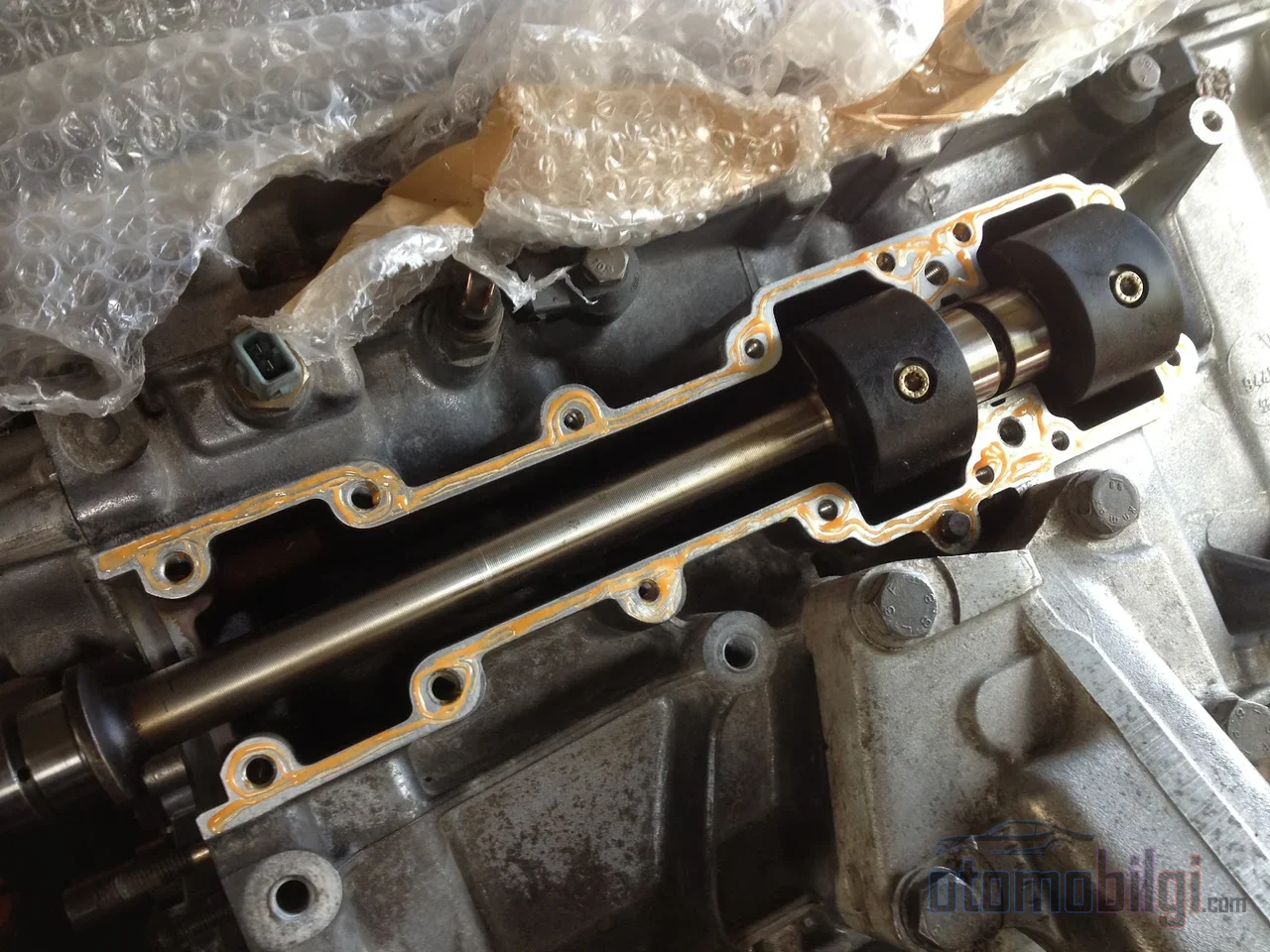
Listen to an inline four-cylinder engine with the hood open and pay attention to that fine, high-frequency tremor reaching the steering wheel as the revs rise. The source of this tremor is usually not a manufacturing defect or wear; it lies in the very nature of the engine's geometry. The counterweights on the crankshaft solve only part of this problem. The remaining part, namely the second-order vibration, cannot be eliminated without special shafts rotating at twice the crank speed. These shafts, known as balance shafts, have been one of the most elegant balance solutions in engine engineering for over a century.
Vibration Arises from the Engine's Geometry
In a piston engine, the pistons and connecting rods move back and forth in a straight line while the crankshaft rotates. Linking these two types of motion creates a purely mechanical problem, independent of thermodynamics: the connecting rod does not behave symmetrically throughout the crank rotation. The distance a piston travels near top dead center is not the same as the distance it travels near bottom dead center. This asymmetry produces a net vertical force twice in every crank revolution.
In an inline four-cylinder engine, cylinders 1 and 4, and 2 and 3, form symmetric pairs, and the first-order forces largely cancel each other out. But the second-order force, a vertical force oscillating at twice the crank speed, cannot be canceled in this configuration; on the contrary, it is amplified. This force increases with the square of the revs: when the revs double, the second-order force quadruples. As the stroke gets longer, the difference in piston accelerations grows, and as the cylinder bore grows, the piston mass increases, so the problem grows.
For this reason, a practical threshold emerges: in inline four-cylinder engines with a displacement exceeding roughly 2.0 to 2.4 liters, the second-order vibration usually reaches a size that cannot be suppressed with mounts, and the balance shaft becomes almost standard. In small-displacement engines, the vibration is often low enough not to require shafts.
Why Are Crank Counterweights Not Enough?
This is the most frequently asked point on the subject. The counterweights on the crankshaft rotate at crank speed and can only balance first-order forces that oscillate at crank speed; they also reduce main bearing loads. However, the second-order force oscillates at twice the crank speed. A mass rotating at crank speed, whatever its weight, cannot cancel an oscillation at twice the frequency. Since the frequencies do not match, the equation cannot even be set up. To eliminate this vibration, a mass rotating at twice the speed is essential.
Highlights
- The balance shaft idea was patented by Frederick W. Lanchester in 1907.
- The twin balance shafts rotate in opposite directions at twice the crank speed and eliminate the second-order vertical force.
- In inline three-cylinder engines, a single shaft balances the end-to-end rocking at crank speed.
- Mitsubishi put the system into series production in 1976 with the Colt Celeste 2000.
- Naturally balanced configurations (inline-six, boxer-six, V12) do not need a balance shaft.
How Does a Balance Shaft Work?
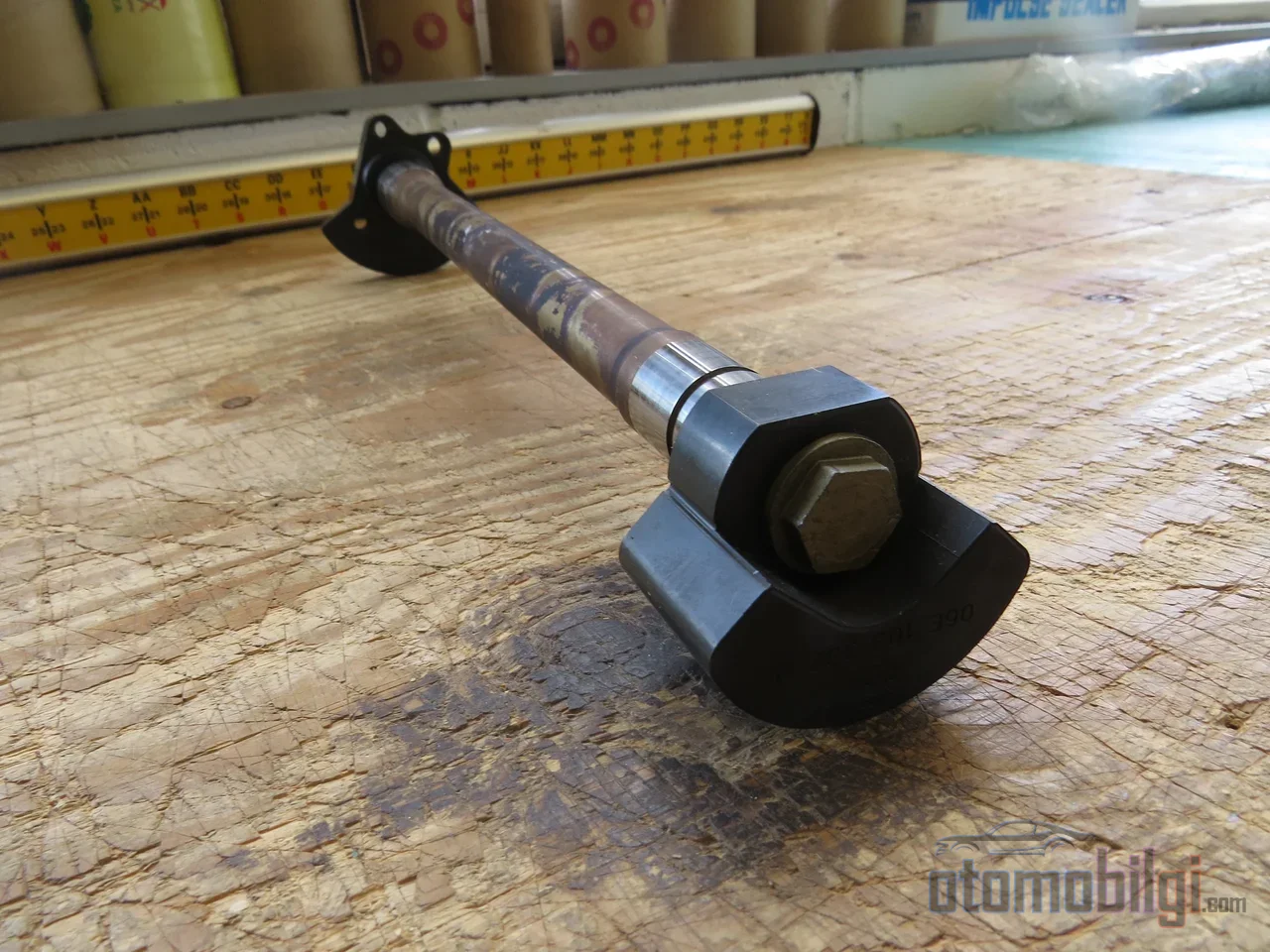
The logic of the solution is to generate opposing forces. Two shafts carrying eccentric weights are driven from the crankshaft by gear or belt drive and rotate in opposite directions to each other, at exactly twice crank speed. The phases are set so that the vertical components of the centrifugal forces produced by the weights add together, while their horizontal components, being equal and opposite, cancel each other out. The resulting net vertical force is at the same frequency as the engine's second-order vibration and in exactly opposite phase; thus the two forces cancel each other out.
The placement of the shafts is also part of the engineering decision. In the conventional layout, the two shafts are placed on either side of the engine, one just above the crank axis and the other higher up. Mitsubishi's Astron 80 engine introduced in 1975, instead of this arrangement, placed one of the shafts noticeably higher, becoming the first design that also balanced the second-order rocking couple arising from the inertia of speed fluctuations and acting around the crank axis. In newer engines, designs that place the shafts in the crankcase are also seen for packaging advantages.
There is also an important limitation: balance shafts do not reduce the torsional vibrations of the crankshaft itself. Their job is to restrain the vibration of the engine block and the vibration transmitted to the body; other elements such as the harmonic balancer deal with the crank's internal dynamics.
The Different Problem of Three-Cylinder Engines: End-to-End Rocking
The balance of three-cylinder engines is surprising at first glance. Thanks to the 240-degree firing interval that divides the 720-degree full cycle among three cylinders, the combined center of mass of the pistons and connecting rods remains stationary; there is no net vertical or lateral force. But the problem lies not in the magnitude of the forces, but in their points of application. The forces are applied at three different points on the crankshaft, giving rise to a couple that rocks the shaft end to end, in other words a first-order rocking vibration.
The solution here is a single balance shaft. Rotating at crank speed but in the opposite direction, with weights at both ends, this shaft counteracts the piston motions at the ends, canceling the end-to-end rocking. In three-cylinder engines, it is sufficient for the shaft to rotate at the same speed as the crank; because the problem is a first-order couple, not a second-order one.
There Is a Solution Without Shafts Too: The Ford 1.0 EcoBoost Example
Not every three-cylinder engine follows this path. The Ford 1.0 EcoBoost stands out as an engine that is balanced without resorting to a balance shaft at all. Engineers here chose to shift the first-order vibration from the vertical axis to the lateral axis by using an unbalanced flywheel and pulley. The logic of the choice is simple: lateral vibration is easier to absorb by the engine mounts and the clutch's torsional damper than vertical vibration is to absorb. This approach also eliminates the shaft's cost, weight, and friction; because the balance shaft added to a three-cylinder engine is a cost that eats back part of the efficiency gain of this configuration.
Three cylinders is also an area with room for improvement in vibration reduction. New-generation balance gear designs using elastic gears have shown that vibration is reduced by up to 99 percent compared to rigid gears. Low-vibration three-cylinder solutions in hybrid and range-extender applications are an active engineering research topic.
From Lanchester to Series Production: The Historical Journey
The mastermind behind the balance shaft idea is the British engineer Frederick W. Lanchester. Lanchester patented his solution to the balance problem of inline engines in 1907. However, it took decades for the patent to turn into series production. It was Mitsubishi that built this bridge: the company licensed the Lanchester patent and put the system on the road in 1976 with the Colt Celeste 2000 model, and refined the design with the Astron 80.
Then the wave spread. The Fiat group, in the powerful unit of the Lambda engine family; many manufacturers, including the Saab 9000 and Porsche 944, used balance shafts under Mitsubishi license in their powerful inline four-cylinder engines. The three-liter inline-four of the Porsche 944 S2 and 968 is one of the largest four-cylinder engines ever seen in modern cars, and this displacement was only achievable thanks to dual balance shafts.
The field of use is not limited to the inline-four either. In the motorcycle world, the Yamaha TRX850 and TDM850 use a shaft with their 270-degree crank; BMW prefers an alternative solution with pivoting counterweights instead of a shaft in its GS parallel twins. Shafts are found in inline-fives and some V6s to reduce rolling motion.
Which Engines Do Not Need a Balance Shaft?
Some configurations are geometrically self-balancing. In a flat-four, opposing pistons move in opposite directions and their forces naturally cancel each other out. In inline-six and Boxer-six engines, first- and second-order forces and rolling couples are balanced; the internal balance of the V12 is nearly perfect. That is why looking for a balance shaft in an inline-six engine is futile; and manufacturers do not fit one.
Small-displacement inline four-cylinder engines usually do without shafts as well; vibration is kept at an acceptable level with a reinforced block, hydraulic engine mounts and lightened pistons. In contrast, rising comfort expectations have made shaft use widespread again in engines above two liters.
Does the Balance Shaft Steal Power? The Reckoning of Benefit and Cost
Removing the shaft is occasionally a topic of debate in performance circles. Critics point to two issues: as a rotating mass, the shaft creates parasitic drag and consumes a small share of the engine's output for its drive. There is also the opposing view: an unbalanced engine's own vibration also consumes energy, so removing the shaft could actually create a greater overall loss. No definitive horsepower figure has been verified with manufacturer data; so it would be dishonest to make a measurable claim here.
The decision to remove it is also a safety matter. A broken drive belt or a seized bearing can kill; therefore balance shaft removal is evaluated more as a longevity modification than a performance modification. With factory engine mounts, the difference in vibration is already barely noticeable. On the other hand, if the removed shaft's unbalanced masses are left uncanceled, the engine runs rough; the risk of oil leakage and pressure loss should not be ignored either.
In summary, the clear answer to the question is this: the balance shaft is a vibration reduction system that eliminates the second-order vertical force arising from piston geometry and oscillating at twice crankshaft speed, by producing a counteracting force with eccentric weights rotating in opposite directions at twice the speed; while in three-cylinder engines it is a system that balances the end-to-end rocking with a single shaft rotating at crankshaft speed. The price is weight, friction and cost; the gain, however, is a refined operating character and long-distance comfort. That is why every engine manufacturer decides whether to fit a shaft by weighing the configuration's natural balance against the displacement threshold.
Sources
- Balance shaft
- Engine Configuration and Smoothness
- Balancing means for reciprocating engines (US1163832A)
- Balancer structure for three-cylinder engines (US4565169A)
- How Engine Balance Shafts Work (In 60 Seconds)
- The twin counter balance shafts
- Why do inline engines need balance shafts
- Pros and Cons to removing the balance shafts
- Structure design method of new balanced vibration reduction gear for the three cylinder engine