Does Tire Pressure Really Affect Fuel Consumption?
Share This Page
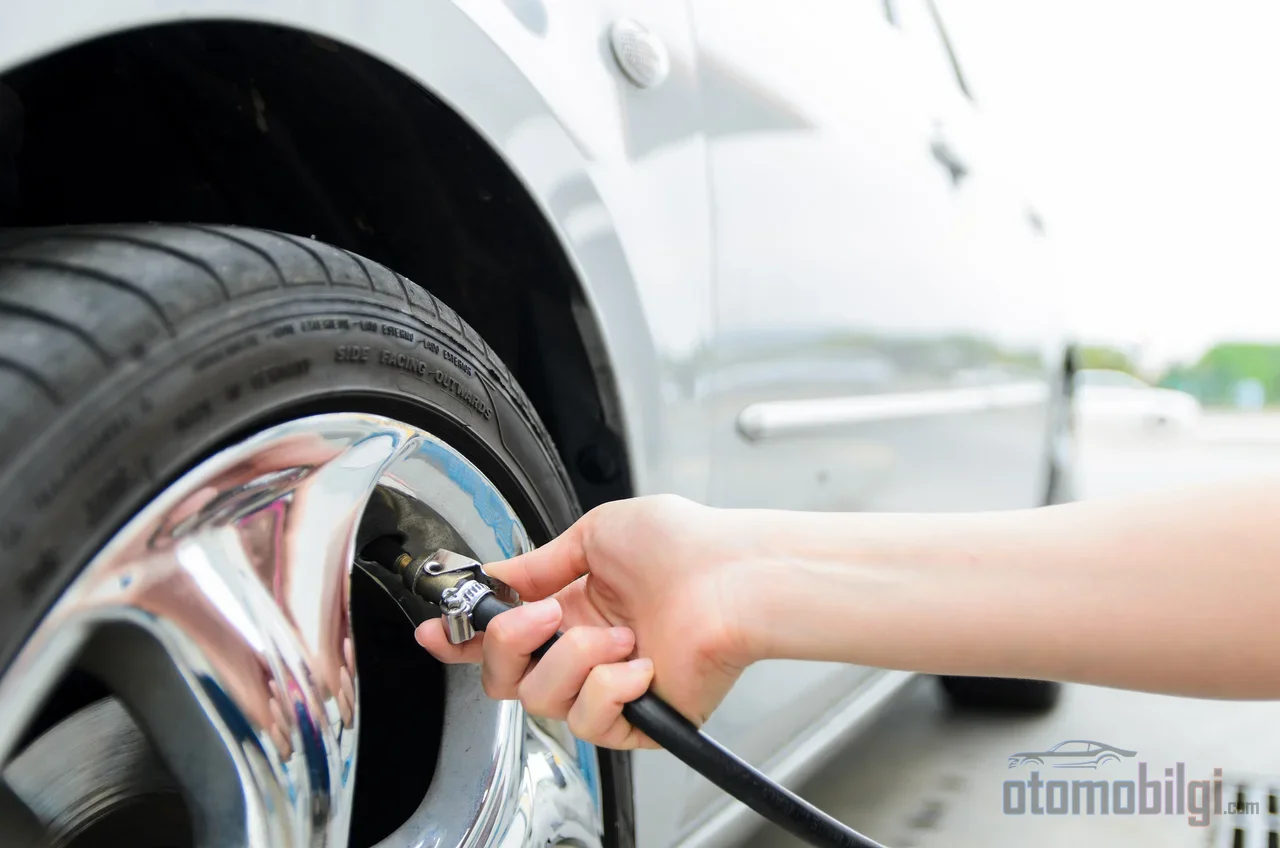
Yes, tire pressure really does affect fuel consumption, and the effect is measurable: every 1 PSI of pressure deficiency across the four tires worsens fuel economy by approximately 0.2-0.3% while a tire falling 8 PSI below the recommended level increases consumption by up to 4%. The mechanism is simple: reduced pressure causes the tire to flex more on the road and raises rolling resistance; the engine burns more fuel to overcome this extra resistance. The correct pressure is determined not by looking at the tire sidewall but at the label on the driver's door.
Highlights
- Every 1 PSI of low pressure in all tires reduces fuel economy by 0.2-0.3% reduces
- 0.3 bar of low pressure increases rolling resistance by 6%while 1 bar of deficiency increases it by 30% increases
- Rolling resistance accounts for approximately 15-20% of passenger car consumption
- A nitrogen-filled tire loses only 1.3 PSI less pressure in a year compared to air
- The correct value is not on the tire sidewall but on the manufacturer's label inside the door
How Low Pressure Increases Consumption: The Rolling Resistance Mechanism
A tire deforms continuously as it rolls. The area in contact with the road compresses, the rotating area tries to return to its original shape, and during this flexing a portion of the energy turns into heat. This loss, known as hysteresis in engineering literature, alone accounts for 85-90% of rolling resistance. The remaining share is distributed among friction and other losses.
Pressure is a decisive adjustment knob in this chain. If a tire is not inflated enough, its body flexes more, the contact area lengthens, and more energy is lost as heat with each rotation. Measurements clearly show its effect: 0.3 bar of low pressure increases rolling resistance by 6%; when the deficiency reaches 1 bar, this increase rises to 30%.Measurements conducted in California found that more than half of vehicles were being driven with at least 0.3 bar of low pressure - meaning this is not a marginal user error but a widespread condition.
So how much of your consumption does this resistance affect? In passenger cars, rolling resistance accounts for approximately 15-20% of total fuel consumption; in light commercial vehicles this share rises to 30-40%,and in heavy trucks up to one third. Since the tire's share grows in larger and heavier vehicles, pressure management becomes even more critical there. A general rule of thumb also works like this: a 10%improvement in rolling resistance provides a reduction in fuel consumption of up to 1-2%.reduction of up to
Pressure-Consumption Relationship in Numbers
Standardized coefficients exist for translating pressure loss into consumption. The US Department of Energy gives a value of 0.2%for every 1 PSI drop, while the EPA gives 0.3% for the same loss; although there is a small difference between the two, the direction is the same. Road type also changes the result: on highway driving, every 10%change in rolling resistance has a 2%effect on fuel economy, while in city driving the effect is 1%.On the highway, since acceleration is not repeatedly applied, resistance changes are felt more directly there.
| Pressure or Resistance Change | Impact on Consumption |
|---|---|
| Every 1 PSI of missing pressure (all four tires) | 0.2–0.3% loss in fuel economy |
| 8 PSI below the recommended pressure | Approximately 4% higher consumption |
| 0.3 bar of missing pressure | 6% increase in rolling resistance |
| 1 bar of missing pressure | 30% increase in rolling resistance |
| 10% improvement in rolling resistance | 1–2% reduction in consumption |
| Driving at 50% pressure (40 mph) | Approximately 10% higher consumption |
The practical meaning of these figures is also concrete: 14 psi (approximately 1 bar) underinflated tires can burn an entire extra tank of fuel per year. Likewise, a fuel economy penalty of up to 10% on properly inflated tires has been measured with standard test protocols on more than one passenger car. It is also true that active pressure management works in the opposite direction: tires kept at optimum pressure on the highway can reduce consumption by up to 2%. reduce it.
Door Placard or Maximum Value on the Tire Sidewall?
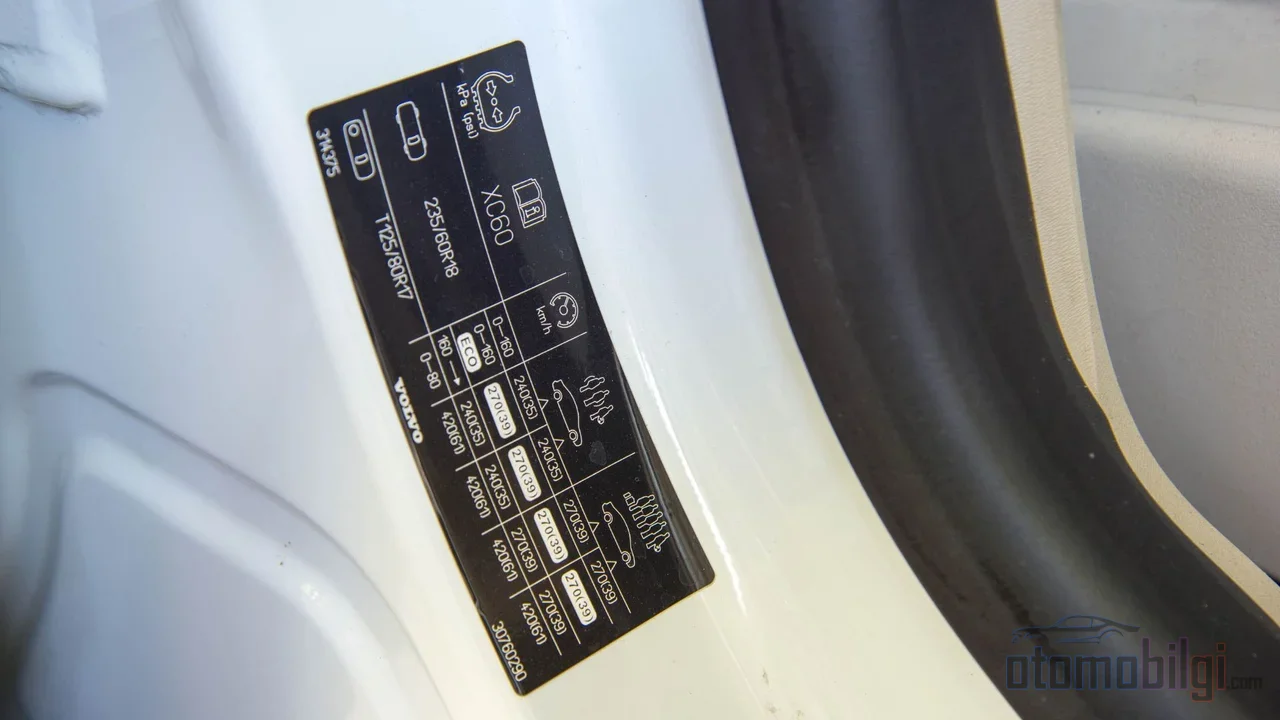
This is the most commonly confused point about tire pressure. The number stamped on the tire's sidewall shows the maximum safe pressure at which that tire can carry its rated load; it is not the recommended daily value for your vehicle. Using this number as a reference for inflation means driving with higher-than-necessary pressure in most passenger cars.
The correct reference is the manufacturer's placard on the side frame of the driver's door or the owner's manual. This placard includes the cold tire pressure, the recommended tire size, and load information. For most passenger cars, the recommended range falls within the 30–35 PSI band, but the exact value is a model-specific number determined by the manufacturer based on that model's weight distribution, suspension geometry, and tire size. The tire manufacturer designs a tire; the vehicle manufacturer determines at what pressure that tire provides the best balance on its own vehicle. That is why the placard always comes before the sidewall.
There is also the importance of measurement timing. During driving, the tire heats up and the pressure can rise by up to 20% compared to the cold value - this is completely normal and should not be corrected. Temperature itself complicates matters too: every 10°F (approximately 5–6°C) change in air temperature shifts the pressure by about 2 PSI. That is why it makes sense to increase the frequency of pressure checks during seasonal transitions and on the first cold mornings. The check should always be done on cold tires, before a long drive.
How to Set Pressure for Full Load and Long-Distance Driving?
If the vehicle is going on a trip with a full trunk or a full load, the pressure requirement changes; the tire will carry more weight and flex more. There is no universal official rule for this scenario, but practical approaches are clear. The common and reasonable formula, if the manufacturer's label does not provide a separate value for a full load, is to go a few PSI above the label pressure and never exceed the maximum value on the tire sidewall under any condition. Data from the truck segment supports this logic: under maximum legal load, a high pressure suited to the load capacity instead of a low standard pressure yields a clear efficiency advantage; similarly, 1 bar of underinflation increases a truck's consumption ~2% while shortening tire life by ~20% .
- City driving and normal loading: use the cold pressure value on the door label.
- Full load or long highway trip: go slightly above the label value, never exceed the sidewall maximum.
- Always set the pressure on cold tires; the value measured on a hot tire after driving is misleading.
- Before a long trip, also check the pressure of the spare tire.
Overdoing it is a separate mistake. Pressure far exceeding the manufacturer's recommendation can reduce rolling resistance and improve consumption marginally, but this gain is paid for with accelerated wear of the tire's center tread, degraded comfort, and reduced grip. The equation is unbalanced; going outside the recommended range is not a saving method, but a trade-off method.
Does Nitrogen-Filled Tires Really Save Fuel?
Nitrogen filling, frequently recommended by tire shops, is the most exaggerated headline in consumption debates. It has a physical basis: normal air already contains 78% nitrogen and pure nitrogen, due to its molecular structure, leaks through the tire wall more slowly than air. So a nitrogen-filled tire loses pressure more slowly - this is a measurable fact.
The scale, however, is disappointing. In consumer tests, nitrogen-filled tires lost only 1.3 PSI less pressure than air over the course of a year. This difference is easily erased with the free flowing air at a gas station once a week and a monthly check. The literature does include studies claiming that nitrogen filling improves tire life by 50% and fuel economy by 23%, but these figures should be read with serious caution as they clearly do not align with mainstream measurements (the 0.2-0.3%/PSI rule, 10% resistance = 1-2% consumption); some publications also carry a commercial interest disclosure.
The balanced conclusion is this: nitrogen's pressure-holding advantage is small but real; the fuel-saving promise is exaggerated. What matters is not which gas you inflate with, but how often you check the pressure. Regular checking with air is both a cheaper and more practical solution.
Do a Few PSI Really Make a Difference? Field Reality and Frequently Asked Questions
The thought that "it's only three or four PSI low, it's trivial" is the most expensive misconception. Apply the coefficient: a total of 8 PSI underinflation across four tires means ~4%' increase means. In a vehicle with high annual mileage, this equates to a few tanks of fuel on its own - and it's a cost paid without ever touching the tires, simply by not skipping the pump.
To be honest, field data isn't as clear as the lab. A field study of thirty vehicles found only a weak correlation between pressure and consumption; the reason is insufficient data volume and the noise of real-world driving conditions. The strong pressure-consumption relationship comes from controlled test protocols. So the effect is there and measurable; but in daily use, much larger variables like wind, traffic, air temperature and driving style can mask it. This doesn't mean pressure checks are unnecessary - it means a predictable gain delivered by the only variable under control.
Practical Check Routine
- Measure tire pressure once a month and before every long trip, on cold tires.
- Always take the target from the door sticker; the value on the tire sidewall is only the upper limit.
- Repeat the check during seasonal transitions, especially when temperatures drop.
- Go a few PSI above the sticker when fully loaded and on long highway journeys, without exceeding the sidewall maximum.
- Account for the fact that consumption may be 2-3% higher during the first few thousand kilometers of new tires.
Tire pressure is the cheapest adjustment point in fuel economy. It requires no organizational effort, equipment investment, or habit change; an air gauge and a few minutes a month are enough. The gain returned to your engine by every psi you add to your vehicle is a measurable, cumulative saving.
Sources
- What impact does tyre rolling resistance have on fuel efficiency - Michelin
- Why rolling resistance matters - Continental Tires
- A Study on Vehicle Tire Inflation and Fuel Consumption - SJSU Mineta Transportation Institute
- Tyres and how they impact fuel consumption - Volvo Trucks
- Tire Safety Ratings and Awareness | TireWise - NHTSA
- Fuel Economy - Maintenance - fueleconomy.gov
- Tire Pressure Maintenance - A Statistical Investigation - NHTSA
- Underinflated Tires in the United States - GAO
- Recommended Tire Pressure - Pirelli
- What Is Tire Rolling Resistance? - TireRack
- Understanding the Impact of Tire Pressure on Your Vehicle's Fuel Efficiency - Jaco Superior Products
- Proper Tire Inflation: Temperature & Altitude - TireReview
- Effect of nitrogen filling on tire rolling resistance - Clemson University thesis
- Nitrogen vs. Air In Tires: Busting The Myths - Principle Volvo