What Does the 2026 BYD Tang Say About the Premium Electric SUV Market in Türkiye?
Share This Page
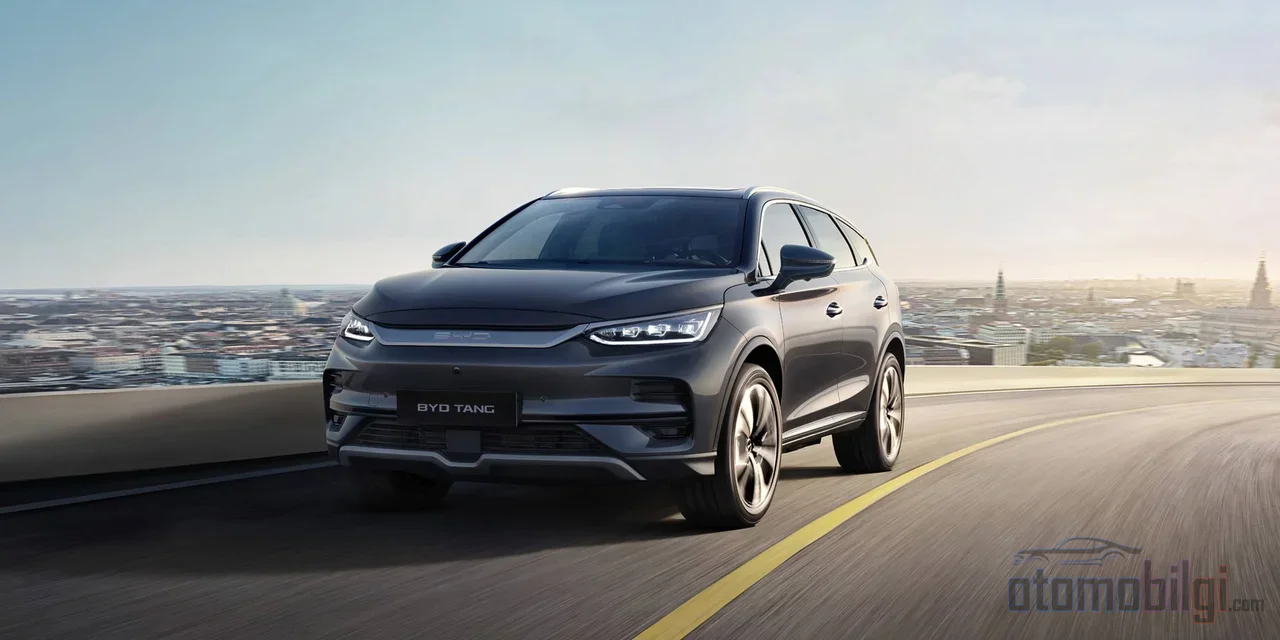
The BYD Tang is BYD's 100% electric, seven-seat SUV with a 108.8 kWh battery, 530 km of WLTP range and 380 kW of power; positioned as the brand's flagship in Europe, it is a premium-segment crossover that accelerates from 0-100 km/h in 4.9 seconds. This page examines the model's segment, its charging and range characteristics, its interior equipment, and its position against German rivals such as the Mercedes EQB or BMW iX, with the figures to back it up.
Highlights
- 108.8 kWh Blade Battery, 530 km WLTP range
- 380 kW (517 PS) dual-motor AWD, 0-100 km/h in 4.9 seconds
- DC charging 170 kW; approximately 30 minutes
- for 30-80%
- 7 seats, up to 1,665 liters of cargo space 2024 five-star Euro NCAP
rating
Who Is the BYD Tang Designed For: Segment and Model Identity The BYD Tang is the brand's second model in the Dynasty series after the Qin, and takes its name from the Tang dynasty in Chinese history. Production began in 2015, and in its current form it is a mid-to-upper-class, 5-door crossover SUV, also classified as E-segment. The dimensions clearly support this positioning: 4,870 mm length, 1,950 mm width, and 2,820 mm wheelbase. In other words, the Tang sits in the same physical class as Europe's flagship SUVs, especially in terms of width.
The second-generation Tang EV was also BYD's first vehicle exported to Europe; sales began in Norway in 2021. This detail matters, because the Tang should be read not merely as another electric SUV in Türkiye, but as the brand's showcase of technology and prestige in Europe. An all-wheel-drive, fully electric, seven-seat package; the only model in BYD's portfolio that offers all three together.
Battery, Range and Charging Character: What Do the Figures Say?
The Tang's technical backbone is based on BYD's LFP-chemistry Blade Battery technology. The battery is produced by placing leaf-shaped cells directly into the pack; LFP chemistry is known for its resistance to thermal conditions and contributed to the 5-star rating in the 2024 Euro NCAP tests. In terms of capacity, the Tang comes with 108.8 kWh of usable capacity in the European version; the nominal capacity is measured at approximately 111 kWh.
| Feature | Value |
|---|---|
| Battery | 108.8 kWh Blade (LFP) |
| WLTP range | 530 km |
| Power | 380 kW (517 PS), AWD |
| 0-100 km/h | 4.9 seconds |
| DC charging capacity | 170 kW |
| 30-80% DC charging | ~30 minutes |
| AC onboard charger | 11 kW onboard |
| Cargo capacity | Up to 1,665 L |
The most debatable row in this table is DC charging. A peak power of 170 kW and a 30-80% time of roughly 30 minutes is a modest figure by today's standards when you consider the Tang's 108 kWh battery. If we divide it out by battery capacity, the Tang takes back a little over a third of its battery per hour; some rivals with 800-volt architectures squeeze the same rate into around 18 minutes. From an engineering standpoint the reason is simple: the Tang uses a 400-volt-class architecture, and the LFP chemistry's tolerance for high C-rate charging is limited.
What Is the Real-World Range?
The 530 km measured under the WLTP cycle is the catalog figure. Real-world estimates based on independent consumption data draw a band 330-660 km depending on campaign and driving conditions. The explanation for this wide band is the difference in measurement method: the lower bound represents consumption under heavy load at highway speeds, while the upper bound represents low-speed city use. Cold weather reduces range in LFP batteries, as in any chemistry; in city use under winter conditions, a value of around 470 km can be expected. In short, the 530 km WLTP figure is a realistic midpoint for daily use, but for long-distance highway runs, planning around 400 km would be healthier.
On the AC side there is an unexpected patience test: with the 11 kW onboard charger, a full charge from zero takes 9 hours 43 minutes . This is a natural consequence of the 108 kWh pack, and it is not a problem for a vehicle charging overnight at home, but it should be factored into scenarios like a workplace lunchtime top-up.
Interior and Technology Equipment: Where Is the Premium Claim?
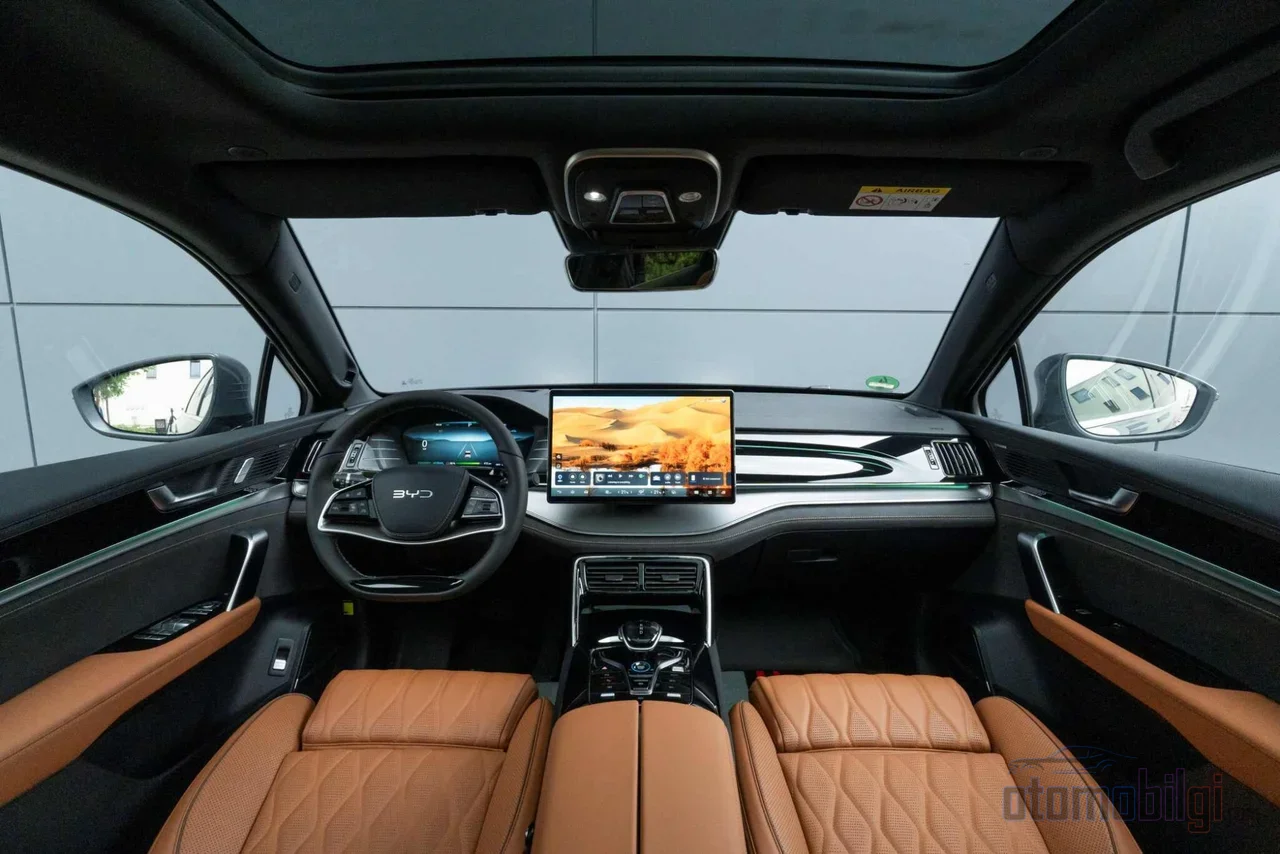
The Tang's cabin is the part that most clearly justifies its price positioning in Europe. A 15.6-inch rotating center display (working vertically or horizontally depending on the situation), a Dynaudio sound system with 12 speakers and 31-color ambient lighting are standard. Upholstery is black/brown leather; heated and massage functions on the front seats, three-zone climate control and a PM2.5 filter are available. A safety feature rarely seen in a family car with rear seats is also standard: Child Presence Detection (CPD), which can detect a child left in the cabin after the vehicle is abandoned.
The heat pump comes as standard equipment - this is an engineering-wise meaningful detail for preserving winter range, and it is still an extra-cost option on some premium rivals. On the connectivity side, Android Auto and Apple CarPlay, NFC card unlocking, 4G connectivity and OTA (wireless) software updates are offered. In addition, the Tang supports 4 kW V2L, that is, energy transfer from the vehicle to the outside - a practical capability ranging from powering tools at a campsite to feeding the home during a power outage.
The Tang's Position Against German Premium Rivals
The Tang's closest German rival among seven-seat electric family SUVs is the Mercedes EQB. The size comparison speaks in the Tang's favor: its 4,870 mm body is 18.6 cm longer than the EQB (EQB: 4,684 mm), and top speed is 190 km/h versus 160 km/h. It is bigger, faster, and offers the same 7-seat usage scenario.
Comparing it with the BMW iX in the higher segment clarifies the Tang's class. The iX is clearly ahead in range and charging speed, while the Tang speaks in volume and equipment density.
| Criterion | BYD Tang | BMW iX |
|---|---|---|
| Cargo volume | 940 L | 500 L |
| WLTP range | 530 km | 701 km |
| 10-80% DC charging | 46 min | 35 min |
In Europe, the Tang's flagship equipment is approximately €69,615 from the list; in used and stock listings, a range of €51,000-61,990 can be seen. This is clearly below the iX's entry level, close to the upper-tier versions of the EQB. In a nutshell: while the Tang loses to the iX in range and charging speed, it beats the EQB in size, performance and equipment density. Offering a bigger battery and a more spacious cabin at a more affordable price than its German rivals, without a class change, is the Tang's main argument on paper.
Pros and Cons: A Balanced Calculation
The picture emerging from where user reviews and independent assessments intersect is as follows:
- Genuinely usable seven-seat volume and comprehensive equipment at an attractive price
- Comfortable and quiet ride, with a 380 kW power reserve
- The safety advantage of LFP chemistry and a 5-star Euro NCAP rating (2024)
- Con: lower DC charging power than some rivals
- Con: risk of a 10-15% drop in real-world range in winter conditions
This picture clearly places the Tang EV here: a strong candidate for the buyer who wants maximum battery capacity and 7 seats, but does not make charging speed the primary criterion. For users who regularly drive long distances and for whom charging speed is critical, the German alternatives in its class are still more rational.
BYD Tang in the Türkiye Market: Price Position and an Unusual Situation
The Tang's situation in Türkiye is an interesting example compared to the rest of the market. The model appears with a single trim in the brand's official Türkiye price list TANG 380 kW AWD and market data shows its price starting from 5,418,000 TL. In the same list, SEAL 390 kW AWD Excellence is at 4,077,000 TL and SEALION 7 AWD Excellence at 4,190,000 TL. So the Tang is not a volume model in BYD's Türkiye portfolio; it is positioned as a technology showcase completing the list from the top - roughly 1.2 million TL above the SEALION 7.
This price places the model above all of the best-selling electric SUVs in Türkiye. Is that an unprofitable choice? Not necessarily. Globally, BYD sold 4.6 million new energy vehicles in 2025, and in the first half of 2026 it has reached 1.81 million units; exports account for 44% of these sales. For the brand, the Tang's purpose is not to generate volume, but to demonstrate BYD's ceiling capability in Türkiye with a 108 kWh, 517 PS flagship. The Turkish electric vehicle market recorded 81,331 sales in the first half of 2026; capturing the top tier of this growing pie is a long-term investment in brand perception.
The possibility of price flexibility during campaign periods is the most concrete opportunity ahead of the Tang. Since the trim already includes the full top-segment equipment, a discount translates directly into a price advantage: getting the same seven-seat volume and 108 kWh battery at a figure below its German equivalent is the only window for a buyer who is price-sensitive but also wants space.
Great Tang: How Will the Third Generation Affect Türkiye?
The Tang's story does not end with the current generation. A third generation, documented in China in 2026 - Great Tang - fundamentally reshapes the existing vehicle: length 5,045 mm, wheelbase 2,950 mm, and the vehicle is now 5-seater only; the three-row seven-seat version is positioned as a separate body under the name "Datang". The cabin features a 35.4-inch gauge band and a 30-inch continuous center/passenger display, seen for the first time in a BYD.
On the technical side, the real leap is in charging: with the second-generation Blade Battery and flash charging technology, 10-70% in about 5 minutes, with a target of 97% in 9 minutes. With 88.7 and 105.8 kWh battery options, CLTC range goes up to 730-850 km, extending all the way to the Great Tang EV variant with 950 km CLTC range and 0-100 km/h in 3.9 seconds. BYD plans to sell this new generation in Europe by the end of 2026 and announces it has reached 150,000 pre-orders in China. The practical meaning of this for the Türkiye market is this: today's Tang will remain the brand's flagship until the next generation launches in Europe, and the cost of buying a product that is technically one generation behind should be reflected in the pricing policy.
Conclusion: A Reference Point of 108 kWh
The BYD Tang is neither the best-selling electric SUV in Türkiye nor the most affordable model; it is a reference demonstrating what the brand can do with the segment's largest battery. With its 530 km WLTP range and 170 kW charging power, it technically loses to rivals focused on 2026's charging speeds; but with its seven-seat capacity, comprehensive equipment, standard heat pump, and V2L capability, it offers a package that German rivals at the same price do not provide. In the short term, price campaigns will tip this equation in the buyer's favor; in the long term, the arrival of the flash-charging Great Tang in Europe will rewrite the scale of this segment.
Sources
- BYD TANG: The 7-Seater All-Electric Performance SUV
- BYD TANG Specifications
- BYD TANG Flagship (2024-2026) price and specifications
- BYD Tang
- BYD Tang 4x4 Long Range
- BYD Great Tang hybrid declared: 342 km EV range, launch H1 2026
- BYD Great Tang EV pre-sales: 950 km range, flash charging, 0-100 in 3.9s
- BYD's New Flagship EV SUV Ultra-Fast Charging
- BYD to sell 7-seat Great Tang electric SUV in Europe
- BYD reveals tech-savvy 5-seat SUV interior with two 30" screens
- BYD Tang vs BMW iX
- BYD Tang vs Mercedes EQB
- BYD Tang size comparison
- BYD Tang Flagship 2026 - Electric SUV Global Overview
- BYD Tang 2026 price
- BYD Sales Statistics