What Should You Pay Attention to with High-Mileage Vehicles?
Share This Page
An internal combustion engine that has passed 200,000 kilometers has not reached the end of its design life; with proper maintenance, it has reached a second life that can extend to 250,000-300,000 km, and in some cases up to 500,000 km. What changes at this point is not the vehicle becoming unusable, but the need for the maintenance schedule to tighten and become specialized according to the condition of each component. This guide brings together, in a single framework, which part should be checked and replaced at which mileage interval in a high-mileage vehicle, how parts selection affects long-term cost, and what to pay attention to during the used-car sale and inspection process.
Highlights
- Switching to high-mileage engine oil after 120,000 km and shortening the oil change interval to approximately 8,000 km is recommended.
- The timing belt should be checked at an average of 60,000-120,000 km or 5-10 years; the chain at 150,000-200,000 km.
- A snapped timing belt can lead to engine rebuild costs of 60,000-150,000 TL due to valve-piston collision.
- In 2026, authorized service 10,000 km maintenance is around 4,000-8,000 TL, and 60,000 km maintenance around 12,000-25,000 TL .
- Inspection is mandatory for vehicles under 8 years old and under 160,000 km; voluntary inspection becomes critical for high-mileage vehicles.
Maintenance Schedule by Mileage Intervals
The logic of maintenance on a high-mileage vehicle is simple: the upper limits the manufacturer sets for a brand-new vehicle cannot be directly applied to an engine with worn gaskets, aging fluids, and increased internal friction. The schedule needs to be tightened to reflect this reality.
| Component | Standard Interval | High-Mileage Recommendation |
|---|---|---|
| Engine oil + oil filter | 10,000-15,000 km or 1 year | ~8,000 km; high-mileage oil |
| Air filter | 15,000 km or 1 year | Check at every service |
| Fuel filter | Check at 40,000 km, replace at 60,000 km | Same; priority for diesels |
| Spark plugs | Standard 60,000 km, iridium 100,000 km | Replace at the recommended limit |
| Brake fluid | Every 2 years | Every 2 years, kept as is |
| Tire rotation | 10,000-15,000 km | Same; replace before tread depth drops below 3 mm |
Under heavy city use, shortening the oil change interval to 7,500 km is a safer approach; short-distance driving consumes the oil's life faster than stated. Brake pads are replaced in the 20,000-40,000 km range, while discs are usually replaced after 60,000-70,000 km - but these values vary depending on driving style, so pad and disc thickness should be measured at every service on a high-mileage vehicle. The legal limit for tires is 1.6 mm tread depth; replacement before dropping below 3 mm is recommended for safe driving, and tires over 5 years old should be checked, and those over 8 years must be replaced.
Timing Belt: Do Not Make the Most Expensive Mistake
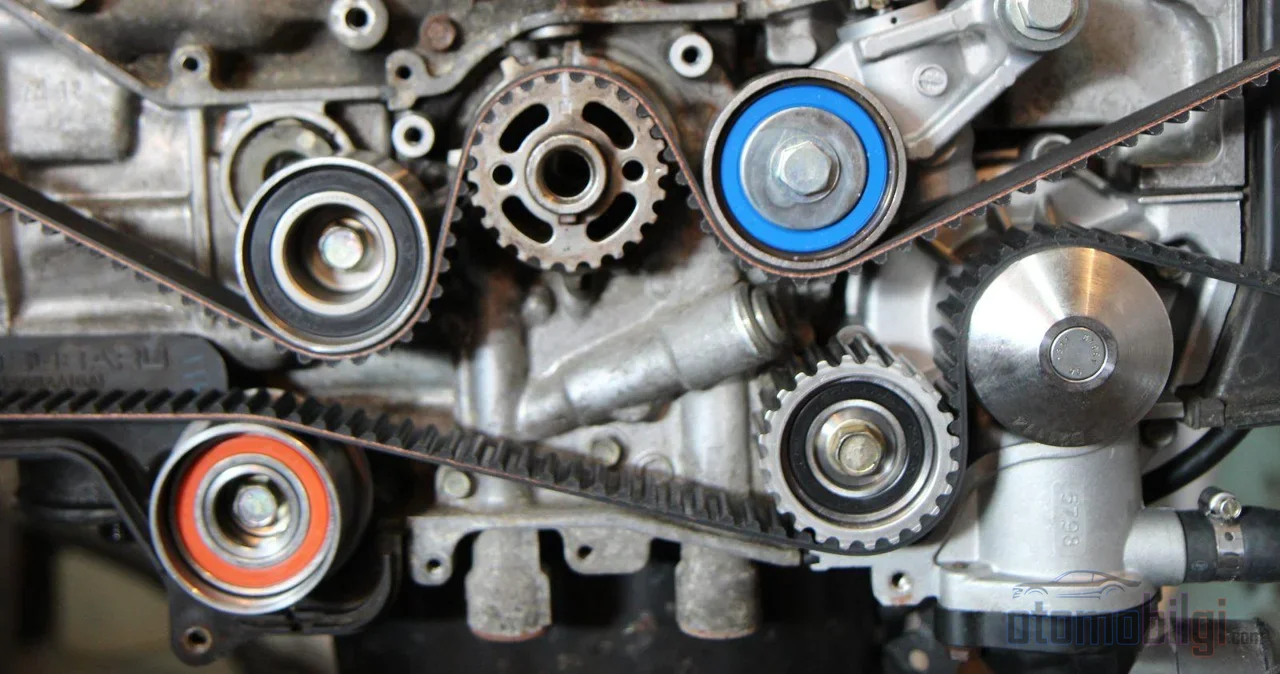
The timing system is the component that can take out the entire engine with a single mistake in a high-mileage vehicle. Belts and chains are managed with different logic:
- Timing belt: Average 60,000-120,000 km or a lifespan of 5–10 years. Manufacturers recommend 90,000–120,000 km or 5–6 years; heavy stop-and-go traffic and hot climates shorten this lifespan.
- Timing chain: It lasts longer than a belt; typically it 150,000–200,000 km should be inspected between these figures or when a metallic rattling is heard during cold starts.
A timing mechanism not replaced on time can break; a valve-piston collision may require a complete engine rebuild, and this is 60,000–150,000 TL a bill many times more expensive than the maintenance itself. On the other hand, some modern engines - for example Hyundai/Kia 1.6 GDI and VW 1.4 TSI - are designed to run on a chain for the vehicle's lifetime without replacement; on such an engine, having it unnecessarily replaced at 80,000 km is, at the very least, 8,000 TL wasted money. The right approach: rely on your vehicle's manual and, if there is a noise sign from the chain, have it inspected without saying "it can wait". Some users have experienced the chain wearing out at 80,000 km on an engine whose manual says 170,000 km - the manual is an upper bound, noise and inspection are a lower bound.
What Should Be Checked After 200,000 Km?
For a vehicle past this mileage, every maintenance should be tailored to the vehicle's actual condition. A regularly maintained engine can continue running smoothly beyond this point; but the inspection discipline for fluids and additional components changes.
Fluids and cleanliness
Coolant, hydraulic steering, brake, transmission and washer fluids should be checked regularly. If an abnormal change in color, smell or consistency is observed, the fluid must be completely replaced - adding top-up additives does not remove contamination. Fuel injector cleaning is also this range's job: clogged injectors cause extra stress on the engine, and a clogged air filter can increase fuel consumption by 12–15% .
Transmission and suspension
In an automatic transmission, oil change is mandatory and is typically done at the 60,000 and 100,000 km intervals; in a manual transmission, the oil is checked and replaced around 100,000 km. Suspension components (shock absorbers, tie rods, bushings) should be visually inspected at every service; in addition, catalytic converter and exhaust components along with a battery test should be on the routine checklist for a high-mileage vehicle. In battery maintenance, terminal corrosion is cleaned with a baking soda-water mixture, the electrolyte level is checked, and if the vehicle will not be used for a long time, it is charged once every 6 weeks .
Aftermarket or Original? The Cost Equation
The difference is not only price: manufacturing quality, material durability, warranty coverage and long-term performance also come into play. Original (OEM) parts are expensive due to high manufacturing standards and brand warranty; this difference is more pronounced in luxury vehicles. As of 2026, authorized service costs are as follows: 10,000 km service 4,000–8,000 TL, 30,000 km service 7,000–14,000 TL, 60,000 km service 12,000–25,000 TL - in premium brands it can exceed 35,000 TL. The annual service cost of a gasoline vehicle is 12,000–18,000 TL band; on diesels, maintenance is usually slightly higher due to fuel filter costs. As an example, the same comprehensive service (oil + oil/air/fuel filter) at private service centers can be found at prices such as 3,375 TRY + VAT .
The decision should be made on a per-category basis. For safety-critical parts such as brakes, timing, steering, and suspension, going for the cheap option is a poor design both in terms of safety and long-term costs; for filters and some body parts, quality aftermarket/equivalent products offer a reasonable balance. There is also something to watch out for on the insurance side: insurance companies may use aftermarket parts to reduce costs; in that case, the vehicle owner can claim the original part price difference from the insurer. In terms of preserving the vehicle's value, original parts are always advantageous.
Second-Hand Value and What to Watch for in Inspection
Mileage is the main factor that directly affects second-hand value; however, a high-mileage vehicle with a regular maintenance history can sell at a noticeably higher price than a lower-mileage vehicle with rolled-back mileage or neglect. Inspection serves two purposes in this equation: it reveals damage records and the vehicle's actual condition.
According to the regulation in Türkiye, vehicles under 8 years of age and not exceeding 160,000 km are required to undergo inspection - meaning that for the vehicles covered in this guide, inspection is not mandatory; it is a critical voluntary step for the buyer. The buyer pays the inspection fee; payment is collected before the process, and the report is delivered to the payer. Be cautious of non-corporate firms claiming "full package inspection"; there are cases of victimization. Since mileage rollback is one of the biggest problems in the second-hand market, the following should be checked:
- Mileage reading via OBD/diagnostic device and comparison with service records
- Consistency of wear on the steering wheel, gear knob, and pedal covers with the mileage (the steering wheel of a car with 50,000 km should not be shiny "like a mirror")
- Condition of tires and discs consistent with the displayed mileage
- Checking how many times the vehicle has been sold and price comparison
Usage Habits That Extend the Vehicle's Life
Maintenance keeps the car on the road; the way it is used determines how many kilometers the engine will last. The habits with the highest returns from an engineering standpoint are:
- Warm-up: A 1-2 minute warm-up before driving brings the oil to optimum temperature. Keep the revs below 3,000 RPM until the oil temperature reaches 70-80°C; avoid sudden acceleration in the first 5 minutes.
- Short-distance use: With daily use of about 3 km, moisture and fuel dilution accumulate in the oil; short city trips cause more engine wear than long-distance driving. One 30-40 minute drive per week clears this accumulation.
- Calm driving: Hard starts, sudden braking, late gear changes, and over-revving at low speeds damage the vehicle; calm driving also extends tire life.
- Idling: Idling the vehicle for long periods is among the critical habits that shorten engine life.
Regular oil changes can extend engine life by up to 50%; for synthetic oils, an interval of 7,500–10,000 km is ideal. In diesel vehicles, the strongest factor determining the life of the DPF (particulate filter) is using engine oil with the correct specification. Body protection should not be neglected either: washing and waxing prevent rust, and a detailed protection application is recommended every two years.
The Real Cost of Neglecting Maintenance
Skipping periodic maintenance is not an abstract risk but a measurable cost: a late oil change means 35,000–80,000 TL for an engine rebuild, a broken timing belt 60,000–150,000 TL for an overhaul, and a clogged air filter means a 12–15% increase in fuel consumption. Added to these are loss of warranty, longer braking distances, and the risk of being stranded. In 2026, many authorized services (such as Ford, VW, and Hyundai) are publishing "maximum price" lists for periodic maintenance that can be queried by chassis number or license plate; in Hyundai's May 2026 table, prices are presented including parts and labor. For the owner of a high-mileage vehicle, the practical strategy is clear: tighten maintenance intervals from the manual, never compromise on quality for safety parts, and document the condition of fluids and suspension at every service - these records protect both the vehicle's life and its second-hand value at the same time.
Sources
- Annual Vehicle Maintenance Calendar: What to Do in Which Month?
- Maintenance Tips for High-Mileage Vehicles
- What Is Periodic Maintenance? How Often Should It Be Done?
- Vehicle Maintenance Guide 2026: Complete KM-Based List
- Used Vehicle Maintenance Calendar: Tasks by Kilometer
- When Should the Timing Chain Be Replaced?
- Timing Chain Replacement: When Does It Need Changing and What Are the Symptoms?
- When Should the Timing Belt and Chain Be Replaced?
- Brake System
- What Is Vehicle Inspection? Why Is It Necessary When Buying a Used Car?
- How to Spot a Car with a Rolled-Back Odometer?
- How Does Mileage Affect a Vehicle's Value?
- Differences Between OEM and Aftermarket Spare Parts
- What Are the Differences Between Original and Equivalent Parts?
- What Is the Original Part Price Difference and How Is It Claimed?
- Which Driving Habits Are Harming Your Vehicle?
- Habits That Extend Engine Life
- How Do Bad Driving Habits Damage Your Vehicle?
- Vehicle Maintenance Cost Comparison 2026
- Auto Service Price List
- Periodic Maintenance Table May 2026
- High-Mileage Car Maintenance (translation)
- What Is a DPF? Particulate Filter Failure and Cleaning
- Why Does the Engine Wear Out on Short City Trips?