From WSK to Rotax: How a Season in World Karting Unfolds?
Share This Page
The world karting scene is not just about a single championship; WSK series, FIA Karting World and European Championships, and Rotax Max Challenge are among the different ecosystems running on the same tracks with different rules. WSK is a family of Italy-based commercial series that runs continuously throughout the season; FIA Karting is the official home of World and European titles; and Rotax is a separate world organizing its own international final with its single-brand engine. On this page, we explain the format of these three ecosystems, their class systems, and how F1 teams scout this scene.
Highlights
- WSK 2026 season: the 5-round Super Master Series, the 4-round Euro Series and the 3-round Final Cup
- At the WSK round in Lonato, 400 drivers from 60 countries on the same grid
- For FIA Karting 2026, 37 international championships across 11 classes were planned
- When moving from Mini to OKJ, kart weight increases from 110 kg to 140 kg goes up
- In the Rotax Grand Finals, alongside the combustion categories, the electric E10 and E20 classes also compete
WSK Series: The Heartbeat of the Season Beats at La Conca
Think of WSK Promotion's 2026 calendar; it starts like a football season's preparation camp: With the collective testing held at La Conca on January 16-18, everyone fine-tunes their karts and takes note of their rivals. Then the real game begins. The backbone of the calendar consists of three series: the one running throughout winter, the WSK Super Master Series, the championship series of the spring months, the WSK Euro Series and the one closing out the season, the WSK Final Cup.
Super Master Series: Winter's Biggest Stage
The Super Master Series in 2026 had five rounds: La Conca (January 21-25), Sarno (February 4-8), Viterbo (February 18-22), Lonato (March 5-8) and the final at Franciacorta (March 18-22). The scale is truly crazy: at the Lonato round, 400 drivers from 60 countries took the start, and in the Franciacorta final, over 400 names hit the track. Imagine the courtyard of a university campus, and then picture everyone going around in a tiny race car - roughly that feeling.
The season champions are also clear: In KZ2, Orlov, in OK, Krutogolov, in OKJ, Pizzonia, in MINI U10, Burgess, in MINI Gr.3, Pace, and in OK-NJ, Perico. This final, which concluded at Franciacorta, shows on its own just how big an industry karting is in the Italian winter.
Euro Series and Final Cup
The Euro Series in 2026 had three stages: Viterbo, Lonato and Cremona. The champions were decided at the Cremona final on July 11: In OK, Firhand, in OKJ, Babicek, in KZ2, Orlov again, in OK-N, Giudice, in OK-NJ, Hedfors, and in the MINI classes, Mair and Miras. Technology doesn't stand still during the season either: On May 13, new qualifying lap rules and an "Anti-Launch System" were introduced - a regulation aimed at preventing launch setups at the start. The Final Cup concludes the season with three rounds; as an interesting detail, the KZ2 class was later limited to two rounds at Lonato and Viterbo.
FIA Karting: The World Championship and the World of Official Classes
Now let's turn to the official face of the medal. FIA Karting is karting's world governing body: in the 2026 international season there are no fewer than 37 international championships across 11 classes. While WSK is a family of series, the prizes here are World and European Championship titles - in other words, karting's "Olympics" are run right here.
The established categories on the 2026 calendar are: OK, OK-Junior, KZ, KZ2, KZ2 Masters, OK-N, OK-NJ and Academy Trophy Senior. One of the new stars is OK-N: this manufacturer-based category has entered both the WSK and FIA calendars, and the 2026 OK-N World Cup, held in Viterbo on October 8-11, was run for both OK-N and OK-N Junior. The true peak came at the season finale: the OK and OK-Junior World Championship was held at La Conca on November 5-8. There was a fierce battle on the gearbox side too; in the KZ World Championship, Trefilov was leading the intermediate standings, while Powell was ahead in the World Cup.
Let me also say this: the class structure is still not fully settled. OK-N's entry into two separate calendars at once and the talk of changes to this category in the 2027 WSK calendar show that the scene is still evolving. Turns out even karting can have a year of reform, right?
The Class System: How to Move from MINI to OKJ, from OK to KZ
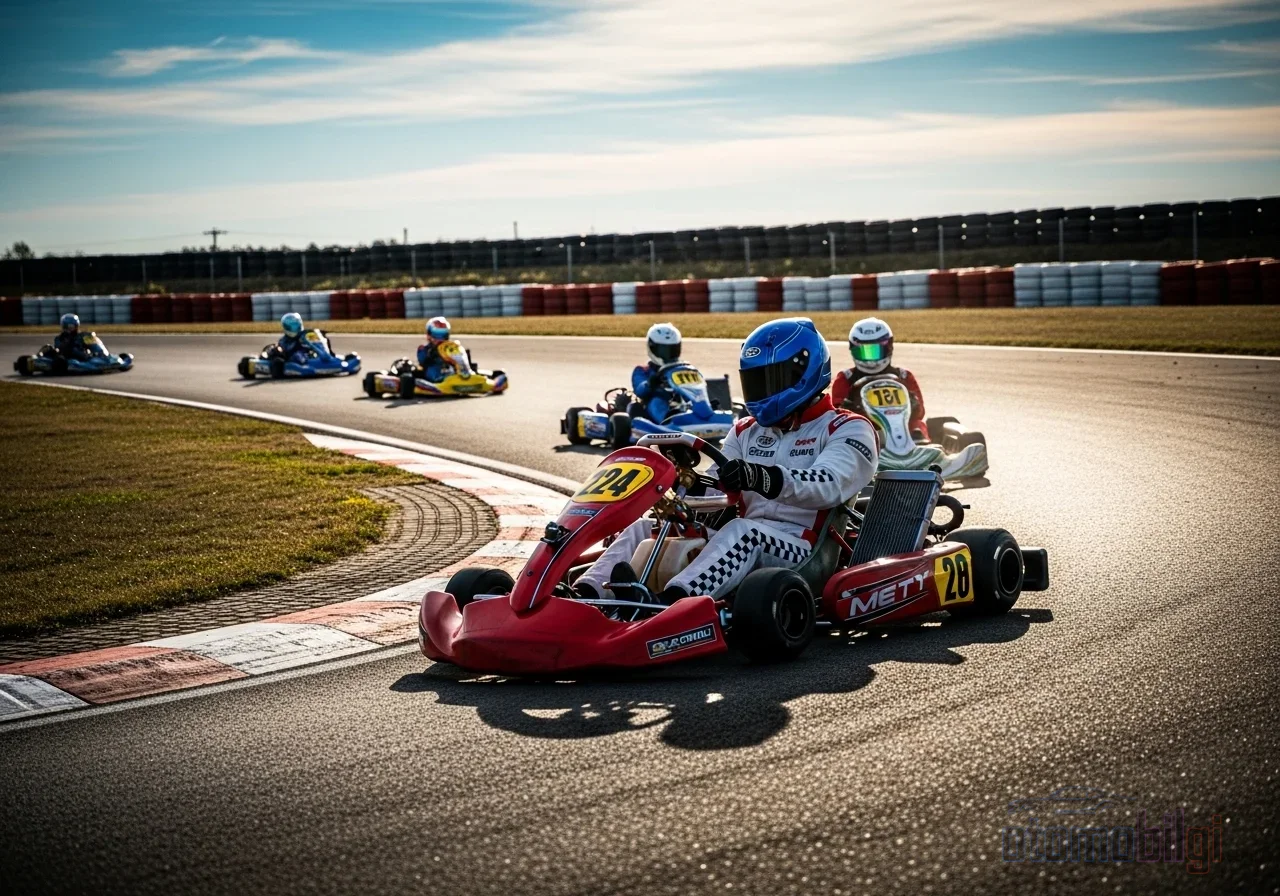
Think of karting classes as a ladder. At the bottom are the MINI categories, in the middle the non-gearbox youth and adult classes, and at the top the world of gearbox karts. So what changes between the steps? Here are the most concrete differences:
| Class | Key feature | Critical rule / transition detail |
|---|---|---|
| MINI (Gr.3 / U10) | The youngest racing class, combined kart + driver weight 110 kg | The WSK calendar has two separate MINI classes: Gr.3 and U10 |
| OKJ (OK-Junior) | No gearbox or clutch, the main class for young drivers | When moving up from Mini, the combined weight rises to 140 kg |
| OK / OK-N / OK-NJ | Non-gearbox adult classes; OK-N is the new manufacturer-based category | OK-N is now on both the WSK and FIA calendars |
| KZ / KZ2 | The main gearbox classes, for ages 15 and up | KZ2 Masters is a variant aimed at adult/experienced drivers |
It's important to know that OKJ has no gears; your left foot's only job is the brakes, not a gearbox. Once you move up to KZ, the kart starts shifting gears just like a motorcycle. While some young drivers from F1 academies continue racing in OK, they also move over to the gearbox side in parallel - because when they step into single-seater race cars, their gear-shifting reflexes are already in place.
Rotax Max Challenge: The Same Tracks, A Completely Different Ecosystem
The third world is a bit different: Rotax Max Challenge. Here everyone uses the same manufacturer's engine, so costs are balanced out considerably - the rich team's engine can't be any faster than the blue-collar driver's. The age ladder is also very clear:
- Bambino: entry classes for ages 4-6
- Mini MAX: ages 9-12, 11 kW (15 hp)
- Junior MAX: ages 13-16, 17 kW (23 hp)
- Senior MAX: ages 15 and up, 22 kW (30 hp)
The pinnacle of the ecosystem RMC Grand Finals: Alongside the combustion categories of Micro, Mini, Junior, Senior MAX, DD2 and DD2 Masters, electric classes also race. Since the 2021 Bahrain round, eight combustion and two electric classes have been seen. The electric path has its own ladder: E10 Bambini (ages 6-9) and E10 Mini (9-12), described as steps that prepare children for the more powerful Rotax E20. In other words, the kart of the future is truly electric, even if it sounds like a cliche.
And yes, this ecosystem also has a Türkiye leg: the 2nd round of the Rotax Max Challenge Türkiye was held on September 20, 2026. So a plane ticket is not required to climb the Rotax ladder.
Why Do F1 Academies Flock to Karting Tracks?
The answer is simple but striking: the road to Formula 1 begins with karting. Monza's official description says exactly this - steering control, speed management and track fundamentals are learned in these mini vehicles. F1 academies therefore build their scouting networks on the karting scene; moreover, they develop young drivers holistically, covering not just on-track performance but also subjects like sports science and off-track training.
Want a concrete example? The Verstappen-Leclerc rivalry began in karting. Verstappen beat Leclerc in 2010 and 2011 in the European Junior World Super Karts championship; Leclerc took his revenge by claiming the title in 2012. Both raced in 2013, in their final seasons, in KZ gearbox classes, and Leclerc won the Winter Cup that year. Even the video from the Sarno round of the 2012 WSK Open Series - leader Verstappen dramatically going off track - still sits in the WSK archives. Think about the fact that two names who clash tooth and nail every week in F1 today were fiercely battling on the same karting grid a decade earlier, and you will understand why karting is called "the school of motorsport."
Which Door from Türkiye Opens to These Championships?
The rest of the page covered the world; now let's look at our own backyard. The MOTUL 2026 Türkiye Karting Championship was held with a calendar covering the Bursa, Kocaeli, Tuzla, Cappadocia and Usak tracks; the season closed with the 6th round at Tuzla Karting Park on October 3-4. Under national rules, the Türkiye Karting Junior, Senior and Master category champions are declared - meaning there is an official ladder in Türkiye as well.
The gateway to the international stage shows itself with concrete examples: Iskender Zulfikari became the winner of the OK class in the 2nd round of the WSK Euro Series at Lonato - seeing a Turkish name at the top of the WSK calendar is a truly historic result. Zayn Sofuoglu also made a name for himself by taking Superpole and pole position at Genk and winning the first race. So the door is truly open; the point is to pass through it regularly.
There is movement at the grassroots level too: TOSFED's Next Talent project has approximately 2,400 child participants is aiming; Halil Ibrahim Karadavut, who set the fastest lap in the heats, won the right to compete in the Türkiye Karting Championship as the first-place prize. 17-year-old Ayse Cebi becoming the Türkiye champion in the senior category proves that female drivers are also strong on this ladder. In Türkiye, racing categories generally start at ages 7-8 while in systems like Rotax Bambino it is even possible to hit the pedal at ages 4-6. At what age would you dare to try karting? Whatever your answer, the door is open from all three worlds you saw above.
Conclusion: Three Worlds, One Goal
WSK is the season engine that runs continuously and reaches record driver numbers; FIA Karting is the address of official titles and the World Championship; Rotax, with its single-brand format that balances costs and its electric future, has a distinct character. Although they may seem like rivals, they all do the same thing: putting the future Verstappens and Leclercs on track as early as age 8. The international results of names like Zulfikari and Sofuoglu from Türkiye also show that what determines climbing this ladder is not where you are on the world map, but how early and consistently you start.
Sources
- The karting 2026 calendar by WSK Promotion
- WSK Promotion 2026: Updated Calendar Released - Kartcom
- WSK Super Master Series - Wikipedia
- FIA Karting: 2026 Official Calendar and Key Dates Revealed - Kartcom
- 2026 in international kart racing - Wikipedia
- FIA Karting World Cup OK-N / OK-N Junior 2026 - Viterbo
- KZ (karting) - Wikipedia
- From Mini to Junior: a crucial transition in modern karting - Vroomkart
- RMC Grand Finals - Rotax Racing
- Rotax Max Challenge - Wikipedia
- Professional Karting | Rotax MAX Challenge
- Confirmed for the 2026 RMC Grand Finals - JAG
- Leclerc vs. Verstappen's karting rivalry - RacingNews365
- Driver Profile: Charles Leclerc - FormulaScout
- Leclerc, Verstappen and more choose rivals from karting days - Formula1.com
- How to become a driver - Monzanet
- TOSFED Next Talent Project Is Starting
- 2026 Türkiye Karting Championship Calendar Announced - trf1.net
- Karting Competitions - TOSFED Results
- 2026 National Karting Rules - TOSFED
- 2026 Türkiye Karting Championship Held in Bursa - Motorsport.com TR
- 17-Year-Old Ayşe Çebi Becomes Türkiye Karting Champion - Habertürk TV
- Karting - Turkish Wikipedia
- What Is a Go-Kart and How Do You Drive One? - Red Bull Türkiye