The First Step Toward a Super License: A Guide to Karting Classes and Age Categories
Share This Page
Karting is the training ground of motorsport: drivers are divided into classes such as Mini, OK-Junior, OK, and KZ according to age and skill, and each class prepares them for the next level in terms of engine power, chassis size, and race format. Every driver with a Formula 1 dream passes through these rungs; in Türkiye, this path is more accessible than ever today thanks to TOSFED licenses and karting schools. Don't worry, I'll break down this seemingly complex system step by step - as if we were chatting at the edge of the track.
Highlights
- OK-Junior is for ages 12-14, while OK is open to those who turn 14 within the calendar year.
- Mini has approximately 11 hp, OK-Junior approximately 25 hp, and KZ2 has 50-52 hp of power.
- KZ karts have 6 gears, three pedals, and braking on all four wheels; 0-60 mph in under 4 seconds.
- In Türkiye, competitive racing starts at around age 7-8 , while the lower limit is lower in hobby karting.
- In 2026, the license fee is 3,600 TL across all branches, and there is no driving license requirement in karting.
How do karting classes and age categories work?
Think of it this way: like footballers, karters also play in the youth academy first. But in karting, the academy has a clear name - you enter a class based on your age and experience, and each class gives you a bit more power, a bit more speed. At the international level, the FIA Karting ladder is clear: OK-Junioris the class where young talents develop, targeting the 12-14 age range; OK is the premier class for senior drivers, open to those who turn 14 within the calendar year. And at the top, there is the gateway to the geared world: KZ2 is the entry level of shifter karting, KZ is the pinnacle of geared karts.
The lower rungs vary by country. In the UK, the structure is set up as follows: starting at age 5 and above with Bambino; from age 7 up to 13, the Cadet classes run. The common feature of Cadet karts is interesting: they use a centrifugal clutch and a pull-start, meaning the child's job is simplified as much as possible. IAME Cadet uses a 60cc 2-stroke engine, Honda Cadet uses 4-stroke GX160/GX200 engines, Rotax MicroMax relies on water cooling.
Australia has a similar ladder: ages 6-9 Cadet 4SS and Cadet 9 (60cc restricted 2-stroke; training only until the 7th birthday), ages 9-12 Cadet 12, then ages 12-15 4SS Junior and KA4 Junior, and Senior classes above 15. So the logic is the same all over the world: young age, small engine, restricted speed - then gradually opened up. That's why there is no single "universal age chart"; the table changes depending on which country you race in.
Mini, Junior, Senior, KZ: what exactly are the technical differences?
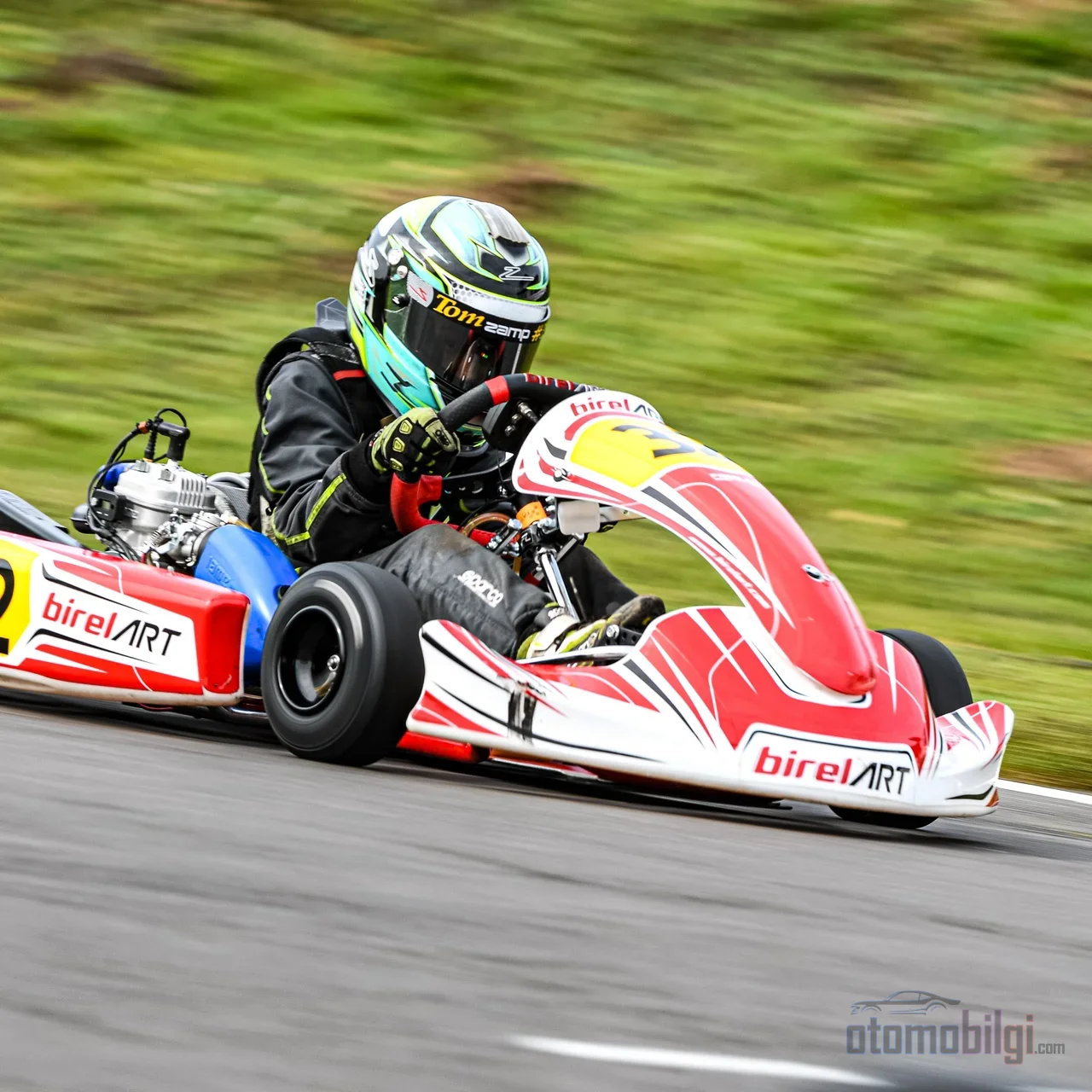
Here's the most enjoyable part. Let's proceed with the figures given by Alessio Lorandi, a former CIK-FIA Junior World Champion, because this is the clearest way to understand the power-to-weight relationship:
| Class | Approximate power | Approximate weight | Tires |
|---|---|---|---|
| Mini (60) | ~11 hp | ~110 kg | Small tires |
| OK-Junior | ~25 hp | ~145 kg | Wide tires |
| OK (Senior) | More than Junior | ~150 kg | Wide tires |
| KZ2 | ~50-52 hp | 175 kg | Wide tires |
This line is critical: The biggest leap is moving from 60 Mini to Junior - according to Lorandi, this transition felt even bigger than moving from F3 to F2. Power nearly doubles, the tires get wider, and the competition gets tougher. That's why rushing this step is not an option.
Is the difference between Junior and Senior karting just age?
No - but it's not as big as you might think either. Junior chassis are very similar to senior chassis component-wise; the difference is that the chassis is made slightly shorter so that young drivers can reach the pedals. In many regions, the junior class uses the same size chassis as the senior class but with a restricted engine; what limits the speed is the weight difference. So the system protects the child not by restricting them, but by balancing things out. Nice engineering, isn't it?
Why are shifter karts a whole different world?
When it comes to KZ, things get serious: a three-pedal setup (heel-and-toe), a gear lever next to the steering wheel, brakes on all four wheels, and a standing start - as opposed to the rolling start in direct drive karts. To me, this feels like learning manual transmission in cars: like suddenly meeting the clutch while riding a bicycle. The KZ UK class in England has 125cc water-cooled 6-speed engines, doing 0-60 mph in under 4 seconds; reaching 90 mph on short circuits and 110-120 mph on long circuits. The 250 National class hits 100 mph on short circuits and 140 mph on long ones - twin-cylinder Superkarts see 170 mph. Incredible, but true.
There's also some good news: in October 2025, the FIA approved Junior and Senior e-karting (electric) categories. So the future of the ladder will also include silent but fast electric karts.
Race formats: sprint or endurance?
Kart racing is fundamentally divided into two big families: sprint races consisting of a handful of laps, and endurance races. In the sprint format, practice and qualifying are held before the race; the race itself can be either a fixed number of laps or a duration between 15 minutes and an hour. The standard championship flow is also simple: qualifying laps determine grid positions, followed by short heats and then the final.
The endurance side is a completely different game: the race can last anywhere from 30 minutes to 24 hours. Qualifying + non-stop racing and mandatory driver changes are applied; participation is generally for ages 12 and up. Imagine being on track in shifts with your teammates for 24 hours - this format shows me karting's team-play side. Beyond these formats, karting in general also has types depending on track type and kart class, such as sprint, endurance, street, speedway, and long-circuit.
Why is karting considered the school of Formula 1?
Because almost every F1 driver came from there - karting is recognized as the school of motorsport, and that is no empty phrase. With its Global Pathway project, the FIA is consolidating feeder series for a more linear progression toward Formula 1. F1 Academy is also actively supporting this pipeline from karting to F1; the "Champions of the Future" collaboration was announced for a clear path from karting to F1 Academy. Discover Your Drive Race Academy even takes young female karters to the British Indoor Karting Championship. So the doors are being opened to everyone.
For an F1-focused driver, the natural path according to Lorandi's description is: Mini → Junior (at international level OKJ, WSK/CIK/Champions of the Future) → Senior → Shifter. Adults can start directly from Senior; 60 Mini covers the 7-12 age range, OKJ has an upper age limit but there is no upper age limit in the OK, X30 and Rotax Senior classes. The social media advice that at least five years of competitive karting is needed to become an F1 driver is also frequently voiced - while it is not an official rule, it indicates that roughly a period of time is required. Academy training also includes off-track subjects such as sports science; so driving is not just about flooring the throttle.
Does skipping classes make sense?
Lorandi's answer is clear: absolutely not. Moving to the wrong class too early does not build skill, it produces frustration. He also says the cleanest basic training is given in direct drive, single-gear Junior/Senior classes; the most expensive class is shifter/gearbox - engine rebuild, brake and tire costs are high. While local series (X30, Rotax) are cheaper and more accessible, reaching the international level is required for an F1 goal. Balancing the family's budget with the child's goal is probably the hardest adjustment in this sport.
How to start karting in Türkiye? TOSFED license, schools and tracks
Good news: climbing this ladder in Türkiye is easier than you think. Those getting a sports license for the first time apply through the Sports Information System on e-Devlet; in 2026 the sports license fee is 3,600 TL across all branches. And my favorite detail: according to the federation directive, a driving license is required in all other disciplines except karting - meaning there is no license requirement in karting. You can chase a track championship at 14 without a license, isn't that something to smile about?
According to the 2026 National Karting Rules, a valid Team License and/or TOSFED Sports Competitor/Driver Certificate is required to participate in competitions. The rules also include a Master category for athletes turning 32 in the 2026 calendar year - so there is really no need to be sad saying "I started late." While competitive races in Türkiye start at age 7-8, on the hobby side TOSFED has a separate Hobby Karting Track Directive; age, speed-power, track and participant number criteria are tied to a table. For young talents, the federation's "TOSFED Is Looking for Its Star" program is also in place (2026 season applications were not yet open); the "How Can I Become a Racer?" criteria are as follows: aged 18-28, citizen of Türkiye/TRNC, driver's license, no criminal record, at least a secondary education graduate.
The tracks and the 2026 championship vibe
Tuzla Karting Park, introduced as Istanbul's only professionally licensed karting track, opened in 2017 and is one of Türkiye's most comprehensive outdoor tracks. There are also statements that a karting track will be built at İstanbulpark. The MOTUL Türkiye Karting Championship returns in 2026 with a great calendar: the second round of the season was held at TOSFED Körfez Race Track on May 16-17, followed by Tuzla on June 27-28, Cappadocia on July 18-19, and the next stop was Uşak. At the newly opened track in Cappadocia, a night race was held for the first time in Türkiye - August 6-9, 2026. Pretty cool, right? In the Bursa round of the season, female drivers Tuğba Yeşiltay, Ela Yeşiltay and Fatma Zeynep Çiçek made the podium in the women's category; Dynamic Racing Team, sponsored by Petrol Ofisi, also completed the Uşak round.
Young talents rising from karting in Türkiye
There is evidence that this sport has truly taken root in Türkiye. Ayşe Çebi became the Türkiye Karting Champion at 17 in the senior category - and says she was inspired by F1 to start karting. Emir Tanju and Alp Aksoy are introduced as "the Turkish drivers closest to F1"; Tanju started his career with karting and quickly gained international experience. Aras Pınar, competing in the Micro category, is also among the names presented as "the champion of the future".
And there are examples from the other end of the spectrum: 10-year-old İskender won about 30 trophies at national and international level in 2.5 years, and his goal is to become an F1 driver - this information is from September 2022, so his current status should be checked. TRF1 also wrote that a Turkish driver competing in the Champions of the Future Academy series could enter the F1 Academy in the future. So there are Turkish names in the pipeline; seeing "driver from Türkiye" on the grid one day is not a dream.
Frequently asked questions: which class at which age?
- At what age can you start? In Türkiye, competitive racing starts at around age 7-8; in some countries racing classes exist from age 5 (for example Kid Karts in the USA, Bambino in the UK). With hobby karts, the message is "there's no age limit for go-karting."
- Where do adults start? From Senior direct drive classes (OK, X30, Rotax Senior); starting directly with shifter is not recommended.
- What's the difference between Mini, OKJ and KZ? In short: the power-to-weight ratio and tire width. You can take another look at the table above.
- How does qualifying work? Qualifying sessions determine grid positions, followed by short heat races and a final.
The bottom line is this: karting is the first real rung of the F1 dream, and every class on that ladder exists to teach you something. Climb from the right class, at the right pace - and see you at the track!
Sources
- FIA Karting Categories
- Kart Classes Explained | Rookie Racing
- Beginner Classes | DPE Kart Superstore
- Best Beginner Kart Classes Explained - Senndit (Alessio Lorandi)
- FIA Approves Junior and Senior E-Karting Categories - Kartcom
- Kart racing - Wikipedia
- Karting Race Formats - Kart Directory
- FIA Global Pathway - Wikipedia
- F1 Academy - Discover Your Drive Race Academy
- TOSFED - License Fees
- TOSFED - How Can I Get a License?
- TOSFED - How Can I Become a Racer?
- TOSFED - 2026 National Karting Rules (PDF)
- Ministry of Youth and Sports - Hobby Karting Track Directive (PDF)
- 2026 Türkiye Karting Championship Calendar - TRF1
- 2026 Türkiye Karting Championship Held in Bursa - Motorsport.com TR
- Tuzla Karting Park
- Karting - Turkish Wikipedia