How to Win a Championship in WRC?
Share This Page
Winning the WRC championship comes down to the total of points distributed according to the results of every rally run throughout the season: the top 10 finishers of each rally score 25-17-15-12-10-8-6-4-2-1 points, while the five fastest drivers in the Power Stage, the rally's final stage, earn 5-4-3-2-1 bonus points. So winning a rally is a great thing, but the championship belongs to the team that collects points smartly across the entire season. So how exactly are these points distributed, what is the purpose of a super special stage, and why do drivers sometimes brake in the final stages? Let me explain it all simply, because this system is far cleverer than you think!
Highlights
- In every rally, the top 10 score 25-17-15-12-10-8-6-4-2-1 points.
- The five fastest in the Power Stage earn 5-4-3-2-1 bonus points, regardless of the rally result.
- A driver can theoretically score a maximum of 35 points in a single rally.
- In the Manufacturers' Championship, only a team's best two cars score points.
- In the event of a points tie, the number of rally wins is considered first, followed by the numbers of second and third places.
How does the WRC points system work?
First, let's lay the foundation. WRC is a world championship run by the FIA and held since 1973. Rallies are held in different countries throughout the season, and each rally consists of 15-25 special stages run on closed roads against the clock. In total, there can be up to 350 km of special stage distance; moreover, organizers are required to ensure that at least 25% of the event's total distance consists of special stages. So there is no cruising around in a caravan in traffic on asphalt - you are racing against the stopwatch every single second.
The result of a rally is the sum of all stage times. Drivers start one by one, the fastest total time wins, and that "winning" business turns into points. The top 10 finishers in the overall classification score points: 25, 17, 15, 12, 10, 8, 6, 4, 2 and 1. These points go to both the driver and the co-driver; because in this sport, the co-driver who reads the pace notes is a full championship partner. Navigation, emergency repairs, tire changes and schedule management are all on their shoulders. Isn't that justice itself?
In the Manufacturers' Championship, things are a bit more complicated: each team can only score with its best two cars . So the team boss also has to think strategically about which two cars will bring in points. It is just like deciding which subject to study more for during exam week - your allowance for dropped points is limited!
Power Stage bonus points: the road to 35 points
Now let's get to the spiciest part: the Power Stage. This is usually the rally's final special stage, and here the five fastest drivers earn bonus points of 5-4-3-2-1, regardless of where they finish the rally. The reason I say "regardless" is this: even if you are 8th in the overall classification, if you set the fastest time on that stage, you pocket 5 points. It is like getting full marks on a single question without studying - it won't pass the class, but it writes a nice grade on your report card!
The bonus points idea is actually not very new. It was first tried in 1999 under the name "TV stage" in two rallies; the goal was to offer spectators more drama. Today, the power stage has transformed into a stage where bonus points are chased in front of live TV cameras, synonymous with drama and excitement. With the update introduced in 2025, a clearer focus was brought to rally victories, but the power stage remained unchanged; it continues to offer the fastest teams up to 5 bonus points.
So how do you get maximum points? A driver wins the rally (25), collects extra points for being fastest on Sunday, and if they finish the power stage in first place (5), they can reach 35 points from a single rally. It is essential to know this so you are not surprised when you see numbers above the 25 points in the top 10 - the secret of a team scoring 29 in Sweden and 30 points in other rallies is the power stage and Sunday bonuses added on top of the classification points.
What is a super special stage, and why does it exist?
Before diving into championship mathematics, let's talk about the rally's opening act. The Super Special Stage (SSS) is a short stage run on parallel tracks, often set up in a sports stadium, where two drivers race head to head. In the WRC, it is usually the first stage of the rally and is run on Thursday evening, after the ceremonial start. It is short, loud, and entirely spectator-focused - you can think of it as the rally's "poster shot."
So what does the SSS have to do with the championship? It carries no direct points, but it has an indirect effect: this format, where two rivals face off side by side, eye to eye, is a psychological battlefield. Moreover, how Thursdays can be improved is still being debated in the racing community - everyone loves the fun of the SSS, but there is still no common formula on how the format should evolve. The outcome of this debate may also affect the points and strategy system in the future.
Retirement penalty and lost points
What happens if something goes wrong in a rally? If the car crashes or breaks down, you miss that stage and receive a 10-minute penalty for every missed special stage. The penalty is calculated by adding it to the fastest time recorded by a team in the same class on that stage. Sometimes teams repair the car and continue to the next day to protect their teams' points structure; but that day's penalties are like a corporal punishment in the overall classification - they end any hope of points.
That is why the cruelest rule in rallying is also the most instructive: speed alone is not enough, reaching the finish is also a skill. A driver who is fastest on a stage and then scrapes along a forest wall goes home that day not with 25 points, but with zero points. Most of the most unforgettable stories in rally history have been written precisely for the sake of this balance.
Final stage strategy: take a risk, or protect points?
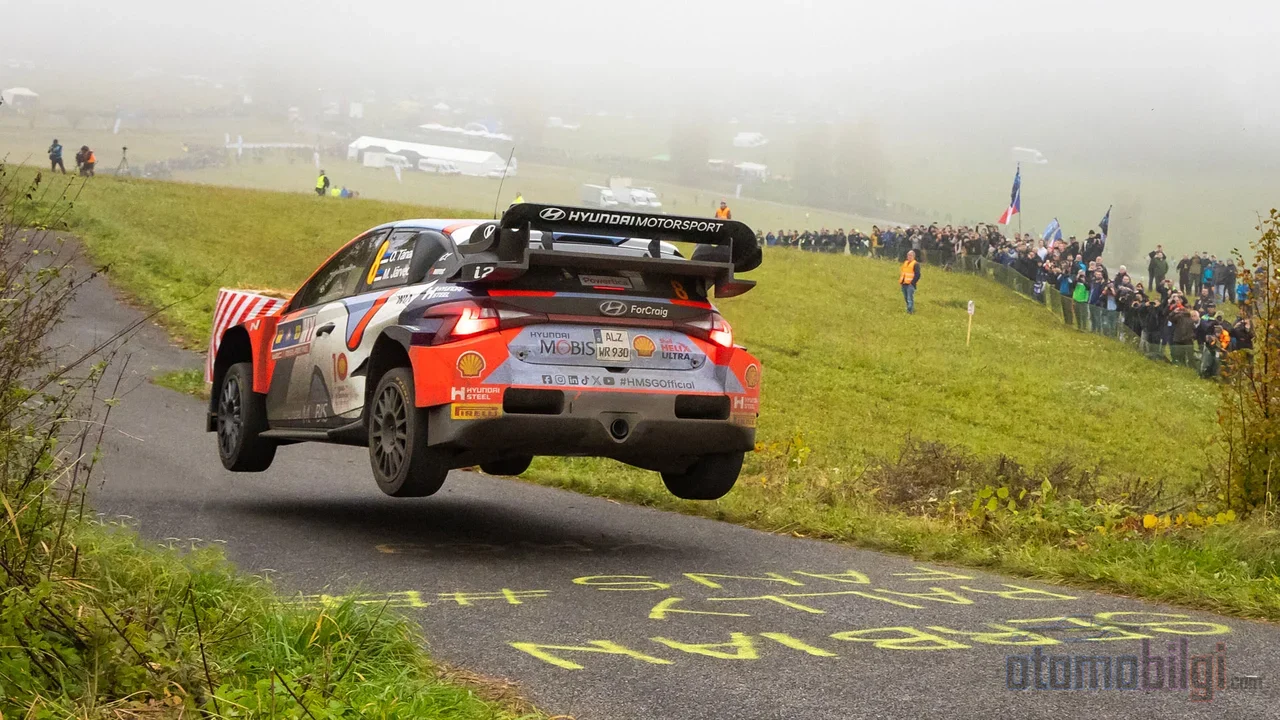
Here is where the real test of the championship begins. In the season's final rallies, drivers face a dilemma: should they push flat out for the rally win, or protect their championship position and finish with a conservative drive? Power stage points make this decision even more delicate. In the past, teams used to save their best tires for the power stage, sacrificing everything to survive mid-rally and banking an ace for the final stage. That was precisely the purpose of the rule changes: to make the final day a livelier, bolder battle. The new format, with its structure that does not reward tire conservation, sends drivers the message "push it."
History shows just how valuable these final-stage dramas are. The era when legends like McRae, Mäkinen, Burns and Sainz battled it out is remembered in the rally community as the most iconic championship decider in WRC history. As a more recent example, the 2024 manufacturers' championship came down to a title fight that lasted until the very last stage. So it is not only the drivers but also the engineers, team principals and tire strategists who sweat it out on the final corner.
What happens if the points are tied?
What if two drivers finish the season level on points? No panic, the rule is ready: first, the number of rally wins during the season is checked; if the tie persists, second places are compared, and then third places. For that reason, the question "should I settle for second, or take risks and go for the win?" during the season is not just about that weekend - it also shapes the potential tie-break scenario at the end of the year. One rally win weighs more than six second places - the math of the sport can sometimes be crueler than the heart, right?
The same logic applies to stage wins. The bonus points you collect from stage victories can keep even a driver whose overall standings look unremarkable in the championship fight. So do not just focus on the podium; keep an eye on the stopwatch from time to time!
How many points is the championship worth and how do you read it?
When we put the information above together, the table emerges on its own:
| Source | Points | When? |
|---|---|---|
| Rally win | 25 | Finishing 1st in the overall standings |
| Rally second place | 17 | Finishing 2nd in the overall standings |
| Rally third place | 15 | Finishing 3rd in the overall standings |
| Rally, 4th-10th places | 12-1 | Other results within the top 10 |
| Power stage win | 5 | As the fastest on the final stage |
| Power stage 2nd-5th places | 4-1 | Within the five fastest on the final stage |
| Maximum in a single rally | 35 | Rally win + Sunday bonuses + power stage victory |
This table was also valid in the 2026 season, and the championship was decided in the final corners of the Rally of Sardinia. Paraguay, Chile, Finland and Sardinia rounds were run on the calendar; as the champions were determined, the same question was asked at each one: "Is it worth taking a risk today?"
In short: the formula for the championship in the WRC
Winning the championship in WRC is not the reward for being the fastest, but for being the smartest and fastest. The points distributed to the top 10 at every rally throughout the season, the bonus points of the final stage, the rule of counting only the best two cars for manufacturers, and the tie-breaking order all come together to create a game like chess. At every stage, the driver answers three questions at once: "How fast can I go, how much risk can I take, and how many points do I need to protect?" Next time you watch a rally, ask yourself these three questions too; I guarantee you will find yourself sitting in front of the screen thinking like a strategist. Maybe one day you will be the one asking these questions at the wheel of a real Rally1 car - who knows?
Sources
- ABOUT WRC
- WRC A-Z
- POINT RANKING | 2025 | WRC
- Sharper focus on rally wins with 2025 WRC points update
- Who can win the 2026 WRC title in Sardinia - and how?
- World Rally Championship
- Power Stage
- Rule changes summary
- WRC Explained: How the World Rally Championship Works
- WRC explained: Your ultimate guide to the 2026 season
- Legs and Stages: The Bits and Parts of a Rally
- Knowledge Is Power. WRC Dictionary
- Bonus Guide #3 for the 2026 WRC ueno Rally del Paraguay