Rally Jargon: From Press to Hairpin, the Language of the Stage
Share This Page
Rally jargon is the name for the stage language heard in WRC broadcasts: terms like press, hairpin, chicane, and flat combine with the co-driver's pacenote reading to shape the driver's throttle and braking decisions within seconds. This page unpacks each of those words through a real stage scenario, so you can follow a rally weekend with understanding, not rote memorization.
Highlights
- Pacenote numbers measure corner severity: 1 is almost a hairpin, 6 is almost a straight line.
- A WRC rally typically consists of 15-25 special stages run on closed roads.
- The pacenote tradition dates back to the 1952 Carrera Panamericana and 1955 Mille Miglia
- races. The Rally1 class was introduced in 2022 and uses a hybrid powertrain that harvests energy under braking.
What Are Pacenotes, and What Does the Co-Driver Actually Do in the Seat?
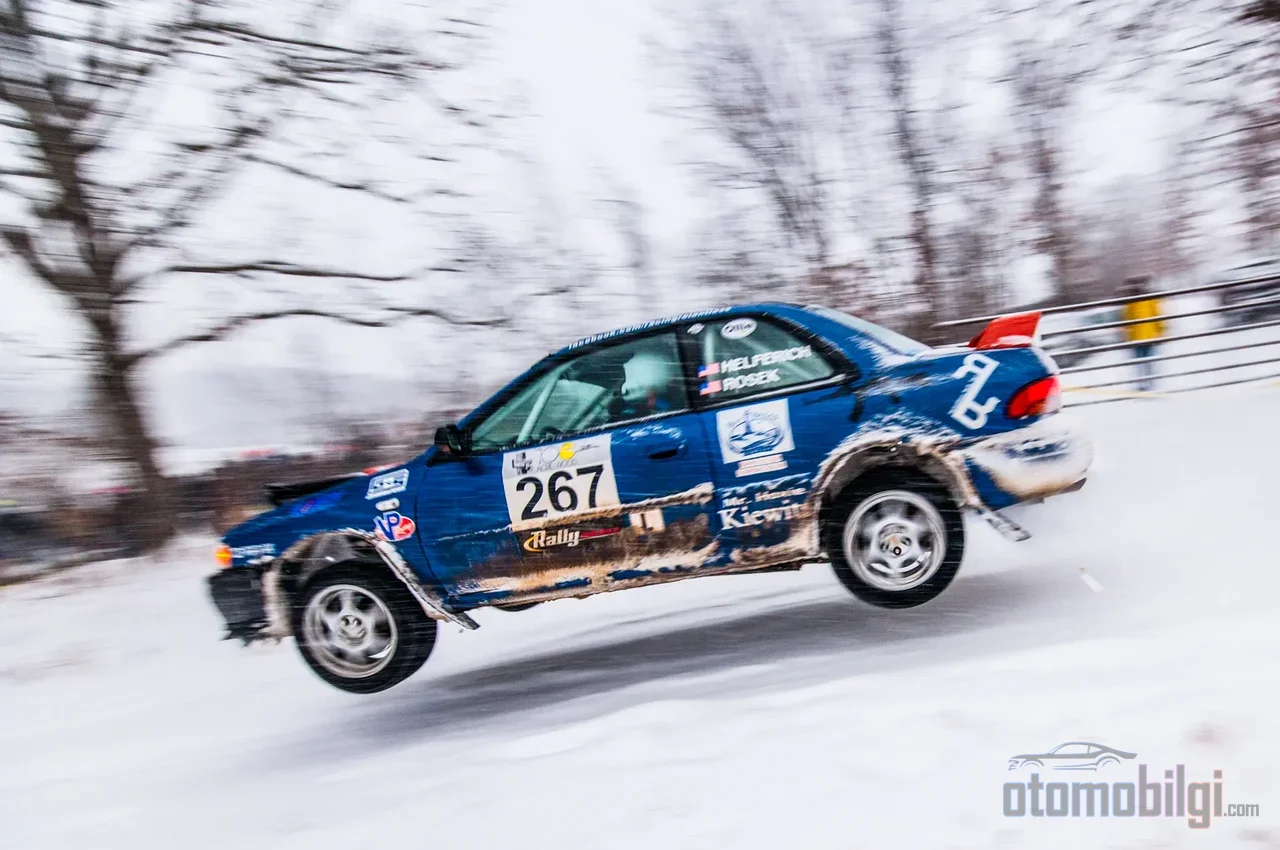
Let's start with the most basic question: what does the man reading out those numbers do in the seat? Pacenotes are a notational system that describes the rally route in extreme detail. Corners, junctions, distances, corner severity, adverse camber, crests, surface type, potholes... everything goes into the notes. The co-driver writes these notes in a strict shorthand system and reads them aloud throughout the stage. There is no single standard system; the notes for a world-famous stage can run to several pages.
A broadcast from a WRC rally summarizes it nicely: reading the notes is the co-driver's easiest job of the weekend. The real job is far more comprehensive. A good set of pacenotes has four layers: corner severity, distances, identifiers, and caution warnings. The co-driver adjusts the reading pace so it stays in the driver's head; once synchronization slips, it is hard to catch back up. That is exactly why the person next to the driver is not just a map reader, but essentially a playmaker.
The roots of this tradition go way back: pacenote use is associated with Karl Kling and Hans Klenk's 1952 Carrera Panamericana adventure, and then with Stirling Moss's 1955 Mille Miglia victory. So the history of co-driving is older than most sports.
What Do the Corner Numbers Mean: The Severity Scale from 1 to 6
The thing you hear most often in a broadcast is the numbers. So what does "Left 4" or "Right 2" mean? There is a critical detail here: rally has no single standard. In a commonly used system, on the so-called McRae-style scale, 1 is almost a hairpin, that is, a corner taken at a hair's breadth in first gear; 6 is a wide sweeper taken in sixth gear at nearly flat speed. The larger the number, the more open the corner. Some systems do the exact opposite, making 1 the slowest corner; some teams even use the numbers to indicate the gear to use. If you clarify once, while watching a broadcast, which team is using which system, everything falls into place.
Let's set up a simple scenario: the co-driver says "150, right 2." The driver translates it like this: 150 meters ahead, a very tight right that traces roughly a half circle, to be taken in second gear. The moment you hear the number, the braking point, gear, and even the exit angle are ready in your head.
Are Hairpin, Square, and Chicane the Same Thing?
No, and knowing the differences comes in handy. Hairpin is a turn drawn like a half circle with an approximately constant radius; that is, roughly 180 degrees. It has variations too: open hairpin is wider, very tight hairpin is almost turning in place. Square is a true 90-degree corner; if it's even sharper, it's called square plus. Hairpin is the tightest category.
Chicane, on the other hand, is a quick left-right or right-left flick in opposite directions. It's very common on German stages, and there they are usually fake chicanes made of bales; the co-driver must also state the direction of entry, because whether you go in left or right depends entirely on that information. The moment you enter on the wrong side, you risk meeting the bales.
Flat, Cautions and Other Critical Warnings
My second favorite word: flat. Its meaning is simple but exciting - don't lift off the throttle. It's used for a transition between a straight and a 6 corner, where the radius barely changes. It's also said for going over a crest or jump without lifting off. When the co-driver says "flat", the driver's right foot stays on the floor; that's what trust is called.
Cautions, that is, warning notices, are the system's insurance column. When reading a pacenote, wherever you see a point or an exclamation mark, it means there is an unexpected danger there. An example note could read like this: after 50 meters, a careful jump, immediately followed by a tight right 2, cut because the inside is dangerous. In this single line, distance, danger, corner severity and road position instructions are all together. Too much information? Not for the driver; because everything becomes second nature throughout the stage.
- Tightens / Opens: The corner radius is changing. When "right 6 tightens right 3" is said, a wide right is narrowing and becoming tighter.
- Into: Connects two notes back to back; like "left 5 into left 3".
- And: There is a short gap of about forty to fifty meters between the two notes.
- Cut / Don't cut: Instruction to cut the inside of the corner; but if there is a rock, landslide or bale danger inside, don't cut is said.
- Crest: A hill where the continuation of the road is not visible. If you hear flat before it, it means you're flying over instead of a blind spot.
- Bad camber: The road is sloped toward the outside of the corner, grip is decreasing.
- Keep right / middle / in: Safe road position; it tells you which line you should be on in a narrow section.
There are also variable surface warnings: at points where you transition from gravel to asphalt or vice versa, the co-driver reads the surface change. When the surface changes, grip, braking distance, even tire temperature change; all the calculations in the driver's brain are reset at that moment. The deceptive notation means the road looks misleading, that it actually behaves differently from how it appears. In short, one word, one life-saving move.
On-Air Terms and Their Field Equivalents
| Term | Meaning in the Field |
|---|---|
| Press | Entering the corner with pressure, at controlled speed; not quite flat but not slow either. |
| Hairpin | Drawing roughly a half circle, the tightest type of turn. |
| Chicane | Back-to-back opposite-direction short bends; built with bales in Germany. |
| Flat | Go through without lifting off at all; usually describes the section between a 6 corner and a straight. |
| Cautions | Caution notes; they mark dangerous spots. |
| Deceptive | The corner is deceptive; it may not behave as it looks. |
| Cut | Cut inside the corner; if it's dangerous, "don't cut" is called. |
The term "press" is also heard in a different context: during the reconnaissance run, that is, the recce, the crew drives the route and prepares their own notes. Some organizations, however, distribute official pacenotes and ban reconnaissance. Depending on which format applies, the crews' job changes considerably.
Special Stage, Super Special Stage and Service Park: The Rhythm of the Weekend
Some of the terms are not about corners but about the anatomy of rallying. A WRC rally typically consists of 15-25 timed special stages run on closed roads. Here, the driver and co-driver chase the fastest time; the classification standings are determined by these times. The linking roads between the special stages are what we call road sections, parts open to traffic; cars must obey traffic rules there, rest assured, no one is speeding through neighborhoods in a rally car.
A super special stage is a short special stage format close to the spectators. In the 2026 season, after the ceremonial start evening, a spectator-friendly super special stage is run in the host city; meaning it is possible to experience the rally atmosphere in the city center, among lights and crowds. It is perfect for a first-time viewer, because you get to see the cars up close and hear their sounds.
The service park is the rally's pit stop. Teams set up base here, and the cars receive maintenance. The rule is strict: a team cannot accept technical assistance outside the service, and operations are limited. So if something breaks on a stage, it is the crew using the car themselves who must fix it. Imagine the co-driver also wearing a mechanic's hat.
Rally1, Hybrid Power and 2026: Where Things Stand and What You Are Watching Now
The most important concept you will hear when cars are mentioned in the broadcast is Rally1: the top class of the WRC, equipped with a hybrid powertrain. This system harvests energy during braking and provides an extra power boost when accelerating. Rally1 was introduced in 2022 and took over from the World Rally Car era in the manufacturers' championship. Moreover, the switch to hybrid power and one hundred percent sustainable fuel is seen as the first part of a generation's technological leap. 2026 is the final full year of the current Rally1 era before new technical regulations; new technical rules arrive in 2027. In other words, the cars you are watching right now are displaying the closing performance of an era.
There is also the points matter you hear about at the end of stages: in the rally's final special stage, extra points are awarded to the top five finishers, and this can be decisive in the championship battle. This final stage, known as the Power Stage, sometimes changes the story of the entire weekend in a single lap.
Why Watching Rallying Feels Different Once You Have Learned the Jargon?
If a sentence like the co-driver's "tightens right 4, left 2, don't cut" sounded like an incomprehensible code to you an hour ago, you will now hear it as a full-blown action scene: the driver sweeps into a wide right at speed, the corner tightens, followed by a tight left in second gear, and because of the danger waiting on the inside edge of the road, no cutting. You will now look with a whole new eye at the pace of the voices, the notes the co-driver reads out breathlessly, and the mechanics working for hours in the service park. At the next WRC weekend, get in front of the screen and try to translate every number you hear in your own head; that's exactly where the fun part of this business begins. You're wondering which term is your favorite, aren't you? I think once you hear the word "flat" in post-stage interviews and see the sparkle in the driver's eyes, what this sport is really about will become clear to you.
Sources
- Pacenotes
- Pace notes: understanding your codriver
- A Beginner's Guide to Rally Pace Notes
- About WRC
- WRC A-Z
- WRC explained: Your ultimate guide to the 2026 season
- Glossary - Rally Türkiye
- What Happens at Service Park - Škoda Motorsport
- WRC Rallye Monte-Carlo 2026: Full Technical Guide
- World Rally Championship