Tandem Battles: What Happens When You Drift in Pairs?
Share This Page
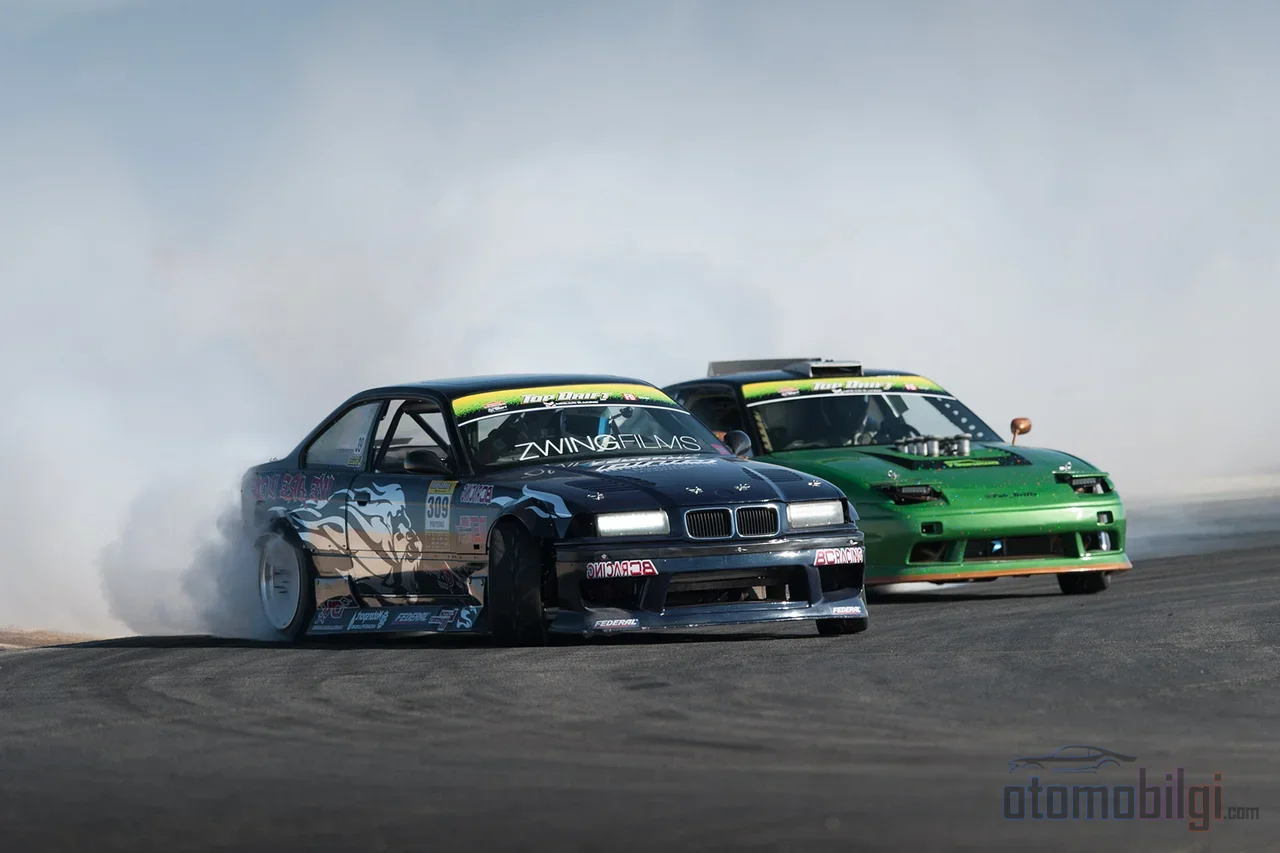
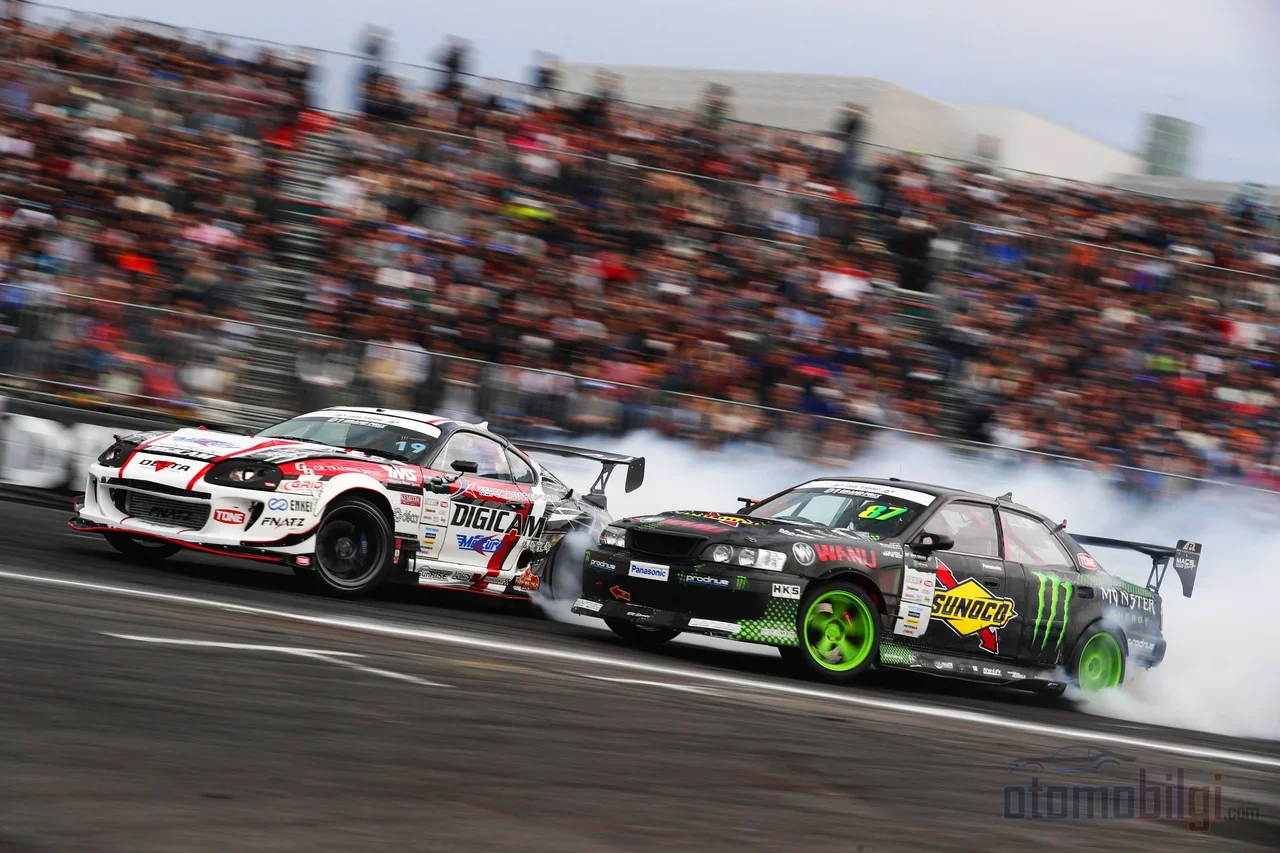
Tandem drift is a head-to-head duel where two cars slide down the same course simultaneously, side by side: one acts as the lead and sets the ideal line, while the other acts as the chase, trying to copy its angle and line as closely as possible without making contact. In solo runs you only earn points for your own driving, while in tandem you must manage both your own reactions and those you provoke in the car ahead - this is exactly where the real battle begins.
Highlights
- The tandem format was introduced by D1 Grand Prix in 2001 under the name "tsuiso" and became the world standard
- The key criterion in chase driving is proximity, meaning how close you stay to the leader
- In Formula Drift, 800-1400 horsepower cars can produce smoke that completely blocks the chaser's view
- The ideal chase position is "door-to-wheel": your front wheel aligned with the leader's door
- In Türkiye, TOSFED's 2026 National Drift Rules clearly regulate transitions and lead changes
Imagine: when you're sliding alone on the track, everything depends on you. Your speed, your angle, your line, your style. Now put another car next to you - at door distance, in the smoke, a rival following your every move like your reflection in a mirror. That is exactly what tandem battles are. And in my opinion, this is the most exciting form of drift. So how exactly do these duels work? Let's take a look step by step.
What Is the Difference Between Solo Drift and Tandem?
In solo runs, the matter is simple: the driver earns points from the judges for speed, drift angle, line, and style. You're advertising your own performance and depend on nothing else. Qualifying rounds work on exactly this logic; this is the round that sets the bracket.
In tandem, the picture changes completely. You're doing two jobs at once: while maintaining your own driving, you have to react to the opposing car in real time. Applying pressure without letting go of control is the essence. To make an analogy: if a solo run is painting a picture, tandem is trying to paint that picture next to someone, together with them but trying not to resemble them. If the pen slips from your hand, both burn.
The format also progresses in two stages: first everyone completes the solo qualifying runs, shaping a Top 32 or Top 16 elimination bracket; then the tandem duels begin in single-elimination format. In these duels, each pilot takes on both the lead and chase positions in turn. So both your chase driving and your leading ability are tested - there's no escape!
Lead and Chase: Two Roles, Two Different Skills
Lead: The leader who sets the perfect line
The lead driver draws a clean and determined line in the style of a qualifying run. They use the correct angle, enter the scoring zones, and most importantly, remain predictable. According to the rules, the leader is forbidden from blocking or making defensive or erratic moves - meaning you can't put on a show to make your rival crash into the wall. Your job is to make your own driving as sustainable and repeatable as possible.
Chase: The follower who has to become your reflection in the mirror
The follower's job description is ruthless: mimic the leader's angle, line, and transitions in real time, apply pressure without making contact. You have to prove your proximity to the judges; if you fall behind, no points. The ideal chase position is known as "pocket": aligned so your front wheel lines up with the leader's door, the A-pillar. It's also called "door-to-wheel" - door to wheel, door to door.
So which is harder, lead or chase? This debate is still open in the community, and I think that's the healthy way to be: lead demands a perfect line and zone pressure, chase demands split-second reactions. They're really like two separate sports; but you have to do both well in the same match.
How to Chase When There's No Visibility Through the Smoke? The Fine Points of Chase Driving
This is, to me, the craziest part of tandem. Cars with 800-1400 horsepower, like those in Formula Drift, produce so much smoke that the chaser can be literally blind. So what do you do in that case? Formula Drift driver Faruk Kugay's solution involves his ears - yes, you read that right:
If the lead car's exhaust sound starts to pass over my hood, I make the transition too.
Kugay explains that even when the sound shifts slightly during aggressive transitions, he transitions blindly and leaps out of the smoke. Another golden piece of advice is about where you look: watch the lead car's front wheels. Corrections and transitions show there first; when you're in the right position, your field of view already frames the leader's front wheels and hood.
There's also a fact that surprises most beginners: close following is actually safer. A chaser chasing from 3-4 car lengths behind goes 45-50 mph while the leader goes ~35 mph; if the leader suddenly slows down or spins, you can't find reaction time and you get a high-speed collision. Starting close is practically a necessity - both for points and for safety.
There's also a nice analogy for describing chase distance: the chase driver uses just the right amount of force and consistency to get as close as possible without contact. Neither too little nor too much; a perfectly fitting pressure.
How Is Tandem Drift Scored? What Do the Judges Look At?
In the chase run, the basic criterion is proximity. In addition, angle matching, line matching, and reaction speed are evaluated. In the lead run, the game reverses: there, solo criteria like line, angle, speed, fluidity, and style come into play. In other words, two halves of the same duel are two different exams.
There's also a measured penalty system for proximity: if the chaser's nose touches the first yellow line, 1-2 points can be deducted; if you fall too far behind, you get 0 points for that zone. In Formula Drift, the duels are 3 judges watched by three judges, and each judge picks the winner after both runs. The judges rank the drivers in focus areas like skill, line, angle, proximity, and style. The number of judges can also vary from series to series; in fact, in some smaller tournaments, each pilot runs three duels and receives individual scores from the judges.
| Feature | Lead run | Chase run |
|---|---|---|
| Main task | Set an ideal and predictable line | Copy the leader and stay close |
| Evaluation | Line, angle, speed, style | Proximity, angle and line matching, reaction speed |
| Prohibitions | Blocking and defensive moves | Contact |
| The biggest enemy | Unpredictability | Loss of visibility in smoke |
How does the match format work round by round?
The standard flow goes like this: qualifying runs → bracket → battle. In the battle, each driver does one lead run and one chase run. At the end of the two runs, the judges determine the winner; if things get complicated, another run is done. According to Formula Drift's 2025 rulebook, each bracket battle is worth 10 points, and a driver who goes all the way through the bracket can collect a maximum of 50 points. D1's official regulations describe the same logic: the chase driver's goal is to complete the course with maximum proximity by mimicking the leader's angle and line. After a properly completed pass, the following driver takes the lead position - yes, the roles switch the second they pass the car ahead.
D1 or Formula Drift? The Two Series' Understanding of Tandem
The origins of tandem battles trace back to Japan and the drift culture rooted in touge roads; but the institution that set the world standard D1 Grand Prix was. Founded in 2001 by Keiichi Tsuchiya and Daijiro Inada, the series introduced the one-on-one "tsuiso" battle format. The early D1 format worked as a solo "tansou" run first, followed by tandem battles in the Top 16 battle bracket; the two-car tsuiso battle then became tradition as a single-elimination tournament that came after the elimination rounds.
Formula Drift, meanwhile, runs the same format with its own scoring architecture: judge rankings, measured proximity penalties, and bracket points. On the Drift Masters side, tandem is explicitly described as the "most spectacular" part of drifting; the solo qualifying runs determine the Top 32 elimination bracket. So while the rule details vary from series to series, the skeleton is the same: qualify solo, battle door to door.
Unforgettable Tandem Moments and Those Who Turned Chasing into an Art
To understand why tandem is so beloved, a few names are enough. Adam LZ's chase against James Deane in the Orlando Top 16 battle is a living lesson in how demanding chasing can be. The "on edge" battles between James Deane's Ford Mustang RTR and Jack Shanahan's Toyota GT86 - matches where both cars danced right at the edge of the limit - stay in fans' minds. Jack's brother Conor Shanahan is also among the drivers who turn chasing into a true art with his precise tandem performances at Drift Masters events. The tandem battles Rey Ruiz won offer a good lesson: the pilot who can match the line and angle and maintain proximity in the chase run wins. In Drift Masters' "100 wildest moments" compilations, door-to-door tandems and crashes appear side by side - summarizing the risk and beauty of this format in a single frame.
How Is Tandem Drift Run in Türkiye?
On the Türkiye side, things proceed within a codified framework. TOSFED's 2026 National Drift Rules explicitly regulate the transition/chase logic and lead changes: after a properly completed transition, the following driver becomes the leader and completes the run according to the scoring criteria. The 2022 rulebook also included a "zero points" provision and stipulated that the team collecting the highest points at the end of the season would be declared "Türkiye Drift Teams Champion."
We see tandem action on the field too: the "Tandem Run" was held at the 3rd round of the Apex Masters Türkiye Drift Championship at Istanbul Park. In the championship's standard format, each pilot completes three qualifying runs evaluated against line, angle, and overall execution criteria; event days open on Sunday morning with practice sessions, and the emphasis on "door-to-door battle" always stands out.
Lessons from Tandem Battles: Pressure, Communication and Nerves
As you can see, tandem is drift at its purest duel. In the lead, you advertise the perfect line; in the chase, you need nerves of steel to make the transition while blind from smoke, using just the exhaust note. From D1's tsuiso to Formula Drift's judged runs, from TOSFED rules in Türkiye to Apex Masters' tandem runs, the same thing exists everywhere: the closer one wins, but the one who makes contact loses. Which do you think is harder - setting the line, or following that line like your shadow? Whatever your answer, I'm sure you'll look a bit more carefully at the distance between the doors the next time you watch a tandem.
Sources
- Tandem Judging
- Tandem Drifting: 7 Pro Tips for Lead & Chase Drivers
- Pro Sporting Regulation
- What are the rules of drifting?
- Formula DRIFT Rulebook Changes for the 2025 season
- Formula DRIFT In 3 Easy Lessons
- Judging Rules 2024
- D1 Grand Prix
- The Beginning of Drifting: D1 Grand Prix
- National Drift Rules 2026 - TOSFED
- TOSFED Rulebook 2022
- Race Preview: TDS 2026/2 Gaziantep
- What is tandem drifting, and how is it judged?