How Is Scoring Done in Drift? Differences Between D1 and Formula Drift
Share This Page
How is scoring done in drifting? In short, here's how: the judges evaluate each driver's line, angle, speed, and style on every corner ; in qualifying, solo runs are converted into numbers, and then in tandem (pair) runs, the lead and chasing driver are compared to determine the winner. But here's the fun part: Japan's D1 Grand Prix and America's Formula Drift do this with completely different formulas. Let's open up both.
Highlights
- In D1, the solo run score is calculated with a formula and can reach up to 103; in Formula Drift, the driver starts with 100 points, and judges apply deductions.
- D1 uses its own system DOSS which measures speed and angle with sensors.
- In tandem, two runs are made: each driver is once in the lead (front) position, and once in the chase (following) position.
- In the event of a tie, most series call a single "One More Time" run.
- The Türkiye Drift Championship opened its 2026 season on April 26 at Istanbul Park. .
What Do Judges Look At? Line, Angle, Speed, and Style
Drift isn't won based on a finish line like a normal race. There's no stopwatch here, and a stopwatch alone isn't enough; because the question being asked isn't "who was fastest," but who slid the best and with the most control. That's why the judges sitting trackside (three people in most professional organizations) score each run according to specific criteria.
The basic criteria are similar in almost every series:
- Line: Refers to how closely the driver holds to the clipping points marked by the judges and how cleanly they hit the outside zones. You could call it a kind of "loyalty to the officially drawn path."
- Angle: The car's slip angle. The bigger and more stable the angle, the more points - but without losing control.
- Speed: How boldly and fast you drive entering and exiting the corner.
- Style / commitment: The fluidity of steering inputs, not making excessive corrections on straights, the courage to drive close to the barriers. In other words, the answer to the question "are you sliding with a scream, or as if sipping coffee?"
Where these four blend together, things get interesting. Some organizations give 60 points to the line and 40 to style (including angle and speed), while another system allocates a 20-point pool for angle and another 20-point pool for style. So each series' rate card is a bit different - but the menu is the same.
D1 Grand Prix: Scoring with a Collision Formula
Now let's move to the Japanese side. D1, born from drifting's roots on mountain roads (touge), is the world's first professional drift series. Its first event was run under the name "All Japan Professional Drift Championship," and later it took the name D1 Grand Prix Professional Drift. And D1's scoring philosophy befits these street origins perfectly: bigger angle, higher speed, steady engine sound, more fluid performance.
How Is a Single Run Scored?
According to D1's official rulebook, even the definition of a single run is cool: "driving with a faster, bigger, and more stable drift angle and changing angles more rapidly within a defined corner." So how does this translate into numbers? There are three components:
- Speed: Full score 10.00.
- Sharp swing: The sharpness of angle changes in corners; on a 7-point scale from 0 to +3.
- Stable big angle: Again, full score of 10.00.
Then the magic formula comes into play: speed score × angle score + swing score. For example, 9.8 × 9.7 + 0.5 = 95.56. Did you notice? Because it's a multiplication, the score can theoretically go up to 103. Anything over a hundred is completely legal in D1. Try it in your head: 10.0 × 10.0 + 3.0 = 103. Exceeding perfection - the Japanese love that anyway.
DOSS: Not the Human Eye, Sensors Do the Talking
My favorite thing about D1 is this: it reduces the "I saw it this way, you saw it that way" argument through technology. The series' own DOSS (D1 Original Scoring System), popularly known as the "drift box," is a device mounted on every car that measures speed and angle with sensors. The 2024 rulebook states it clearly: elements that can be scored by measurement must, in principle, be scored only by measurement, and cars must have a mounting area prepared for the measuring device. So the speed and angle score comes from the sensors, while the judges look at parts like swing and overall impression. A nice balance, right?
A bigger angle, higher speed, a steady engine note and a more fluid performance earn a higher score.
Formula Drift: Start with 100 Points, Lose Them Along the Way
Let's return to America. Formula Drift works in the exact opposite direction: every pilot starts with a perfect 100 points and the judges make deductions as mistakes happen. Think of it like a health bar in a video game - you have full health as long as you're untouched, but the points wear away when you scrape a wall or miss the line. Psychologically it creates an interesting difference too: in D1 you "build up" your score, while in FD you play not to lose.
FD is also known as a faster-paced series that places more weight on speed and measurability. A comparison often repeated in the community: D1 cars aren't necessarily slow, but in that series technique and driving style stand out, while Formula Drift is run at a much faster pace. Since speed is scored directly in D1, keeping the car glued in the chase position also becomes harder. Of course, these are largely forum and social media opinions - not an official comparison - but they summarize the spirit of the two schools nicely.
Two Schools Side by Side: Differences in One Table
| Feature | D1 Grand Prix | Formula Drift |
|---|---|---|
| Scoring logic | Accumulates upward with the speed × angle + swing formula | Starts with 100 points, deductions are made |
| Ceiling score | 103 | 100 |
| Measurement | DOSS sensor system (speed and angle) | Primarily judged by the jury |
| Emphasis | Angle, technique and style | Speed and high tempo |
| Origin | Japan, touge culture | America |
In Europe, the picture takes somewhat of a third path. Drift Masters, founded in 2014 and regarded as the continent's leading series, uses a qualifying scoring system of 60 for line, 20 for angle, 20 for style points are awarded; within the style there are 5 initiation, 10 fluidity, and 5 commitment points. In tandem, the lead run is worth 10 points and the chase run 9. Let's go through an example: Driver A gets 28 on lead and 25 on chase, for a total of 53. Driver B scores 24 + 26 = 50. A wins. Simple and easy to understand - sometimes that's the best system.
Tandem Battles: How Is the Winner Determined?
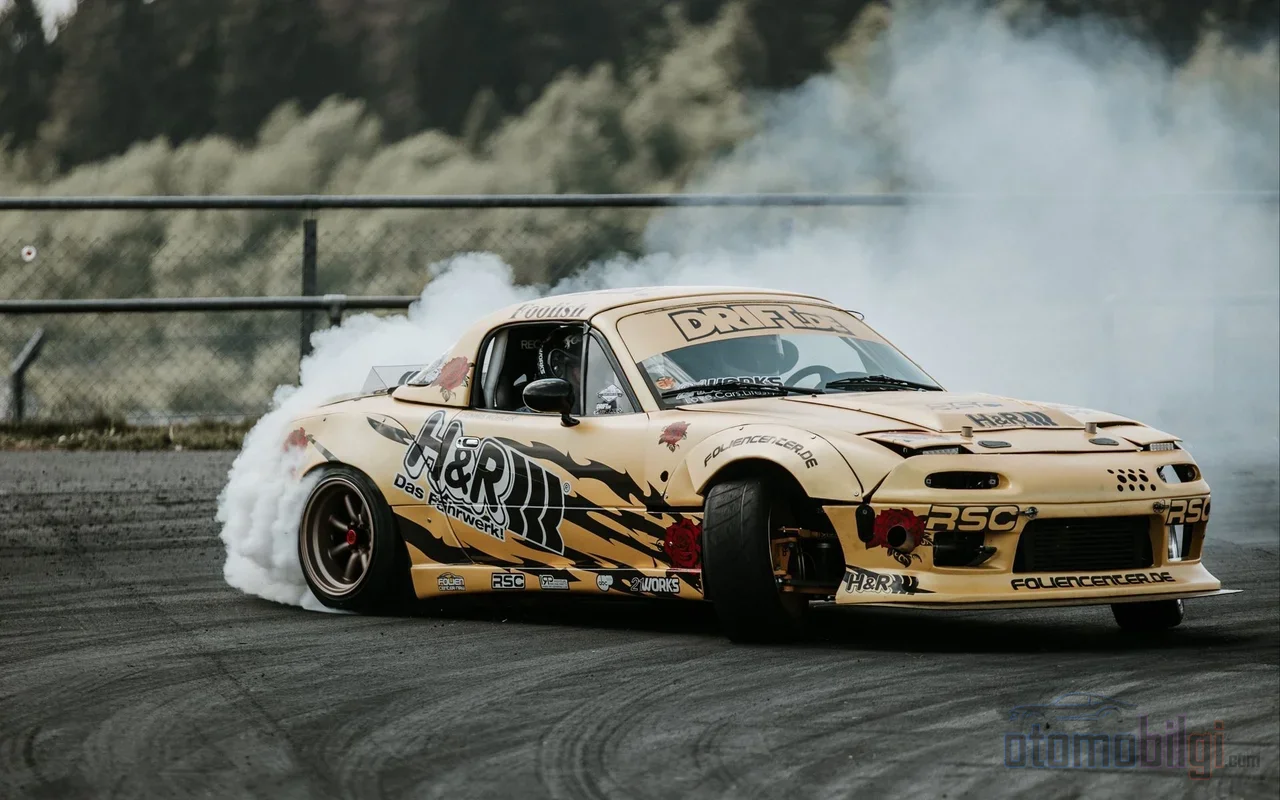
This is where the drivers who made it through qualifying enter the real showdown. In a tandem, two cars slide at the same time: one is lead (in front), the other chase (following). Then the roles swap; each driver runs once in front and once behind. The driver with the higher qualifying score earns the right to choose whether to lead or chase in the first run - which shows just how important qualifying is.
The Roles of the Lead and Chase Drivers
The job of the lead driver isn't as easy as it looks. They have three essential tasks:
- Run the ideal line and hit the points the judges want.
- Run a followable lap - that is, stay true to the acceleration/deceleration map (Accel/Decel map). A lead who suddenly brakes like a sugar cube in the middle makes the chase driver's job impossible, and there's a penalty for it: in D1, blocking before the run -3 ranks or more results in a penalty.
The chase driver's job is even more nerve-wracking: start at the same time as or earlier than the lead, maintain maximum proximity , match the angle or overtake, and mirror the lead's transitions in their mirror. In D1, the chase car is scored on speed, relative angle, and proximity: close the distance at the same or greater angle and you score points, open up the gap and you lose them. And a critical rule: the risk of contact belongs to the follower. Light contact is fine, but if you push the car ahead into a spin, in D1 that brings a -3 to -5 rank penalty, or even disqualification.
So is overtaking (pass) forbidden? Not exactly: a pass is only allowed if the lead goes off track, at the inner clipping point, and from the inside. So the "let me just squeeze past here" hero move doesn't always work. In the case of a tie, most series call a single "One More Time" run; in Drift Masters, if the outcome still can't be decided even after an OMT, the qualifying results kick in as a last resort.
Under Which System Did the Legends Shine?
Scoring systems don't just produce numbers; they also determine what kind of driver becomes a star. Keiichi Tsuchiya, considered the cradle of drifting, is known by the nickname "Drift King," and his story comes precisely from drifting's touge origins on mountain roads. His generation became legends on the street with style and courage in an era when "style and courage" weren't scored. Then D1 carried that spirit onto a rule-bound stage.
On the American side, the picture is completely different: Chris Forsberg, the first driver to win three championships in Formula Drift - 2009, 2014, and 2016. Do you know the two words those who praise it repeat most often? Fluidity and consistency. In other words, FD's long season format and interruption logic reward not the driver who fires in a single lap, but the one who runs flawlessly every week. Two systems, two different types of hero. If it were you, which one would you try your luck in?
The Future of Judging: Is Artificial Intelligence Taking a Seat at the Trackside?
A human jury is undeniably exciting but subjective. In the Formula Drift circle, criticism of jury decisions is occasionally voiced as a "jury crisis," and the series' new jury rulebook and elimination format changes are being debated in the community. On the other side, technology is advancing: the artificial intelligence jury system called DRIFT/RS used by Drift Kings reads every car 20 times per second, with centimeter precision, and produces line, angle, and impact (contact) scores. D1, too, has been applying an older and more disciplined version of the same idea with DOSS for years.
My prediction is this: the future will be hybrid. Sensors will measure speed, angle, and distance; the feeling of "did he dare, did his heartbeat quicken" will again come from the human eye. Otherwise, a fully machine-judged drift final would be a bit soulless, admit it.
So What Is the Situation in Türkiye?
Let's wrap up on our own home turf. 2026 Türkiye Drift Championship is organized by the Drift Otomobil Spor Kulübü in cooperation with TOSFED and Apex Masters, and the season opened on Sunday, April 26, 2026 at Istanbul Park. The 3rd round was run on June 21, 2026; and the 4th round was held on Sunday, September 27, 2026 again at TOSFED Istanbul Park. The day's program sounds familiar: at 11.35 in the morning, TOSFED Drift Cup matchups, and at 14.00 the championship elimination matchups - meaning one qualifying run, then the tandem format, the classic flow seen around the world.
Mid-season, the standings have heated up too: after round 3 Rüzgar Okman with 100 points leads, Çağlar Küçükdumlu with 90 and Abdullah Bostan with 78 points follow him. So the same formula works in Türkiye as well: collect points in qualifying, pass your opponent in the tandem, slide toward the championship. The next time you sit at the edge of the track on race day, you'll be able to look at it like a judge and understand why the referees admire some runs and frown at others. Perhaps the next D1 legend is currently glued to someone's bumper in the chase position at Istanbul Park - who knows?
Sources
- D1 Scoring Criteria
- Drift Masters 2026 Judging Rules
- D1 Grand Prix
- What's D1 Grand Prix
- D1GP vs Formula Drift: Judging, Cars and Format Compared
- Pro Technical Regulations
- What are the rules of drifting? All you need to know
- DRIFT/RS AI Judging
- 2026 Apex Masters Türkiye Drift Championship Round 3
- Türkiye Drift Championship Round 4
- How is D1GP qualify scoring done? : r/Drifting