The Hidden Cost of Replacing Your Tires Early
Share This Page
When to replace a set of tires is a decision that directly affects how much money stays in your wallet. Replacing a tire while the tread depth is still above the legal limit, that is, before its job is done, raises the cost per kilometer; waiting until the very end, on the other hand, is paid for with increased fuel consumption and longer braking distances on wet roads. On this page, I explain the factors that shorten and extend tire life, the effect of replacement timing on total ownership cost, and how to find the real per-kilometer tire cost with your own calculation.
Highlights
- A properly maintained passenger car tire provides an average of 40,000-60,000 km or 5-6 years of service.
- The legal minimum tread depth in Türkiye is 1.6 mm; tires must be replaced after reaching 10 years of age from the date of manufacture.
- Low tire pressure increases fuel consumption by 3-10% and accelerates wear.
- Tire selection and rolling resistance can affect fuel consumption at a level of 10-20% .
- Rotation intervals vary according to the owner's manual; common recommendations are 5,000-10,000 km .
At how many kilometers should tires be replaced: Why is average lifespan not a single figure?
It is a well-known fact among those who have long been in this business: the question "how many kilometers do tires last" has no single answer. The range given by manufacturers speaks broadly; for passenger car tires, 40,000-60,000 km is considered a reasonable average, whereas depending on usage patterns this range can spread out to 30,000-100,000 km . Most drivers in practice replace their tires at around 65,000 km; this is the key number that determines how many times a set of tires will be purchased over a vehicle's life.
Kilometers should be considered together with age. A properly maintained new tire serves a passenger car for an average of 60,000 km or 5-6 years without problems. However, tire rubber also ages internally over time: according to JATMA and LASTIK-DER standards, tires, even if the tread depth appears sufficient, must be replaced after reaching 10 years of age from the date of manufacture, including the spare tire. It is recommended that tires that have completed five years of use be inspected by an expert at least once a year. The DOT code on the tire's sidewall shows the last four digits indicate the week and year of manufacture; these four numbers are the silent partner of the purchase and replacement decision.
And there is also the character of the tire. Performance tires with a soft rubber compound claim their price for grip by wearing 20-30% faster than standard tires. On Michelin's side there is an interesting measurement: an average tire lasts 32,000 km at the front; this is about 8,000 km less than what is expected from a quality tire. So even two tires on the same vehicle cannot age on the same schedule; front-rear position, driving style, and compound produce this difference.
Factors that shorten and extend tire life: What is under your control?
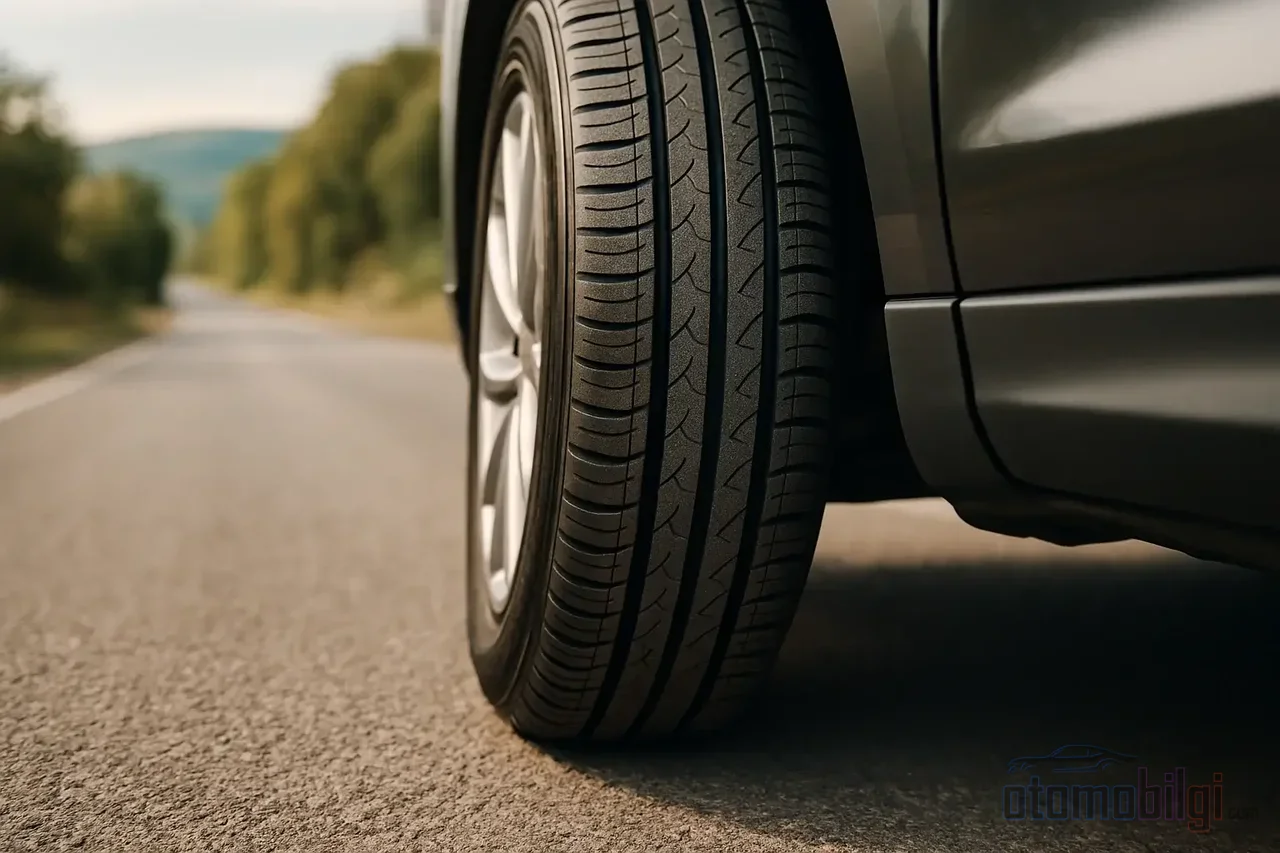
A significant portion of the factors determining a tire's lifespan is in the driver's hands. Typical usage conditions in Türkiye do not work in our favor here: rough and potholed roads, stop-and-go city traffic, and hot climates have long been cited as factors that shorten tire life. Sudden acceleration and hard braking cause wear in the tire's center area; all-day stop-and-go city driving accelerates wear compared to highway cruising. A car that used to reach high speeds once a week today breathes within traffic; accordingly, the fatigue that falls to the tire's share has increased.
On the preventive side, there is a well-known but neglected list:
- Pressure check: At least once a month, including the spare tire; the measurement should be done when the tires are cold.
- Rotation: Manufacturers generally recommend every 5,000-8,000 km; some sources give a range of 8,000-10,000 km. The exact interval varies according to the owner's manual.
- Wheel alignment: Faulty alignment does not press the tire parallel to the ground; wear is concentrated on one side.
- Season-appropriate tires and compliance with load capacity: Wrong tires and excessive loads both shorten lifespan.
- Proper storage: Even an unused spare tire ages; sunlight, moisture, and temperature changes degrade the rubber's chemical structure.
One warning about rotation: rotation is not possible on vehicles with different front-rear sizes or rim widths. Before going to the mechanic and saying "do a rotation," check whether your own vehicle is suitable for this. Those with TPMS (tire pressure monitoring system) on their vehicle are lucky; by helping maintain the correct pressure, it supports both tire life and fuel savings. Balancing and rotation are cheap insurance for this job; a small service fee is almost symbolic compared to the cost of premature replacement.
The hidden cost of premature replacement: The same cost is divided over fewer kilometers
A tire's economics is actually a simple division operation. The cost of a set of tires is fixed; what determines the cost per kilometer is how many kilometers that cost is divided over. When you replace a tire expected to last 50,000 km at 35,000 km, the amount you pay per kilometer increases by one-third. Even though nothing about the tire has changed. This is the invisible tax of premature replacement.
Of course, not every type of early replacement is subject to this tax. Replacing just days before the legal 1.6 mm limit is not the same equation as replacing when the tread is only half worn. Indeed, experts recommend not waiting for the 1.6 mm limit; safety on wet surfaces drops noticeably in the last millimeters of tread depth. In other words, late replacement is also a cost item: increased fuel consumption, longer braking distance on wet surfaces, and the risk of aquaplaning. Converting braking distance into price is difficult, but converting it into accident costs is easy.
There is also a transaction cost on the side of change timing. Under the winter tire program, mounting and dismounting labor is paid at every seasonal changeover; as of 2026, this fee starts at 1,000 TL for 13-14 inch wheels. Wearing out the tire earlier with every kilometer also means paying these transaction costs more frequently.
Tire pressure and fuel consumption: The liters that go from the tank
Rolling resistance is the fundamental factor affecting a tire's fuel consumption, and tire choice can affect consumption at the level of 10-20% According to EU tire labeling, the calculated consumption difference between fuel class A and G is 7.5% meaning two tires sitting side by side on a store shelf may not burn the same fuel in the same vehicle.
On the pressure side, the figures vary a bit: low pressure increases consumption by 3% to 10%, and some calculations mention an increase of up to 10-20%. The difference varies depending on how much the pressure drops and on the vehicle; but the direction is always the same: missing air means both more fuel and faster wear. It should also be remembered that a slightly softer suspension swallows more generously with wider tires - switching to a wider, lower-profile tire than the vehicle's specification can push the consumption increase in user experiences up to 0.3-0.4 liters per 100 km.
| Factor | Effect | What to do |
|---|---|---|
| Low tire pressure | Fuel consumption increases by 3-10%, wear accelerates | Check monthly while tires are cold |
| Rolling resistance | Consumption can vary at the level of 10-20% | Look at the fuel class on the label |
| Irregular rotation | Front-rear wear becomes uneven | Rotate every 5,000-10,000 km |
| Misaligned front end (alignment) | One-directional rapid wear | Have the alignment checked |
How is the real tire cost per kilometer calculated?
In total cost of ownership calculations, tires, alongside fuel and insurance, are an item that is often forgotten but can never be ignored. The list price alone says nothing; the combination of fuel, insurance, maintenance and tires makes up the real bill over a five-year period. To place the tire correctly in this bill, a per-km calculation is made and the method is simple:
- Add up the set price: The purchase price of the four tires + mounting, balancing and valves.
- Write down the expected life: If maintenance is well done, choose a value from the 40,000-60,000 km range that suits your conditions; approach the lower band for city stop-and-go use.
- Divide the price by kilometers: The result is the tire's cost per kilometer. Early replacement increases this number; delayed replacement increases the fuel item instead.
- Convert to an annual picture: The formula annual total expenses ÷ annual km reduces all vehicle expenses to a single per-km figure; add the tire cost to this picture.
The fuel side can also be measured with the same logic: (Distance ÷ 100) × average consumption × price per liter formula gives the annual fuel cost. For example, a vehicle that drives 15,000 km a year and burns 7.2 liters per 100 km, with fuel priced at 48 TL per liter, pays 51,840 TL in fuel per year. This figure is price-dependent but the method is permanent: applying the effect of pressure checks on fuel to this formula once with full pressure and once with insufficient pressure and seeing the difference is the most convincing answer to the question of why tire maintenance matters. A simple division puts the tire replacement decision on data, not emotion.
Tread depth check: the 1 TL coin and DOT code method
You do not need sophisticated tools to measure tread depth. The practical method recommended by the Car Doctor is this: place a 1 TL coin into the tire's tread channel; if the edge of the coin is fully visible, it is time to replace. This check takes two or three minutes and can even be done while waiting at a fuel station. The legal limit is 1.6 mm; in practice it is recommended not to wait until this limit, because safety erodes rapidly in the final millimeters on wet surfaces, and a tire approaching its wear indicators has already begun to make itself heard.
A clarification is also needed at one point: the well-known 1.6 mm value follows a different process on the truck side; a new era has begun in which truck tire wear has entered the legislation, and the exact wear limit for C3 tires has not yet been fully determined. The practical guide for a passenger car owner does not change: the coin test, the DOT code, and an expert inspection once a year.
Conclusion: The right timing is not a decision, it is a calculation
Both rushing and delaying a tire replacement cost money; the difference is that the cost of early replacement shows up in the ledger, while the cost of delayed replacement is hidden in fuel and braking distance. A driver who checks pressure monthly, does not skip rotation, and monitors tread depth with the coin test finishes their set both safely and at the lowest cost per kilometer. The most expensive tires I have seen in thirty years have been the tires of drivers who thought they were cheap and closed them out early or late with little maintenance.
Sources
- What Is the Tire Lifespan of Vehicles? - Continental
- How Do We Extend the Service Life of Tires? - Bridgestone Türkiye
- What Is Tire Lifespan and What Factors Wear Tires Out? - Carpex Online
- How Many Kilometers Do Tires Last? When Should Tires Be Replaced? - Lassa
- What Is the Tire Lifespan of Vehicles? - VW Commercial Vehicles
- Mileage expectations for SUV tires - Michelin Türkiye
- Ways to Reduce Fuel Consumption with the Right Tire Choice - Borusan Next
- Tire Pressure and Fuel Consumption - Omtecshop
- When Should Tires Be Changed? - Otodoktor
- Vehicle Cost of Ownership Calculation - yakittahmin.com.tr
- Total Vehicle Cost of Ownership - Hesapsonuc
- Vehicle cost of ownership - Ermat Group
- Winter tire replacement fees 2026 - A Haber
- Wear regulations for truck tires - Kamyonum