How Did Audi Quattro Bring All-Wheel Drive to Rallying?
Share This Page
In the winter of 1977, something surprising happened on a snow-covered test track: Volkswagen Iltis, Audi's heavy, wheeled military vehicle, unexpectedly outpaced the sports cars on the track. Chassis engineer Jörg Bensinger never forgot that moment. So how did this simple observation change the course of rally history? This is exactly where the Audi Quattro story begins - a wild journey from the moment all-wheel drive looked like an engineering accident to the monsters of Group B.
An Idea Born on a Snowy Test: How Did the Quattro Come About?
The event is simple to describe but its impact was enormous. Bensinger noticed that in 1977, the Iltis performed noticeably better than the other vehicles in snow tests. The reason? All-wheel drive. While the other cars sent power to two wheels, the Iltis distributed power to all four, gaining traction on ice out of nowhere. Think of it this way: press all four of your hands onto a slippery surface, and you grip far more easily than with just two.
Audi took this idea seriously, and together with Pre-Development Director Walter Treser, began development based on an Audi 80 variant. The design became known for the bulging fenders drawn by Martin Smith; production entered on a dedicated line, partly by hand. In other words, this was not a vehicle rolling off a conveyor belt every second, but a project shaped by handcraft.
The Audi Quattro first appeared on stage at the Geneva Motor Show on March 3, 1980 and was offered to European customers by the end of the same year. The name comes from "quattro," which means "four" in Italian; the original model is also called the "Ur-Quattro" today - German for "original/primal." Moreover, this car was the first production automobile to combine a turbocharged engine with permanent all-wheel drive. Two revolutions in one body.
Highlights
- The Quattro was first introduced at the 1980 Geneva Motor Show; a total of 11,452 units were produced (1980-1991).
- Road version: 200 PS, 285 Nm of torque, 0-100 km/h in 7.1 seconds.
- In 1981, Michèle Mouton became the first female driver to win a World Rally Championship round with the Quattro.
- Drivers' championship: Hannu Mikkola (1983) and Stig Blomqvist (1984).
- The Sport Quattro S1 E2 with an official 480 PS - in reality over 500 PS - was the pinnacle of Group B.
The Moment the Rally World Changed: 1981 and the First Victories
In the rally world, everyone was racing with two-wheel drive. Front-wheel-drive cars were cheap and balanced, while rear-wheel-drive ones were the domain of expert pilots on corner exits. Then the FIA changed the rules and the all-wheel-drive door opened - and Audi was the first to leap through it. All-wheel drive was not merely a trick useful in bad weather; it redefined everything, including traction, braking points, corner entry, and throttle control. While rivals put power to two wheels, Audi used all four. The math was very clear.
The Quattro first appeared as a development vehicle in October-November 1980 at the Rali Urbibel Algarve in Portugal; the official debut came at the 1981 Jänner Rally. And here's the first big stamp: the Jänner Rally victory in January 1981. Then in February, Hannu Mikkola kept on winning in Sweden. After that, things moved fast - in 1981, Michèle Mouton made history as the first female driver to win a world rally championship with the Quattro. It was a moment that broke entrenched ideas about both technology and the sport at the same time.
Curious about what lies beneath the road version? A 2,144 cc longitudinally mounted inline 5-cylinder with turbo and intercooler, delivering 200 PS of power and 285 Nm of torque at 3,500 rpm. 0-100 km/h in 7.1 seconds, top speed over 220 km/h. For the early 1980s, those figures were seriously impressive.
The Championship Years: The Mikkola and Blomqvist Era
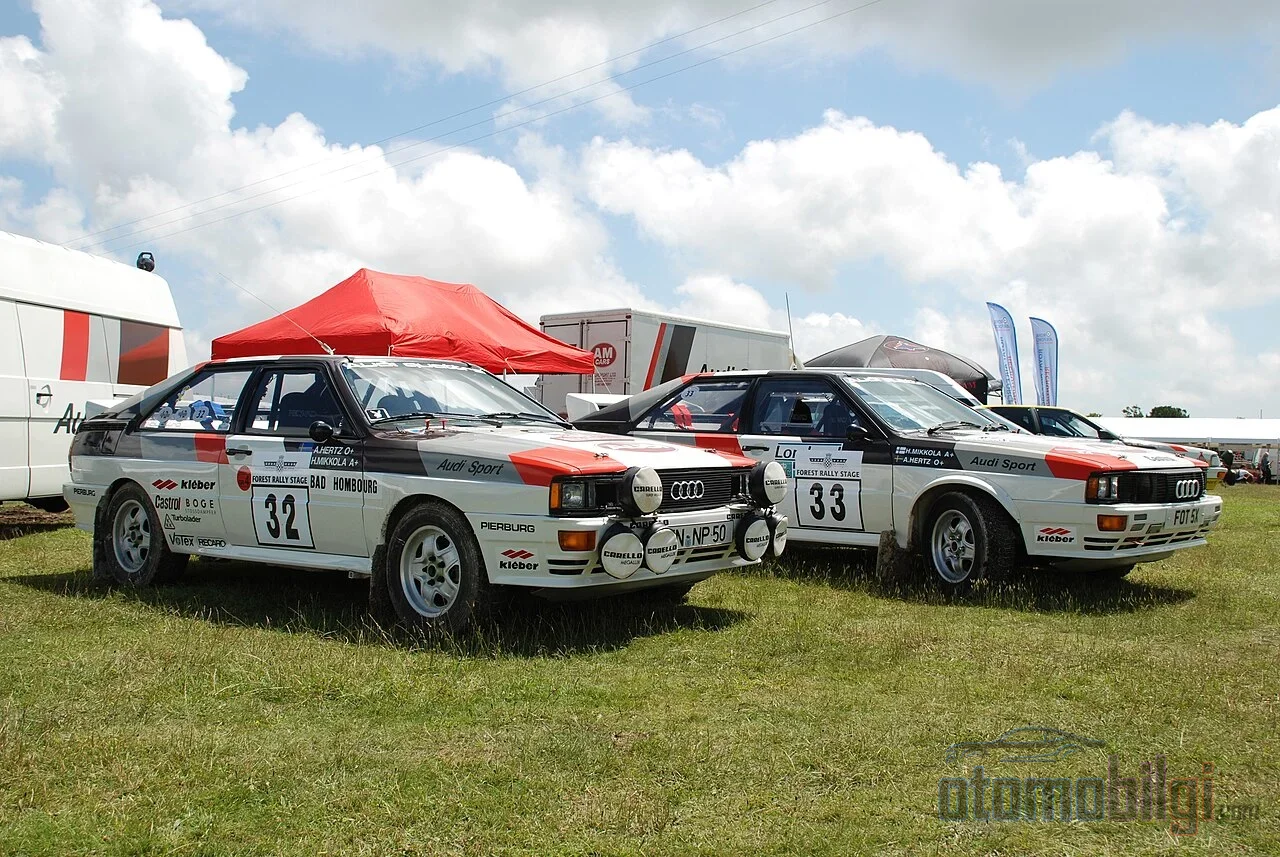
The Quattro A1 officially entered the World Rally Championship with the 1983 Monte Carlo, and Mikkola won Sweden and Portugal the same year. Then the Quattro A2 took the stage, and things got truly serious. In the hands of Blomqvist, Mikkola and Walter Röhrl, the A2 collected a total of 8 world rally victories - three in 1983 and five in 1984.
Now, let's talk about the championship table: In 1982 and 1984, Audi won the Manufacturers' Championship. As for drivers, Hannu Mikkola in 1983 and Stig Blomqvist in 1984 stood at the top - in 1984, Mikkola finished second and Audi had a tremendous year, winning 7 of the 12 rally events. Between 1981 and 1985, the Quattros won a total of 23 world rallies. Also, from 1982 onwards, Audi competed in the South African National Rally Championship with Sarel van der Merwe and Geoff Mortimer, establishing complete dominance there with two examples as well. So this car wasn't just on the world stage - it was in every corner of it.
| Version | Year | Power | Standout feature |
|---|---|---|---|
| Quattro (road) | 1980 | 200 PS | First production car with turbo + permanent four-wheel drive |
| Quattro A1 | 1983 | 306 PS | Entry into the WRC with Monte Carlo |
| Quattro A2 | 1983-84 | ~355 PS | 8 world rally victories |
| Sport Quattro S1 | 1984 | ~450 PS (racing) | 224 units built, 320 mm shorter wheelbase |
| Sport Quattro S1 E2 | 1985 | officially 480 PS, actually 500+ PS | 0-100 km/h in 3.1 seconds, 1,090 kg |
The Group B Madness: The Era When the Sport Quattro S1 Pushed the Limits
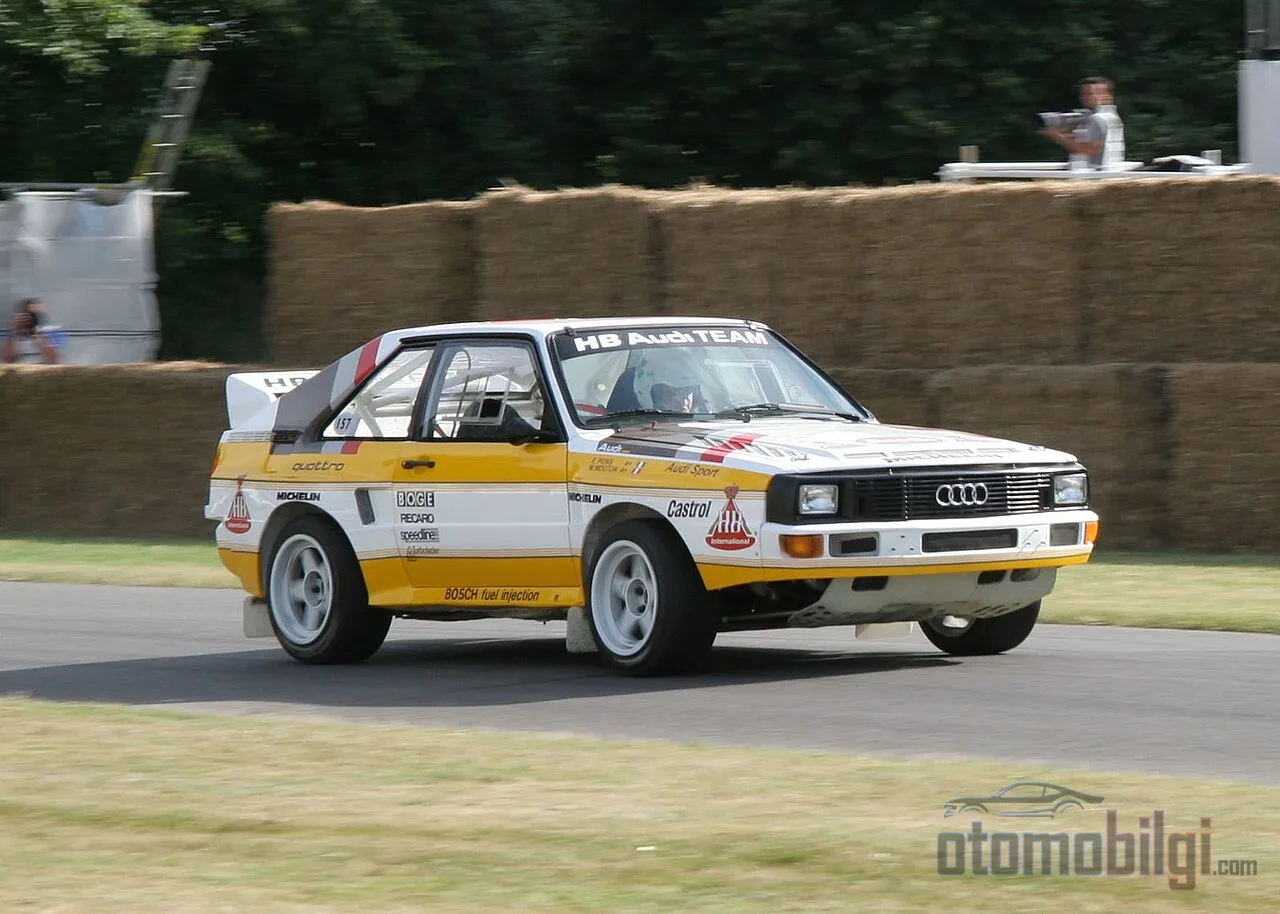
Group B was rallying's wildest era: the rules were loose, the engineers flew, and the crowds poured onto the roads. Audi's answer was the Sport Quattro S1. Developed for homologation, this version had a wheelbase shortened by a full 320 mm compared to the standard Quattro, a carbon-kevlar body, and an aluminum 2,133 cc DOHC engine. The road version produced 306 PS; the racing versions were around 450 PS. 224 units of the short version were built, and the price was announced as DM 203,850 - in other words, not a wallet-friendly toy.
Then, at the end of 1985, the Sport Quattro S1 E2 arrived, and everything got even more absurd. The official figure was 480 PS but the real power, at 8,000 rpm, was over 500 PS; many sources state that the power was accepted as approximately 550 hp - widely regarded as the highest output within Group B. The recirculating air turbo system reduced turbo lag, that annoying moment of waiting for power to arrive when you press the throttle. With a weight of only 1,090 kg, it did 0-100 km/h in 3.1 seconds. Some examples even had "power-shift" gearboxes that would later enter our lives as DSG. The S1 E2 debuted at the 1985 Rally Argentina with Blomqvist, and the Röhrl/Geistdörfer crew won the 1985 San Remo. 20 competitive S1 E2s were built; about 15 of them survive today and only 6 competed in the world rally championship - meaning every E2 you see today is practically a museum piece.
One of the most famous off-track moments of these cars happened at Pikes Peak: Mouton won Pikes Peak with the Sport Quattro in 1985, setting a record; in 1987, Röhrl conquered the same summit with the S1. Asphalt, gravel, dirt - four-wheel drive did its job everywhere. But all that power and all that crowd would not end as well as you might think.
Why Was Group B Banned? The Story of a Tragic End
Group B's power was fascinating, but the price was heavy. Immediately after the deaths of Henri Toivonen and co-driver Sergio Cresto at the 1986 Tour de Corse, the FIA banned the group from the WRC. That same year, the crash at the 1986 Portuguese rally - the driver trying to avoid a crowd of spectators - had already called the group's future into question; inadequate crowd control and fatal accidents at events were also factors that increased the burden.
FISA's investigation was the most striking part of the whole story: It determined that the human brain could not keep up with the speed of these cars, and that drivers experienced what we call tunnel vision, an inability to see their surroundings. In other words, engineering had surpassed human reflexes. Audi withdrew its works team from the WRC after the 1986 Portuguese rally, and the last factory cars produced that year were rated at 600 PS. Moreover, the mid-engined Audi Sport Quattro RS 002 designed for Group S (2.1 L 5-cylinder, 700 PS, 1,000 kg) was tested by Röhrl but never raced. That's what you call a dream cut short in mid-stride.
The Ur-Quattro's Road Life and Its Value Today
While its adventure on the racing scene ended, the Ur-Quattro continued its life on the road. In 1987, the classic manually locking center differential was replaced by a Torsen center differential; in 1989, the engine received a 2,226 cc 20-valve DOHC block, and this version reached a top speed of 230 km/h with 162 kW (220 PS) of power. Even the instrument clusters were a topic: a green digital LCD gauge arrived in 1983, turning orange in 1988. Sales in the USA started with the 1983 model year, but power had been reduced to 160 hp due to emissions rules; a total of 664 were sold in the USA and only 99 in Canada. The last Ur-Quattro rolled off the production line on May 17, 1991.
Today, these cars hold a very special place in the collecting world. A well-maintained 1983 Audi Quattro is worth around USD 49,500 - and it is regarded as one of the most significant performance cars of the 1980s. Why? Because it proved that permanent all-wheel drive could transform road cars, and it started the all-wheel-drive road car trend we see everywhere today. Total production was 11,452 units between 1980 and 1991; all of them came out of those hand-crafted lines in Ingolstadt.
The modern quattro Legacy: Where Is the 40-Year-Old System Today?
When a technology passes the 40-year mark, it is no longer a trend but an institution. Today, the quattro system's four-decade legacy remains alive even in the age of hybrid and electric vehicles. The modern Audi quattro system is designed to react instantly to changing traction even in electric vehicles; a dual-motor, rear-biased quattro design stands out in today's models. Quattro AWD is offered as standard in many versions of the 2026 Audi models.
So the simple truth noticed on a snowy track in 1977 still lives on today as the feeling behind the steering wheel. The Audi Quattro is not just a rally car; it is the beginning of a philosophy that gives you confidence in every corner, every storm, every patch of bad weather.
In summary: How Did the Audi Quattro Change Rallying?
The short and clear answer is this: The Audi Quattro, introduced in 1980 as the first production car to combine a turbocharged engine with permanent all-wheel drive, changed everything in rallying - a string of victories that began with the 1981 Jänner Rally, the drivers' championships of Mikkola and Blomqvist, and the S1 E2, Group B's most powerful car, proved that all-wheel drive was now a necessity. Rivals first mocked it, then copied it. The banning of Group B brought a tragic end to this story, but the Ur-Quattro's decades-long cult status and the modern quattro legacy show every day that the idea never died. Who could have guessed that an idea born on a snowy track would shake the automotive world this much?
Sources
- Audi Quattro
- Group B
- quattro in rallying
- Deep dive on 40 years of Audi quattro all-wheel-drive
- 1985 Audi Sport quattro S1 E2
- This Audi Sport Quattro is a Group B legend
- The Audi Quattro And The Group B Rally Era
- Buyer's Guide to the Audi Quattro
- Audi quattro buyer's guide
- 1983 Audi Quattro Base Value
- Stig Blomqvist