How Do Fuel, Tire and Pit Stop Strategy Work in IndyCar?
Share This Page
In IndyCar, fuel, tires and pit stop strategy are a quiet math exercise that often determines the race result more than the driver's skill: since the fuel tank is limited to 18.5 gallons, no car can finish the race on a single tank, and teams replan refueling, tire choice and pit timing according to the type of track. So the fastest-looking car on the starting grid may not be the team that does the best math. In this article, we dive into that calculation.
Highlights
- Fuel tank of 18.5 US gallons; In IndyCar, refueling in the pits is free; in F1 it has been banned since 2010.
- An ideal Indy 500 pit stop takes about 7 seconds: four tires + a full tank + a wing adjustment.
- A maximum of 7 crew members may be on the pit wall at the same time.
- On road and street courses, teams choose the early side of the pit window; on ovals it is exactly the opposite - they wait to catch an FCY.
- Fuel strategy influenced the outcome of the 2010, 2011, 2016, 2017 and 2018 Indy 500s throughout the 2010s.
The Race Doesn't End on a Full Tank: The Math of Fuel Economy
Think of it this way: What would you do if you had to get into a car with a half-sized tank before a 500-kilometer journey? You would either ease off the throttle along the way or keep looking for gas stations frequently. IndyCar teams live exactly this in every race. The single-piece, puncture-proof fuel cell inside the Dallara IR-12 chassis holds 18.5 gallons; and the engine, unless Honda and Chevrolet's 2.2-liter V6 twin-turbo hybrid units don't want to be frugal, produces 650-700 horsepower, and when the hybrid system kicks in, up to 150 horsepower of extra energy can be released.
That is why there is a concept called the "fuel window" at the center of the team engineers' board: a range of laps showing how many laps you can go on a full tank. In every race, engineers divide the tank by the lap count, calculate how many laps fuel-saving mode will gain, and split the race accordingly. When the driver says "save, save" over the radio, this is exactly the table being read out.
This is precisely where the biggest difference from F1 arises. In Formula 1, refueling during the race is banned; in IndyCar, refueling in the pits is completely free. This single rule places fuel management at the heart of IndyCar strategy. Indeed, there are quite a few years in which fuel strategy decided the Indy 500: in 2010, 2011, 2016, 2017 and 2018, the winners were often not the fastest but the teams that burned fuel most cleverly. In the words of a race engineer, fuel strategy is where races are quietly won or lost.
One note: Older sources give per-lap consumption and mpg figures, but since the low-voltage hybrid system introduced in 2024 stores energy and releases it on command, today's picture works differently from the old numbers. For this reason, directly using old fuel figures for the current hybrid era would be a mistake.
Black or Red? Tire Compound Selection
In IndyCar, a single name supplies the tires: Firestone's Firehawk family. There are five separate constructions for three different track types (oval, road course, street circuit): street circuit tires, road course tires, Indy 500, superspeedway and short oval tires. So every weekend, teams are essentially choosing between different models as if from a different shoe brand.
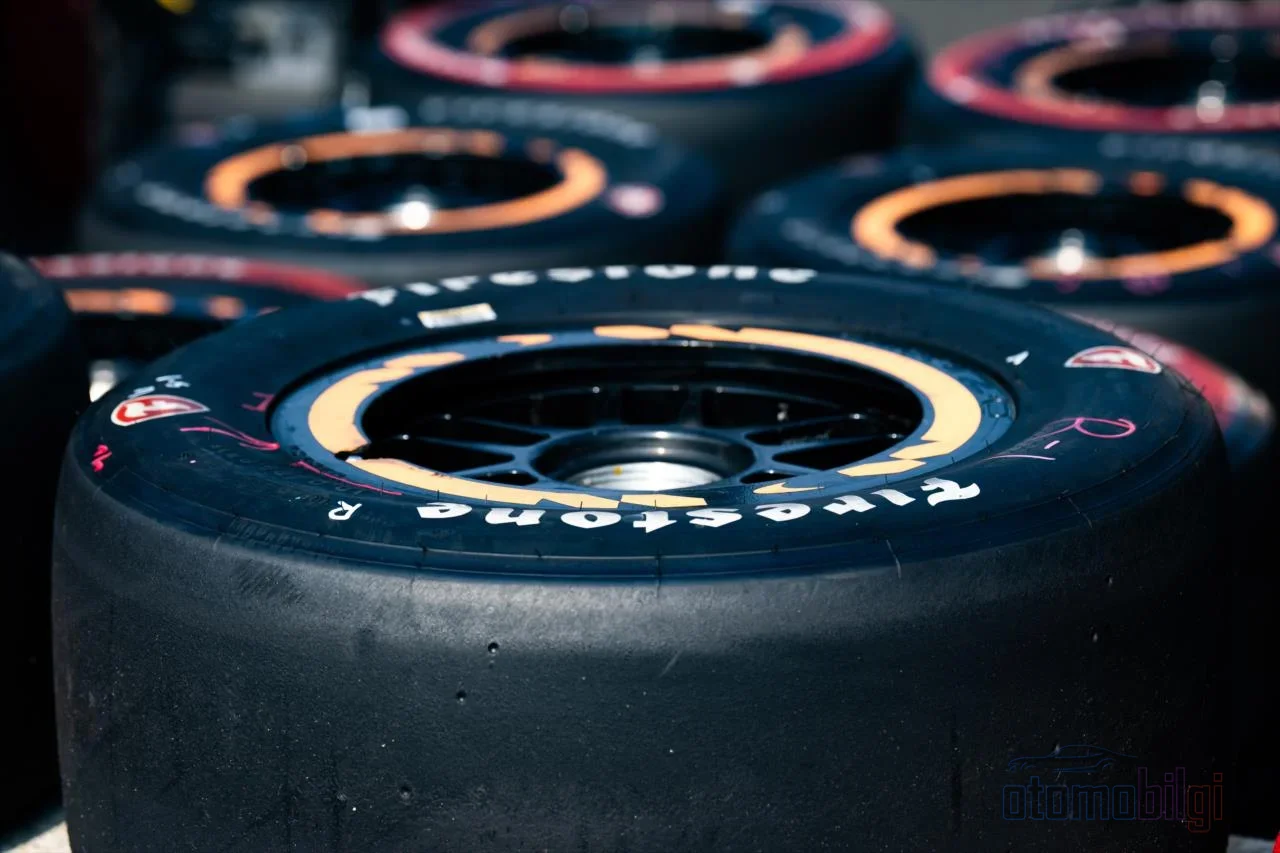
On road and street courses, the job runs on two compounds: primary (black-banded, harder compound) and alternate (red-banded, softer compound). Teams choose between these two plus a wet tire. The red tire warms up faster and delivers quicker laps, but degrades sooner - just like dancing shoes: they look great, and by the end of the night your feet ache. On ovals, only the primary is used; but because of those massive oval forces, each corner of the car demands a differently constructed tire. The left-side tires and the right-side ones, the fronts and the rears, do not do the same job.
The subtle but important detail here is this: the high degradation tendency of the alternate tire introduced in 2022 truly brought tire life into IndyCar strategy. They no longer just say "we're out of fuel, let's pit"; they also think "the red tire will die three laps from now, what can we gain in those three laps?" What's more, since the tire manufacturer changes the compounds every year and recalibrates the degradation balance, predicting how a tire will behave at the start of a weekend is a game full of surprises even for the engineers.
What Happens in 7 Seconds? The Anatomy of a Pit Stop
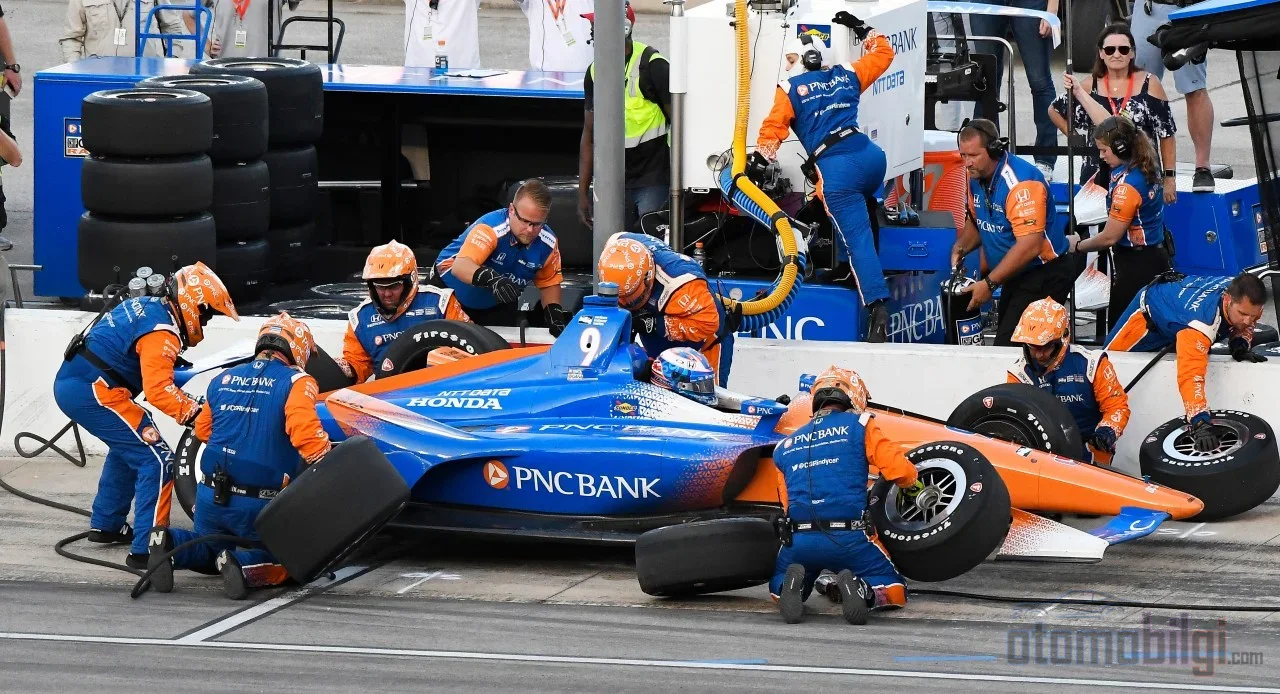
So what actually happens when a car enters the pits? The rulebook is clear: no more than 7 crew members may be on the track side of the pit wall at the same time. Those 7 people are one per wheel (the front tire changers also make wing adjustments), the fueler, and other crew. Four tire changes + filling the 18.5-gallon tank + the requested wing adjustments: an ideal stop at the Indy 500 is about 7 seconds. A normal stop, with four tires, usually lasts somewhere between 6 and 10 seconds.
You might think "is eight seconds really that bad?", but where fuel is being taken on and there's a 7-person limit, you can't expect F1's 2-second magic tricks. The answer to why F1 pits are faster lies exactly here: in F1 there's no fueling and the crew count is much higher. In IndyCar, on the other hand, every stop is both a physical and a strategic operation.
What's more, not every stop is the same. Teams distinguish three different jobs in the pits:
- Fueling: The heart of standard service; the emptier the tank, the longer the stop takes.
- Tire change: All four wheels are changed, and the front tire changers also make the wing adjustment meanwhile.
- Damage repair: A quick fix done when the front wing is broken; sometimes it can be done on its own.
There is also a rule side to this: a driver who crosses the Pit Commitment Line can no longer take full service; they are only entitled to damage repair or a two-second fuel splash and drop to the end of the field. In other words, entering the pits is a one-way decision, there is no going back.
When Does FCY Come Out? The Pit Window and the Yellow Flag Game
Here is the most frustrating yet most fun part of IndyCar strategy: full-course yellow, meaning a yellow flag across the entire track. Once FCY is declared, the pit lane closes, the pace car gathers up the field, and once the field bunches up, the pit reopens. This closure changes the fate of the pit strategy: A team that pits under yellow finishes its tire and fuel work "for free" while its rivals are still turning fast laps under green. There is no mandatory pit stop to begin with; since the fuel tank doesn't cover the race distance, 1-3 stops per race are inevitable, but the timing is entirely in the team's hands.
The problem is that nobody can know when the FCY will come. In the Indy 500, cars pit on average every 25-33 laps, and drivers plan for 5-8 stops; but a single yellow flag can throw all that plan into the trash. That's why engineers live with the constant question of "do we pit now, or wait one more lap?" Penalties are also taken seriously: there is a whole spectrum ranging from a warning to a drive-through penalty, from "stop and hold" to a position loss, even points deductions and disqualification. A careless mistake in the pits can burn an entire race.
How Does Strategy Differ on Ovals and Street Circuits?
Same team, same car, but two completely opposite strategy books. Why? Because the cost to your race of the time you spend in the pits depends on lap time. On an oval, lap time can be as short as about 23 seconds; on road courses, it can climb up to 1 minute 45 seconds. The 10 seconds you lose in the pits means it's nearly impossible to make it up on an oval; on a road course, it's easier to recover.
That's why a contrast like this emerges between the two worlds:
| Direction | Road / Street Circuit | Oval |
|---|---|---|
| Pit timing | The early side of the pit window is preferred | Pitting under green is avoided, FCY is awaited |
| Tire choice | Choice among primary + alternate + wet | Primary only, but with a different setup per corner |
| Impact of pit loss | Since lap times are long, it's easier to make up | A stop under green can cost 2-3 laps |
| Risk | Being caught in the pits while the pit lane is closed | Missing the yellow flag |
The reason for pitting early on road courses is simple: If you're caught in the pits while the pit lane is closed, the field bunches up and you lose serious positions. In a 26-car field, cars that have completed their pit stop before the FCY move ahead; even a leader who hasn't pitted early can drop as far as 13th. The motto of team engineers is the same: "On road courses, you want to pit toward the front side of the pit window."
On ovals, however, the picture reverses. Pitting under green flag can cost you 2-3 laps; so teams try to avoid pitting as much as possible and catch an FCY - a stop under yellow is a free stop. But there's a balance here too: Staying out 10 laps longer becomes pointless if the rival on fresh tires is much faster. So the "let's wait" decision carries its own risk too. A recent example: In a race of the 2026 season, the cars in the top two positions on lap 49. took their final pit stops of the race, and Kirkwood passed Palou 16 laps from the finish - whoever pitted when made the winner clear at that moment.
Fuel Saving: Excitement or Boredom?
Let's be honest: Not everyone enjoys this calculation. One view holds that fuel saving makes IndyCar racing exciting; with the tank constantly on the verge of running dry, every lap becomes a scene of tension. The opposing camp argues that fuel-mileage races have become too common and that races "won on pure speed" are the ones that truly matter. Even the forums are blazing with this debate - should fuel saving be abolished entirely? My personal opinion? Wondering which of two teams made a different fuel calculation under a yellow flag and who will push harder on the final lap is, to me, the purest tension in racing. But I admit, I would also like to see that "come on, floor it" moment every week.
Seeing the Team's Calculation in Their Head While Watching the Race
From now on, when you watch an IndyCar race, you'll see not just fast cars on screen but a working calculator. A car coming out on red-banded tires? The team bet on the alternate compound, aiming to gain positions in the early laps. A car diving into the pit lane on green during ovals? Either it ran out of fuel or the engineers think the yellow flag is far away. The leader slowing down at the end of the race? The fuel window calculation may not be adding up.
And don't forget: Starting with the 2026 season, independent, non-profit INDYCAR Officiating has taken over race control; a three-member independent board (two members appointed by the team owners, one by the FIA) makes all the decisions. So every rule enforcement, from pit lane penalties to FCY closures, is now in more independent hands. The next time you listen to the radio excitement as the pit window closes during a race, you'll now be able to read all the math behind that 7-person crew's 7 seconds. That, right there, is the ultimate viewer superpower.
Sources
- Mastering the art of IndyCar strategy - Racecar Engineering
- IndyCar vs F1: Key Differences, Strategy & Refueling - Catapult
- A Beginner's Guide to INDYCAR: Key Terms - IndyCar.com
- What to Know About INDYCAR: From Race Control to Championship Points - IndyCar.com
- NTT INDYCAR Series Rulebook - IndyCar ePaddock
- 2026 IndyCar Series - Wikipedia
- The art of an Indy 500 pit stop - TAG Heuer Magazine
- How to Win the Indianapolis 500 - Road & Track
- Winning a Race on Pure Speed - Oilpressure