How Does One Become an IndyCar Race Driver?
Share This Page
A driver usually reaches IndyCar by starting in karting and USF Pro Championships climbing the ladder: championships in USF Juniors, USF2000 and USF Pro 2000 earn scholarships, the driver moves up to the final rung, Indy NXT, and if they shine there, the door to IndyCar teams opens. This ladder is entirely scholarship-focused and brings new names to the grid every year.
Highlights
- The USF Pro ladder is distributing over $1.48 million in scholarships and prizes in 2026.
- The USF Pro 2000 champion moves up to Indy NXT with a scholarship worth $594,500
- The Indy NXT champion earns an $850,000 scholarship.
- On the 2025 IndyCar grid, 16 USF Pro graduates were racing.
- Rinus VeeKay went from karting to IndyCar in less than 4 years .
The Ladder's Rungs: The Road from Karting to IndyCar
Everything starts with karting, just like almost everywhere in the world. But in America, the road after karting is clearly drawn: USF Juniors → USF2000 → USF Pro 2000 → Indy NXT → IndyCar. Known formerly as Road to Indy, today's version of this system is the USF Pro Championships Presented by Continental Tire; it was founded in 2010 and since then has hosted drivers from 37 countries across six continents . So this is not a national development program, but a ladder open to everyone.
The best part of the system is this: the champion of each rung moves up to the next series automatically with a scholarship. So being fast alone isn't enough - you have to be champion. That makes every season feel like a final. What's more, the tracks are varied: permanent circuits, temporary street circuits and ovals all together. A youngster preparing for IndyCar starts gaining oval experience at just 15 years old. In many European ladders, this opportunity is almost nonexistent.
What's at each rung?
| Series | Role | Championship scholarship |
|---|---|---|
| USF Juniors | Entry level, age 14 and up | $249,675 (promotion to USF2000) |
| USF2000 | First full race season experience | $405,050 (promotion to USF Pro 2000) |
| USF Pro 2000 | Third rung of the ladder | $594,500 (promotion to Indy NXT) |
| Indy NXT | Final preparation for IndyCar | $850,000 (IndyCar opportunity) |
The ladder's roots are surprisingly deep too: USF2000 is the revival of the old series that ran from 1990 to 2006, while USF Pro 2000 traces its roots back to the 1991 Star Mazda Championship. In short, these rungs weren't invented yesterday - it's a system polished over the years.
How Do the Cars Evolve? Three Series, One Philosophy
Here's the detail that impressed me the most: USF Juniors, USF2000 and USF Pro 2000 all use Tatuus chassis, and the three series share the same monocoque as well as the main suspension and body components. That's something few ladders in the world have. The logic is simple: the driver doesn't waste time adapting to a completely different car at each rung, and instead focuses on how to work with the car's increasing power and tires. Think of it like learning to ride a bicycle - first increasing your speed on the same bike.
The chassis is built on a full carbon composite and aluminum honeycomb monocoque; it meets FIA safety standards and carries a Halo-like protection device. Additionally, considering that the US has a race culture without ovals... wait, with ovals, the front structure was specially reinforced for oval conditions. On the engine side, there is Elite Engines built MZR 2.0-liter unit; a factory version is used in USF Pro 2000 racing.
Moreover, the cars are continuously updated. From 2025, the rev limit in USF Pro 2000 was raised from 7850 to 8350, which provided approximately 40 hp gain at lower revs. In USF2000, removing the air restrictor brought approximately 20 hp of extra power. So the ladder doesn't just go up in name; at every level the engine genuinely screams louder.
Scholarship Mechanism: Winners Move Up a Level for Free
What fuels the ladder is scholarships. For 2026, USF Pro Championships distributes over $1.48 million in scholarships, prizes, and bonuses in total - some announcements cite this figure as $1.5 million, because different items can be counted at different times. The USF Juniors champion moves up to USF2000 with $249,675, the USF2000 champion moves up to USF Pro 2000 with $405,050, and the USF Pro 2000 champion moves up to Indy NXT with a scholarship worth $594,500.
At the top, things get even more serious. The Indy NXT champion receives a $850,000 scholarship, and this package is not just cash: it also includes two IndyCar tests and two race entries, including the Indianapolis 500. So the champion gets the chance to learn what IndyCar smells like before sitting in the red seat. The runner-up doesn't go home empty-handed either: they receive $125,000.
A fresh example: 2025 USF Pro 2000 champion Max Garcia lifted the trophy with at just 16 years old 9 wins, 9 poles, and 13 podiums, and moved up to Indy NXT, to Abel Motorsports, with a $594,500 scholarship. In 2026, USF Pro 2000 was won by rookie Jack Jeffers; the Exclusive Autosport driver mathematically secured the championship at Road America and closed the season with 6 wins, 10 podiums, and 7 poles. As you can see, the ladder keeps working.
The Money Reality: What Happens When Scholarships Aren't Enough?
Now let's get to the brutal part. Scholarships are attractive, but the real cost of a season doesn't always match the scholarships. Racing circles say a full USF Pro season costs approximately $650,000 excluding crash damage and travel; an Indy NXT season also demands a budget of similar magnitude. For a driver who cannot capture the full scholarship, the remaining gap has to be filled through sponsor hunting or family budgets. That's why every rung of the ladder is not just a speed race, but also a budget race.
This reality directly shapes career decisions. Some talented drivers have to stay longer at one level; others, when they fail to win a scholarship, turn to Europe or other series. For winners, the Indy NXT championship scholarship is an almost complete solution; but looking at the entire ladder, the access problem is still a serious topic of debate. In short, steering talent is a must, but it's not sufficient on its own.
How Does It Differ from F1's Academies in Europe?
Perhaps this question has crossed your mind: how do young drivers rise through the Formula 1 side? There are FIA-backed academies and team academies there; big teams sign karting drivers as young as 12-13 to their rosters and cover their costs. On the IndyCar side, the model is different: there is no centralized academy; instead, there is a championship-focused scholarship system. USF Pro markets itself as "the world's most effective driver development program," and of course marketing language presents this as a flat claim; but it must be acknowledged that the two systems serve different goals: the European ladder develops drivers for F1, the American ladder for IndyCar.
There are practical consequences of this, too. The American path provides oval experience at an early age and allows a driver's own performance to carry them forward through scholarships. F1 academies offer broader financial protection at an earlier age, but the doors pass through catching the eye of a handful of big teams. Both work; the rules of the game are simply different. Seeing Indy NXT as the IndyCar equivalent of F2 is at least a thought-provoking comparison.
Does the Ladder Really Work? The Examples of O'Ward, Herta and Kirkwood
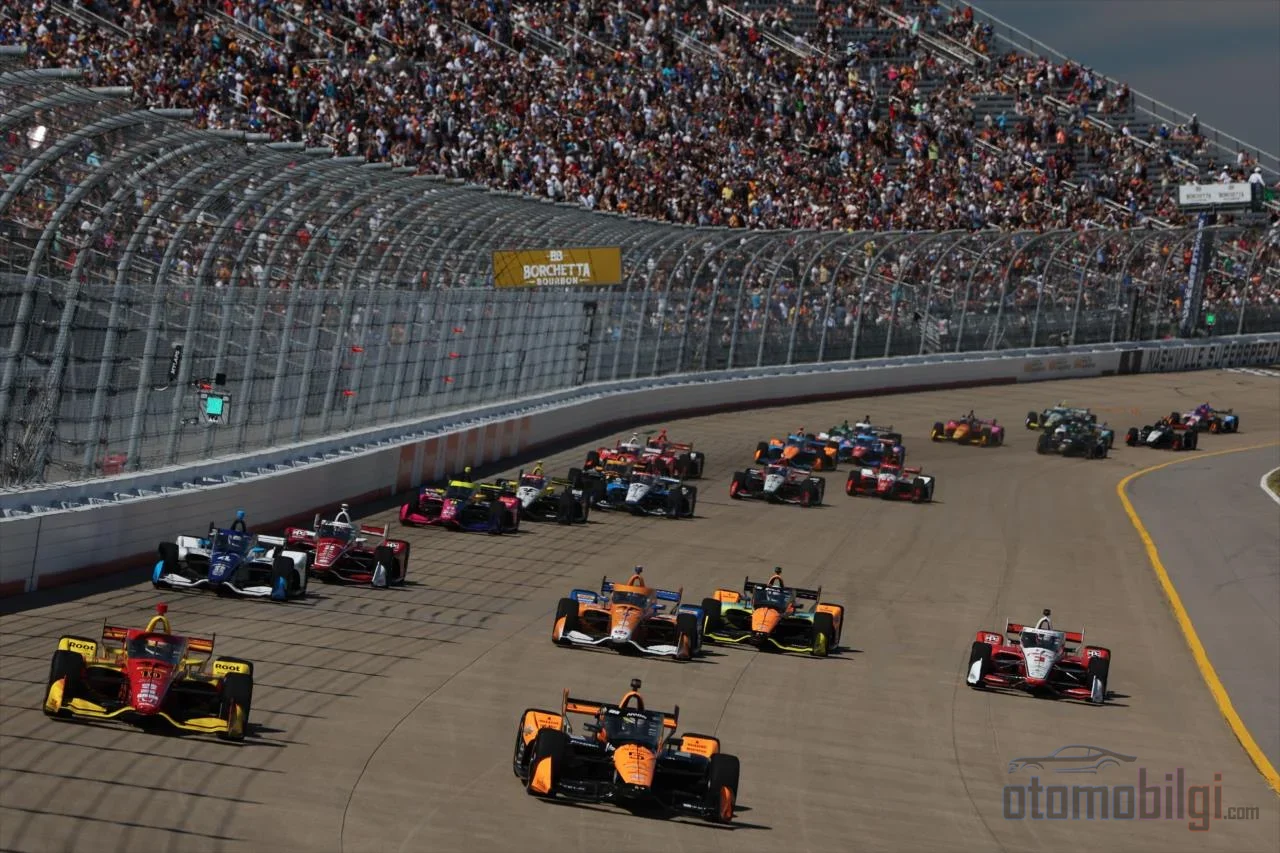
The theory is nice, but what happened in practice? Here is the most solid answer: on the 2025 NTT IndyCar grids, 16 USF Pro graduates took part, and there were 15 graduates on the starting line of the 2025 Indianapolis 500. That is a serious ratio. Rinus VeeKay climbed from karting to IndyCar in less than 4 years, making him living proof of how efficient the ladder can be.
And star examples are a bonus. Pato O'Ward, after coming up through the ladder, practically returned home at Arrow McLaren; as of 2026 he completed his 9th season in IndyCar, his 6th year with the team, and in 2021 he became the first Mexican driver to win an IndyCar race, in Texas. Colton Herta, at Nashville 2026, passed O'Ward to take the first oval win of his career - yes, those who come up through the ladder are not there just to participate, but to win as well. Kyle Kirkwood is the textbook example: 2019 USF Pro 2000 champion, 2021 Indy NXT champion, moved up to IndyCar with A.J. Foyt Racing in 2022, and today counts 6 IndyCar wins; in 2025 he had the best season of his career with Andretti.
Of course, not every story is a fairy tale. David Malukas's path was bumpy: he had to leave McLaren due to the races he missed after a mountain biking accident, then signed with A.J. Foyt Racing and eventually landed in Team Penske's No. 12 Chevrolet seat. So the ladder gets you to IndyCar, but staying there is a completely different test. The fact that some names were left without contracts in 2026 is proof of that. Still, the picture is clear: the ladder works, and a new influx of rookies continues - names like Mick Schumacher, Caio Collet and Dennis Hauger joined IndyCar in 2026. And in Indy NXT, the 2026 championship came down to the final weekend at Laguna Seca with six drivers separated by only 3 points; in other words, the competition at the doorstep has never been this hot.
The Contract and Seat Battle: The Rules of the Final Step
At the end of the ladder, what awaits you is not a technical exam but a commercial process. The Indy NXT champion heads to IndyCar tests with an $850,000 package, but an IndyCar seat means a contract signed with a team; the scholarship opens the door, but the contract is opened by the team and the sponsors. Teams look at both performance and the budget the driver can bring. Even the runner-up receiving $125,000 shows that in this system's design, a second chance has value too.
That is also why the transfer frenzy known as silly season is talked about so much: the number of seats is fixed, while the number of candidates grows every year. In a single Indy NXT season, you might see a driver who lost the championship by 3 points listed side by side with the champion in the same team rosters. That is why the most common advice given to young drivers is simple but harsh: become the champion. Because in this system, the scholarship only goes into the pocket of the one who lifts the trophy.
Final Word: My Advice for Those Who Want to Climb the Ladder
The road to IndyCar is not an elevator but a ladder; and at every step, both your steering and your budget are being tested. But the fair part is this: on a night when speed has spoken enough, the scholarship carries you one level up. This line stretching from USF Juniors to Indy NXT and from there to the pit lane of the Indianapolis 500 has fed nearly a quarter of the grid in recent years. The chance that tomorrow's winner in Nashville or Texas might come from someone lapping a karting track today is worth thinking about, isn't it?
Sources
- USF Pro Championships
- The Series
- 2026 USF Pro 2000 Championship
- 2026 Indy NXT Rulebook - INDYCAR ePaddock
- About The INDYCAR Ladder System
- Indy NXT: 2026 season guide
- USF Pro 2000: 2026 season guide
- What is NTT INDYCAR SERIES and INDY NXT by Firestone?
- Pato O'Ward - indycar.com
- Christian Lundgaard - indycar.com
- David Malukas - indycar.com
- David Malukas - Team Penske
- IndyCar vs Formula 1: Junior driver development series ladders compared