What Kind of Electric Car Is the 2026 Hyundai IONIQ 6?
Share This Page
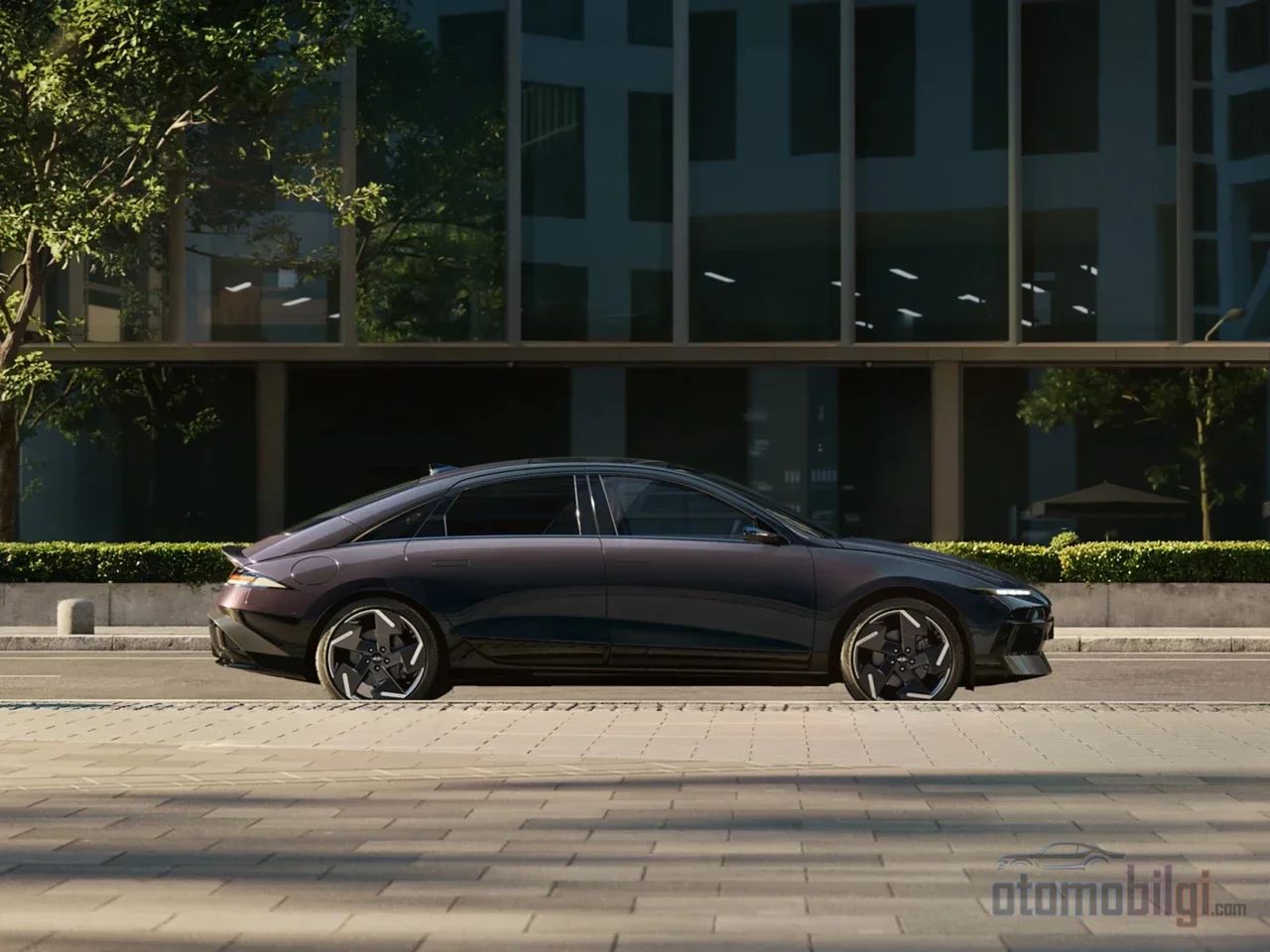
The Hyundai IONIQ 6 is the brand's four-door "electrified streamliner" sedan built on the E-GMP platform; it is still sold new in Türkiye, yet it is one of the least covered models in domestic electric vehicle content. Unlike its SUV-bodied sibling the IONIQ 5, this sedan focuses on highway aerodynamics, 0.21 drag coefficient and up to 680 km of WLTP range, pushing the efficiency limits of its segment.
Highlights
- Best-in-class aerodynamics: Cd 0.21 - below the Tesla Model 3's 0.22 figure.
- 84 kWh battery in the rear-wheel-drive version delivers up to 680 km of WLTP range; the 63 kWh version offers 521 km.
- 800-volt architecture allows 10-80% in about 18 minutes at compatible stations.
- In real-world use, it is the most efficient member of the lineup at 13-15 kWh/100 km .
- October 2026 campaign price in Türkiye: starting from 3,246,000 TL.
IONIQ 6 Identity: How Does It Differ from the IONIQ 5's Sedan Sibling?
This is the first question on many readers' minds: the IONIQ 5 is already on sale, so why should there also be an IONIQ 6? From an engineering standpoint, the answer is clear: both vehicles share the same E-GMP platform; the Kia EV6 and EV9 use the same architecture too. The same battery, the same motor options, the same 800-volt charging architecture. The distinguishing difference is the body style and its effect on aerodynamics.
While the IONIQ 5 is a high-riding SUV, the IONIQ 6 is a sleek-lined sedan that Hyundai calls a "streamliner." Looking at the dimensions, after the facelift we are talking about 4,925-4,930 mm length, 1,880 mm width and 1,495 mm height; the wheelbase is 2,950 mm. An interesting detail: the IONIQ 5's wheelbase is longer at 3,000 mm, meaning that although the IONIQ 6 is larger in overall size, it has a shorter distance between the axles - it is the body shape, not the size, that defines this car's identity.
Inside the cabin, the difference is noticeable in practice. The IONIQ 5 leads in functionality with its approximately 520-527-liter hatch trunk. The IONIQ 6's trunk is 401 liters; to this is added an approximately 45-liter front trunk (frunk). Since the sedan lid's opening is not as wide as the hatchback's, it falls behind its SUV sibling when loading bulky items. In short, if you want practicality, the IONIQ 5; if you want to sweep up highway kilometers efficiently, the IONIQ 6 is the sensible choice.
Cd 0.21: Aerodynamics, This Model's Real Equipment
In electric vehicles, the biggest enemy of range is air resistance at high speeds; motor efficiency works in the city, but on the highway it is the body shape that speaks. The IONIQ 6's 0.21 drag coefficient is therefore the model's single most important figure: it is the best value in its class and below the 0.22 of the Tesla Model 3 and the approximately 0.219 of the BYD Seal.
The interesting thing about this figure is that it was achieved with a design that is not the classic "teardrop" shape. The 2026 facelift refines things in this direction: a shark-nose, slimmer daytime running lights, and a single-piece "ducktail" spoiler. It was debatable that the pre-facelift design was polarizing; the facelift brings a face that is easier to sell visually, but the aerodynamic philosophy has not changed.
The result translates into real life like this: in mixed use, 13-15 kWh/100 km consumption makes the IONIQ 6 the most efficient member of the series. Even in a version with the 84 kWh battery and 20-inch wheels, 624 km of WLTP range and approximately 14.7 kWh/100 km consumption have been measured. In the real world, reaching 75-80% of the WLTP figure in mixed use, and 60-65% in highway-only use, is a reasonable expectation. These figures show it is one of the smartest at converting highway kilometers among vehicles carrying the same 84 kWh pack.
Range and Charging: How Well Does the 800-Volt Architecture Work?
The IONIQ 6 is sold in Türkiye with two battery options: 63.0 kWh version offers up to 521 km, 84.0 kWh and the rear-wheel-drive version offers up to 680 km of WLTP range. The rear-wheel-drive 84 kWh model 168 kW (approximately 229 hp) of power and 350 Nm of torque; 0-100 km/h in 7.4 seconds. The AWD version, with 325 hp , offers 583 km of WLTP range. It should be noted that this is not a performance-focused car - this model's promise is not speed, but efficiency.
On the charging side, the 800-volt architecture comes into play. At suitable 800-volt stations, charging from 10% to 80% takes approximately 18 minutes ; on high-power grids this drops to as low as 15 minutes , meaning up to 426 km of range can be added in 15 minutes. Compatibility with 400-volt stations also exists, but these times increase noticeably on 50 kW chargers - when planning a long trip, it makes sense to plan your route around 350 kW stations.
Let us add two technical notes. First: charging power drops significantly after 80%; in a fast-charging strategy, leaving stops at 80% and continuing on the road shortens total travel time. Second: on the AC side, 11 kW three-phase charging is available and the vehicle's V2L function can power external devices at 3.6 kW - a feature useful in camping or emergency scenarios.
Interior and Technology Equipment
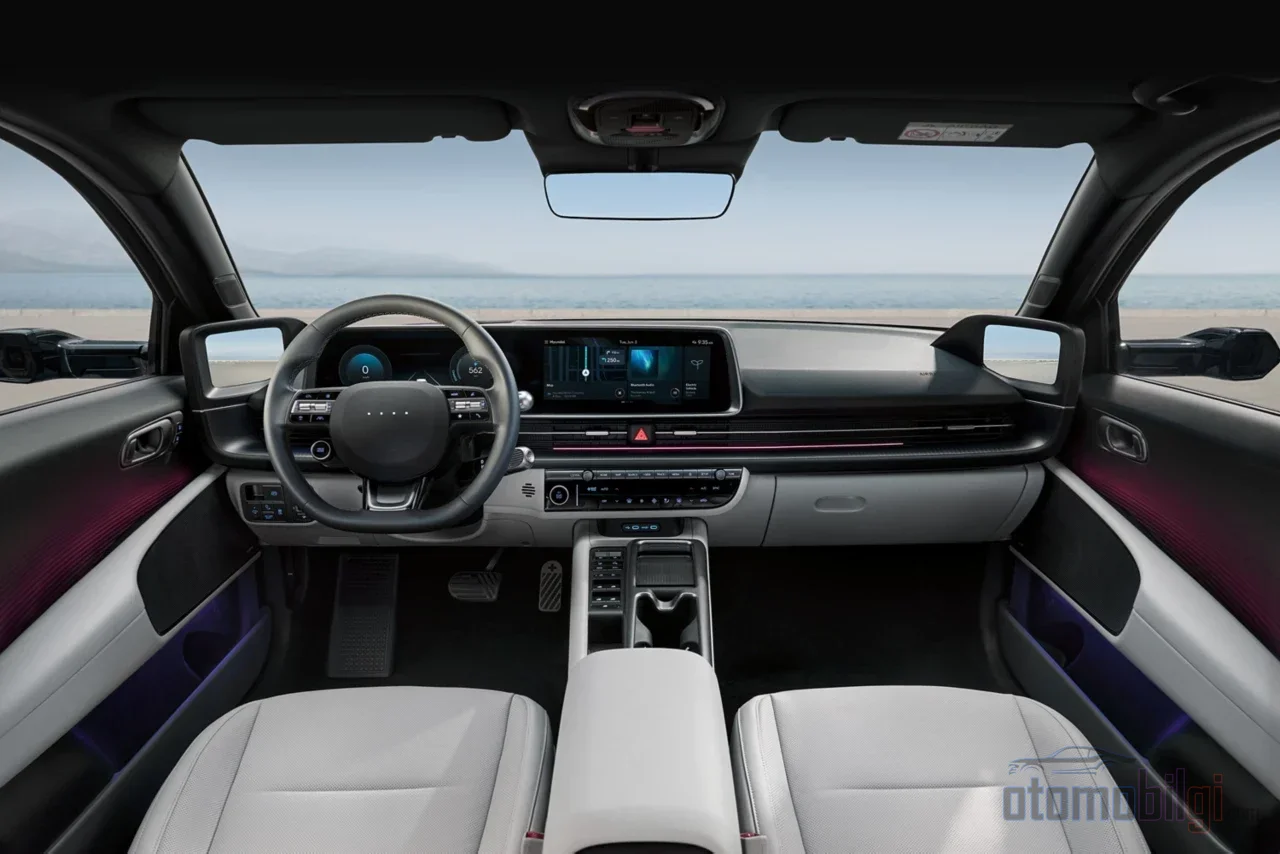
The cabin has a clean, horizontally-lined layout: twin 12.3-inch panoramic screens carry the driver and multimedia information. The equipment list includes items meaningful under Türkiye's conditions: heat pump (critical for winter range), front and rear heated seats, Speed Sync ambient lighting that syncs rapidly, and the Hyundai SmartSense ADAS package. Highway Driving Assist 2 offers Level 2+ driving assistance, while OTA software updates and Bluelink connectivity allow remote management of the vehicle.
The preservation of physical HVAC buttons is a significant usability advantage compared to the menu-screen dependence we've become accustomed to with Tesla. On the safety side, it holds a 5-star rating (2022) from Euro NCAP. The warranty coverage is also broad: 5 years with unlimited mileage for the vehicle, and 8 years/160,000 km for the battery (70% capacity guarantee).
It is a known issue that ICCU (Integrated Charging Control Unit) failures in early E-GMP vehicles could affect 12-volt battery charging and propulsion. Those considering a used purchase would do well to check that recall procedures have been completed; in new purchases, this risk has largely been overcome in current production.
IONIQ 6's Position Against the Tesla Model 3 and Kia EV6
All three cars answer the same question: mid-range electric, long range, fast charging. But their identities differ. The table below summarizes the notable measurable differences:
| Criterion | Hyundai IONIQ 6 | Tesla Model 3 | Kia EV6 |
|---|---|---|---|
| Drag coefficient | Cd 0.21 | Cd 0.22 | SUV-style body |
| Charging architecture | 800V, 10-80% in ~18 min | Supercharger network | 800V (E-GMP) |
| Strengths | Comfort, dealer network, CarPlay | Software, entry price, charging network | Driving feel, 7-year warranty |
| Body/packaging | Sedan, 401 L + frunk | Sedan, front in total load volume | Crossover, elevated seating |
In Edmunds' ratings, the two cars are very close: the IONIQ 6 scores 7.8/10 overall, the Model 3 7.9/10. The difference lies in the type of experience: IONIQ 6 users say it leads in seat comfort, suspension and climate control; on the Tesla side, the software ecosystem is the deciding factor. The IONIQ 6's winning areas can be summarized as: 800-volt charging stop compatibility, wireless CarPlay and physical climate control buttons, and a widespread dealer network. The Model 3's cards, meanwhile, are a lower entry price and the Supercharger network.
The case against the Kia EV6 is clearer: since they share the same platform, the technical DNA is similar, but the IONIQ 6 pulls ahead in highway efficiency with its lower entry price and its Cd story. The EV6, on the other hand, answers a different need with its driving character, 7-year warranty and crossover packaging. It must be acknowledged that, given the EV6's advantage in cargo volume (28 versus 21 cubic feet against the Model 3), readers seeking trunk practicality should not insist on the IONIQ 6.
IONIQ 6 in the Türkiye Market: Price, Sales and Positioning
The IONIQ 6 is on sale on Hyundai Türkiye's official website with a stated "range of up to 680 km." During the October 2026 campaign period, the maximum campaign sales price of the Advance 125 kW 4X2 version was 3,246,000 TL; in zero-kilometer listings, the range for two versions appeared as 3,246,000-3,795,000 TL . The official list prices of the facelifted model were announced at 2,482,000 TL for the Advance 125 kW and 3,725,000 TL for the Progressive 160 kW - which is instructive in showing the gap between campaign structures and actual sales prices versus list prices.
The facelifted version was expected to arrive in Türkiye in August–September 2026, and its launch was announced in early August; it is sold with 63 kWh (521 km) and 84 kWh (680 km) battery options. In the monthly sales tables, the model appears on the list but is not the leader: in September 2026, the VW ID.7 ranked higher with 316 units, while the IONIQ 6 with 139 units appears on the list. The market context is growing rapidly: the market share of electric cars in Türkiye reached 23.7% in September 2026 - a year earlier, this figure was 14.6%.
There is another striking development within a year: Hyundai will become the second brand to produce electric cars in Türkiye in 2026 ; production will take place at the Izmit facilities. The assessment that the brand reached 59,618 sales in 11 months and that the Turkish electric vehicle market could reach a share of 35–40% by 2030 supports the model's long-term position in this market.
IONIQ 5 or IONIQ 6? A Quick Decision Guide
To answer this frequently asked question with the material's data: both vehicles carry the same battery, the same motor, and the same 800-volt architecture. The only measurable distinguishing difference is the range of the 84 kWh version: the IONIQ 6 offers 680 km, and the IONIQ 5 570 km WLTP - the 110 km difference comes entirely from the aerodynamic difference. For city and family use, the IONIQ 5's hatch trunk and spacious cabin have the advantage; for long highway kilometers and the pursuit of low consumption, the IONIQ 6's streamliner body is advantageous. It should also be noted that in Türkiye comparisons, the IONIQ 5's 160 kW Advance version (3,490,000 TL) has an advantage in terms of pricing.
Conclusion: A Clear Identity as an Efficiency Sedan
The IONIQ 6 is not a car for everyone, and that is a deliberate choice. Its trunk opening is not as practical as the IONIQ 5's, its performance lags behind AWD rivals, and its design still may not suit everyone's taste. But for those who love cars that do their own thing, the picture is clear: Cd 0.21 aerodynamics, an 800-volt charging architecture, 13-15 kWh/100 km real-world consumption, and a 5-year unlimited-km warranty come together to create a measurably strong package for buyers seeking a highway-focused electric sedan in Türkiye. In this segment, where it competes with the Tesla Model 3's software and charging network and the Kia EV6's crossover practicality, the IONIQ 6's differentiator is clear: range efficiency per kilometer.
Sources
- Refreshed IONIQ 6 | Highlights - Hyundai Motor Europe
- New IONIQ 6 | Highlights | Hyundai Motor Türkiye
- IONIQ 6 Price List - Hyundai Motor Türkiye
- IONIQ 6 relieves range anxiety - Hyundai News EU
- Hyundai Ioniq 6 Ireland Review - odo.ie
- Hyundai Electric Cars 2025 - go-electra.com
- Refreshed IONIQ 6 official Türkiye prices - Log.com.tr
- Hyundai Ioniq 6 Price List - arabam.com
- Hyundai to be the second brand producing EVs in Türkiye in 2026 - Anadolu Agency
- Hyundai Ioniq 6 vs Tesla Model 3 - Edmunds
- 2026 Kia EV6 vs Tesla Model 3 - Car and Driver
- IONIQ 6 or IONIQ 5 - elektrikliturkiye.com