Where Were the First Charging Stations Installed and How?
Share This Page
The first charging stations were established in the early 20th century in cities like New York - General Electric's street-type "Electrant" units, dealership and garage charging points, and store stations that attracted wealthy customers; home charging, however, formed the real backbone. Electric companies built the infrastructure on top of their lighting networks, and even battery swapping was tried - but the portability of gasoline left this network behind. This page tells the story of that forgotten infrastructure, from its founding to its modern-day lessons.
Highlights
- The first American electric car was built by William Morrison in 1891; it had a top speed of 14 mph.
- General Electric produced a street charging unit for New York at the turn of the century called the Electrant.
- The oldest garage-type charging station thought to have survived is in Thomas Edison's concrete garage from 1908.
- The battery swapping idea was proposed in 1896; Hartford Electric Light Company implemented it between 1910-1924.
- By the 1930s, electric cars had largely disappeared from the roads.
Infrastructure That Started at the Outlet: Home and Depot Charging
The first charging network for electric cars, unlike today's fast-charging maps, was built on a completely opposite logic: homes first, everything else after. By 1910, a homeowner could install a charging unit on their own property and leave their vehicle plugged in overnight. These early wall-mounted units connected their cables directly to the vehicle - technologically not all that far from today's home chargers. In addition, a growing number of repair shops in cities had begun offering charging as a side service.
The technical reason for this approach was simple: early batteries had low capacity and long charging times. The 24 battery cells in Morrison's 1891 six-passenger wagon required charging every 50 miles. With such an energy balance, a "charge at night, drive by day" model was a far more efficient solution than building an extensive public network.
Rectifier: The First Bridge from AC to DC
The critical component of home charging was the mercury-vapor rectifier developed in 1902. This valve, which converted the grid's alternating current into the direct current required by batteries, was the key component that made charging practical on a household scale. From an engineering perspective, the difference between an early 1900s home charging point and a modern Level 2 unit lies not in the basic function, but in power and control electronics.
The First Public Charging Points: Electrant and City Garages
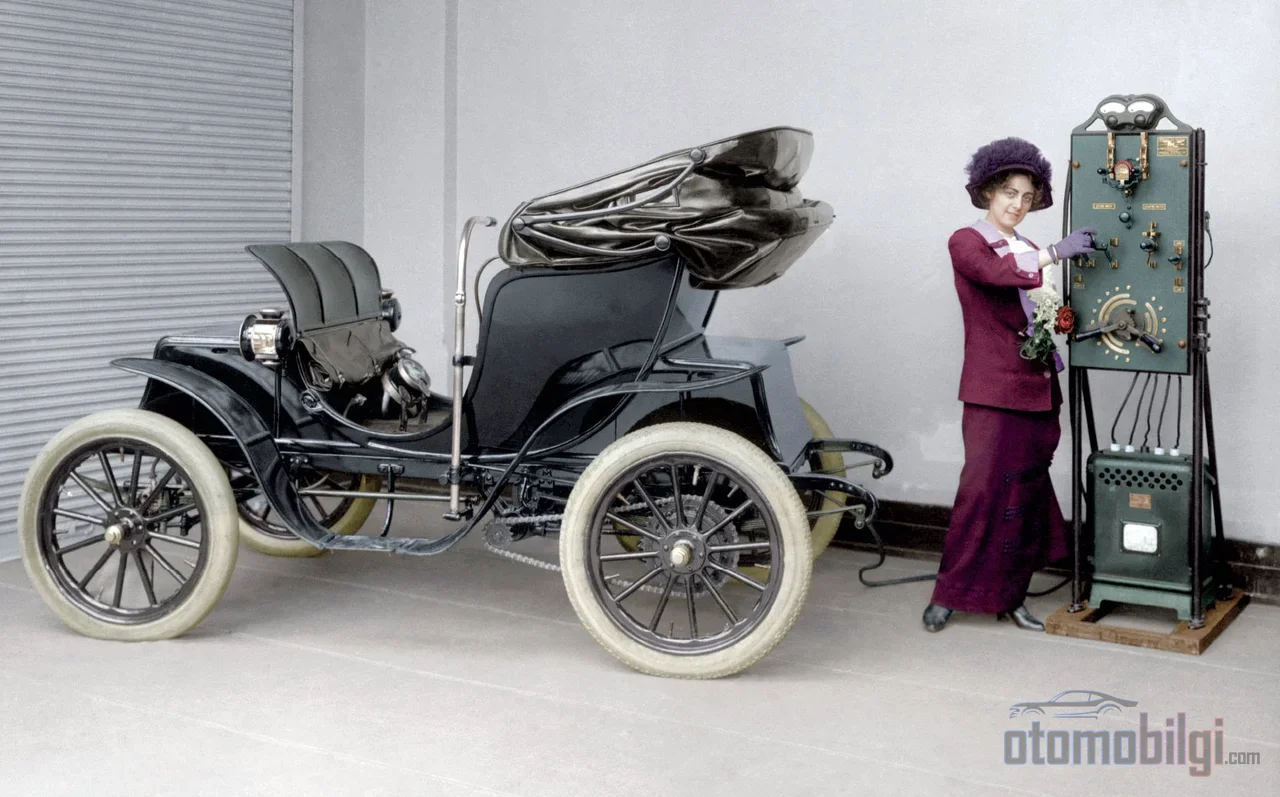
General Electric led the way on the public side. At the turn of the century, the company produced a street charging unit for New York called the Electrant. Its design philosophy was remarkably modern: like today's 240-volt Level 2 AC or DC fast-charging units, the Electrant could be placed virtually anywhere a vehicle could park. City-centered store districts also set up their own charging stations to attract wealthy customers - especially women drivers who did not want to use a hand crank. Dealer charging points were also among the options; some models had removable batteries, and the vehicle could be left at the garage for charging.
Visual archive records confirm the reality of this infrastructure: a photograph from 1906 shows an early charging garage in New York, while a frame from 1912 shows a worker operating a giant vehicle charger made by General Electric. Numerical data on the full extent of the network in its spread-out state, however, is not certain; common claims about the number of public stations in 1910s America remain too vague to be used without confirmation from a primary source.
Edison's garage: the oldest surviving example
The most tangible remnant of the infrastructure story is the concrete garage that Thomas Edison had built in 1908. The structure houses the oldest garage-type electric vehicle charging station thought to have survived. Edison was among those who believed in the future of the electric car; together with Henry Ford, they produced at least one electric prototype. But both saw the future of the gasoline engine as brighter - Edison's effort to develop lighter batteries was repeatedly postponed; one reason was that nickel-iron batteries never managed to deliver on time their promise of being an alternative to heavy and bulky lead-acid packs. Another factor was more structural: electricity was not yet widespread outside city centers.
I believed in the future of the electric car; but the future of the gasoline engine was brighter.
Battery Swapping: The Fast "Refueling" Model Tried a Century Ago
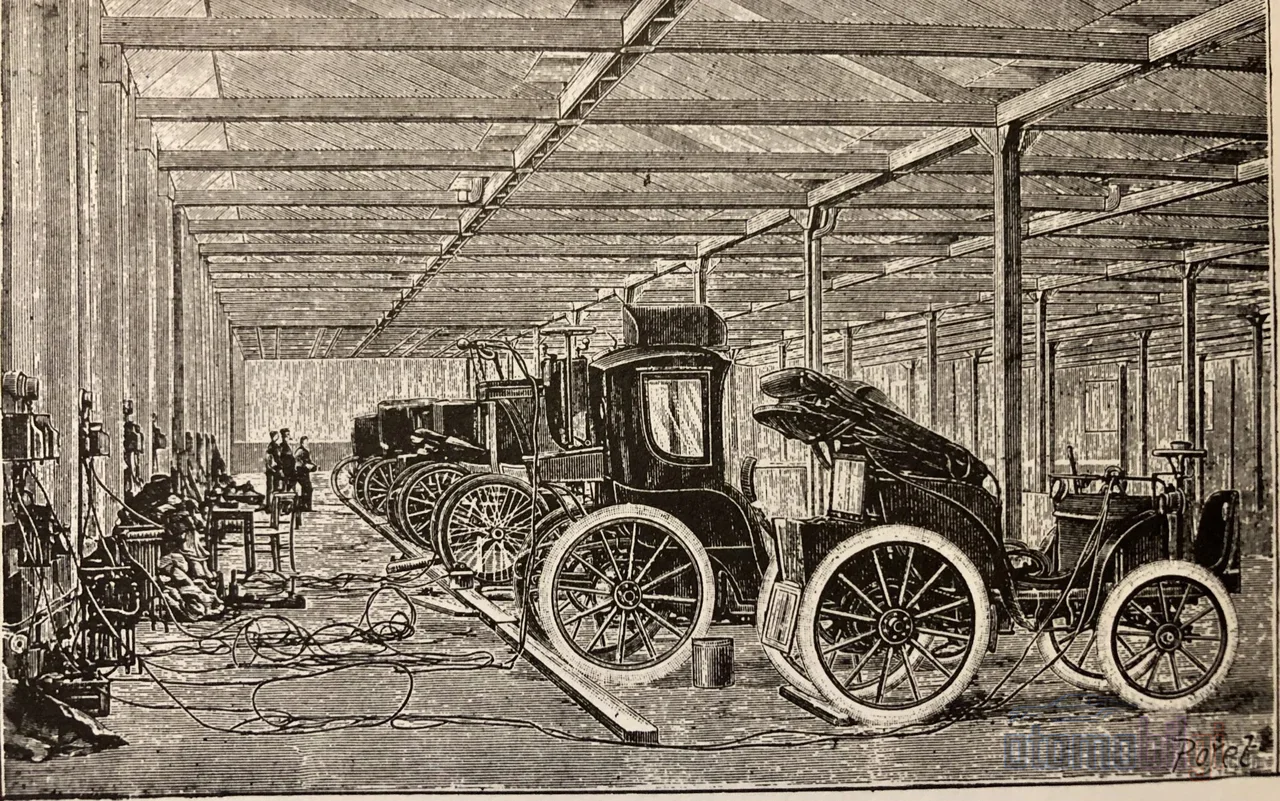
The most radical answer of the era to the charging time problem was battery swapping. The idea was first proposed in 1896 and was implemented by the Hartford Electric Light Company between 1910-1924 with its GeVeCo battery service. During this period, both vehicles and batteries were modified to allow quick swapping. In New York, the Electric Vehicle Company went even further: it converted an ice skating rink into a battery swap station - the cabin would enter, depleted batteries were replaced with charged ones, and the vehicle would exit. The venture collapsed by 1907, but as a scheme it was identical to today's battery swap models. The structural obstacle was also clear: spare batteries were far too heavy per unit of energy, and this meant logistics capable of carrying the entire weight.
Why Did Electric Companies Build Charging Networks?
The architect of the early charging infrastructure was neither a vague government program nor automakers; it was the electric companies. Commercial electricity generation and distribution, established for lighting and light rail systems, formed the foundation of the infrastructure the electric car needed. As the city network expanded, charging points were added on top of it - the era's version of the "is the grid ready" question raised in today's infrastructure debates, there was no grid; the grid was built first, and charging followed it.
The limits of this model were also the limits of the grid. Gasoline was a portable fuel: it could be delivered in barrels to a distant town. Electricity, on the other hand, was not yet a service everyone could access beyond a certain distance from where it was generated. The charging network being limited to cities was not merely a technological failure, but the geography of energy distribution at the time.
How Did Gasoline-Powered Driving Pull Ahead?
Early gas stations were actually sparse too; at the beginning of the 20th century, drivers had to memorize station locations when planning their routes, and stations became widespread in the 1930s. So the charging network was not the only force left behind by gasoline. Several measurable factors worked together to leave the electric car behind:
- 1912: Charles Kettering's electric starter motor eliminated the hand crank with its first application in the 1912 Cadillac - gasoline's biggest practical disadvantage was erased.
- 1908: Ford's Model T was selling for 850 dollars; most electrics were at least twice as expensive. In 1923 the Model T dropped below 300 dollars, while electrics could be 10 times more expensive.
- Cheap crude oil found in Texas lowered gas prices; electrics could be 2-3 times more expensive.
- As roads extended beyond the cities, low-speed, short-range electrics ceased to be suitable for long journeys.
The result came quickly: by 1930 electric cars had largely disappeared from the roads, and by 1935 almost entirely. The charging network had been built before the gasoline network - but the vehicle market that carried it disappeared.
| Comparison | Early electric | Early gasoline |
|---|---|---|
| Fuel/energy infrastructure | Homes, garages, Electrant, store stations | Sparse stations, became widespread in the 1930s |
| Price balance (1908) | At least twice the Model T | Model T: 850 dollars |
| 1923 price difference | Up to 10 times more expensive | Below 300 dollars |
| Range limit | Short range, low speed | Long journeys with portable fuel |
| Critical technology | 1902 rectifier, battery swap | 1912 electric starter |
From the Interim Period to the EV1: The Long Wait of Charging Technology
After the 1930s, the subject of charging infrastructure fell off the agenda for six decades. The return to the agenda came with the GM EV1, developed in 1996 in response to California's zero-emission vehicle mandate: the first mass-produced battery-electric car, with a range of about 60 miles and a top speed of 80 mph. About 800 vehicles were leased in Los Angeles, Tucson and Phoenix between 1996-2003. The EV1's contribution on the charging side cannot be ignored: inductive charging system - Magne Charge "paddle" technology - offering a theoretical 80 kW capacity, and the vehicle sent battery type and charging status information to the charger. Production was stopped in 2002, but the lessons learned from the EV1 shaped subsequent battery technology, consumer education, and infrastructure development.
The links of the modern chain were completed in this order: AC Propulsion's 1997 lithium-ion cell tzero; Eberhard and Tarpenning founding Tesla Motors in 2003; Musk, whose offer to take over tzero production was declined, investing in Tesla; and the Tesla Roadster, which entered production in 2008 as one of the first vehicles with a 200-mile range on a single charge. Reaching the cumulative 1 million EV sales milestone, however, took more than 8 years after the first mass-market EVs. A remarkable technical detail: All units in the US charging station databases before 2011 were "legacy" charging equipment serving first-generation vehicles like the EV1.
What Does a Century-Old Charging Network Teach Modern Networks?
The most striking parallel lies in the usage model: Today, just like a century ago, vehicles are charged mainly at home; In North America, more than 80% of charging takes place at home. In other words, the early era's "home backbone" scheme did not become invalid, it was merely interrupted and returned. The early network's weak point is equally current: infrastructure cannot survive without vehicles, and vehicles cannot be sold without infrastructure. That is why, in the modern era, the balance between charging usage and infrastructure development is still at the heart of the matter; data based on more than 100 million charging sessions from last year show that usage lags behind infrastructure development.
The economics of the public side are also going through a maturation process similar to that of the early era: some of the early fast-charging networks became profitable, most did not, and the business model of fast charging is still developing. The US set a record in 2025 by adding 20% more public charging points than the previous year - but the prevalence of charging access continues to be cited as a major obstacle to increasing EV sales. The main lesson from the electric companies' first endeavor still holds today: infrastructure must be built before the vehicle; but the vehicle market keeps the infrastructure alive. Two hundred years ago that balance could not be achieved and a network collapsed. This time, the balance is being established with far stronger hands both in the vehicle and on the grid.
Sources
- The Electric Vehicle Evolution - Advanced Energy
- First Electric Car: A Brief History of the EV, 1830 to Present
- Timeline: History of the Electric Car
- Why Thomas Edison Believed Electric Cars Were the Future
- Electric Cars Engineering & History
- Electric Car Drivers: Be Thankful You Didn't Recharge In 1900
- Battery swapping
- History of the electric vehicle
- General Motors EV1
- Charging station
- Driving the future, then and now: the story of the EV1
- Revolutionizing the Roads: The GM EV1 and Pioneering Charging Technology
- Electric Vehicle Sales and the Charging Infrastructure
- Electric Vehicles Have Been Around Since the 19th Century
- The Story in Pictures of the Early Electric Cars, 1880-1920
- The lost history of the electric car
- A Brief History of Battery Swapping
- Evolution of Plug-In Electric Vehicle Charging Infrastructure
- Lessons learned on early electric vehicle fast-charging
- The state of EV charging in America
- Electric vehicle charging - IEA Global EV Outlook 2026
- 2026 Charging Forward Report
- The History of EV Charging