Why Does It Use Less Fuel in the City? The Difference Between City and Long-Distance Consumption
Share This Page
Electric vehicles consume less in the city because in stop-and-go traffic they recover energy through regenerative braking the moment they slow down, and at low speeds air resistance stays at a minimum level. On the highway, braking rarely happens, a constant high speed forces the car to continuously push forward, and aerodynamic drag becomes the main consumer of energy. In other words, the perception from the gasoline era that "a city car burns a lot" is completely reversed with electric vehicles.
Highlights
- Regenerative braking can recover approximately 20% of the energy On a 100-kilometer journey, about 20 kilometers of range is returned.
- At highway speeds, aerodynamic drag accounts for more than 50% of the energy spent pushing the car forward.
- An average EV consumes about 12-20 kWh per 100 km in the city; at 110-120 km/h highway speeds, this figure rises to ~23 kWh.
- Real-world range can be up to 30% lower than the WLTP value, according to ADAC tests.
- There is no concept of idling in EVs: while waiting in traffic, the motor consumes no energy.
Why does an electric vehicle burn less in the city?
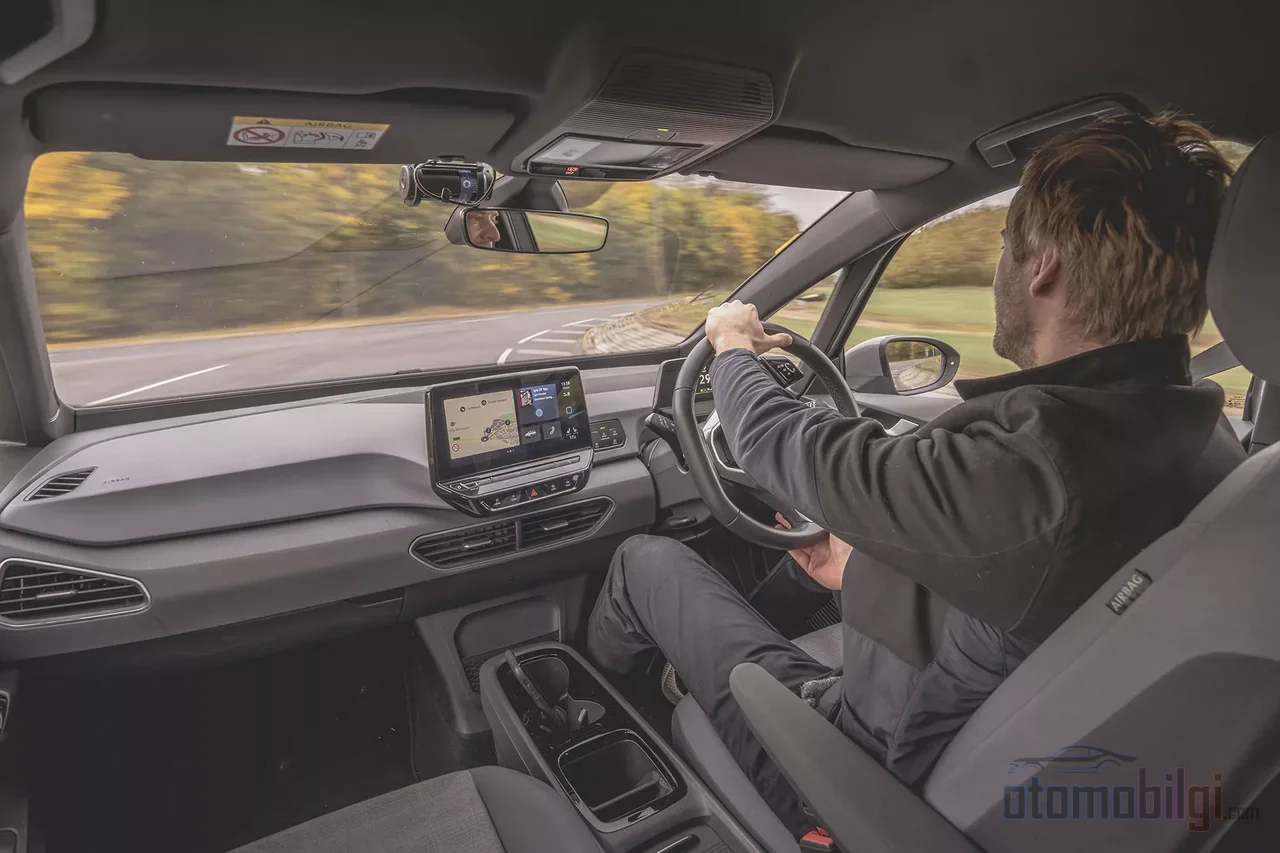
City traffic is a punishment for a gasoline car: when you stop at a red light, the engine keeps running, every acceleration happens in the least efficient region, and the energy spent on braking turns into heat in the brake pads and is lost. In an electric vehicle, the opposite applies to all three. When the motor is stopped, it consumes no energy; there is no such thing as idling. Accelerations occur in the region where the electric motor is most comfortable on its efficiency curve. And braking, thanks to regenerative braking, becomes recovery rather than loss.
The working logic of regenerative braking is simple: when you lift off the accelerator or slow down, the electric motor turns into a generator, converting the car's kinetic energy into electricity and sending it to the battery. This energy can be used again. In a gasoline car, the energy at the moment of braking is permanently lost; in an electric vehicle, a significant part of the road is covered "for free" twice.
How many kWh does regeneration recover?
Let's go through a numerical example. On a hilly 42-kilometer home-to-work route, when regeneration is set to the second-highest level, approximately 4 kWh is recovered throughout the journey, and only 2 kWh is net usable from the battery. If the same route is driven in reverse - with an elevation gain of about 900 meters - the picture flips: consumption rises to 8 kWh while recovery drops below 2 kWh. The message is clear: the contribution of regeneration cannot be considered independently of the route and traffic profile.
Estimates suggest regenerative braking recovers roughly 20% of the energy shows that it recovers - meaning roughly 20 miles of range is returned on a 100-mile journey. While this contribution is negligible on the highway, stop-and-go city traffic is where regenerative braking "shines" the most. A surprising amount of energy can also be harvested on downhill descents. An academic study of UK origin also confirms that higher regeneration levels provide greater recovery and lower net consumption.
There is also a practical driving side: with strong regeneration levels, the car can be driven with almost no pressing of the brake pedal, controlling only the accelerator pedal. This is called one-pedal driving and it is not offered on every model. Lifting off the accelerator means braking; this is the strongest regeneration level. A driver who reads the road early and lifts off the accelerator in time preserves both the brake pads and the kWh at the same time.
When do the brake lights come on?
Regenerative braking is as much a traffic safety matter as it is an electrical engineering issue. While your car slows down, the driver behind you needs to see you. The practical rule works like this: when deceleration stays below 0.7 m/s² the brake lights usually do not come on, in the 0.7-1.3 m/s² range it depends on the manufacturer, and above 1.3 m/s² brake lights are mandatory in most countries. In other words, the intensity of regeneration directly affects how early the vehicle behind you will notice you.
Why consumption increases on the highway: the physics of air resistance
As speed rises, two resistances the vehicle fights against come into play: rolling resistance and air resistance. While rolling resistance changes largely linearly with speed, air resistance increases exponentially with speed. For this reason, above any speed threshold, aerodynamic drag becomes the dominant force. Above 60 km/h, roughly 30-40% of the energy is spent just on cutting through the air. At highway speeds this figure exceeds 50%; at 130 km/h, up to 80% of the car's power is used against aerodynamic drag.
An electric vehicle is particularly sensitive to this curve, because an electric motor gains less efficiency at high speed compared to a gasoline engine. Practical result: EVs are most efficient in the 80-95 km/h band. On the highway, even a speed of 60 mph instead of 70 mph makes a measurable contribution to range. 130 km/h is known as a speed that significantly raises EV consumption.
The second factor is the absence of regeneration. In smooth highway driving there is almost no deceleration; recovery correspondingly approaches zero. While every stop in the city means a mini charge, on the highway energy flows in one direction only. The combination of the two effects - high air resistance and zero regeneration - is the exact explanation for highway consumption being higher than in the city.
City and highway consumption profile in numbers
An average electric vehicle uses approximately 12-20 kWh per 100 kilometers consumes electricity. Since urban speed limits in Türkiye mostly stay within the 30-50 km/h band, EV consumption in this scenario drops noticeably compared to long-distance driving. On the highway, consumption at a constant 110-120 km/h rises to ~23 kWh/100 km levels. For comparison, let's look at the gasoline side: while gasoline vehicles consume an average of 6-8 liters per 100 km in the city, on the highway this figure is around ~6.5 liters - meaning the curve bends in exactly the opposite direction for gasoline vehicles.
| Scenario | Electric vehicle | Gasoline vehicle |
|---|---|---|
| Urban (30-50 km/h, stop-and-go) | ~12-20 kWh/100 km | ~6-8 L/100 km |
| Highway (constant 110-120 km/h) | ~23 kWh/100 km | ~6.5 L/100 km |
| Dominant resistance | Low-speed advantage in the city + regeneration | Fuel consumption in every scenario |
| Most efficient speed band | ~80-95 km/h | Variable, usually constant mid-speed |
Energy can also be compared in units: 1 liter of gasoline contains approximately 9.5 kWh, and 1 liter of diesel approximately 10.5 kWh of energy. Based on this equivalence, a vehicle burning 4.1 liters of gasoline over 100 km consumes energy roughly equal to 39 kWh - a value many times higher than the urban consumption of a modern EV.
Why is Istanbul traffic an advantage for EVs?
The distinguishing feature of Istanbul traffic is not fluid driving, but the cycle of frequent stopping and moving again. A gasoline vehicle loses energy at every stage of this cycle; it burns fuel even while idling. In an electric vehicle, however, waiting consumes no energy, and the deceleration following each new movement sends energy back to the battery through regeneration. Precisely for this reason, EV and plug-in hybrid profiles have a structural advantage in urban use in metropolises like Istanbul. A journey of around 155 kilometers, such as the Istanbul-Bursa route, is also described by EV owners as a low-cost experience - urban efficiency and highway range can be combined in the same vehicle.
What does the WLTP value tell us, and what should we realistically expect?
The range figure on the window sticker comes from the WLTP cycle. WLTP is a test cycle that establishes a relatively balanced distribution between urban and non-urban driving, and doubles both the distance and the driving phases compared to the old NEDC standard. It is more realistic than NEDC because it also includes charging losses; however, it is still a laboratory cycle and runs on a single profile. Moreover, some manufacturers use CLTC or NEDC instead of WLTP; in this case, placing the brochure figures of two EVs side by side directly is misleading.
It is healthier to set real-world expectations on a per-profile basis. The general picture from user experiences is as follows: in the city, a range 10-15% above WLTP is expected, while on the highway 10-15% below is expected. Independent real-world tests, however, show that the distance achievable on a single charge can drop by up to 30% from the WLTP value. The difference comes from climate, driving style, speed profile, and auxiliary loads.
How do temperature and air conditioning change this picture?
Ventilation and climate control form the second layer stacked on top of the profile difference. Cabin heating and air-conditioned cooling can quickly deplete the battery; in the cold, both the heating load and the battery's chemical reactivity pull the range down. In hot weather, range drops through two mechanisms: active cooling kicks in to keep the battery from overheating, and air conditioning use increases. Giving a single figure like "air conditioning always reduces range by 10%" is wrong; the effect varies with outside temperature, sun, humidity, trip duration, and target cabin temperature. Knowing that seat heaters consume less energy than air conditioners makes a difference in the winter months. Bringing the battery to its ideal temperature while plugged in before a long trip - that is, preconditioning - positively affects both charging speed and range.
Efficient driving according to profile and long-distance planning
Driving style has a greater impact than managing auxiliary systems like turning off the air conditioning. A few rules proven for city driving:
- Accelerate smoothly and reach your target speed; traffic light races are the most expensive enemy of range.
- Read the road and lift off the accelerator early; this both saves energy and maximizes regenerative braking.
- In city driving, set regeneration to a strong level; in stop-and-go profiles, this is the best way to recover energy.
- Since strong regeneration can reduce traction on slippery surfaces, lower the level in bad weather conditions.
- If the battery is completely full, regenerative braking is reduced or disabled - there is no room to store the energy; this is noticeable in the first kilometers of short trips started with a full charge.
On long roads, the equation changes. Since aerodynamic drag does not work in your favor, planning discipline becomes decisive. The route should be set in advance, range and charging times checked, charging at short intervals preferred over one long charge, and accommodation chosen according to its charging infrastructure. Simple preparations like downloading charging station apps and creating an account before setting off, and planning with buffer time, directly determine the quality of the journey.
Frequently asked: stop-and-go traffic and the one-pedal debate
The most common concern of those considering switching from gasoline to electric is the question "does sitting in locked-up traffic eat the range?" The answer is reassuring: in stop-and-go traffic, an electric vehicle uses almost no energy, because there is no idling, and the braking that follows each new start returns energy to the battery. It can be said that traffic anxiety is a false pattern carried over from gasoline habits.
Whether one-pedal driving actually maximizes range is debatable. Current analyses conclude that one-pedal mode is equal to or slightly more efficient than well-executed manual braking; the view that mode selection alone is not decisive is also widespread. What matters is not the pedal architecture but the general principle: the less hard braking, the more regeneration.
Summary table: which profile should expect what
Depending on your driving scenario, it is possible to summarize your realistic range expectation under three headings. In city use, you can exceed the WLTP value slightly; regeneration and low speeds work in your favor. Mixed use is the area closest to WLTP. On long highway-heavy journeys, factor in 10–15% below WLTP, and up to 30% deviation under demanding speed and temperature conditions. The real solution to range anxiety is not a bigger battery, but reading the profile correctly.
Sources
- How Much Do Electric Vehicles Consume in the City and on Long Journeys? - BYD Türkiye
- How to Maximise EV Range with Regenerative Braking - go-e.com
- How to maximise range on your electric car by the way you drive - GRIDSERVE
- Study on energy consumption characteristics of passenger cars - ScienceDirect (Lee, 2023)
- Answered: Your Questions on EV Aerodynamics - Dassault Systèmes SIMULIA
- Optimizing the Aerodynamic Efficiency of Electric Vehicles - IIETA
- How Much Fuel (Electricity) Do Electric Vehicles Consume? - Bridgestone Türkiye
- How Much Does an Electric Vehicle Consume on Long Journeys? - Araclo
- Why Your EV Will Never Hit Its WLTP Range - go-e.com
- Electric Vehicle Range Testing: NEDC vs WLTP vs EPA - J.D. Power
- Factors Affecting the Range of Electric Vehicles - Borusan Oto
- Does Air Conditioning Affect Electric Vehicle Range? - Yol Asist
- Tips for Long-Distance Travel with an Electric Vehicle - ChargeIQ
- Is One-Pedal Driving the Most Efficient for EVs? - The Watt Car
- Electric Vehicle Charging Cost Between Istanbul and Bursa - Skywell Türkiye