How Does the Lambda Sensor Control Exhaust Emissions?
Share This Page
The lambda sensor is a critical emission control component that continuously provides feedback to the engine control unit (ECU) by measuring the amount of oxygen in the exhaust gas, ensuring that the air-fuel mixture is kept at the ideal ratio of 14.7:1. Thanks to this measurement, the catalytic converter stays within the range where it operates most efficiently; when the sensor fails, however, fuel consumption and exhaust emissions increase measurably.
Key Highlights
- The first automotive lambda sensor was introduced in 1976; that same year, it was first applied together with a three-way catalytic converter
- Ideal stoichiometric mixture: 14.7:1 air-fuel ratio (λ = 1)
- The lifespan of a heated sensor is typically around 100,000 miles (160,000 km)
- The wideband sensor was introduced in 1992 and provides accurate readings across a wide air-fuel range
- The most common consequences of a faulty sensor: increased fuel consumption, rising CO emissions, and failure of the emissions test
What Does the Lambda Sensor Do and How Does It Work?
One of the least known but most critical parts of the exhaust system is the oxygen sensor, which takes its name from the Greek letter λ: λ (lambda) expresses the air-fuel equivalence ratio. The sensor does not measure the oxygen concentration in the exhaust gas directly; instead, it measures the oxygen difference between the exhaust gas and the outside air. This difference is converted into a voltage signal and sent to the ECU: a rich mixture raises the voltage, while a lean mixture produces a low voltage.
The output of a typical zirconia sensor moves within three distinct ranges: approximately 0.2 V at a lean mixture, approximately 0.8 V at a rich mixture, and around 0.45 V at the ideal set point. The sensor is at its most sensitive exactly at the stoichiometric point (λ = 1). Based on this signal, the ECU tries to keep the air-fuel ratio as close to 14.7:1 as possible; because the three-way catalytic converter operates at full efficiency only with this mixture.
A balance is struck here: too much fuel increases hydrocarbon (HC) and carbon monoxide (CO) emissions; too little fuel raises the production of nitrogen oxides (NOx). The sensor reports this fine line between the two extremes to the ECU several times every second, and the injector pulse durations are adjusted accordingly.
Historical development: From 1976 to today
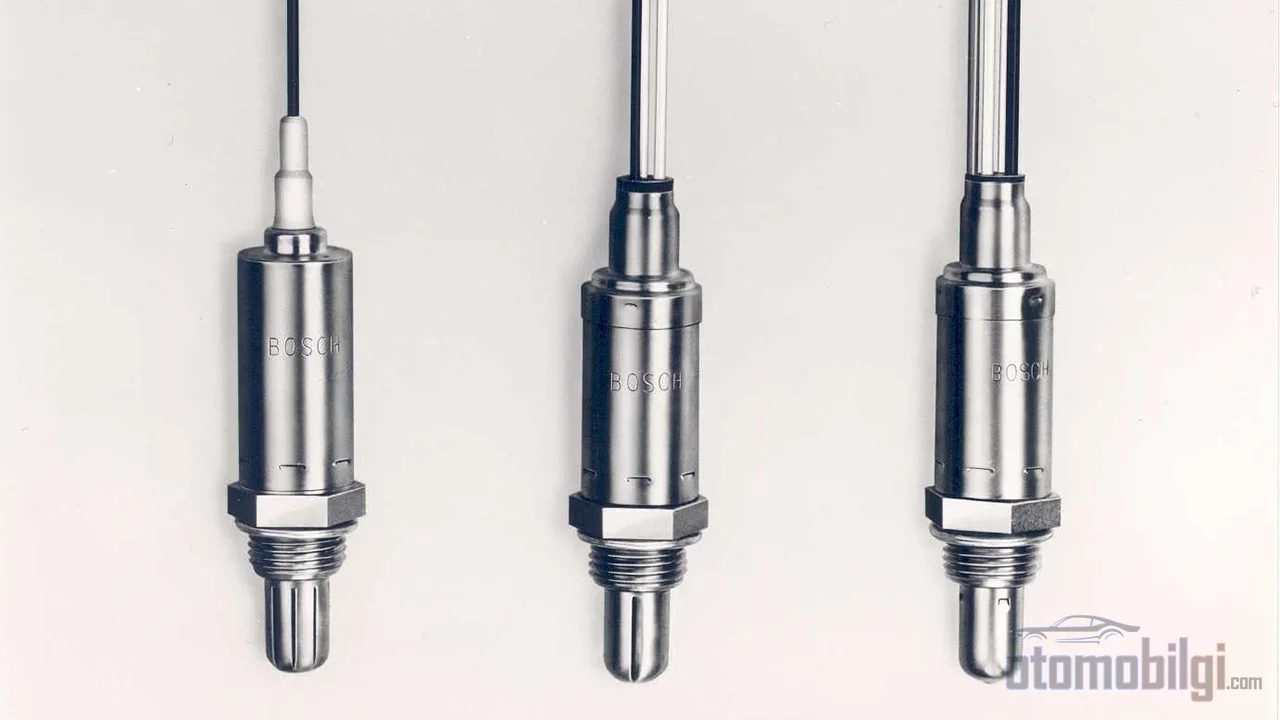
The first automotive lambda sensor was developed at Bosch under the supervision of Günter Bauman in the late 1960s and was introduced in 1976; it was used in Volvo and Saab vehicles that same year. Volvo was the first manufacturer to implement this technology together with a three-way catalytic converter. The planar type sensor entered the market in 1990: it significantly reduced the mass of the ceramic sensing element and incorporated the heater into the ceramic structure, providing faster startup and a faster response.
What Is the Difference Between Narrowband and Wideband Sensors?
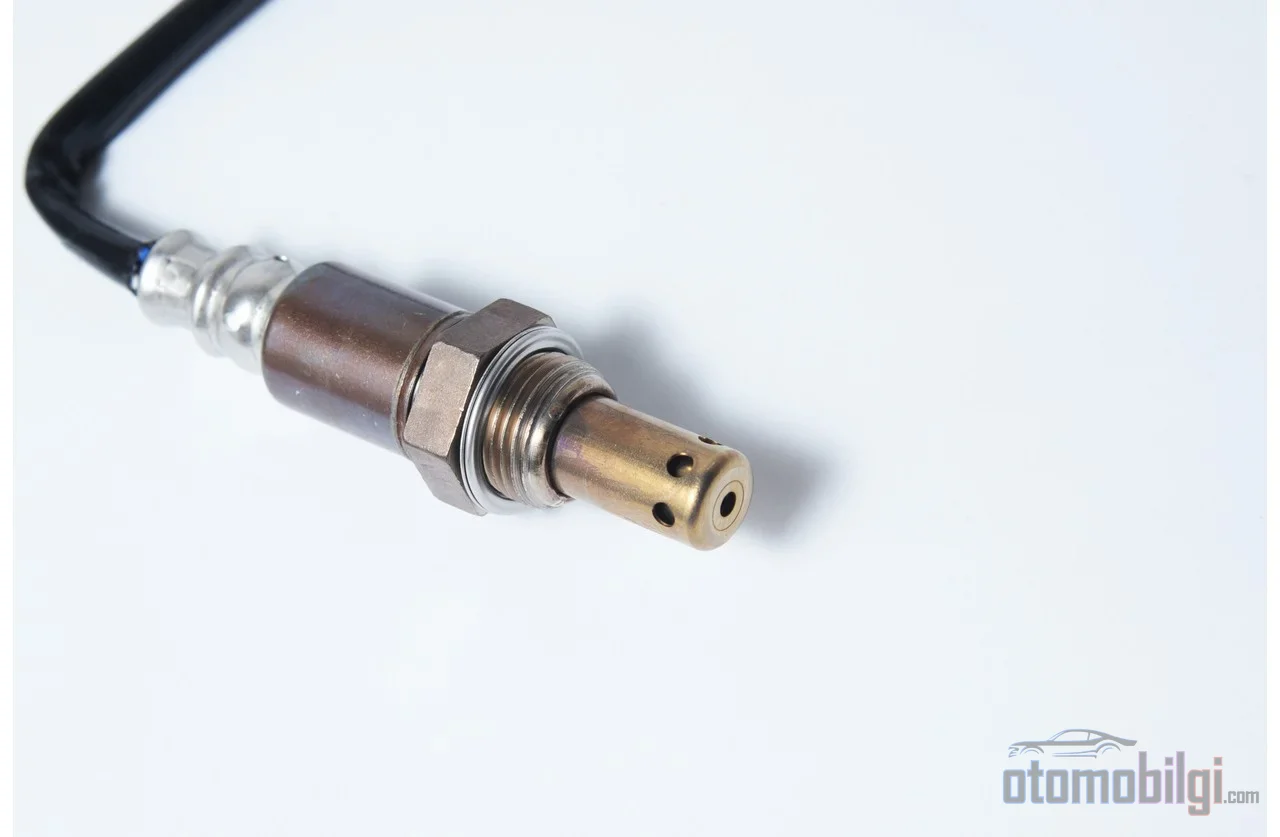
The classic zirconia sensor is of the narrowband type and, as its name suggests, responds only to a narrow range of air-fuel ratios. This sensor effectively distinguishes three things: the mixture is lean, rich, or at the exact stoichiometric point. It is an excellent tool for finding and holding the 14.7:1 ratio; but it cannot measure mixtures beyond that point. The narrowband sensor operates in a range of about 600 °F.
The wideband sensor was introduced in 1992 and is also known in the automotive industry as a UEGO (universal exhaust-gas oxygen) sensor. It contains an electrochemical oxygen pump; the pumping current directly indicates the oxygen content in the exhaust. It has three basic elements: an ion oxygen pump, a narrowband zirconia sensor, and a heating element; the wiring diagram is typically six wires. It must be heated to a range of 1,200–1,400 °F to operate.
| Feature | Narrowband | Wideband |
|---|---|---|
| Year introduced | 1976 | 1992 |
| Measurement range | Lean/rich/λ = 1 only | Precise reading across a very wide air-fuel range |
| Operating temperature | ~600 °F | 1,200–1,400 °F |
| Typical number of wires | 2–4 wires | ~6 wires |
| Alternative name | Zirconia sensor | UEGO sensor |
The wideband sensor eliminates the narrowband's continuous lean-rich cycling, allowing the ECU to make fuel and ignition adjustments much faster. It became widespread as demands for fuel economy, low emissions, and performance increased. A rare alternative, the titania (TiO2) sensor, does not generate voltage; it changes its electrical resistance according to the oxygen concentration. It is more expensive than zirconia but responds faster and does not require a reference air sample.
How Do ECU Feedback and Fuel Trim Work?
The signal from the sensor is the heart of the fuel feedback control loop. Based on what the oxygen sensors detect in the exhaust, the ECU adjusts the fuel supply several times per second. Short-term fuel trim (STFT) responds instantly to the sensor's feedback: when the sensor reports a lean mixture, the trim is increased; when it reports a rich mixture, it is decreased. Correct fuel trim values are not possible without a correct feedback signal.
This loop is not active under all conditions. Under low-load conditions, the engine runs in closed-loop mode, and the sensor signal corrects the fuel map in real time. Under high-load conditions such as full throttle, the ECU deliberately enriches the mixture to protect the engine and ignores the sensor output; this is called open-loop mode.
The sensor plays a dual role in engine management. The upstream sensor (before the converter) handles fuel control; the downstream sensor (after the converter) measures the efficiency of the catalytic converter. The converter's efficiency depends directly on the fuel trim, and by comparing the upstream and downstream sensor signals, the ECU monitors whether the converter is performing as expected. If efficiency drops, the driver is alerted via the indicator/diagnostics system - this is a situation frequently seen in the context of the P0420 code.
What Are the Symptoms of a Faulty Lambda Sensor?
When a sensor fails, the ECU stores a DTC (diagnostic trouble code) and the check engine light comes on. Beyond the light itself, the fault also manifests itself in driving:
- Increased fuel consumption
- Rising exhaust emissions and failure of the emissions test
- Hesitation during acceleration and rough idling
- Engine hesitation, uneven running and misfiring
- In some cases, stalling (the engine cutting out)
The failure tendency matters: the sensor typically reads incorrectly lean. To compensate for this, the fuel system runs the engine overly rich, and the result - contrary to what you would expect - is increased emissions and increased fuel consumption. A faulty sensor can prevent the air-fuel ratio from being set correctly, leading to poor fuel economy and, over time, component damage.
Common fault codes
The codes read from the check engine light indicate the nature of the fault. The most frequently encountered ones are:
| Code | Meaning |
|---|---|
| P0130 | Sensor circuit fault (Bank 1 Sensor 1) |
| P0131 | Low voltage |
| P0132 | High voltage |
| P0133 | Slow response |
| P0140 | No activity (Bank 1 Sensor 2) |
| P0141 | Heater circuit fault |
| P0150 | Bank 2 Sensor 1 fault |
How Does a Faulty Sensor Affect Fuel Consumption and the Emissions Test?
The answer to the fuel consumption question is clear: yes, a faulty oxygen sensor reduces fuel economy. This sensor is the primary input by which the ECU judges the air-fuel ratio; if the signal is wrong, the engine runs deliberately rich and fuel exits the exhaust unburned. Running overly rich or lean increases emissions; in particular, CO (carbon monoxide) values rise noticeably.
On the emissions test side, the situation is even more critical. Since the sensor directly affects emissions, passing an emissions inspection with a faulty sensor is highly unlikely; emission levels will most likely be measured far above the limit. Behind the test failure there is often this small and relatively inexpensive component.
One detail is worth mentioning: modifications that deliberately run the engine slightly lean may provide a slight fuel saving on paper. The price of this is rising NOx emissions, increased exhaust temperature and the risk of catalytic converter damage. There is an inverse relationship between efficiency and emissions/durability, and the ECU's design setpoint is the product of this balance.
Why Does the Lambda Sensor Fail and How Long Does It Last?
Sensor life varies significantly depending on the presence of a heater: an unheated sensor lasts approximately 50,000-80,000 km, and its failure usually results from soot accumulation on the ceramic element. A heated sensor typically offers a life of around 160,000 km.
Contamination sources
The main factors that kill the sensor early can be read from the color of the deposits:
- Leaded gasoline: Contaminates the sensor and the catalytic converter; depending on the lead concentration, the life can drop to as low as 24,000 km
- Silicone/silicate contamination: Leaves a bright white to light gray deposit
- Oil leak (blow-by): Forms a black, oily deposit on an old engine
- Overly rich mixture: Leaves a black sooty deposit
- Coolant leak: Fluid entering the combustion chamber as a result of a gasket leak contaminates the sensor
One final warning: prolonged rich operation is not just a fuel expense. A sensor failure can damage the catalytic converter and lead to far more expensive repairs, up to catastrophic failure of the converter itself. Not delaying when the check engine light shows an O2 sensor code is often equivalent to saving the converter.
Conclusion: A Small Sensor, A Big Balance
The lambda sensor is the silent architect of the exhaust system: it measures several times every second, the ECU adjusts the fuel accordingly, and the catalytic converter maintains its efficiency within that narrow window of 14.7:1. The fundamental principle has not changed since 1976; only the measurement range has widened and the response has accelerated. What the sensor measures is simple - the correctness of the mixture. When that correctness degrades, the result first shows itself at the pump (increased consumption), then at the inspection station (rising emissions), and finally in the most expensive place of all, the converter.
Sources
- Oxygen sensor
- Making Sense of Sensors: The Oxygen Sensor
- Narrowband vs Wideband: Oxygen Sensors Explained
- Narrowband vs. Wideband O2 Sensors
- O2 Sensor Training Guide: OBDII Codes
- Signs of a Bad Oxygen Sensor
- Failing O2 Sensors Result In Increased Emissions
- Understanding Fuel Trim Theory and Operation