Why Does Exhaust Emission Testing Fail and What Does It Reveal?
Share This Page
Exhaust emission measurement is the process of measuring the gases emitted from a vehicle's exhaust with certified equipment and comparing them against legal limits; if CO, HC and, in diesels, smoke opacity exceed these limits, the vehicle cannot pass inspection. Knowing how the measurement is performed and which faults distort the result both protects against unnecessary part replacements and shortens preparation for a re-inspection.
Highlights
- For gasoline vehicles with electronic engine management, the CO limit is 0.3%, while for older carbureted vehicles it can go up to 3.5%.
- For diesels, smoke opacity must be below 1.5 m⁻¹ for older vehicles and 0.7 m⁻¹ for Euro 6 vehicles.
- The ideal lambda value is in the range of 0.97-1.03 ; every value outside this indicates a rich or lean mixture.
- In a heavy vehicle study, PM emissions dropped by 25%-50% after repair; the average repair cost was $1,088 .
- Euro 7 will apply to new M1 and N1 vehicle types as of November 29, 2026.
What Is Actually Being Measured During Inspection?
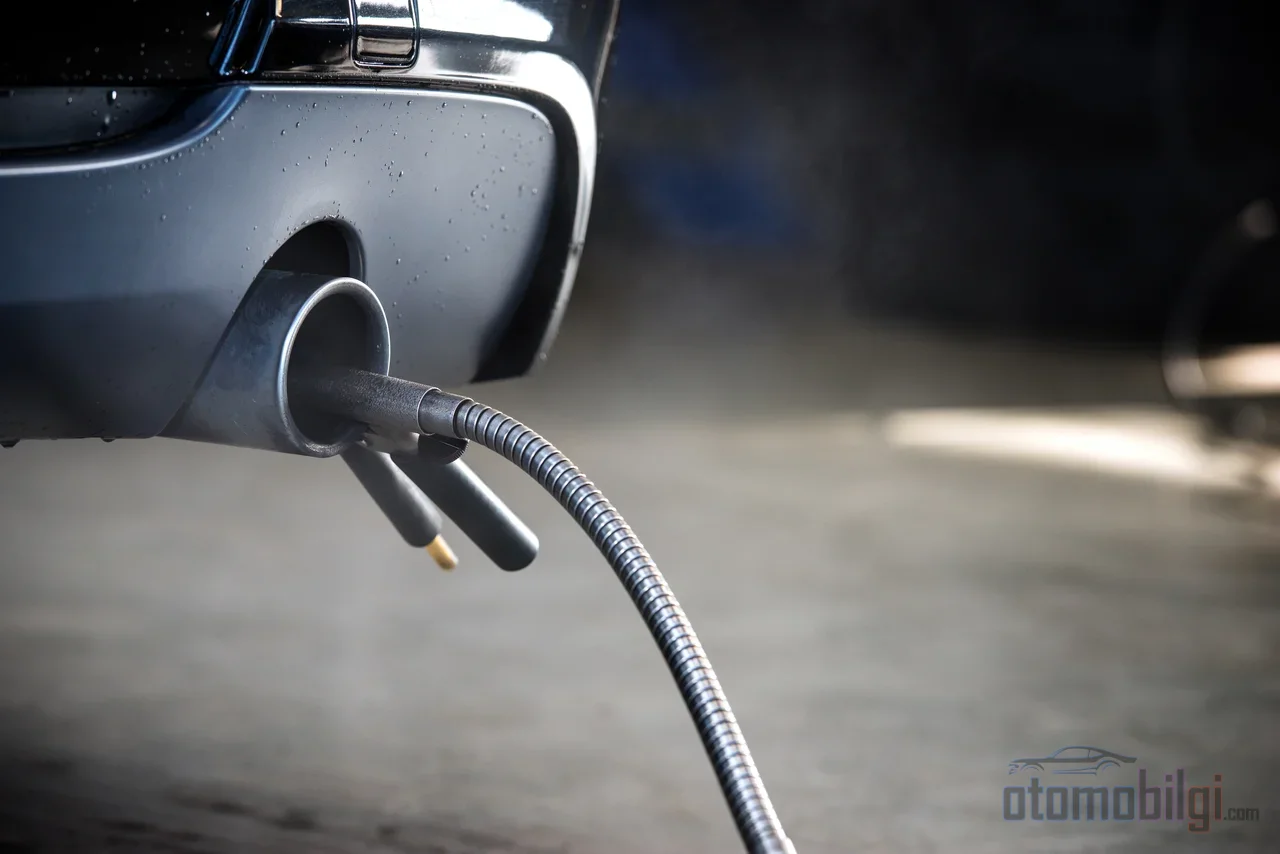
The entire measurement process is standardized; obtaining closely similar results at different inspection stations is a prerequisite for the test to carry regulatory significance. For gasoline vehicles, the procedure roughly consists of three stages: the engine is brought to normal operating temperature, the exhaust system is visually inspected, and a gas analysis is performed at idle (and also at an elevated rpm depending on the registration date). For vehicles with OBD, fault codes and whether emission-related readiness monitoring cycles have been completed are also read electronically.
The basic parameters monitored by the gas analyzer are as follows:
- CO (carbon monoxide): A direct indicator of incomplete combustion. For Euro 3 and newer vehicles with electronic engine management, the typical limit is 0.3%; older carbureted vehicles are granted tolerance up to 3.5%.
- HC (hydrocarbons): Fuel residue leaving the exhaust unburned. High HC is a classic sign of ignition or injection problems.
- Lambda: How close the air-fuel mixture is to the stoichiometric point. The ideal range is 0.97-1.03; values outside this range indicate that the mixture is running rich or lean.
For diesel vehicles, smoke opacity is measured instead of gas analysis. A beam of light is passed through the exhaust smoke cloud to a detector; the darker the smoke, the more the light is absorbed and the higher the opacity value. Limit values vary by age: 1.5 m⁻¹ for older vehicles, 0.7 m⁻¹ for Euro 6 vehicles. In the free acceleration test, the accelerator is momentarily pressed fully down while the vehicle is warm and in neutral, and held for five seconds or until maximum rpm; the average of the three peak opacity values recorded is reported.
Limits of the opacity test
The free acceleration test is technically a primitive method; even a slight extra load can raise the result. More importantly, in modern diesels with particulate filters, opacity values have dropped below the detection limit of measuring devices, so the test is no longer discriminatory for these vehicles. That is why some countries are switching to particle number measurement, known as PN-PTI, using a portable particle counter at idle; in the Euro 7 era, the pressure of a revised smoke test and PN measurement at the annual inspection to catch vehicles with faulty or removed DPFs is also increasing.
Why Does the Exhaust Emission Measurement Fail?
There is not always a major fault behind a failure; the measurement reflects the overall condition of the engine's chain of air, fuel, ignition, and exhaust after-treatment. When one link of the chain breaks, the result exceeds the limit. The most common technical causes are as follows:
- Clogged air filter: When insufficient air enters the engine, the mixture is disrupted and emissions increase; it is one of the most common and cheapest-to-fix causes of failure.
- Exhaust leak: The gas sample measured by the analyzer is compromised; leaks must be repaired by welding before the inspection.
- Thermostat stuck open: The engine must run at its normal operating temperature to burn cleanly; an engine running at low temperature directly worsens emissions.
- Check engine light: If the light is on, it means the ECU is reporting a fault code; in this case, fault diagnosis must be done first, and one should not place hope on the test alone.
Sensor failures: MAF and O2
A dirty or faulty mass air flow (MAF) sensor reports an incorrect amount of air to the engine, causing the mixture to run rich or lean; O2 sensor failures produce the same result. In both cases, engine performance may appear normal in daily use, but the gas analyzer immediately reveals the mixture deviation. For this reason, before replacing parts, a focused inspection is needed to determine whether the problem lies with the air, fuel, ignition, or a sensor.
How catalytic converter and EGR failures show up in the measurement
When the catalytic converter degrades, the vehicle drives normally and the performance difference is not noticed; but emission standards are no longer met and the inspection inevitably ends in a negative result. In addition, an excessive amount of unburned fuel entering the converter causes the catalyst to overheat, accelerating the damage. The EGR (exhaust gas recirculation) system, on the other hand, reduces NOx by lowering combustion temperature; an insufficient flow fault produces high NOx. The signature of a faulty EGR on the gas analyzer is characteristic: high HC, low CO, low O2, low CO2, and high NOx. A technician who can read this pattern goes straight to the EGR instead of randomly trying parts.
The real culprit in diesels: the fuel system
Free acceleration opacity testing is the most sensitive method for detecting faults, especially in fuel system components. Most repair records concern injectors, fuel pump, pump calibration, throttle control, and injection timing. On the DPF side, if the soot load exceeds the safe limit, the ECM restricts power and speed; if neglected, a chain of events leading up to forced stops begins. In addition, differences in measurement methodology must be known: opacity is a weak predictor of particulate matter mass; the peak CO value measured during a snap test more reliably predicts PM.
Why Is Measurement So Standardized?
The meaning of a limit depends on the measurement being repeatable. The traditional regulated pollutants are CO, HC, NOx, and PM; solid particle number (PN) limits have also been added starting from Euro 5b. In laboratory-type certification tests, proportional sampling of the exhaust is stored in a bag and regulations define how NOx, HC, CO, CO2, CH4, N2O, and CH2O can be measured. The tests in the annual inspection are the civilian reflection of this chain: the Euro 6 diesel NOx limit is 80 mg/km, and even though Euro 6 limits have not changed, the measurement method has been updated over the years. Euro 7 will apply to M1 and N1 category new vehicle types and components from November 29, 2026; for heavy vehicles the date is May 2028, and this regulation, which also covers non-exhaust emissions such as tire and brake particles, consolidates all road vehicles into a single legislative text. The limits at inspection stations are the field enforcement leg of this certification regime.
Which Repair Is Really Necessary in a Vehicle That Fails Inspection?
Reading the measurement result maps out the repair. High CO and HC usually indicate a mixture or ignition problem, high NOx points to an EGR or combustion temperature problem, and high opacity in a diesel points to the fuel system. Randomly replacing the catalytic converter, without solving the underlying rich mixture problem, wears out the new converter as well. There is measurable evidence that repairs work: in heavy vehicles with high opacity, PM emissions dropped by 45-50% in pre-1991 vehicles and 25-30% in post-1991 vehicles after repair. The average repair cost was $1,088 (range $699-$2,053). However, there is a trade-off to be aware of: while repairs reduce PM, they can increase NOx by an average of 7%; since in mechanically controlled engines wear raises PM while lowering NOx, this inverse relationship is a well-known engineering fact.
Unnecessary part replacement traps
The most expensive mistake is replacement without diagnosis. The recommended order is as follows:
- First, have the fault codes read and clarify the source of the check engine light.
- Rule out cheap and common causes such as the air filter, exhaust leak, and thermostat.
- Perform sensor (MAF, O2) testing; locate the source of the mixture deviation by measuring.
- Only after these steps are completed should you decide on expensive components such as the catalytic converter or EGR.
There is also a legal side: in many jurisdictions it is prohibited to tamper with emissions control system components, and only compliant parts may be installed during repair. Having the repair carried out by a reputable and certified technician makes things easier both for the retest and for any exemption application.
The Retest Process and Practical Preparation
The path to follow when a vehicle fails is clear: have a diagnosis performed, complete the repair, and go in for re-inspection. In many areas, a free retest is granted within a certain period after the first test; typical practice is a 30-60 day window, and a form showing the repair data is required. For vehicles that fail twice despite repairs, some regions have an exemption (waiver) mechanism under certain conditions; however, repair records must be up to date, and very old repairs may not be taken into account. If the vehicle is retested immediately after the repair, the OBD readiness cycles may not be complete, so the result may be "not ready" or a fail; this does not mean the vehicle is dirty.
What to do before the test
- Bring the vehicle in with the engine at normal operating temperature ; a warmed-up engine reduces HC and CO risk. A longer drive is beneficial for the catalytic converter to heat up well.
- Devices such as a kill switch that cuts the battery can reset OBD readiness codes and invalidate the test; avoid intervening in the battery before the test.
- Schedule the test before the deadline; in some areas the inspection certificate is valid for a certain period, and an early test provides a buffer of time for repairs in case of an unfavorable result.
In short, exhaust emissions measurement is not a mysterious ritual but a measurable engineering audit. Whatever the gases say, that is where the problem lies; a correctly read analysis report is the shortest path both to passing the inspection on the first try and to protecting your wallet.
Sources
- Measurement of Emissions
- Quantifying the Emissions Benefit of Opacity Testing and Repair of Heavy-Duty Diesel Vehicles
- 40 CFR Part 1066 -- Vehicle-Testing Procedures
- Vehicle Emission Inspections
- How do I pass emissions measurement first time?
- What Do You Mean My Car's Not Ready?
- Vehicle emissions and battery durability (Euro 7)
- Euro 1 to Euro 7 – Vehicle Emissions Standards
- Euro 7 emission standard: business impact
- How to Pass a Failed Emissions Test | P0420 Code
- 5 Most Common Reasons Cars Fail Emissions Testing
- Will a Bad Catalytic Converter Make You Fail a Smog Test?
- What to Do About A Clogged Diesel Particulate Filter