Diesel or Gasoline for the Environment: A Real Emissions Comparison

Share This Page
From an environmental standpoint, there is no single correct answer to the question: While modern petrol vehicles can produce CO2 values on the same line as or lower than diesel, diesel engines fall clearly behind in NOx and particulate emissions. Which one is cleaner depends on the vehicle's age, the filter you use, and where you drive the vehicle.
Highlights
- In real road tests, the Euro 6 diesel produced 148–163 g/km of CO2; a similar petrol model stayed equal or lower in all conditions at 140–157 g/km.
- In real use, diesel emits approximately 4.5 times more NOx than petrol: 89.1 mg/km versus 20.0 mg/km.
- One litre of diesel releases approximately 13% more CO2 than the same volume of petrol.
- The first stage of Euro 7 on 29 November 2026 comes into force for new car and van models.
- New diesels with filters are cleaner than petrol in terms of black carbon particulates; but older diesels remain the dirtiest option in urban use.
Which pollutes less, diesel or petrol: The real picture of the comparison
For many years, the established belief was this: Diesel consumes less fuel, therefore produces less CO2, and is better for the environment than petrol. This chain of logic appears solid at first glance. However, modern test data require us to question each link of the chain one by one. The environmental impact of internal combustion engines is not measured by a single metric; CO2, NOx, and particulate matter are assessed on three separate axes, and the positions of the two fuels on these axes are entirely different.
CO2 presents itself as a climate issue, while NOx and particulates emerge as a public health problem. When choosing a vehicle, determining which axis weighs more for you depends directly on your use case. That is why we will approach the comparison below first with numbers, then with scenarios.
| Criterion | Diesel | Petrol |
|---|---|---|
| Type-approval CO2 value (NEDC, compared models) | 117 g/km | 113 g/km |
| Real-road CO2 (PEMS range) | 148–163 g/km | 140–157 g/km |
| Real-world NOx | 89.1 mg/km | 20.0 mg/km |
| CO2 per fuel | Approximately 13% higher | Reference |
| Typical engine efficiency | ~32% | ~24% |
| NOx treatment | Requires SCR/AdBlue | Three-way catalytic converter |
| Particulates (modern filtered vehicles) | Lower black carbon | Reduced with GPF |
| Suitable use | Long distance, heavy load | Urban, short trips |
Why should the CO2 assumption be questioned: Two fuels of the same model
The most revealing test is the study comparing the diesel and petrol versions of the same car: These two versions of the lower-medium segment share the same platform, similar weight, and similar aerodynamics; the only significant variables are the engine and the fuel. In the type-approval documents, the diesel's value of 117 g/km was already higher than the petrol's 113 g/km. In laboratory measurement, the petrol dropped to 109 g/km (4% below type approval) while the diesel rose to 124 g/km (6% above it). In the more realistic WLTP cycle, the picture remained the same: diesel 139 g/km, petrol 126 g/km.
What decides the comparison is the values measured on real roads. In road tests conducted with a portable emissions measurement system, the diesel produced 148-163 g/km of CO2, while the gasoline version stayed within the 140-157 g/km band; meaning the gasoline version emitted equal or lower CO2 under every condition. The technical reason for this is twofold. First, due to the chemistry of diesel fuel, it contains more carbon per liter: burning the same volume of diesel releases about 13% more CO2 than gasoline. Diesel's advantage is offset by the fewer liters it consumes per kilometer; modern gasoline engines have largely closed this gap. Second, the diesel vehicle's final aftertreatment system targeting NOx adds extra weight and extra fuel consumption, further eroding the claimed CO2 advantage. Moreover, the tested diesel's list price was about 3,400 euros higher than the gasoline version's; with the environmental benefit claim weakening and the cost difference also factored in, the balance began to be questioned.
In terms of fuel efficiency, however, the diesel engine is not the losing side: its typical thermal efficiency of ~32% is superior to the gasoline engine's ~24%. But this combustion process, which burns at a higher temperature and more efficiently, has a natural price: greater NOx formation. Efficiency and pollutant emissions open under the same parachute.
NOx and particulates: Diesel's real weak point
NOx is the general name for nitrogen oxides. It is the main precursor of ground-level ozone formation under sunlight; NO2, meanwhile, is a pollutant that can aggravate heart and lung diseases. For this reason, in city centers NOx emissions are a far more urgent public health agenda than CO2. To provide historical context, the European Environment Agency counted roughly 16,000 ozone-related and 430,000 fine-particulate-related premature deaths in the EU for 2011; road transport was responsible for 41% of Europe's NOx emissions at that time. These figures belong to the 2011-2015 period and do not directly reflect today's vehicle fleet, but they show the scale of the problem.
Current real-world usage measurements draw the picture clearly: gasoline vehicles emit an average of 20.0 mg NOx per kilometer, while diesels remain at the 89.1 mg level; a difference of more than four times. The reason the gasoline engine achieves this is technically simple. The three-way catalytic converter cleans NOx, CO, and hydrocarbons in the exhaust with high efficiency in a single unit. In diesels, the lean mixture running with excess oxygen does not suit the operating principle of the three-way converter; NOx can only be reduced with additional systems, when the engine is hot, and through expensive aftertreatment technologies. Since this system in Euro 6 diesels can operate with limited efficiency even at highway speeds, diesel NOx factors remain far above those of gasoline vehicles, especially in highway use.
On the particulate matter side, the picture has reversed over the last decade. Particles in the PM2.5 class, meaning those below 2.5 microns, are small enough to pass from the lung membrane into the bloodstream; the black carbon component of carbonaceous particles also has a strong warming effect. For decades, diesel was presented as the cleaner alternative under post-Kyoto climate policies. However, once air quality measurements revealed the health impact of diesel particulates, many local governments began restricting diesels from city centers. Interestingly, new diesels equipped with filters have moved ahead in this area: A scientific study published in 2017 showed that modern diesels with particulate filters produce fewer carbonaceous particles than gasoline engines. The DPF mandate in North America and Europe significantly reduced diesel particulate pollution. So the deciding factor in the particulate question has become not so much the fuel type as the vehicle's age and filter equipment.
The filter era: How DPF and GPF changed the balance
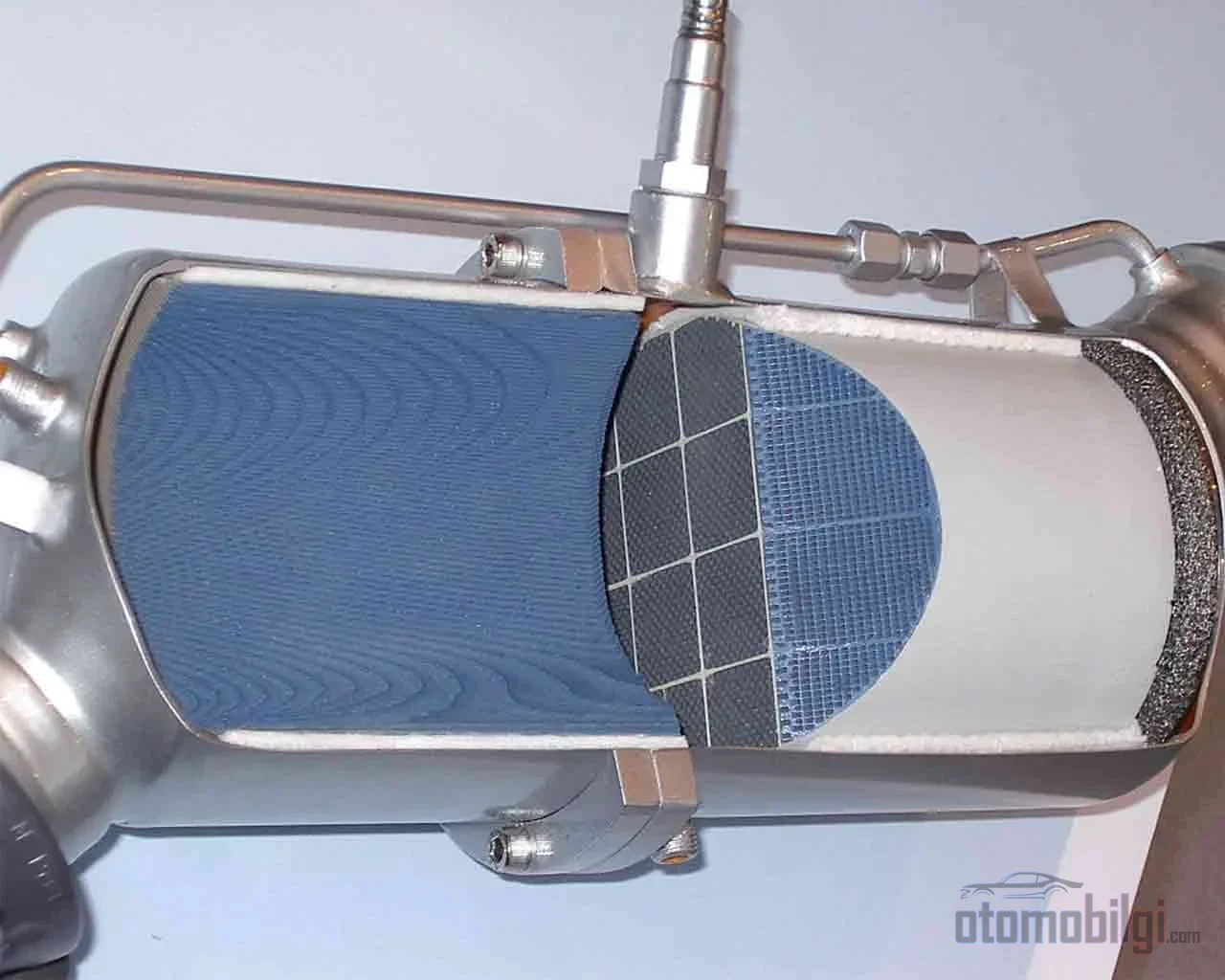
The diesel particulate filter (DPF) is a porous ceramic unit that captures soot in the exhaust gas. The captured soot is burned off and destroyed when the filter reaches a high temperature; this process is called regeneration. On the gasoline side, the gasoline particulate filter (GPF) was developed to capture the fine particles produced by direct-injection engines. The operating logic of the two filters is similar: physically trapping the particles and then burning and destroying them at the appropriate temperature.
The DPF's weakest point is the temperature required for regeneration. If the engine cannot reach its optimum operating temperature for a long time, the filter quickly accumulates soot beyond its burning capacity and becomes clogged. The main conditions that increase the risk of clogging are:
- Frequently repeated short trips, where the engine never warms up
- Heavy stop-and-go traffic and consistently driving at low rpm
- A faulty EGR valve or injectors
- Using the wrong type of engine oil
A clogged DPF restricts exhaust flow; the result is power loss, excessive smoke, failed regeneration attempts, and hard starting. This is the mechanical summary of why city driving is problematic for diesels. Short trips also pave the way for fuel dilution in the oil, deposit buildup in the injectors, and turbo wear.
On the GPF side, the balance is milder. It works with passive regeneration, meaning it cleans itself as long as the exhaust temperature is sufficient during normal driving; but it may need active support in cycles with consistently low temperatures. The GPF's additional back pressure can slightly reduce efficiency and increase fuel consumption. For both fuel types, filter era changes the balance enough to invalidate a pure fuel comparison: today's question is no longer just diesel or gasoline, but which filter actually works under which usage regime.
AdBlue and SCR: Is diesel's NOx account being settled
The main answer to diesel's NOx problem is the selective catalytic reduction (SCR) system. The system injects a solution called AdBlue into the exhaust line just before the catalyst. AdBlue consists of 32.5% urea and 67.5% pure water by weight; decomposes in the hot exhaust to produce ammonia, and the ammonia converts NOx into harmless nitrogen and water inside the catalyst. When working properly, SCR can reduce NOx emissions by up to 90%, CO and hydrocarbons by 50–90%, and particulates by 30–50%.
Impressive as this picture looks, the calculation carries two costs. First, AdBlue is a separate consumable, and the system adds extra weight. Second, and more critically, the SCR catalyst does not work efficiently below a certain temperature. On short journeys, the engine stays cold, so the system cannot reach the efficiency it was designed for; it is precisely in urban conditions, where diesel is already problematic, that the aftertreatment is at its weakest. It is this cycle that erodes diesel's CO2 and practical advantage: the hardware added to clean up NOx increases fuel consumption and loses its effectiveness in the cold. In addition, with Euro 6, diesel fuel contains less than 0.001% sulfur, which is mandatory for the aftertreatment systems to function.
The use case is decisive: City or long distance
When turning all these numbers into a practical decision, a single question is enough: where, and at what mileage, do you drive the vehicle?
Mostly urban and short trips: Petrol
In crowded urban areas, the public health impact of NOx and particulate emissions is felt most intensely; it is precisely under these conditions that diesel's emission profile is at its worst and the risk of DPF clogging is highest. Short distances with a cold engine are also the zone where the SCR system remains ineffective. For predominantly urban use, petrol is the consistent choice in terms of both emissions and mechanical durability.
Long highway journeys and heavy loads: Diesel's legitimate territory
At high and constant speeds, the engine runs continuously hot; in this case, DPF regeneration completes easily, the SCR catalyst approaches its design efficiency, and diesel's torque advantage becomes pronounced under heavy loads. In usage combining long distances and high annual mileage, a modern diesel with properly functioning filter hardware is still a defensible choice.
Vehicle age should also be factored into this picture: While new diesels with filters can be cleaner than petrol in terms of particulates, older diesels remain significantly dirtier in urban use. Similarly, low emission zone regulations are effectively pushing older diesels out of city centers; local restrictions can influence the purchase decision independently of the CO2 picture.
From Euro 6 to Euro 7: How the standards changed the comparison
Euro 6, which came into force in 2014, sharply lowered NOx and particulate limits for new vehicles, and also imposed a particulate number limit on petrol vehicles with direct injection equal to that of diesel; this requirement became mandatory three years after the standard's dates. In other words, the petrol side also had to fit its DPF equivalent - this is the institutional reason why GPF became widespread.
Next up is Euro 7. For new light-duty models, the first tier of the standard, which will come into force on November 29, 2026, covers all gasoline, diesel, hybrid and electric vehicles and gives greater weight to performance under real driving conditions. Euro 7's distinguishing feature is that it also brings non-exhaust emissions from brake and tire wear into the regulatory scope. A later stage will follow for heavy-duty vehicles. In other words, the standard no longer measures only the tailpipe; it attempts to measure every surface where the vehicle comes into contact with its surroundings.
The market is following these changes at its own pace: In the EU, the share of new diesel registrations had fallen from its 2011 peak of 55% to 44% in 2017; in 2016, more than 60% of world diesel car sales were still in the EU. As diesel's market share declines, the technical picture is becoming clearer: a modern, filtered diesel with SCR equipment is meaningful only in a long-distance profile; in urban use, the data points to gasoline. There is no single fuel answer for the environment; the right question is which emission weighs more heavily in your own mileage profile.
Sources
- Fact Sheet: Gasoline vs. Diesel - ICCT
- Gasoline vs Diesel: Which is More Polluting?
- Petrol cars versus diesel cars - WinACC
- Comparison of NOx and PN emissions between Euro 6 petrol and diesel cars - Gao et al., 2021
- Diesel / petrol: a comparative study of real-world emissions - FlotAuto
- Euro 1 to Euro 7: complete guide to vehicle emission standards - Geotab
- EU: Cars and Light Trucks - Emission Standards - DieselNet
- What is Euro 7 and when does it start - RAC
- Meeting Euro 7 Regulations - Automotive IQ
- Updating the minimum emission standard for new road vehicles - GOV.UK
- What is a Gasoline Particulite Filter (GPF)? - Corning
- Gasoline Particulate Filters - DieselNet
- Impact of Gasoline Particulate Filters on Fuel Economy - Chevron Lubricants
- Selective Catalytic Reduction (SCR) - EngineTechForum
- SCR Catalyst – NOx Reduction with AdBlue - Cardictionary
- Latest Technologies to Reduce Diesel Engine Emissions - BlueSkyDEF
- Petrol vs Diesel Cars: Which Is the Better Choice? - Carwow
- The Effect of Short Trips on Diesel Engine Wear - Goldfarb
- What Is DPF Clogging? Causes, Symptoms, and Fixes - Fuelox
- DPF filter: what it is and why it becomes clogged - OxyhTech
- The 7 Most Common Reasons For A Blocked DPF - Turbopacs
- The Symptoms and Risks of a Clogged Particulate Filter - Noleaky
- Clogged Diesel Particulate Filter Causes & Symptoms - Hot Shot's Secret
- Diesel Vs Petrol Cars - dsCars